
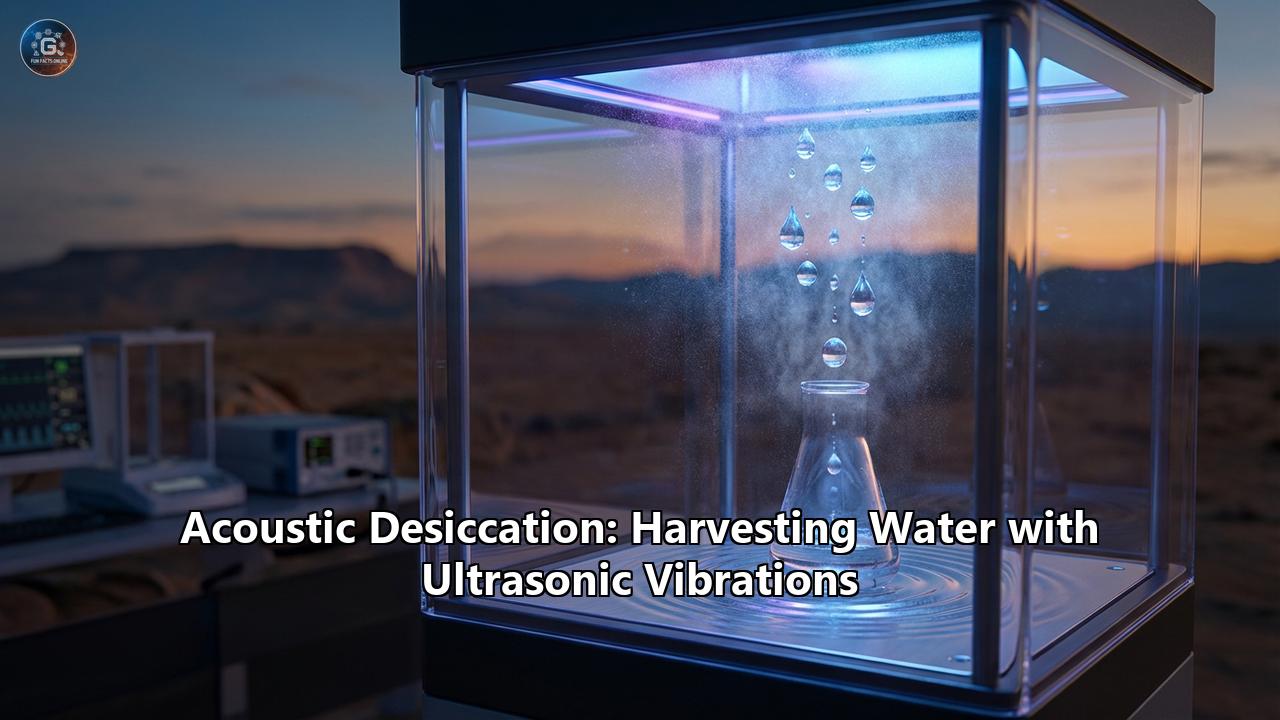
In the quiet corners of research laboratories at Oak Ridge National Laboratory and the Massachusetts Institute of Technology, a revolution is vibrating at a frequency just beyond the range of human hearing. It is a technology that promises to upend centuries of thermal engineering, challenging the oldest method humanity has used to dry things: heat.
For thousands of years, from sun-drying fish in ancient Mesopotamia to the tumbling electric dryers in modern basements, the equation has remained unchanged: add heat, evaporate water, wait. It is a brute-force approach, effective but energy-inefficient, destructive to delicate materials, and slow. But a new paradigm is emerging. By harnessing the high-frequency mechanical power of sound, scientists are unlocking a process known as Acoustic Desiccation.
This is not drying by evaporation. This is drying by ejection. It is a physical, rather than thermal, removal of water. By tuning ultrasonic vibrations to specific frequencies, we can now shake water molecules free from clothes, food, industrial sludges, and even the air itself, achieving in minutes what used to take hours, and doing so with a fraction of the energy.
This article explores the deep science, the groundbreaking applications, and the future potential of harvesting water with ultrasonic vibrations.
Part 1: The Physics of Sound and Water
To understand how sound can dry a pair of jeans or pull drinking water from a desert breeze, we must first understand the fundamental interaction between acoustic waves and liquid water.
Beyond the Heat Barrier
Traditional drying faces an immense thermodynamic hurdle: the Latent Heat of Vaporization. To turn one kilogram of liquid water into vapor, you must inject approximately 2,260 kilojoules of energy. This is an immutable law of physics. It explains why your clothes dryer is likely the second most energy-hungry appliance in your home (after the refrigerator and HVAC). You are paying for the energy required to phase-change water from liquid to gas.
Acoustic desiccation bypasses this phase change entirely. instead of heating water molecules until they fly apart as steam, ultrasonic technology uses mechanical force to atomize them.
The Piezoelectric Heart
At the core of this technology is the piezoelectric transducer. These are materials—often ceramics like lead zirconate titanate (PZT)—that have a unique electromechanical property. When you squeeze them, they generate an electric charge. Conversely, and crucial for our purpose, when you apply an electric voltage to them, they change shape.
If you apply a high-frequency alternating current to a piezoelectric transducer, it expands and contracts thousands of times per second. In ultrasonic drying applications, these transducers vibrate at frequencies typically between 20 kHz (20,000 cycles per second) and 1 MHz.
The Mechanism of Atomization
When these high-frequency vibrations are applied to a wet porous material—like a cotton shirt or a sponge—the energy is transferred to the water trapped inside.
- Capillary Wave Theory: As the transducer vibrates, it creates capillary waves on the surface of the water droplets. As the intensity of the vibration increases, these waves become unstable.
- Cavitation: The rapid oscillation creates alternating high and low-pressure cycles within the liquid. During the low-pressure cycle, vacuum bubbles form (cavitation bubbles). When these bubbles collapse during the high-pressure cycle, they release intense localized energy.
- Ejection: The combination of unstable surface waves and cavitation creates a phenomenon called atomization. The water is physically torn apart into microscopic droplets (a "cold mist") and ejected from the fabric or material.
Because the water remains in liquid form (as mist) rather than vapor, the process does not require the massive energy input of latent heat. It is akin to shaking a wet rug, but on a microscopic, ultrasonic level.
Part 2: The Laundry Revolution
The most relatable application of this technology is arguably the one that affects our daily chores: the ultrasonic clothes dryer.
The Oak Ridge Breakthrough
Researchers at the U.S. Department of Energy’s Oak Ridge National Laboratory (ORNL), led by Dr. Ayyoub Momen, pioneered the "Direct Contact Ultrasonic Fabric Dryer." Their prototype doesn't look like a traditional tumbling box. instead, it resembles a press.
When wet fabric is pulled across the piezoelectric transducers, the water is atomized instantly. In demonstrations, a sodden strip of fabric enters the mechanism and exits dry and cool to the touch mere seconds later. The water is converted into a cool fog that is simply sucked away by a fan and collected in a tank.
The Advantages
- Speed: The ultrasonic drying process is incredibly fast. While a thermal dryer might take 50 minutes to dry a load of laundry, ultrasonic technology can theoretically do it in less than 20 minutes.
- Energy Efficiency: Because it avoids the latent heat of evaporation, the system is up to 5-times more energy efficient than resistive electric dryers. If widely adopted, this could save billions of dollars in residential energy costs annually.
- Fabric Preservation: Heat is the enemy of clothing. It shrinks fibers, fades dyes, and creates lint (which is essentially pieces of your clothes breaking off). Ultrasonic drying is a "cold" process. Your favorite black jeans wouldn’t fade, and your wool sweaters wouldn’t shrink.
Part 3: Drinking from Air – The MIT Breakthrough
While drying clothes is about convenience and efficiency, the application of acoustic desiccation to Atmospheric Water Harvesting (AWH) is about survival.
The Challenge of Sorption
Harvesting water from the air in arid environments often involves materials called sorbents—like metal-organic frameworks (MOFs) or hydrogels. These materials act like super-sponges, sucking moisture out of the air even at low humidity (down to 20%).
The problem is getting the water out. Traditional AWH systems collect water at night when it's cool, but then have to wait for the heat of the day (or apply artificial heat) to evaporate the water out of the sorbent to condense it. This cycle is slow and limits water production to once per day.
The Ultrasonic Shake
In late 2025, a team at MIT unveiled a game-changing approach. They discovered that specific ultrasonic frequencies could break the weak molecular bonds (Van der Waals forces) holding water molecules to the sorbent material.
By attaching small ultrasonic actuators to the water-harvesting plates, they could "shake" the water out.
- Speed: Thermal desorption takes hours. Ultrasonic desorption takes minutes.
- Continuous Cycling: Because the release is so fast, the system doesn't have to wait for a day-night cycle. It can absorb, shake, and release water dozens of times a day, exponentially increasing the water yield of a single device.
- Efficiency: The MIT team found this method to be significantly more efficient than thermal heating, making it viable for off-grid applications powered by small solar panels or batteries.
This "acoustic water tap" could revolutionize water access in desert regions, providing a steady stream of clean drinking water from dry air without the massive energy footprint of desalination.
Part 4: The Food Industry and the "Sponge Effect"
Food processing is another sector where acoustic desiccation is making waves. Traditional drying (dehydration) often ruins food. High heat destroys vitamins, alters flavor profiles, and changes the texture of fruits and vegetables into something tough or rubbery.
The Sponge Effect
When ultrasound is applied to plant tissue (like an apple slice or a grape), it induces a rapid series of compressions and expansions. This is known as the "Sponge Effect."
- Micro-channels: The acoustic stress creates microscopic channels within the cellular structure of the fruit.
- Mass Transfer: These channels provide an expressway for moisture to escape to the surface, where it can be easily removed.
Osmotic Dehydration
A particularly powerful technique is Ultrasound-Assisted Osmotic Dehydration. Here, fruit is placed in a sugar or salt solution while being blasted with ultrasound. The sound waves break down the boundary layers that usually slow down the process, allowing water to leave the fruit cells much faster.
The Result: Dried fruit that retains its bright color, most of its Vitamin C, and a texture that is closer to fresh fruit than the leathery standard of thermal drying.Part 5: Industrial and Environmental Frontiers
Beyond the home and the kitchen, acoustic desiccation is poised to solve heavy industrial challenges.
Sludge Dewatering
Wastewater treatment plants produce massive amounts of "sludge"—a semi-solid slurry that is expensive to transport and dispose of because it is mostly water. Removing this water is difficult because it is bound tightly to the solid particles.
High-power ultrasonics can disrupt the bacterial cells and flocs in the sludge, releasing the "bound water" that mechanical pressing can't reach. This reduces the volume of waste significantly, lowering disposal costs and environmental impact.
Pharmaceutical Manufacturing
In the production of high-value pharmaceutical powders, heat is often a liability. many drugs are heat-sensitive (thermolabile) and degrade if dried thermally. Ultrasonic spray drying allows for the creation of precise, microscopic drug particles at low temperatures, ensuring high potency and better solubility in the body.
Part 6: The Future and The Silence
If this technology is so superior, why isn't it in our homes yet?
The Challenges
- Cost: Piezoelectric transducers are currently more expensive to manufacture than simple heating coils.
- Coupling: Sound waves don't travel well through air (which is why the clothes dryer requires "direct contact" with the drum). Engineering reliable contact mechanisms for tumbling clothes is mechanically complex.
- Frequency Control: If not perfectly tuned, high-power ultrasonics can generate audible screeching (sub-harmonics) or heat up the transducers themselves.
The Horizon
Despite these hurdles, the trajectory is clear. As material science improves and the cost of power electronics drops, acoustic desiccation is moving from the lab to the pilot plant. Startups like Ultrasonic Technology Solutions are already working to commercialize the technology for industrial drying belts.
We are standing on the precipice of a "Silent Revolution." In the future, our laundry rooms will be cooler, our food more nutritious, and our deserts more livable, all thanks to the invisible, shivering power of sound. The water is there; we just need to know the right frequency to ask for it.
Reference:
- https://asmedigitalcollection.asme.org/thermalscienceapplication/article/13/2/021025/1084672/Experimental-Evaluation-and-Kinetic-Analysis-of
- https://www.e3s-conferences.org/articles/e3sconf/pdf/2023/27/e3sconf_agritechviii2023_01017.pdf
- https://www.heattechnologiesinc.com/science/
- https://www.ultratechsol.com/what-is-ultrasonic-drying.html
- https://patents.google.com/patent/JP2017522535A/en
- https://www.e3s-conferences.org/articles/e3sconf/pdf/2023/30/e3sconf_eppct2023_01008.pdf
- https://altumtechnologies.com/dewatering-of-waste-water-efficiently-with-software-guided-ultrasound/
- https://publications.csiro.au/publications/#publication/PIcsiro:EP165883
- https://www.foodinfotech.com/exploring-impact-of-ultrasound-on-food-drying/