
In the quiet, sterile labs of the 1980s, a crystallographer named Nadrian Seeman was wrestling with a problem that had nothing to do with genetics. He was trying to arrange proteins into orderly crystals to study them, a task akin to stacking marbles that refuse to sit still. His solution, born from a moment of inspiration in a campus pub, would not only solve his crystallization problem but birth an entirely new field of science. He realized that the molecule famous for carrying the code of life—DNA—could be repurposed as a structural building block.
Forty years later, we are no longer just reading the code of life; we are building with it.
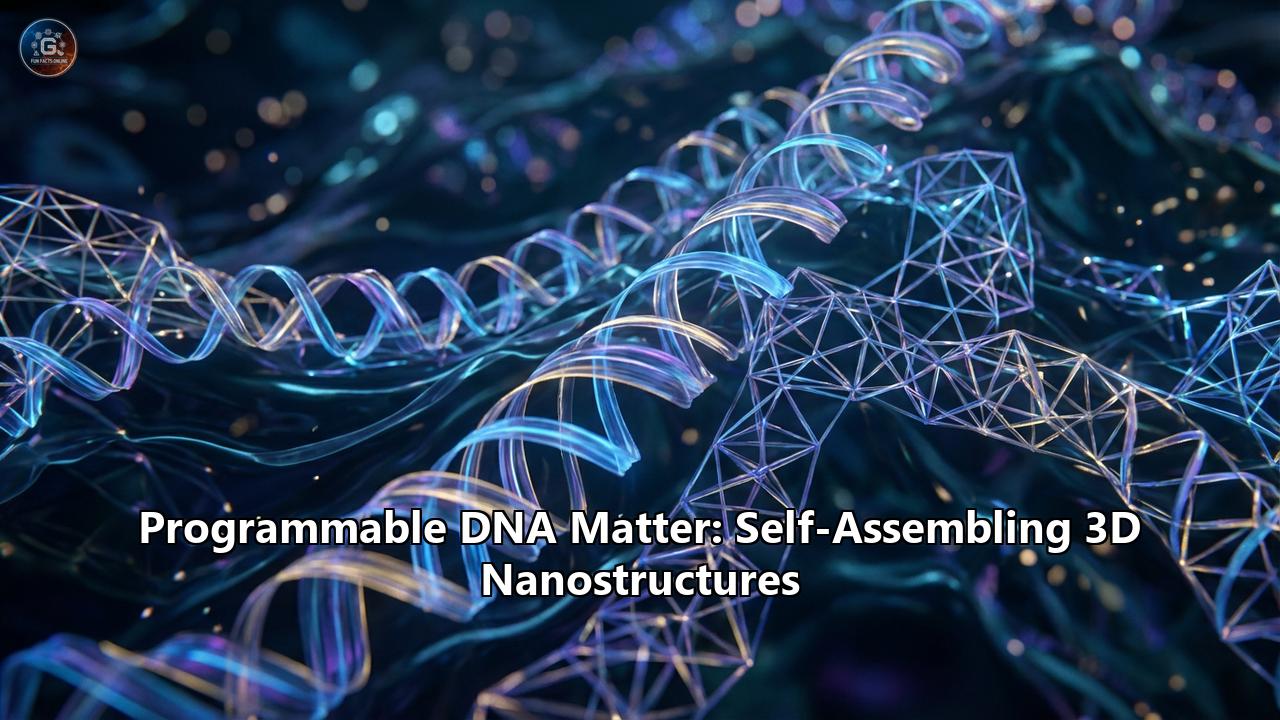
Welcome to the era of Programmable DNA Matter, a frontier where biology meets engineering to create self-assembling 3D nanostructures. This is not science fiction. Today, researchers are programming strands of DNA to fold themselves into tiny robots that hunt cancer cells, nanoscale factories that assemble molecules atom by atom, and archival storage drives that could hold the entire internet in a shoebox.
The Architect’s Blueprint: How DNA Becomes a Brick
To understand how we build with DNA, we must first forget its biological role. In this context, DNA is not a carrier of genetic traits; it is a programmable material.
The magic lies in Watson-Crick base pairing. DNA consists of four bases: Adenine (A), Thymine (T), Cytosine (C), and Guanine (G). The rules are strict and unbreakable: A always pairs with T, and C always pairs with G. This predictability is the engineer’s dream. If you synthesize a strand of DNA with the sequence A-T-C-G, you know with absolute certainty that it will bind only to a strand with the sequence T-A-G-C.
By carefully designing sequences that complement each other at specific points, scientists can program DNA strands to self-assemble into complex 3D shapes. It’s like designing a Lego set where every brick has a specific barcode and magnets that only snap to the correct partner. You don't build the structure manually; you mix the bricks in a test tube, heat them up, and let them cool. As they cool, they find their partners, spontaneously forming the desired shape.
The Two Pillars of Construction: Origami and Bricks
Two primary techniques dominate this field, each with its own philosophy of construction.
1. DNA Origami: The Scaffolded Masterpiece
Invented by Paul Rothemund in 2006, DNA origami is the technique that put this field on the map. It uses a long, circular single strand of DNA (often from a bacteriophage virus) as a "scaffold." Hundreds of short, synthetic "staple" strands are then added. These staples bind to specific distant regions of the long scaffold, pinching and folding it into a compact shape—much like how a single piece of paper is folded into a crane.
- Pros: Extremely robust and high-yield. We can create smiley faces, maps of the Americas, and even boxes with lids that open and close.
- Cons: The size is limited by the length of the scaffold strand.
2. DNA Bricks: The Modular Revolution
If origami is paper folding, DNA bricks are true Legos. Developed by groups at Harvard and the Wyss Institute, this method eliminates the long scaffold entirely. Instead, it uses hundreds of short, interlocking strands that bind to four neighbors each. This allows for modular designs; you can build a massive cube and then "carve" out a sculpture by simply removing specific bricks from the mix.
- Pros: Theoretically limitless size and complexity. It allows for the creation of 3D canvases with thousands of distinct "voxels" (volumetric pixels).
- Cons: Originally required strict conditions to assemble, though recent "crisscross polymerization" techniques have made this more robust.
The Medical Revolution: Nanorobots in Your Bloodstream
The most immediate and life-changing application of programmable DNA matter is in medicine. We are moving from the age of "dumb" drugs—chemicals that flood the entire body to kill a few bad cells—to "smart" nanorobots.
The Trojan Horse for Cancer
One of the most famous examples of a DNA machine is the "nanorobot" designed to kill tumors. These are essentially DNA clamshells. Closed tight, they travel harmlessly through the bloodstream. However, they are equipped with a lock mechanism made of DNA aptamers—short strands that recognize specific protein markers found only on the surface of cancer cells.
When the nanorobot bumps into a cancer cell, the "key" (the cancer marker) fits the "lock" (the aptamer). The clamshell springs open, exposing its payload: a dose of antibody or a coagulation drug that cuts off the tumor's blood supply. This ensures the drug is delivered only where it is needed, drastically reducing the sickening side effects of chemotherapy.
The Artificial Immune System
Beyond killing cancer directly, DNA nanostructures are being used to train the immune system. Researchers have built 3D DNA tetrahedrons (four-sided pyramids) that act as rigid scaffolds for presenting antigens to immune cells. Because the spacing of these antigens can be controlled with sub-nanometer precision, these structures can stimulate an immune response far more potent than free-floating proteins ever could. It is a vaccine, engineered to architectural perfection.
Material Science: Alchemy at the Nanoscale
While biologists look inward, material scientists are using DNA to build the external world. DNA is being used as a template to organize inorganic materials—gold, silica, quantum dots—into structures that nature cannot produce.
Metamaterials and Invisibility
By attaching gold nanoparticles to precise points on a 3D DNA crystal, scientists can create optical metamaterials. These are materials with structures smaller than the wavelength of light, allowing them to bend electromagnetic waves in unnatural ways. Theoretically, a perfect metamaterial could guide light around an object, rendering it invisible—a real-life cloaking device. While we aren't there yet, DNA scaffolding provides the only viable path to manufacturing these complex 3D lattices at scale.
Molecular Lithography
Computer chips are currently made by carving patterns into silicon with light (lithography). As we push the physical limits of how small these transistors can get, DNA offers a "bottom-up" alternative. Instead of carving down, we can build up. DNA bricks can self-assemble into a template for carbon nanotubes or metallic wires, creating circuitry that is smaller and more complex than anything Intel or TSMC can currently etch.
The Data Crisis: Storing the Internet in a Test Tube
Humanity generates about 2.5 quintillion bytes of data every day. Our magnetic tapes and hard drives are running out of space, and they degrade after a few decades. DNA is the ultimate storage medium. It is millions of times denser than a hard drive and, if kept cool and dry, can last for hundreds of thousands of years (just look at the DNA recovered from woolly mammoths).
The DNA Hard Drive
Programmable DNA matter allows us to move beyond simple sequence storage. Researchers are now building 3D DNA files. Imagine a microscopic library where data is not just a string of A's and C's, but a physical structure. By using nanopores—tiny holes that read electricity as molecules pass through them—we can "read" the shape of a DNA nanostructure to retrieve data.
Companies like Catalog and Iridia represent the commercial vanguard here. Catalog, for instance, is not synthesizing new DNA for every bit of data. Instead, they use a library of pre-made DNA "words" and stitch them together into massive sentences using enzymes. It’s a printing press for genetic data, drastically lowering the cost of storage.
The Frontier: "DNA and Water" and the Rise of Voxels
In late 2024 and throughout 2025, the field witnessed a breakthrough that sounds deceptively simple: DNA and water self-assembly.
Researchers at Columbia University and Brookhaven National Laboratory developed a method where DNA strands are attached to soft particles, which then act as "voxels." By tuning the DNA strands to repel water (hydrophobicity) in specific patterns, they forced the particles to arrange themselves into complex macroscopic crystals.
This is a paradigm shift. It means we aren't just building "wireframe" DNA shapes anymore; we are building solid, volumetric matter. It’s the difference between drawing a cube on paper and holding a wooden block. These "DNA-programmed materials" can switch properties on demand—becoming conductive, transparent, or rigid when exposed to specific triggers.
The Challenges: Why Aren't We There Yet?
If this technology is so powerful, why can't you buy a DNA computer at Best Buy?
- Cost: Synthesizing high-quality DNA is still expensive. While the price has dropped from dollars to pennies per base, building a gram of DNA nanostructures is still exorbitantly pricey compared to plastic or silicon.
- The Error Rate: Self-assembly is a statistical process. Most bricks find their partners, but some don't. In a drug delivery vehicle, a 1% error rate is acceptable. In a computer chip, it's catastrophic.
- Physiological Stability: Your body hates foreign DNA. Our blood is full of nucleases—enzymes evolved to shred viral DNA. For medical applications, DNA nanostructures must be coated or chemically modified to survive the journey to their target.
The Future: A New Industrial Revolution
We are standing on the precipice of a "Molecular Industrial Revolution." Just as the ability to forge steel defined the 19th century and the control of silicon defined the 20th, the control of self-assembling programmable matter will define the 21st.
The vision is grand: Universal Fabricators. Imagine a vat of liquid containing trillions of DNA bricks. You download a schematic for a smartphone, a vaccine, or a solar cell. You inject a "seed" crystal into the vat, and before your eyes, the liquid clouds over as the structure grows, atom by atom, into the final product.
It starts with a single strand, finding its partner in the dark. But where it ends is limited only by our ability to write the code.