
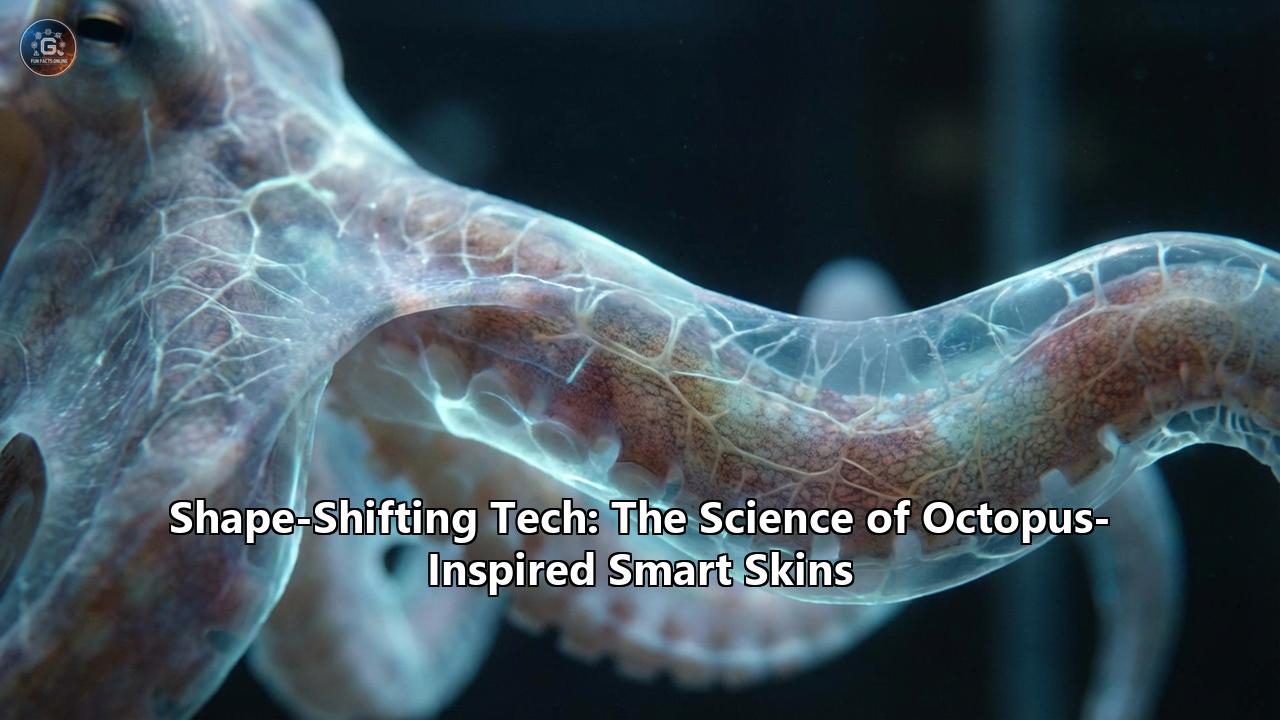
The octopus does not simply hide; it becomes. In a fraction of a second, a creature resting on a coral reef transforms from a smooth, fleshy red invertebrate into a jagged, mossy, rock-like structure, indistinguishable from the substrate beneath it. This is not magic. It is arguably the most sophisticated display of biological engineering on Earth—a masterclass in optics, materials science, and distributed neurological control that human engineers are only just beginning to rival.
For decades, the concept of an "invisibility cloak" or a truly adaptive camouflage suit was the exclusive domain of science fiction, relegated to the worlds of Predator or Harry Potter. But today, in laboratories from Cornell to Seoul, and in military research facilities from DARPA to BAE Systems, the fiction is bleeding into reality. We are witnessing the dawn of Cephalopod-Inspired Smart Skins: synthetic materials that can sense their environment, process that data, and physically morph—changing color, texture, and thermal signature—in real-time.
This is the story of how biology’s ultimate shape-shifters are teaching us to rewrite the rules of visibility, and how this technology is poised to revolutionize soft robotics, military stealth, wearable technology, and human-machine interfaces.
Part I: The Biological Muse – Decoding the Cephalopod
To build an artificial octopus, one must first understand the biological one. The octopus, along with its cousins the cuttlefish and the squid, belongs to the class Cephalopoda. These animals have evolved a skin system that functions less like a biological wrapper and more like a high-definition, 3D video display.
The cephalopod skin is a multilayered optical device. It doesn't just contain pigment; it manipulates light.
1. The Chromatophore: The Pixel of NatureAt the surface layer lie the chromatophores. These are small, elastic sacs filled with pigment granules—usually black, brown, red, orange, or yellow. Unlike human skin, where pigment is static (you don't tan in milliseconds), the cephalopod chromatophore is a neuromuscular organ. Each microscopic sac is attached to tiny radial muscles. When the brain sends a signal, these muscles contract, pulling the sac open like an expanding balloon.
Imagine a drop of ink on a rubber sheet. If you stretch the sheet, the dot becomes a large pancake of color. If you let it relax, the dot shrinks to invisibility. An octopus has millions of these "pixels," and by orchestrating their expansion and contraction, it can generate complex patterns—bands, stripes, and spots—in milliseconds.
2. The Iridophore: The Structural ColoristBeneath the pigment layer lies the iridophore layer. These cells do not contain pigment. Instead, they contain stacks of protein plates (reflectins) that interfere with light waves. By changing the spacing between these plates (often via chemical shifts driven by the neurotransmitter acetylcholine), the animal can tune which wavelengths of light are reflected and which are absorbed.
This is "structural color"—the same physics that gives a peacock feather its shimmer or a soap bubble its rainbow swirl. Iridophores allow cephalopods to create iridescent blues, greens, and silvers—colors that their pigments cannot produce. They act as the animal’s internal prism, manipulating the angle of light to match the polarized light of the ocean environment.
3. The Leucophore: The Passive ReflectorDeeper still are the leucophores. These cells contain granular vesicles that scatter all incoming light. They act like a white projection screen. If you shine a red light on a leucophore, it reflects red. If you shine blue, it reflects blue. This passive layer provides the high-contrast background brightness that allows the chromatophores above to pop.
4. The Papillae: The 3D Texture EnginePerhaps the most mind-bending feature is the ability to change texture. Color matching is useless if you are a smooth blob on a jagged rock. The octopus solves this with papillae—complex muscular hydrostats located in the skin.
A muscular hydrostat works on the principle that water is incompressible. The human tongue is a muscular hydrostat; it has no bones, yet it can lengthen, shorten, curl, and stiffen. Octopus papillae are tiny, concentric networks of muscles that can squeeze sections of skin to make them pop outward, forming spikes, ridges, and bumps. In an instant, the animal goes from 2D smoothness to 3D roughness, breaking up its silhouette to fool the eyes of predators.
Part II: The Physics of Artificial Invisibility
Replicating this biological symphony requires mastering three distinct fields of physics and engineering: electrochromism (color change), actuation (shape change), and sensing (seeing the background).
The first challenge is color. Early attempts at artificial camouflage relied on simple LEDs. While effective for glowing, LEDs are emissive—they generate light. Real camouflage must be reflective (subtractive), manipulating ambient light just like the octopus does. If you glow in the dark, you are a target, not a ghost.
Thermochromic and Electrochromic MaterialsCurrent research focuses on materials that change optical properties under external stimuli. Thermochromic liquid crystals—familiar to anyone who has seen a mood ring—change color with temperature. By embedding networks of resistive micro-heaters behind a thermochromic skin, researchers can "write" colors onto a surface.
However, heat is energy-intensive and slow. The cutting edge lies in electrochromism and electrophoresis. In 2024 and 2025, major breakthroughs were made using "electronic ink" technologies similar to e-readers, but upgraded for full-color spectrums and flexibility. These systems use charged pigment particles suspended in a microfluidic cavity. When a voltage is applied, the particles migrate to the surface, becoming visible. Reverse the voltage, and they dive back down, revealing the layer beneath.
Structural Color via Soft PhotonicsThe "Holy Grail" is replicating the iridophore. Scientists at the University of Cambridge and MIT have developed "polymer opals"—synthetic photonic crystals. These are flexible materials embedded with millions of nano-spheres. When the material is stretched or compressed, the distance between the spheres changes, shifting the wavelength of light they reflect. Stretch it, and it turns blue; compress it, and it turns red. This is "mechano-chromism"—color change driven by movement, mirroring the biological link between the octopus’s skin tension and its appearance.
Part III: Shape-Shifting Matter – The Rise of CCOARSE and LCEs
Color is only half the battle. The defining breakthrough of the 2020s has been in texture morphing. How do you make a robot grow spikes?
The CCOARSE MethodOne of the pioneering technologies in this field was developed by researchers at Cornell University, led by Rob Shepherd and James Pikul. They coined the term CCOARSE: Circumferentially Constrained and Radially Stretched Elastomer.
The concept mimics the octopus papillae. It involves a sheet of silicone (a stretchable rubber) embedded with a non-stretchable fiber mesh. The mesh is laser-cut into specific patterns—concentric circles, spirals, or grids. When the silicone is inflated with air (pneumatics), the mesh restricts expansion in certain directions while allowing it in others.
For example, a series of concentric rings in the mesh forces the inflating silicone to bulge upward in the center, creating a perfect conical spike. By patterning the mesh differently, the skin can morph into the shape of river stones, succulent plants, or coral ridges. This allows a soft robot to physically blend into a gravel bed or a rocky outcrop.
Liquid Crystal Elastomers (LCEs)While CCOARSE relies on air pumps, a newer class of material is stealing the spotlight: Liquid Crystal Elastomers (LCEs). These are polymers that contain liquid crystal molecules (like those in your LCD screen) chemically bonded into the rubber network.
LCEs are "programmable matter." When heated (often via embedded silver nanowire heaters), the liquid crystals lose their alignment, causing the material to contract violently along a specific axis. By 3D printing LCEs with the molecular alignment pre-programmed (a technique called "4D printing"), researchers can create flat sheets that, upon activation, fold themselves into complex origami cranes, curling grippers, or bumpy textures without any air pumps or motors.
In early 2026, researchers at Penn State and UC San Diego demonstrated "smart hydrogel skins" printed with LCEs that could simultaneously change color (by altering refractive indices) and texture (by uneven swelling) when triggered by a simple environmental cue, such as a change in humidity or temperature. This brings us closer than ever to a passive, autonomic camouflage system.
Part IV: The Electronic Skin (E-Skin) Revolution
To act like an octopus, the skin must also feel like one. The cephalopod brain does not micromanage every chromatophore; the skin possesses "distributed intelligence." It can sense light and texture locally.
Stretchable ElectronicsThe field of E-Skin has exploded. The challenge has always been that electronics (silicon, gold, copper) are brittle, while skin is soft. The solution? Liquid Metal.
Teams at the University of Colorado Boulder and elsewhere have pioneered the use of Gallium-Indium alloys—metals that are liquid at room temperature. By injecting these liquid metals into micro-channels within a rubbery polymer (like polyimine), they create circuits that act like liquid wiring. You can stretch them by 60%, twist them, or even slice them in half. Because the polymer is self-healing (using dynamic covalent bonding), the skin can chemically re-bond, and the liquid metal reconnects, restoring the circuit instantly.
Sensory Feedback LoopsFor a smart skin to be effective, it needs eyes. Not giant eyeballs, but an array of thousands of microscopic photodiodes. Recent prototypes embed micro-LEDs (to emit light) and organic photodiodes (to detect light) into the same stretchable layer.
Imagine a robot crawling through a pipe. Its belly skin detects the color and texture of the pipe surface. This data is processed locally by flexible transistors printed directly on the skin. The skin then triggers the dorsal (back) actuators to match that pattern. This creates a "transparency" effect—the observer looks at the robot but sees the pipe pattern "projected" on its back.
Part V: Military Applications – The Quest for Thermal Invisibility
While the visual spectrum is important, modern warfare is fought in the infrared. Thermal imaging cameras detect heat signatures—the glowing white silhouette of a tank engine or a warm human body against a cold background.
ADAPTIV and BeyondBAE Systems made headlines years ago with the ADAPTIV system—hexagonal tiles that could rapidly heat up or cool down to mask a tank's thermal signature. But the new generation of tech is far more subtle.
In 2025, the "HT4" technology and similar breakthroughs in active thermal camouflage moved the game forward. Using graphene-based coatings, engineers can now tune the emissivity of a surface electrically.
Every object emits thermal radiation based on its temperature and its "emissivity" (how efficiently it radiates heat). By changing the electrical charge across a graphene layer, you can change its emissivity. This means a hot tank can be made to emit very little radiation, appearing "cold" to a thermal camera. Conversely, a cold patch can be tuned to emit more, matching the background.
The ultimate goal is the Multi-Spectral Stealth Suit: a wearable garment that scatters radar waves (using metamaterials), matches the visual background (using electrochromics), and suppresses the thermal signature (using variable emissivity coatings). We are effectively building the "Predator" suit.
Part VI: Soft Robotics and Healthcare
The implications extend far beyond the battlefield.
The Gentle Touch of RobotsTraditional robots are hard, heavy, and dangerous. A factory arm can crush a human skull by accident. Octopus-inspired soft robots are made of silicone and air. They can squeeze through gaps smaller than their bodies.
Equipped with smart skin, these robots become the ultimate search-and-rescue tools. A snake-like robot could navigate the rubble of a collapsed building. Its skin protects it from sharp debris (self-healing), while its texture-morphing ability allows it to grip slippery surfaces (biomimetic friction). If it encounters a trapped survivor, the soft, inflated body can gently lift debris without causing crushing injuries.
Prosthetics and HapticsFor amputees, E-skin offers the promise of restoring the sense of touch. By wrapping a prosthetic limb in a sensor-laden smart skin, pressure and temperature data can be encoded into digital signals and fed into the user's peripheral nerves.
Furthermore, the texture-changing capability allows for haptic feedback. Imagine a virtual reality glove made of this material. When you pick up a virtual apple in the metaverse, the skin on your fingertips physically inflates to create pressure, and micro-vibrations simulate the texture of the fruit. You don't just see the virtual world; you feel it.
Part VII: The Future – Living Materials
We are approaching a horizon where the line between "material" and "machine" vanishes.
The next frontier is Bio-Hybrid Skins. Instead of mimicking chromatophores with plastic and voltage, researchers are beginning to use actual living cells. "Engineered Living Materials" (ELMs) incorporate modified bacteria or yeast into hydrogel matrices. These cells can be genetically programmed to fluoresce or produce pigment in response to toxins or stress.
Imagine a hazmat suit that is alive. It doesn't just block radiation; it detects a chemical leak and turns bright red to warn the wearer, while simultaneously releasing enzymes to neutralize the toxin.
Conclusion: The Age of Adaptive Matter
We have spent the Bronze Age, the Iron Age, and the Silicon Age forcing materials to do our bidding through brute force—smelting, forging, etching. The Era of Smart Skins represents a shift to Adaptive Matter.
We are no longer building rigid fortresses to withstand the environment. We are building systems that—like the octopus—survive by understanding the environment and becoming one with it.
From a soldier disappearing into a jungle canopy, to a prosthetic hand that can feel the warmth of a loved one's touch, to a robot that changes its shape to perform surgery inside the human body, the legacy of the cephalopod is rewriting the future of technology. The octopus has had 500 million years to perfect its skin. We are just catching up.
Deep Dive: The Engineering Behind the Magic
To truly appreciate the scale of this technological leap, we must look closer at the specific engineering hurdles that are being overcome right now.
1. The Stretchability Paradox
Electronics hate stretching. Silicon wavers shatter at 1% strain. Human skin (and octopus skin) stretches to 150% or more.
- The Solution: Geometric Engineering. Instead of finding new elements, engineers use "serpentine" layouts. Gold and silicon traces are laid out in S-shapes or fractal springs. When the skin stretches, the wires uncoil like a telephone cord rather than breaking.
- The Breakthrough: Nanomesh conductors. Gold nanowires are sprayed onto a surface to form a random mesh. It looks like a pile of microscopic spaghetti. When stretched, the spaghetti strands slide over each other but maintain electrical contact, maintaining conductivity even under extreme deformation.
2. The Power Problem
An octopus eats crabs to power its skin. A robot needs batteries. Heavy batteries defeat the purpose of "soft" robotics.
- The Solution: Wireless Power and Energy Harvesting. Smart skins are being designed with induction coils to receive power wirelessly (NFC). Even more advanced are triboelectric nanogenerators (TENGs) built into the skin itself. These harvest energy from static electricity generated by friction—so the very act of the robot moving creates the power to change its color.
3. Computational Camouflage
An octopus has a massive optic lobe to process visual data. A smart skin needs to do this without a supercomputer backpack.
- The Solution: Artificial Neural Networks (ANNs) on a Chip. We are moving toward "edge computing" where the AI algorithms for pattern matching are hard-coded into flexible chips on the skin itself. The skin takes a picture of the gravel, the neural network classifies it as "grey/rough/high-contrast," and selects the pre-set camouflage texture—all in microseconds, without sending data to the cloud.
Case Study: The "Pneumatic Pixel"
Consider the work done at the Rogers Research Group (Northwestern University). They developed a skin containing a grid of tiny balloon-like actuators. Each balloon contains a small amount of a distinct chemical dye.
- State A: The balloon is deflated. The dye is hidden deep in the pore. The surface looks white (the color of the matrix).
- State B: A micro-pump inflates the balloon. It pushes the dye-filled sac to the surface. The pixel turns red.
- State C: The pump over-inflates the balloon. It bulges outward, creating a physical bump (texture) while also being red.
This system effectively combines the chromatophore and the papillae into a single mechanical unit. It is simple, rugged, and requires no complex chemical reactions—just air pressure and colored fluid. This "microfluidic camouflage" is currently one of the leading candidates for the first generation of deployable active camouflage for vehicles.
The Ethical Dimension
As with all great leaps, there are shadows. Invisibility is a superpower, and superpowers are dangerous.
- Privacy: If a drone can land on your windowsill and look exactly like a patch of brick, privacy becomes obsolete.
- Deception: Deepfakes manipulate video; smart skins manipulate physical reality. In a future where objects can change their appearance on command, "seeing is believing" will no longer be a valid proverb.
However, the potential for good—for medical devices that heal, for robots that help, and for materials that adapt to our needs—outweighs the fear. The octopus has been the quiet observer of the oceans for eons. Now, by mimicking its silent brilliance, we are stepping into a world where technology is no longer a hard shell that separates us from nature, but a soft, living interface that connects us to it.
The future is soft. The future is stretchable. The future is changing color. And it is hiding in plain sight.
Reference:
- https://materialdistrict.com/article/octopus-texture-changing-camouflage-robot-skin/
- https://www.sciencedaily.com/releases/2026/02/260206034836.htm
- https://news.cornell.edu/stories/2017/10/octopus-inspires-3-d-texture-morphing-project
- https://en.wikipedia.org/wiki/Cephalopod
- https://www.slashgear.com/1271286/active-camouflage-technology/
- http://clem.sch.free.fr/SEP/Messenger2001.pdf
- https://www.youtube.com/watch?v=xR1a5QDWea0
- https://www.shs-conferences.org/articles/shsconf/pdf/2023/06/shsconf_essc2023_04014.pdf
- https://news.uchicago.edu/story/octopus-skin-inspires-engineers-develop-programmable-camouflaging-material
- https://emergencyopsconcepts.com/modern-military-camouflage-a-research-based-analysis/
- https://www.labmanager.com/octopus-inspires-3-d-texture-morphing-project-6297
- https://www.elektormagazine.com/articles/octopus-inspired-synthetic-skin
- https://www.armyrecognition.com/archives/archives-land-defense/land-defense-2024/revolution-in-military-camouflage-with-ht4-technology-promises-complete-thermal-invisibility