
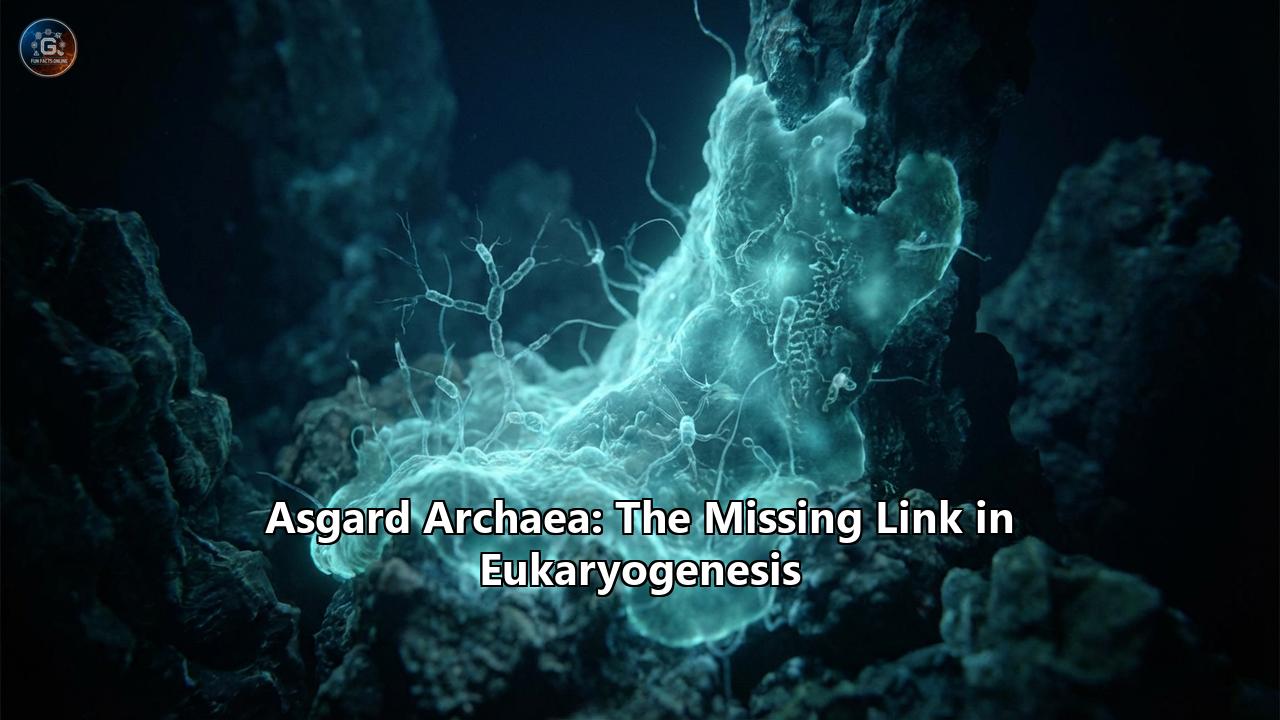
The silence of the deep ocean floor is deceptive. Down in the crushing dark, amidst the cold seeps and hydrothermal vents where the Earth exhales its chemical breath, a drama of cosmic proportions has been playing out for billions of years. For decades, humanity looked at the tree of life and saw a distinct separation: us and them. There were the complex, compartmentalized cells of Eukaryotes (animals, plants, fungi, and protists) and the simple, uncompartmentalized cells of Prokaryotes (bacteria and archaea). The gap between them was an evolutionary chasm so wide that biologically, it seemed impossible to cross. It was the greatest missing link in the history of life.
But the ocean floor held a secret. Buried in the muck of the Arctic Mid-Ocean Ridge, near a hydrothermal vent field named after a trickster god, lay the answer. They are the Asgard archaea. They are not just another branch on the tree of life; they are the root of our own existence. They are the microscopic architects that bridge the void between the simple and the complex. This is the story of their discovery, their biology, and how they are rewriting the history of every human being on Earth.
Part I: The Great Divide and the Eocyte Heresy
To understand the magnitude of the Asgard discovery, one must first appreciate the intellectual fortress it dismantled. For the better part of the 20th century, biology was governed by a dichotomy: Prokaryote vs. Eukaryote. Eukaryotic cells—the stuff of you, me, the oak tree outside, and the mushroom on your pizza—are masterpieces of biological engineering. They possess a nucleus wrapping their DNA, a power plant (mitochondria), a trash compactor (lysosomes), and an internal skeleton (cytoskeleton). Prokaryotes, by contrast, were viewed as bags of chemicals: unstructured, simple, and fundamentally different.
In 1977, the microbiologist Carl Woese shattered this binary view. peering through the lens of ribosomal RNA sequences, he realized that "bacteria" were actually two distinct groups. He identified the Archaea (originally Archaebacteria), a group of superficial look-alikes to bacteria that were genetically as different from bacteria as a human is from a blade of grass. Woese proposed the "Three-Domain System": Bacteria, Archaea, and Eukarya. In his view, these three lineages split apart in the primordial soup eons ago, evolving in parallel.
For decades, this was the textbook standard. Eukaryotes were their own primary domain, ancient and distinct. But not everyone agreed. In the 1980s, James Lake proposed a controversial alternative: the Eocyte Hypothesis. He argued that the tree of life had only two primary trunks, not three. He suggested that Eukaryotes didn't evolve alongside Archaea, but emerged from within them. Specifically, he pointed to a group of sulfur-loving archaea called Eocytes (Dawn Cells) as our direct ancestors.
Lake’s idea was met with skepticism. It implied that we are, effectively, overgrown, complex archaea. Without genomic data to bridge the gap, the Eocyte hypothesis remained a minority view, a "heresy" in the church of the Three Domains. The missing link—an organism that was clearly an archaeon but possessed the genetic toolkit of a eukaryote—remained elusive.
Part II: The Trickster in the Sediment
The turning point came not from a petri dish, but from a computer server. By the early 2010s, the field of metagenomics was revolutionizing microbiology. Instead of trying to grow finicky microbes in the lab—a task that fails 99% of the time—scientists began sequencing all the DNA found in environmental samples. They would scoop up mud, sequence everything in it, and use algorithms to puzzle together the genomes of the creatures living there.
In 2015, a team led by Thijs Ettema at Uppsala University was analyzing sediment samples from a gravity core taken near Loki’s Castle, a hydrothermal vent field on the Mid-Atlantic Ridge between Greenland and Norway. The environment was harsh, anoxic, and alien. As they pieced together the DNA fragments, a strange genome began to take shape.
It was clearly an archaeon, but it was unlike any archaeon ever seen. It contained genes that, until that moment, were thought to exist only in eukaryotes. These were not just random genes; they were the blueprints for complex cellular machinery—genes for bending membranes, building skeletons, and trafficking cargo.
The team named this new organism Lokiarchaeota, a nod to the location of its discovery and the "elusive, shape-shifting" nature of the Norse god Loki. The discovery, published in Nature, sent shockwaves through the scientific community. Lokiarchaeota was the "smoking gun" for the Eocyte hypothesis. It was an archaeon that looked genetically like a starter kit for a eukaryote.
But Loki was not alone.
Part III: The Asgard Pantheon Rises
The discovery of Lokiarchaeota triggered a global treasure hunt. Microbiologists revisited metagenomic datasets from environments all over the world—deep sea trenches, mangroves, aquifers, and hot springs. They were looking for Loki’s relatives.
They found a dynasty.
In the White Oak River estuary in North Carolina, they found Thorarchaeota. In the hot springs of Yellowstone and radiata pools of New Zealand, they found Odinarchaeota. In deep marine sediments, they found Heimdallarchaeota.
Following the naming convention established by Ettema’s group, this new Superphylum was christened the Asgard Archaea, named after the realm of the gods in Norse mythology. The pantheon grew rapidly:
- Lokiarchaeota: The original tricksters, potential ancestors of the eukaryotic host.
- Heimdallarchaeota: Found in marine sediments, these organisms currently hold the title of "closest known relative" to eukaryotes in many phylogenetic analyses. Their genomes contain the richest set of eukaryotic-like genes.
- Thorarchaeota: Likely mixotrophs capable of degrading organic matter and fixing carbon.
- Odinarchaeota: Found in hydrothermal environments, possessing a unique form of tubulin (the protein that makes microtubules in our cells).
- Helarchaeota: Potential hydrocarbon oxidizers found in Guaymas Basin.
- Wukongarchaeota: A deep-branching lineage named after the Monkey King of Chinese mythology (breaking the Norse tradition), found in the deep ocean, showing unique metabolic traits like acetogenesis.
- Hodarchaeota, Gerdarchaeota, Kariarchaeota: Newer additions that further fill in the gaps of metabolic diversity.
The sheer diversity of the Asgard superphylum proved that these were not freak occurrences. They were a dominant, widespread, and diverse group of organisms that had been hiding in plain sight (or rather, in plain mud) for billions of years.
Part IV: The Genomic Smoking Gun – Eukaryotic Signature Proteins (ESPs)
What makes the Asgard archaea the "missing link"? The evidence lies in their proteins.
For decades, biologists defined eukaryotes by specific cellular machineries that prokaryotes simply didn't have. These were called Eukaryotic Signature Proteins (ESPs). The discovery of Asgard archaea dismantled this definition because Asgard genomes are riddled with ESPs.
1. The Cytoskeleton: Actin and TubulinIn your cells, actin filaments provide structure and allow for movement (like muscle contraction or cell crawling). Bacteria have a distant relative of actin called MreB, but it is structurally distinct. Asgard archaea, however, possess "Lokiactins" and "Heimdallactins" that are structurally closer to your actin than to bacterial MreB. Even more shockingly, Odinarchaeota possess "OdinTubulin," a protein that bridges the gap between the bacterial cell-division protein FtsZ and eukaryotic microtubules. This suggests the Asgard ancestor already had a complex internal skeleton.
2. The Membrane Benders: ESCRT ComplexEukaryotic cells are constantly budding off vesicles (tiny bubbles) to transport materials or recycle membrane proteins. This is done by the ESCRT (Endosomal Sorting Complexes Required for Transport) machinery. Asgard archaea possess functional ESCRT homologs. This implies they were capable of sophisticated membrane manipulation—a prerequisite for engulfing another cell (the future mitochondrion).
3. The Tagging System: UbiquitinOur cells use a "kiss of death" system called Ubiquitin to tag proteins for destruction. It’s a complex quality control system. Asgard archaea have a fully functional ubiquitin modification system, previously thought to be exclusive to eukaryotes.
4. The Switches: Small GTPasesSmall GTPases are the molecular switches of the eukaryotic cell, regulating everything from signal transduction to cargo transport. While bacteria have a few, eukaryotes have hundreds. Asgard genomes are enriched with a vast repertoire of these GTPases, suggesting they had already evolved complex signaling networks.
The presence of these proteins poses a fascinating question: What are they doing in a prokaryotic cell? Asgard archaea don't have nuclei or mitochondria. Why do they need a cytoskeleton or a vesicle transport system? The answer likely lies in their lifestyle—a lifestyle that would eventually lead to the most important merger in history.
Part V: The Face of the Ancestor – Prometheoarchaeum syntrophicum
For five years following the discovery of Loki DNA, the Asgard archaea were "virtual organisms." They existed only as sequences in a computer database. Skeptics argued that the "Eukaryotic" genes might be artifacts—contamination from real eukaryotes in the mud samples. To prove the skeptics wrong, someone needed to grow one.
Enter Hiroyuki Imachi of JAMSTEC (Japan Agency for Marine-Earth Science and Technology) and Masaru Nobu.
Culturing deep-sea archaea is notoriously difficult. They grow excruciatingly slowly and die if exposed to oxygen. Imachi’s team set up a specialized bioreactor that mimicked the deep-sea methane seep conditions. They incubated mud from the Nankai Trough. And they waited.
They waited twelve years.
It took over a decade of careful sub-culturing, monitoring, and patience. Finally, in 2020, they introduced the world to strain MK-D1, the first isolated Asgard archaeon. They named it ---Prometheoarchaeum syntrophicum---, after Prometheus, the Titan who created humanity from mud and gave them fire.
The Revelation of Morphology:Under the electron microscope, Prometheoarchaeum was strange. It wasn't a simple sphere or rod. It was a small coccus (sphere) that sprouted long, branching, tentacle-like protrusions. These tentacles were not flagella; they were extensions of the cell body itself.
The Lifestyle of Syntrophy:The "syntrophicum" in its name explains its survival strategy. Prometheoarchaeum cannot grow alone. It relies on a partner. It degrades amino acids and peptides, producing hydrogen as a waste product. If that hydrogen builds up, the archaeon stops growing. It needs a partner—a "hydrogen scavenger" (like the methanogen Methanogenium or a sulfate-reducing bacterium)—to eat the hydrogen.
This reliance on a partner is the key to the Eukaryogenesis puzzle.
Part VI: The E3 Model – Entangle, Engulf, Enslave
The physical appearance and metabolic needs of Prometheoarchaeum provided the final pieces for a new model of how eukaryotes began. The old "Phagocytosis Model" suggested a large, hungry archaeon ate a bacterium and failed to digest it. But archaea don't do phagocytosis (eating whole cells) in the way amoebas do; it's energetically too expensive for them.
With the discovery of Prometheoarchaeum, the "Inside-Out" or "E3 Model" (Entangle-Engulf-Enslave) emerged as the leading hypothesis.
Here is the scenario:
- The Entangle: An ancestral Asgard archaeon (let's call it the Asgard host) lived in the sediment. It had long, branching tentacles (actin-supported protrusions) that it used to increase its surface area for absorbing nutrients. It lived in a close "syntrophic" relationship with a partner—an Alphaproteobacterium (the future mitochondrion) that could consume the Asgard's waste products (hydrogen or electrons).
- The Engulf: Over evolutionary time, the dependency deepened. The Asgard host's tentacles began to wrap around the bacterial partner, perhaps to maximize the transfer of resources or to protect its valuable partner from drifting away. The tentacles grew and fused, slowly enclosing the bacterium within a web of membrane. This wasn't "eating"; it was a hug that never ended.
- The Enslave (Endogenize): Eventually, the bacterium was fully trapped inside the Asgard host. Instead of dying, it thrived. It provided ATP (energy) to the host, while the host provided protection and raw materials. The host's ESPs—the membrane remodeling machinery (ESCRT) and the cytoskeleton—were repurposed to manage this internal guest. The bacterium lost its independence, shedding genes it no longer needed, and became the Mitochondrion.
This model explains why Asgard archaea have "eukaryotic" cytoskeleton genes before they became eukaryotes. They needed the cytoskeleton to build the tentacles that facilitated the merger.
Part VII: The Phylogenetic Rewriting
The discovery of Asgard archaea has effectively ended the Three-Domain debate. The Tree of Life has been pruned. We are now living in a Two-Domain world: Bacteria and Archaea.
Eukaryotes are not a primary domain. We are a secondary merger. We are a branch of the Asgard archaea that acquired a bacterial pet. Phylogenetically, you are an Asgard archaeon. A human is, in essence, a colony of trillions of modified Heimdallarchaeota (or Hodarchaeota) cells, driving around in a complex vehicle, powered by enslaved purple bacteria.
Recent analyses (2024-2025) have refined this placement. The lineage Hodarchaeales, nested within or near the Heimdallarchaeota, appears to be the specific sister lineage to all eukaryotes. These archaea possess pathways for degrading carbon similar to our own metabolism, living in cooler, more oxygen-tolerant environments than the deep-sea Loki.
Part VIII: The Meaning of the Discovery
The implications of Asgard archaea extend far beyond taxonomy. They challenge our philosophical understanding of complexity.
1. Complexity is Gradual, Not Sudden:We used to think the "Eukaryotic Big Bang" was a sudden leap. Asgard archaea show us that the toolkit for complexity was being assembled in the prokaryotic world for a billion years before the mitochondrion arrived. The potential for complex life was always there, waiting for the right energetic spark (the mitochondrion) to ignite it.
2. The Definition of "Self":We are chimeric entities. Our nuclear genome is Archaeal (Asgard). Our energy metabolism is Bacterial. Our membranes are a strange mix (bacterial lipids replacing archaeal ones over time). We are a composite organism, a testament to the power of cooperation and symbiosis over pure competition.
3. The "Dark Matter" of Biology:Asgard archaea were unknown until 2015 because they don't grow on standard agar plates. They remind us that the vast majority of life on Earth—the "microbial dark matter"—remains uncultured and unknown. How many other "missing links" are hiding in the mud?
Part IX: Future Frontiers
The study of Asgard archaea is still in its infancy. While we have hundreds of genomes, we only have a handful of cultures. The race is on to:
- Culture Heimdallarchaeota: Since these are likely our closest relatives, growing them would allow us to see the "pre-eukaryote" in action. Do they have even more complex membrane structures?
- Understand the Nucleus: The origin of the nucleus remains the last great mystery. Asgard archaea don't have one. Did the nucleus evolve to protect the fragile Asgard genome from the chaotic activity of the captured mitochondrion?
- Explore Metabolic Diversity: Recent finds like Wukongarchaeota show that Asgards are metabolically diverse. Understanding their chemistry could reveal how life survived during Earth's major oxygenation events.
Conclusion
For billions of years, the ancestors of the Asgard archaea lived in the quiet mud, extending their tentative arms into the darkness. They were not "primitive" failures; they were patient innovators, assembling the Lego blocks of life—actin, ubiquitin, vesicle transport—one by one.
Then, one day, one of them held on to a passing bacterium and didn't let go. That single embrace changed the planet. It gave rise to the algal blooms, the fungal forests, the dinosaurs, and eventually, the scientists who would return to the ocean floor to find their long-lost parents.
The Asgard Archaea are not just a missing link; they are a mirror. When we stare into the genome of Lokiarchaeum or Prometheoarchaeum, we are not looking at an alien. We are looking at the foundational blueprint of ourselves. We are the children of Asgard, born of a deep-sea alliance, rising from the sediment to reach for the stars.
Reference:
- https://www.independent.co.uk/tech/microbe-evolution-life-fossils-mitochondria-a9306741.html
- https://www.biosino.org/elmsg/asgardarchaeaDetail
- https://www.biorxiv.org/content/10.1101/2024.10.14.618318v2
- https://www.researchgate.net/figure/Metabolic-pathways-of-Asgard-archaea-indicating-variation-at-the-phyla-level-Carbon_fig2_330732205
- https://www.researchgate.net/figure/Eukaryotic-signature-proteins-in-Asgard-archaea-Distribution-of-ESP-homologues-in-Asgard_fig6_371573620
- https://pmc.ncbi.nlm.nih.gov/articles/PMC8815363/
- https://www.biorxiv.org/content/10.1101/2024.10.14.618318v3
- https://pmc.ncbi.nlm.nih.gov/articles/PMC11165668/
- https://en.wikipedia.org/wiki/Asgard_archaea
- https://pmc.ncbi.nlm.nih.gov/articles/PMC6684364/
- https://www.news-medical.net/news/20250322/Asgard-archaea-provide-clues-to-the-origin-of-complex-life-forms.aspx
- https://en.wikipedia.org/wiki/Archaea
- https://coconote.app/notes/c902a7a9-4e29-415b-b42b-333b3161f377
- https://en.wikipedia.org/wiki/Promethearchaeum
- https://pmc.ncbi.nlm.nih.gov/articles/PMC6646929/
- https://a.osmarks.net/content/wikipedia_en_all_maxi_2020-08/A/Asgard_(archaea))
- https://www.researchgate.net/publication/326561827_Asgard_archaea_are_diverse_ubiquitous_and_transcriptionally_active_microbes
- https://www.biorxiv.org/content/10.1101/527697v1.full
- https://www.mdpi.com/2076-2607/9/4/859
- https://www.researchgate.net/publication/346327062_Expanding_diversity_of_Asgard_archaea_and_the_elusive_ancestry_of_eukaryotes
- https://astrobiology.com/2024/07/structure-based-inference-of-eukaryotic-complexity-in-asgard-archaea.html
- https://pmc.ncbi.nlm.nih.gov/articles/PMC10989751/
- https://pmc.ncbi.nlm.nih.gov/articles/PMC10989744/
- https://pmc.ncbi.nlm.nih.gov/articles/PMC11316595/
- https://pubmed.ncbi.nlm.nih.gov/38967634/