
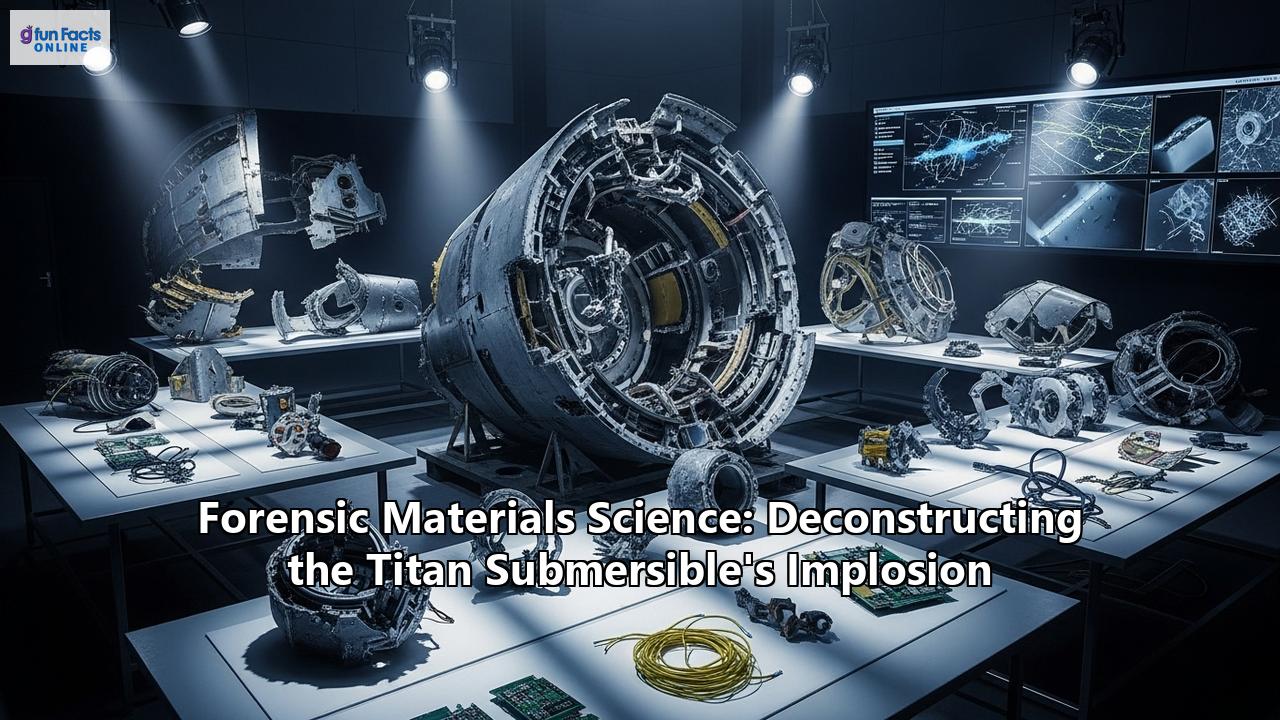
Deconstructing the Deep: How Forensic Materials Science is Unraveling the Titan's Tragic End
The silent, crushing depths of the North Atlantic became the final resting place for the Titan submersible on June 18, 2023, in a catastrophic implosion that claimed five lives and ignited a global firestorm of questions. As the world watched the frantic search unfold, a quieter, more methodical investigation was already taking shape—one that would rely not on sonar pings, but on the silent testimony of the very materials that failed. This is the world of forensic materials science, a discipline now at the epicentre of deconstructing the Titan's demise, piece by shattered piece.The tragedy, which occurred during a dive to the famed wreck of the Titanic, has pulled back the curtain on the high-stakes world of deep-sea exploration and the unforgiving physics that govern it. At the heart of the investigation lies a fundamental question: Why did the Titan, an ostensibly cutting-edge vessel, fail so spectacularly? The answer, as investigators are discovering, is written in the very fabric of its construction—a story of ambitious design, questionable materials, and a fatal disregard for the immense pressures of the deep ocean.
A Vessel Unlike Any Other: The Titan's Controversial Design
To understand the failure, one must first understand the vessel. The Titan was not a typical deep-sea submersible. Most vessels certified for such depths rely on a pressure hull constructed from a single, robust material, typically titanium, forged into a spherical shape—the most geometrically sound structure for resisting uniform external pressure. The Titan, however, was a radical departure from this proven engineering.
Operated by the American company OceanGate, the Titan was built around a cylindrical hull, a shape inherently less stable under the colossal pressures of the deep. More controversially, this hull was not made of a single metal, but of a composite of carbon fiber and titanium. Specifically, the pressure vessel comprised two titanium hemispherical end caps, two matching titanium interface rings, and a 2.4-meter-long, 142-centimeter-internal-diameter cylinder made of filament-wound carbon fiber.
OceanGate's CEO, Stockton Rush, who was among those who perished in the implosion, championed this design as a revolutionary step forward, one that would make deep-sea exploration more accessible. The use of carbon fiber, a material prized in the aerospace industry for its high strength-to-weight ratio, was intended to make the Titan lighter and more buoyant than its all-titanium counterparts. However, its application in a deep-sea submersible was largely untested, a fact that raised red flags among industry experts long before the fatal dive.
The Science of the Squeeze: Understanding Implosion and Material Failure
At the Titanic's depth of approximately 3,800 meters (12,500 feet), the water pressure is a staggering 400 atmospheres, or about 6,000 pounds per square inch. This is akin to the weight of a commercial jet pressing down on every square inch of a surface. Under such immense, uniform pressure, any structural weakness in a submersible's hull can lead to an implosion—a violent, instantaneous collapse inward.
The energy released in such an event is immense. The implosion of the Titan would have occurred in milliseconds, far too fast for the human nervous system to even register. The focus of the forensic investigation, therefore, is not on the sequence of events during the implosion itself, but on the pre-existing conditions and material failures that precipitated it.
For the Titan, the primary suspect was its carbon fiber hull. While exceptionally strong under tension (the pulling forces experienced by an aircraft fuselage), the behavior of carbon fiber composites under the immense compressive forces of the deep sea is far less understood. Unlike metals, which tend to bend and deform under stress, providing some warning of impending failure, carbon fiber is brittle and can fail suddenly and catastrophically.
The Autopsy of an Implosion: Forensic Analysis of the Debris
The recovery of the Titan's wreckage from the seabed, approximately 500 meters from the bow of the Titanic, was a critical first step in the forensic investigation. The debris field itself told a story. The fact that the wreckage was found in a relatively concentrated area suggested the implosion occurred at or near the submersible's maximum depth.
The U.S. Coast Guard, in conjunction with the National Transportation Safety Board (NTSB) and other international bodies, has been leading the painstaking analysis of the recovered components. This is where the principles of forensic materials science come to the fore, employing a range of techniques to read the story written in the fractured remains.
While the full, detailed forensic reports remain part of an ongoing investigation, the findings that have been released paint a damning picture of the Titan's structural integrity. The U.S. Coast Guard's Marine Board of Investigation (MBI) concluded that the implosion was a "preventable tragedy" and that the primary contributing factors were OceanGate's "inadequate design, certification, maintenance and inspection process for the Titan."
The investigation into the debris reportedly revealed a failure of the adhesive that bonded the carbon fiber hull to the titanium end caps. Furthermore, analysis of the carbon fiber itself has been particularly revealing. An NTSB engineer reported that the hull exhibited "wrinkles, porosity and voids" dating back to its manufacture. These are significant defects in a composite material, creating stress concentrations and weak points that are highly susceptible to failure under pressure.
The manufacturing process itself has come under intense scrutiny. The Titan's hull was constructed by winding carbon fiber filaments and applying pre-impregnated carbon fiber fabrics in layers, which were then cured. This process, if not executed perfectly, can introduce the very flaws that the NTSB identified. There have also been reports that the carbon fiber used was "expired" stock from Boeing, purchased at a discount. While Boeing has denied any record of the sale, the mere suggestion that out-of-spec materials could have been used is a major concern for investigators.
One of the most critical pieces of evidence to emerge is the account of a "loud acoustic event" or "bang" heard during a dive in 2022. This sound was recorded by the Titan's own acoustic monitoring system, a feature that Rush had patented and claimed could provide early warning of hull failure. In hindsight, materials scientists believe this was the sound of the carbon fiber delaminating—the layers of the composite separating under stress. This should have been an unambiguous signal that the hull's structural integrity had been compromised.
A History of Warnings: The Perils of Uncertified Innovation
The tragedy of the Titan was not a sudden, unforeseen accident. It was the culmination of a series of decisions that prioritized innovation over established safety protocols. OceanGate deliberately chose not to have the Titan certified by a recognized classification society like the American Bureau of Shipping (ABS) or Lloyd's Register. Rush argued that the lengthy and expensive certification process stifled innovation.
This decision meant that the Titan was not subjected to the rigorous, independent testing and validation that is standard practice in the submersible industry. A typical certification process involves a thorough review of the vessel's design, materials, and construction, as well as a series of pressure tests to ensure its structural integrity. The materials themselves are tested for their mechanical properties, and the completed hull is subjected to non-destructive testing techniques like ultrasonic scans and X-rays to detect any hidden flaws.
OceanGate's internal safety culture has also been described as "toxic" in the U.S. Coast Guard's report. There are accounts of employees who raised safety concerns being dismissed or ignored. This environment, coupled with the lack of external oversight, created a situation where critical warnings about the submersible's safety were not heeded.
Lessons from the Deep: Historical Parallels in Submersible Accidents
The Titan implosion is not the first time a submersible has been lost in the deep ocean. The history of underwater exploration is punctuated by tragedies that have, in turn, led to significant improvements in safety and design. The loss of the U.S. Navy submarines USS Thresher in 1963 and USS Scorpion in 1968 are two of the most notable examples.
The investigation into the sinking of the Thresher, which claimed 129 lives, revealed that a failure in a silver-brazed piping joint likely led to a catastrophic flooding event. This finding spurred the creation of the Navy's rigorous SUBSAFE program, which implemented stringent quality control and certification processes for all submarine components. The Thresher investigation highlighted the critical importance of material quality and fabrication techniques, lessons that resonate powerfully in the wake of the Titan disaster.
The cause of the Scorpion's loss remains less certain, with theories ranging from a torpedo malfunction to a battery explosion. However, the investigation, which involved the deep-sea submersible Trieste II surveying the wreckage, underscored the challenges and importance of deep-ocean forensic analysis.
These historical precedents demonstrate a clear pattern: catastrophic failures in the deep sea are almost always the result of a combination of design flaws, material failures, and operational shortcomings. They also show that rigorous, independent investigation and a commitment to learning from past mistakes are essential for preventing future tragedies. The Titan investigation is the latest, and perhaps most public, chapter in this ongoing story.
The Path Forward: Regulation, Responsibility, and the Future of Deep-Sea Exploration
The deconstruction of the Titan's implosion is far from over. While the broad strokes of the failure are becoming clear, the final reports from the U.S. Coast Guard and NTSB will likely provide even more granular detail on the precise mechanisms of the material failure.
The legacy of the Titan will undoubtedly be one of regulatory change. The incident has exposed a loophole in maritime law that allowed a private, uncertified submersible to operate in international waters, carrying paying passengers to extreme depths. There are now widespread calls for stricter regulations and mandatory certification for all deep-sea submersibles, regardless of their intended purpose.
The tragedy also serves as a stark reminder of the unforgiving nature of the deep ocean. The immense pressures and hostile environment demand a level of engineering rigor and respect for safety protocols that cannot be compromised. As the field of forensic materials science continues to unravel the story of the Titan's final moments, it is providing not only answers about what went wrong, but also invaluable, and ultimately life-saving, lessons for the future of deep-sea exploration. The silent fragments of the Titan, now under the microscope, are speaking volumes, and it is imperative that the world listens.
Reference:
- https://www.youtube.com/watch?v=VZ8ITSxhZmc
- https://www.nuclearinfo.org/wp-content/uploads/2023/05/Txoilgas.com_USS_Scorpion_Court_of_inquiry_findings_26_October_1993.pdf
- https://www.13newsnow.com/article/news/nation-world/titan-sub-implosion-report/507-d3f5017a-7923-4ed2-ba37-d49bded5fd6b
- https://www.usni.org/magazines/naval-history/2025/february/uss-scorpion-buried-sea
- https://news.ycombinator.com/item?id=44798705
- https://news.usni.org/2021/03/15/panel-navy-has-done-itself-a-major-favor-in-releasing-thresher-investigation
- https://mcdowellowens.com/practice-areas/marine-services
- https://www.quora.com/What-really-happened-to-the-USS-Scorpion-Was-the-wreck-ever-found
- https://en.wikipedia.org/wiki/USS_Scorpion_(SSN-589))
- https://ca.news.yahoo.com/oceangates-flawed-practices-caused-titan-133457581.html
- https://mrcds.com/lessons-from-the-loss-of-the-uss-thresher/
- https://www.usni.org/magazines/proceedings/1999/june/real-story-scorpion