
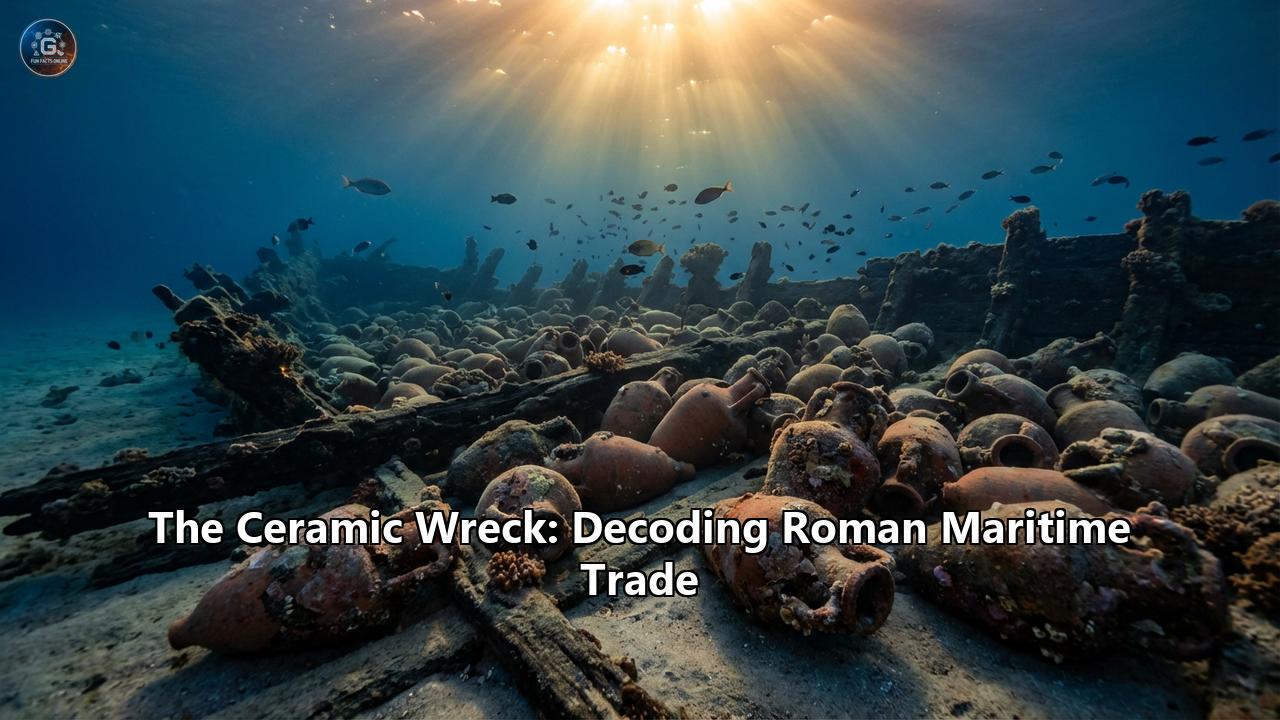
In the silent, silt-heavy gloom of the Mediterranean, fifty meters beneath the surface off the coast of Adrasan, Turkey, a ghost from the ancient world has recently begun to speak. For two millennia, it lay dormant, a wooden skeleton cradling a secret cargo. When divers from Turkey’s Heritage for the Future project, led by Minister of Culture and Tourism Mehmet Nuri Ersoy, descended upon the site in July 2025, they did not find the usual scattered debris of a shipwreck. They found order.
They found thousands of red plates, stacked in teetering, defiant columns, just as the stevedores had placed them 2,000 years ago. This was not merely a shipwreck; it was a suspended moment in time, a commercial transaction interrupted by a storm in the 1st century BC. Dubbed "The Ceramic Wreck" (or the Adrasan Plate Wreck), this discovery has sent shockwaves through the archaeological community, challenging our fundamental understanding of Roman maritime trade, logistics, and consumer culture.
Most ancient shipwrecks are defined by their "amphora tumuli"—mounds of large, robust jars used to transport wine, oil, and garum. The Ceramic Wreck is different. It is a rare "plate wreck," a vessel dedicated to the transport of fine dining ware. But the true miracle lies in the mud. The crew of this doomed merchantman had employed a preservation technique so ingenious that it baffled modern experts: they packed their fragile cargo in raw clay. This ancient shock absorber turned into a hermetic seal, protecting the pottery from marine encrustation for twenty centuries. When archaeologists peel back the grey clay today, the "Eastern Sigillata A" red gloss underneath shines as brilliantly as it did when it left the kilns of Antioch.
This article delves into the depths of the Ceramic Wreck, exploring what its pristine cargo reveals about the complex, vibrant, and surprisingly modern economy of the rising Roman Empire.
I. The Cargo: The "Tupperware" of the Ancient Elite
To understand the significance of the Ceramic Wreck, one must first understand what it was carrying. The thousands of vessels stacked in the hold are known to specialists as Eastern Sigillata A (ESA). In the 1st century BC, this was not just crockery; it was a revolution in dining.
Before the advent of ESA, fine pottery was often black-glazed, imitating the tarnished look of silver. But as the Roman Republic transitioned into an Empire, fashions shifted. The world developed a taste for gold and bronze plate. For the vast majority of the population who could not afford solid gold dining sets, ESA was the answer. Produced in the region of Northern Syria (likely around Antioch, modern-day Antakya), ESA was fired to a deep, rich red and coated with a slip that, when fired, achieved a glossy, almost metallic sheen. It looked like polished copper or bronze. It was beautiful, durable, and crucially, stackable.
The Standardization of TasteThe cargo of the Adrasan wreck is strikingly uniform. Archaeologists have found hundreds of identical plates of specific forms (such as Hayes Form 4) and bowls (Hayes Form 22). This speaks to a level of industrial production that rivals the modern era. These were not unique artistic creations made by a lone potter at a kick-wheel; they were mass-produced in manufactories, ordered in bulk by merchants, and shipped across the sea to grace the tables of aspiring Roman citizens in Italy, Gaul, and Spain.
This uniformity suggests the rise of a powerful "consumer culture." The Adrasan ship wasn't carrying a commission for a king; it was carrying bulk goods for a market. It speaks to a middle class with disposable income and a desire to emulate the aristocracy. When a Roman merchant in Gaul or a wealthy landowner in Spain set their table with these red plates, they were signalling their participation in a civilized, Roman way of life. They were buying into the "brand" of the Empire.
II. The "Clay Cocoon": An Ancient Engineering Marvel
The most headline-grabbing aspect of the Adrasan discovery is the state of preservation, which is entirely due to the packing method. Ancient shipwrecks are usually encrusted with "concretion," a concrete-like coating of marine organisms (barnacles, worms, coral) that locks artifacts together. Cleaning them requires months of acid baths and mechanical chipping.
The Adrasan ceramics, however, were encapsulated in raw clay. This served a dual purpose:
- Shock Absorption: In the rough seas of the Mediterranean, the soft, pliable clay prevented the stacked plates from rattling against each other and shattering. It was the ancient equivalent of bubble wrap or styrofoam peanuts.
- The Hermetic Seal: When the ship sank and settled into the low-energy, silt-heavy environment of the seafloor, the clay packing did not dissolve. Instead, it hardened into a mud seal, creating an anaerobic (oxygen-free) cocoon around each plate. Marine life needs a hard substrate to colonize; they cannot latch onto soft mud. Therefore, the clay prevented the ocean from reclaiming the cargo.
When divers fan away the silt today, they are seeing the plates exactly as the packers in Antioch saw them. This preservation is so complete that archaeologists hope to find more than just pottery. The clay seal might have preserved organic residues—traces of the straw or reed mats used between layers, or perhaps even fingerprints of the stevedores left in the wet clay 2,000 years ago. It offers a rare, intimate connection to the invisible hands that built the ancient economy.
III. Decoding the Trade Routes: Beyond the "Grain Run"
For decades, the dominant model of Roman maritime trade was the "parasitic" theory. Historians believed that fine pottery was a secondary cargo, stuffed into the empty spaces of ships that were primarily carrying bulk staples like grain or olive oil. The logic was that pottery was too cheap and fragile to justify a dedicated voyage.
The Ceramic Wreck challenges this view. The sheer volume of ESA on the Adrasan ship, and the apparent lack of other bulk cargoes like heavy amphorae (though excavation is ongoing), suggests that this vessel may have been chartered specifically to move high-value tableware. This implies a level of market sophistication previously underestimated. It suggests that the demand for "Antioch Red" in the West was so high that merchants could turn a profit by filling an entire ship with nothing but plates.
The RouteThe location of the wreck—off the Lycian coast of Turkey—provides a clue to its journey. The ship was likely sailing west from the Levant (Syria/Antioch), hugging the southern coast of Anatolia before attempting the open-sea crossing towards Greece, and eventually Italy. This was the "superhighway" of the ancient Mediterranean. The currents and prevailing winds favored a counter-clockwise route.
The ship likely met its end in a sudden storm, a common fate off the treacherous headlands of Lycia. The tragedy for the crew 2,000 years ago has become a gift for us. By freezing the cargo in transit, the wreck allows us to reconstruct the logistics of the trade:
- Production: The pottery was fired in the massive kilns of Antioch.
- Packaging: It was moved to a port (possibly Seleucia Pieria), where specialized packers coated it in clay and stacked it.
- Shipping: It was loaded onto a medium-sized merchantman (estimated 20-25 meters long), a "workhorse" of the sea.
- Distribution: Had it survived, the cargo would likely have been offloaded in a major hub like Puteoli (near Naples) or Ostia (Rome), then broken down into smaller lots for distribution to retail shops across Europe.
IV. The Human Element: "Objects are Fossils of Behavior"
Beyond the economics, the Ceramic Wreck offers a poignant look at the human experience of the Roman world. We look at those stacked plates and we recognize the intent. We recognize the careful packing, the business transaction, the hope of profit, and the risk of the journey.
The discovery allows us to reconstruct the "dinner parties" of the past. ESA was the tableware of the social climber. It was used for serving wine, meats, and stews seasoned with garum. It was the backdrop for political discussions, business deals, and family gatherings. The Adrasan ship was carrying the physical components of "Romanization." Being Roman wasn't just about paying taxes or speaking Latin; it was about dining like a Roman. It was about eating from a red-slipped plate, drinking from a specific shape of cup. This ship was carrying the Roman lifestyle in crates.
A Window into Shipboard LifeWhile the cargo is the star, the ship itself holds secrets. The hull construction, likely "mortise and tenon" (where planks are locked together with wooden joints), represents the pinnacle of ancient shipwrightry. The personal possessions of the crew—cooking pots, oil lamps, perhaps a lucky talisman—are likely still hidden in the aft section of the wreck, awaiting discovery. These artifacts will tell us who these sailors were: Were they slaves? Freedmen? Locals from the Levant or Romans from Italy?
V. The Future of the Past: High-Tech Archaeology
The excavation of the Adrasan wreck is the crown jewel of Turkey's "Blue Heritage" initiative. It represents a new era of underwater archaeology where the goal is not just to raise artifacts, but to preserve context.
The artifacts raised from the wreck are currently undergoing desalination and conservation in Antalya. The clay coating, while protective, has also kept the ceramics "wet" for 2,000 years. If dried too quickly, the salts absorbed by the pottery would crystallize and shatter the glaze. The process of stabilizing them will take years.
However, the scientific potential is limitless.
- Residue Analysis: Did the clay packing contain anti-fungal agents?
- Chemical Fingerprinting: Can we pinpoint the exact clay bed in Antioch where the pots were made?
- 3D Modeling: Digital reconstruction of the stack allows researchers to understand the "stowage factor"—how ancient stevedores optimized space in the hold.
The Ceramic Wreck is more than a collection of dirty dishes. It is a time machine. It transports us back to a world of bustling ports, savvy merchants, and skilled artisans. It reveals a globalized economy that, in many ways, mirrors our own—a world connected by trade, driven by consumer demand, and reliant on the perilous, brave work of mariners.
As the divers continue their work in the deep blue waters of Adrasan, unsealing the clay cocoons one by one, they are not just recovering pottery. They are decoding the DNA of the Roman Empire, one red plate at a time. The storm that sank this ship was a tragedy, but the silence that followed has preserved a history that is now, finally, ready to be told.
Reference:
- https://www.youtube.com/watch?v=e1T8OzXEyw8
- https://archaeologymag.com/2025/07/2000-year-old-shipwreck-discovered-off-turkish-coast/
- https://nuttersworld.com/roman-era-shipwrecks-mediterranean/adrasan-plate-wreck/
- https://www.heritagedaily.com/2025/07/preserved-shipwreck-contains-2000-year-old-ceramic-treasures/155535
- https://classics.uc.edu/troy/grbpottery/html/esa.html
- https://www.scribd.com/document/330770736/Eastern-Sigillata-a-in-Italy
- https://www.researchgate.net/publication/250138267_Eastern_Sigillata_A_in_Italy