
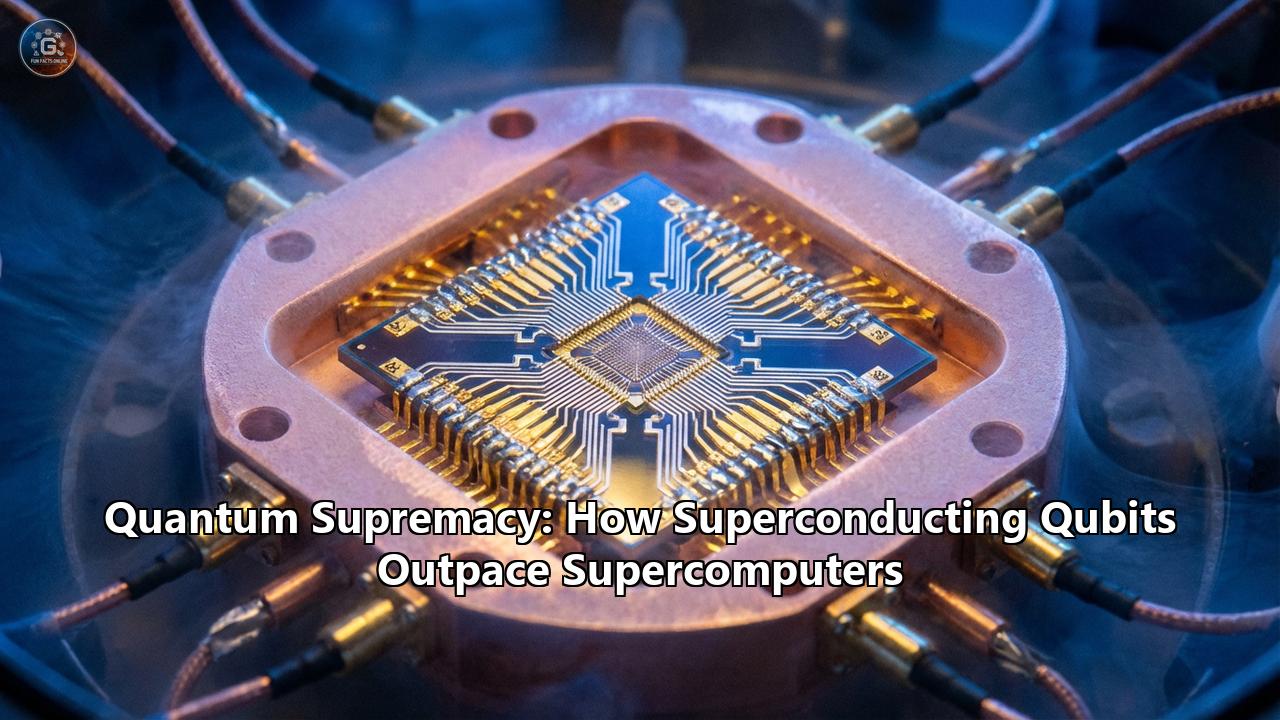
The history of computing is often told as a linear march of progress: from the vacuum tubes of ENIAC to the silicon transistors of the Intel 4004, and eventually to the warehouse-sized supercomputers like Frontier and Summit that simulate climate change and nuclear arsenals. For decades, "faster" simply meant "more transistors" and "higher clock speeds." But in late 2019, and definitively in December 2024 with the unveiling of the Willow processor, that linear narrative shattered.
We have entered the era of Quantum Supremacy.
This is not merely a story of a faster chip. It is the story of a fundamental divergence in how we process information. While classical supercomputers struggle against the physical limits of Moore's Law, a new breed of machines—powered by superconducting loops of niobium and aluminum, cooled to temperatures colder than deep space—has begun to solve problems that would take the most powerful classical computers trillions of years to crack.
This article serves as the definitive guide to this revolution. We will dismantle the physics of the transmon qubit, explore the engineering marvels of dilution refrigerators, dissect the "impossible" math of Random Circuit Sampling, and analyze the fierce geopolitical and corporate race between Google Quantum AI, IBM, and China’s USTC.
Part 1: The Physics of the Impossible
To understand how a quantum processor outpaces a supercomputer, we must first understand why it shouldn't work at all. Quantum mechanics is the physics of the very small—atoms, electrons, photons. In this realm, particles can exist in multiple states at once (superposition) and influence each other instantly across vast distances (entanglement).
Building a computer from these fragile states is like trying to balance a pyramid of cards in the middle of a hurricane. And yet, superconducting qubits have emerged as the leading candidate to tame this chaos.
The Artificial Atom: The Transmon Qubit
Unlike other quantum approaches that use trapped ions (individual atoms held in vacuum chambers) or photons (particles of light), superconducting quantum computing relies on macroscopic circuits that behave like artificial atoms.
The workhorse of this revolution is the Transmon Qubit (Transmission Line Shunted Plasma Oscillation Qubit).
1. The Superconducting State
At the heart of a transmon is the phenomenon of superconductivity. When materials like aluminum or niobium are cooled below a critical temperature (typically near absolute zero), they lose all electrical resistance. Electrons, which normally repel each other, pair up into Cooper pairs. These pairs condense into a single quantum state, moving through the metal lattice without scattering. This frictionless flow is essential because any resistance would generate heat, destroying the delicate quantum information.
2. The Josephson Junction: The Non-Linear Inductor
A simple loop of superconducting wire acts like a standard LC (inductor-capacitor) harmonic oscillator. Its energy levels are equally spaced—like rungs on a ladder where every step is the same height. This is useless for computing because if you try to drive the system from the "0" state (ground) to the "1" state (excited), you might accidentally push it to "2", "3", or higher. You cannot isolate the two logic states needed for a bit.
Enter the Josephson Junction.
Invented by Brian Josephson (who won the Nobel Prize for it), this component is a "sandwich" of two superconducting layers separated by an ultra-thin insulating barrier (usually aluminum oxide). Cooper pairs can tunnel through this barrier. Crucially, the junction acts as a non-linear inductor.
This non-linearity changes the "ladder" of energy levels. It makes the gap between state |0⟩ and state |1⟩ different (usually larger) than the gap between |1⟩ and |2⟩. This property, known as anharmonicity, allows control electronics to hit the qubit with a microwave pulse tuned exactly to the |0⟩↔|1⟩ transition without accidentally triggering higher states. The Josephson Junction effectively turns a circuit board into a controllable, artificial atom.
The Engineering of Silence
These qubits are incredibly sensitive. A stray photon, a vibration, or even a fluctuation in the earth's magnetic field can cause decoherence, causing the qubit to collapse from a quantum superposition back into a classical 0 or 1.
To fight this, chips like Google’s Sycamore and Willow are housed in dilution refrigerators. These gold-plated chandeliers circulate a mixture of Helium-3 and Helium-4 isotopes to cool the processor to 10 to 20 millikelvin—a fraction of a degree above absolute zero. This is colder than the cosmic microwave background radiation of outer space (2.7 Kelvin). In this frozen silence, the thermal noise is effectively muted, allowing the superconducting circuits to "hear" the microwave control pulses sent by the operators.
Part 2: Defining Supremacy
The term "Quantum Supremacy" was coined by theoretical physicist John Preskill in 2012. It does not mean that quantum computers are better at everything. It defines a specific milestone: the moment a programmable quantum device performs a task that no classical computer can perform in any feasible amount of time.
The Benchmark: Random Circuit Sampling (RCS)
To prove supremacy, researchers don't use standard algorithms like factoring numbers (yet). They use a stress test called Random Circuit Sampling (RCS).
Imagine a grid of qubits. You apply a random sequence of operations (gates) to them: entangling qubit A with qubit B, rotating qubit C, and so on. As the circuit gets deeper (more layers of operations), the quantum state becomes an incredibly complex, entangled superposition of all possible $2^n$ outcomes (where $n$ is the number of qubits).
At the end, you measure the qubits and get a string of 0s and 1s.
Why is this hard for classical computers?For a classical supercomputer to simulate this, it must track the probability amplitude of every single possible outcome.
- For 50 qubits, that's $2^{50}$ states (about 1 quadrillion).
- For 70 qubits, it's $2^{70}$ (about 1 sextillion).
- For 105 qubits (like the Willow chip), the number of states exceeds the number of atoms in the visible universe.
Classical supercomputers run out of RAM (memory) to store these states. They can try to use "tensor network" compression techniques, but as the "entanglement entropy" (complexity) of the circuit grows, these compression methods fail.
The Timeline of Dominance
1. The Sputnik Moment: Google Sycamore (2019)
Google fired the first shot with its 53-qubit Sycamore processor.
- The Task: Generate samples from a random circuit.
- The Result: Sycamore finished in 200 seconds.
- The Claim: Google estimated the world's fastest supercomputer, IBM’s Summit, would take 10,000 years to do the same.
- The Aftermath: IBM disputed this, arguing that by optimizing storage, Summit could do it in 2.5 days. Even if true, 200 seconds vs. 2.5 days is a massive speedup, but the "10,000 years" claim sparked a fierce scientific debate.
2. China Strikes Back: Zuchongzhi (2021-2025)
Researchers at the University of Science and Technology of China (USTC) quickly joined the race.
- Zuchongzhi 2.1 (2021): 66 qubits. They performed a task 1000x harder than Sycamore.
- Zuchongzhi 3.0 (March 2025): A monster 105-qubit processor. The team claimed it was one quadrillion times faster than supercomputers for specific sampling tasks. It utilized a "flip-chip" architecture to improve connectivity and reduce interference.
3. The Knockout Blow: Google Willow (December 2024)
In late 2024, Google unveiled the Willow chip, effectively ending the debate about whether classical computers could "catch up."
- Specs: 105 qubits with tunable couplers.
- Performance: It executed a benchmark in 5 minutes that Google projected would take a classical supercomputer 10 septillion ($10^{25}$) years.
- The Significance: $10^{25}$ years is longer than the age of the universe. No amount of classical optimization, RAM expansion, or GPU clustering can bridge that gap. The race, for this specific problem, is over.
Part 3: The Golden Fleece – Exponential Error Suppression
While "Supremacy" makes headlines, the real holy grail of quantum computing is Fault Tolerance.
Qubits are noisy. They make errors. In classical computing, if you want to store a bit more reliably, you might copy it three times (000) and take a majority vote. In quantum computing, you can't clone qubits (the No-Cloning Theorem). Instead, you use Quantum Error Correction (QEC), specifically the Surface Code.
This involves creating a "Logical Qubit" made of many "Physical Qubits." The physical qubits form a checkerboard pattern: "Data" qubits hold the information, and "Measure" qubits constantly check their neighbors for errors without destroying the data.
The Willow Breakthrough
For years, a paradox plagued the field: adding more physical qubits to a logical qubit actually increased the error rate because the added hardware introduced more noise than it fixed.
In December 2024, the Willow chip achieved a historic first: Exponential Error Suppression.
Google demonstrated that as they increased the size of the logical qubit (using more physical qubits from the Willow chip), the error rate went down. This proves that we have crossed the threshold where quantum error correction actually works. It is the green light for building million-qubit systems.
Part 4: The Titans of the Field
Google Quantum AI (The "Supremacy" Camp)
- Philosophy: Prove it works mathematically first. Focus on difficult, abstract benchmarks (RCS) to force hardware improvements.
- Key Tech: Tunable couplers. Sycamore and Willow chips use a special component to turn interactions between qubits off when not needed. This drastically reduces "crosstalk" (unwanted chatter between qubits), which is the killer of high-fidelity operations.
IBM (The "Utility" Camp)
- Philosophy: Focus on "Quantum Utility"—running circuits that are useful now, even if not fully error-corrected. They emphasize "transparency" and putting chips on the cloud for the world to use.
- Key Tech:
Eagle (127 qubits), Osprey (433 qubits), Condor (1,121 qubits): IBM focused on scaling numbers early.
Heron (133 qubits - 2024): A pivot back to quality over quantity. Heron features tunable couplers and much lower error rates.
Blue Jay & Starling: Future systems targeting 2029 for full fault tolerance.
- Strategy: IBM champions "Quantum-Centric Supercomputing," integrating quantum processors (QPUs) with classical CPU/GPU clusters to handle the heavy lifting of error mitigation.
USTC / China (The "High-Dimensional" Camp)
- Philosophy: National strategic dominance. Achieving benchmarks that are undeniably beyond classical reach.
- Key Tech: The Zuchongzhi series (Superconducting) and Jiuzhang (Photonic). Zuchongzhi 3.0’s use of 182 couplers for 105 qubits demonstrates an extremely high-density interconnect architecture, crucial for running complex 2D surface codes.
Part 5: The Sustainability Argument: 26 kW vs. 21 MW
One of the most overlooked aspects of this technology is energy efficiency.
To simulate the random circuit sampling task used in the original 2019 supremacy experiment:
- IBM Summit Supercomputer: Would consume approximately 14 Megawatts of power (enough to power a small city).
- Google Sycamore: Consumed approximately 26 Kilowatts.
Most of Sycamore's power wasn't even the chip—it was the pumps and compressors for the dilution refrigerator. The chip itself consumes negligible power (milliwatts) because superconductors have zero resistance.
As we move toward the AI era, where training models consumes gigawatt-hours of electricity, quantum computing offers a path to "Green High-Performance Computing." For optimization problems (like figuring out the most efficient grid distribution or protein folding), a quantum computer could theoretically arrive at a solution using a fraction of the energy of a GPU cluster running for weeks.
Part 6: The Road Ahead (2026-2035)
We are currently in the NISQ (Noisy Intermediate-Scale Quantum) era, transitioning into the FTQC (Fault-Tolerant Quantum Computing) era.
1. 2026-2028: The Era of Logical Qubits
The immediate goal is not more physical qubits, but better logical* qubits. Google, IBM, and others aim to build a "forever qubit"—a logical bit of information that lasts indefinitely because the error correction cycle is faster than the error generation rate.
2. 2029-2030: Commercial Utility
This is the target year for IBM's "Starling" and Google's commercial milestone. We expect to see the first "useful" applications that justify the cost:
- Nitrogen Fixation: Simulating the FeMoco enzyme to create fertilizer without the energy-intensive Haber-Bosch process (which currently consumes ~2% of the world's natural gas).
- Battery Chemistry: Modeling lithium-sulfur or solid-state interactions at the atomic level to double EV range.
3. The RSA Threat (The "Q-Day")
There is a fear that a large enough quantum computer (running Shor’s Algorithm) could crack RSA encryption, the backbone of the internet. Estimates suggest we need roughly 20 million physical qubits to break 2048-bit RSA in 8 hours. With Willow at 105 qubits, we are far away. However, the "Store Now, Decrypt Later" threat is real, prompting agencies like NIST to standardize Post-Quantum Cryptography (PQC) algorithms today.
Conclusion
Quantum supremacy is no longer a theoretical debate; it is an experimental reality. The Google Willow chip and China’s Zuchongzhi 3.0 have proven that we can engineer systems that manipulate information in a Hilbert space so vast that classical physics cannot contain it.
We have moved from the "Vacuum Tube" era of quantum computing into the "Transistor" era. The engineering challenges remain immense—scaling from 100 qubits to 1,000,000 requires solving massive cabling, heat, and control issues. But the physics works. The gate has been opened. We are no longer just computing; we are choreographing the fundamental fabric of the universe to do our math for us.
Reference:
- https://finviz.com/news/260647/my-top-3-quantum-computing-stocks-to-buy-in-december
- https://debuglies.com/2025/03/14/chinas-zuchongzhi-3-0-quantum-processor-redefining-computational-boundaries-with-a-105-qubit-breakthrough-in-2025/
- https://www.ibm.com/roadmaps/quantum/
- https://www.youtube.com/watch?v=_y43boNNoVo
- https://postquantum.com/industry-news/zuchongzhi-3-0-quantum-chip/
- https://elnion.com/2025/03/20/has-chinas-zuchongzhi-3-quantum-processor-reshaped-the-race-to-quantum-singularity/
- https://orangeqs.com/news/sustainability-impact-quantum-chip-testing/
- https://thequantuminsider.com/2024/07/04/supremacy-surprise-speedy-supercomputer-surpasses-sycamore/
- https://physicsworld.com/a/quantum-computers-vastly-outperform-supercomputers-when-it-comes-to-energy-efficiency/
- https://www.forbes.com/sites/luisromero/2025/03/10/quantum-singularity-ahead-chinas-zuchongzhi-3-reshapes-quantum-race/
- https://postquantum.com/quantum-computing/fault-tolerant-quantum-race/
- https://www.youtube.com/watch?v=W7ppd_RY-UE
- https://en.wikipedia.org/wiki/Willow_processor
- https://www.digit.in/features/general/google-willow-quantum-chip-explained-faster-than-a-supercomputer.html
- https://www.youtube.com/watch?v=eMMkzv_LjNM
- https://ismailtasdelen.medium.com/the-quantum-chip-race-whos-leading-the-charge-in-2025-470bdfd1a4e9
- https://quantumai.google/static/site-assets/downloads/willow-spec-sheet.pdf
- https://www.ibm.com/roadmaps/quantum/2025/
- https://www.hpcwire.com/2024/12/09/google-debuts-new-quantum-chip-error-correction-breakthrough-and-roadmap-details/
- https://www.constellationr.com/blog-news/insights/ibm-outlines-quantum-computing-roadmap-through-2029-fault-tolerant-systems
- https://quantumcomputing.stackexchange.com/questions/8608/making-sense-of-the-sycamores-computing-prowess-power-consumption