
For centuries, when humanity looked up at the night sky and wondered about the worlds orbiting other stars, our imaginations were fundamentally tethered to the only template we knew: our own Solar System. The architecture of our cosmic backyard—small, dense, rocky planets huddled close to the Sun, and massive, gaseous giants patrolling the frigid outer reaches—seemed like a universal blueprint. It was a logical, elegant design born from the temperature gradients of a primordial stellar nebula. For decades, planetary scientists assumed that if we ever found other planetary systems, they would essentially be variations on this familiar theme.
Then came the exoplanet revolution.
Telescopes like Kepler, TESS, and now the James Webb Space Telescope (JWST) have peeled back the cosmic curtain, revealing a galaxy teeming with planetary systems that defy our fundamental expectations. We have found "Hot Jupiters" skimming the surfaces of their stars, highly eccentric worlds orbiting on comet-like trajectories, and compact systems of "Super-Earths" and "Mini-Neptunes" packed so tightly together they could comfortably fit within the orbit of Mercury.
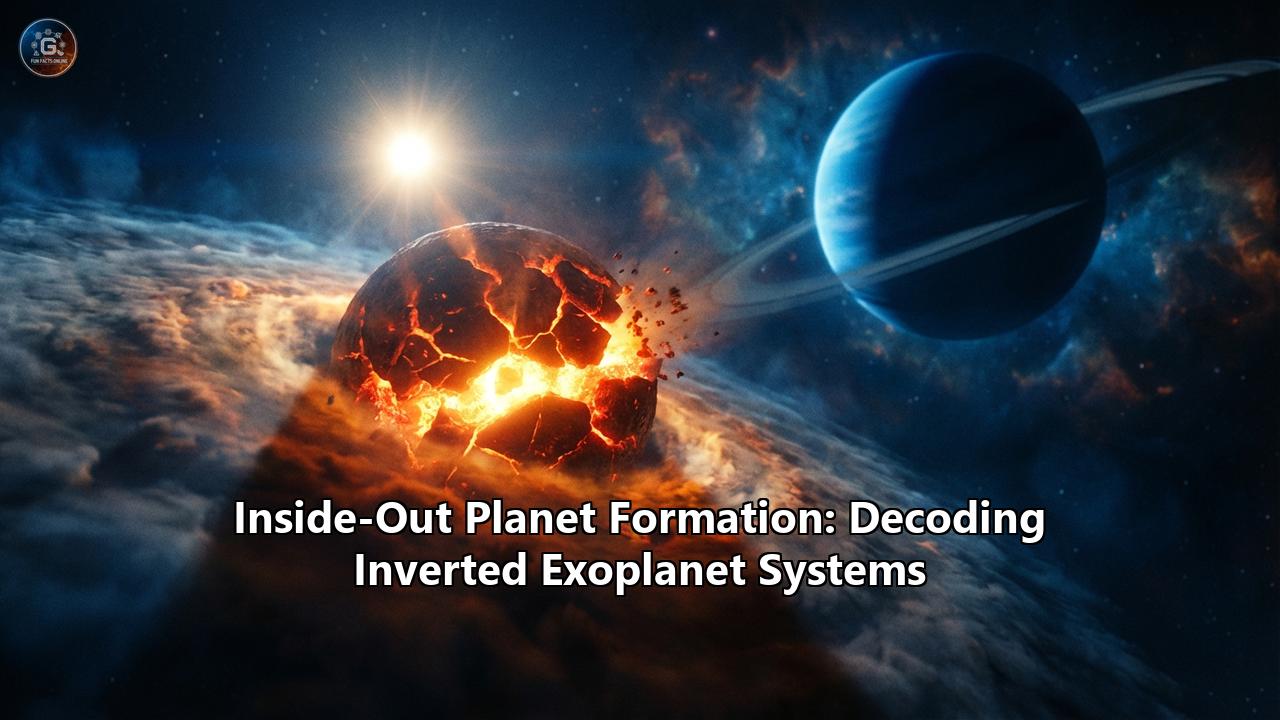
Yet, perhaps nothing has shattered our classical planetary models quite like the recent discovery of LHS 1903. In early 2026, an international team of astronomers announced the detection of a system 116 light-years away that turns everything we thought we knew upside down. It is an "inverted" planetary system. In LHS 1903, the inner planets are massive gas giants, while the outermost known world is a small, barren, rocky sphere.
How could a rocky planet form on the outside of gas giants? To answer this question, astrophysicists have had to dust off and revitalize a radical, paradigm-shifting theory of planetary genesis: Inside-Out Planet Formation (IOPF).
This comprehensive exploration delves into the mechanics, the physics, and the staggering implications of inverted exoplanet systems. We will journey from the classical models of planet formation to the microscopic dance of pebble accretion, exploring the complex magnetohydrodynamics of protoplanetary disks, and ultimately decoding the astrochemical signatures that dictate the birth of worlds. Welcome to the cutting edge of planetary astrophysics.
The Classical Blueprint: The Nebular Hypothesis and the Snow Line
To truly appreciate the weirdness of an inverted system like LHS 1903 and the necessity of the Inside-Out Planet Formation theory, we must first understand the classical model it disrupts.
The prevailing theory for the birth of planetary systems is the Nebular Hypothesis, initially proposed in the 18th century by Emanuel Swedenborg, Immanuel Kant, and Pierre-Simon Laplace, and heavily refined over the 20th century. According to this model, stars form from the gravitational collapse of giant molecular clouds of gas and dust. Because these clouds are slowly rotating, the collapsing material flattens into a spinning disk—a protoplanetary disk—around the nascent star.
Within this disk, the temperature drops drastically the further you move away from the central protostar. This temperature gradient is the architect of the classical planetary system. Close to the star, temperatures are blisteringly high. Volatile elements and compounds—like water, carbon dioxide, methane, and ammonia—can only exist as gases. Only materials with high melting points, such as metals (iron, nickel) and silicates (rock), can condense into solid grains.
These solid grains collide and stick together, growing into pebbles, then planetesimals, and finally planetary embryos through a process known as core accretion. Because metals and silicates make up only a tiny fraction (less than 1%) of the total mass of the disk, the planets that form in the inner region are relatively small. These become the terrestrial, rocky planets: Mercury, Venus, Earth, and Mars. Furthermore, the intense stellar winds and radiation from the young star eventually blow the remaining hydrogen and helium gas away from the inner system, stripping these nascent rocky worlds of any thick, primordial gas envelopes.
Further out in the disk lies a critical boundary known as the "Frost Line" or "Snow Line." Beyond this distance (roughly 2.7 to 3 Astronomical Units in our Solar System, situated between Mars and Jupiter), it is cold enough for volatile compounds to condense into solid ice. Because water and other volatiles are vastly more abundant in the universe than rock and metal, the amount of solid material available beyond the snow line is massive.
Here, planetary embryos can grow much larger and much faster. Once a rocky-icy core reaches a critical mass of about 10 Earth masses, its gravity becomes strong enough to rapidly pull in surrounding hydrogen and helium gas from the disk. This leads to runaway gas accretion, birthing gas giants like Jupiter and Saturn. Even further out, where the gas density is lower and growth is slower, we find the ice giants, Uranus and Neptune.
This model—rocky on the inside, gaseous on the outside—is logically sound, physically mathematically robust, and perfectly matched our Solar System. For a long time, it was the only story of planet formation we needed.
But the universe, it turns out, is vastly more creative than our local neighborhood suggests.
The Kepler Anomaly: STIPs and the Migration Debate
The first cracks in the classical model appeared in the 1990s with the discovery of "Hot Jupiters"—massive gas giants orbiting their stars in a matter of days. Since gas giants could only form beyond the snow line, their presence so close to their host stars meant they must have formed far out and subsequently "migrated" inward, dragged by the friction of the gas disk or gravitational interactions with other planets.
Migration theory became the patch that saved the classical model. But then came the NASA Kepler Space Telescope, launched in 2009. Kepler stared unblinkingly at a single patch of sky, measuring the minute dimming of starlight caused by planets transiting across their host stars.
Kepler's legacy was profound. It revealed that the most common types of planets in the galaxy are Super-Earths and Mini-Neptunes—worlds between the size of Earth and Neptune. Tellingly, our Solar System possesses neither. Even more confounding was where these planets were found. Kepler discovered a vast number of Systems with Tightly-packed Inner Planets (STIPs).
In a typical STIP, you might find three, four, or even five planets ranging from 1 to 10 Earth masses, all orbiting their star closer than Mercury orbits the Sun, with orbital periods ranging from a few days to a few months. These planets are incredibly compact, yet their orbits are remarkably stable, nearly circular, and coplanar.
The sheer abundance of STIPs presented an existential crisis for the classical model. How do you cram several massive rocky or gaseous planets into a region of the disk that, according to the standard model, shouldn't have enough solid material to build even one Earth?
Astrophysicists split into two camps to solve the STIP anomaly:
- The Migration Camp: This hypothesis suggested that the planets of STIPs formed much further out in the disk, beyond the snow line where material is plentiful, and then migrated inward en masse. However, this theory ran into severe theoretical roadblocks. Smooth inward migration typically traps planets in mean-motion resonances (orbital ratios like 2:1 or 3:2). While some Kepler systems are resonant, the vast majority of STIPs are not. Furthermore, there is no natural "stopping mechanism" to prevent the planets from migrating all the way into the star and being incinerated.
- The In-Situ Formation Camp: This camp argued that STIPs formed exactly where we see them today. To make this work, theorists had to postulate incredibly massive inner disks (the Minimum Mass Extrasolar Nebula, or MMEN), packed with solid material. But justifying how so much mass accumulated so close to the star without forming a gas giant or falling into the star remained a glaring theoretical loophole.
The field was deadlocked. We needed a new paradigm—a mechanism that could transport solid material to the inner disk, concentrate it, and build planets right on the doorstep of the star.
Enter Inside-Out Planet Formation (IOPF)
In 2014, astrophysicists Soumya Chatterjee and Jonathan C. Tan published a series of landmark papers proposing a radical new framework called Inside-Out Planet Formation (IOPF). Rather than treating the entire protoplanetary disk as a simultaneous nursery where planets grow concurrently, IOPF treats the disk as an active, sequential planetary factory that operates from the inside moving out.
To grasp how IOPF works, we must venture into the complex magnetohydrodynamics (MHD) of a young star system.
1. The Magnetorotational Instability (MRI) and the Dead Zone
A protoplanetary disk is not just a passive ring of dust; it is a dynamic, highly ionized plasma. Because gas in the inner disk orbits faster than gas further out (Keplerian rotation), friction occurs. The primary source of this friction—or "viscosity"—that allows gas to lose angular momentum and accrete onto the star is turbulence driven by magnetic fields.
This phenomenon is called the Magnetorotational Instability (MRI). For MRI to operate, the gas must be sufficiently ionized (electrically charged) so it can interact with the magnetic field.
In a young protoplanetary disk, the region very close to the star (up to about 0.1 to 1 AU) is intensely hot—often exceeding 1,200 Kelvin. At this temperature, alkali metals like sodium and potassium undergo thermal ionization, stripping them of electrons. This thermal ionization provides enough charged particles to trigger robust MRI turbulence. Thus, the innermost region of the disk is "MRI-active". It is highly viscous, and gas flows rapidly onto the star.
However, as you move further away from the star, the temperature drops rapidly. Beyond the 1,200 K threshold, thermal ionization stops. Furthermore, this region is too dense for ionizing radiation (like cosmic rays or stellar X-rays) to penetrate to the disk midplane. Because the gas here is not ionized, the magnetic fields cannot grip it. The MRI shuts down.
This vast, tranquil region of the disk is known as the "Dead Zone". Here, viscosity plummets, and gas moves very slowly.
2. The Pressure Trap at the Dead Zone Inner Boundary (DZIB)
The transition between the high-viscosity MRI-active inner zone and the low-viscosity Dead Zone is not just a mathematical curiosity; it is the crucible of planet formation. This transition point is called the Dead Zone Inner Boundary (DZIB).
Think of a busy highway where cars are moving at 70 mph, but suddenly hit a zone where the speed limit drops to 10 mph. The result is an inevitable, massive traffic jam. In the protoplanetary disk, gas flows inward slowly through the Dead Zone, but once it crosses the DZIB into the highly viscous MRI-active zone, it speeds away onto the star. Because gas is supplied slowly from the outside but removed quickly from the inside, gas tends to pile up right at the boundary.
This pile-up creates a local peak in gas pressure—a pressure maximum. And in astrophysics, pressure maxima are traps for solid material.
3. The Radial Drift of Pebbles
While the gas is doing its dance, solid particles are undergoing their own evolution. Microscopic dust grains in the outer disk collide and stick together, growing into "pebbles" ranging from millimeters to centimeters in size.
In a standard disk, the gas feels an outward push from internal pressure, which makes it orbit the star slightly slower than orbital mechanics (Kepler's laws) would dictate for a solid body. The solid pebbles, trying to orbit at the true Keplerian speed, feel a constant "headwind" from the slower-moving gas. This aerodynamic drag saps their angular momentum, causing them to spiral inward toward the star at alarming speeds. This phenomenon, known as radial drift, is a famous problem in classical planet formation—particles should fall into the star before they can grow into planets.
But the pressure maximum at the DZIB acts as an insurmountable barricade. As gas piles up at the boundary, the local pressure gradient actually reverses. The gas on the outer edge of the bump is pushed outward, making it orbit faster (super-Keplerian). Now, the inward-drifting pebbles encounter a "tailwind." Their inward drift halts completely.
4. Spawning a Planet
Driven by relentless radial drift from the vast outer disk, millions of tons of pebbles stream inward and crash into the pressure trap at the DZIB. They cannot pass. Over tens of thousands of years, an incredibly dense, narrow ring of solid pebbles builds up at this boundary.
As the pebble ring grows denser, it eventually triggers the Streaming Instability, or simple gravitational collapse. The ring fragments and coalesces under its own weight, rapidly birthing a solid planetary core right at the DZIB.
This core sits in a bath of pebbles and gas. It continues to grow explosively through a process called Pebble Accretion. Because pebbles are small and strongly affected by gas drag, they are easily captured by the gravity of the growing protoplanet. The planet quickly balloons into a massive Super-Earth or Mini-Neptune.
5. Opening the Gap and the Retreat of the Dead Zone
The newly formed planet continues to feed until it reaches a critical mass (typically a few Earth masses). At this point, the planet's gravitational influence becomes so strong that it begins to carve a physical trough, or "gap," in the gas disk, effectively pushing material away from its orbit.
By opening a gap, the planet cuts itself off from the supply of pebbles, capping its own growth. But it also triggers a chain reaction that continues the planetary factory.
The gap reduces the gas density in the immediate vicinity of the planet. With less dense gas blocking the way, high-energy X-ray photons from the young central star can now penetrate further out into the disk midplane. These X-rays ionize the gas just beyond the planet.
Because the gas is now ionized, the magnetic fields grip it once more. The MRI activates further out. The dead zone is forced to retreat outward by a few fractions of an Astronomical Unit.
With the dead zone retreating, a new Dead Zone Inner Boundary (DZIB) is established further away from the star. A new pressure maximum forms. The inward stream of pebbles is trapped at this new, outer location. A new pebble ring builds up. A second planet is born.
This process repeats sequentially. Planet one forms at the inner edge, pushes the boundary back. Planet two forms, pushes the boundary back. Planet three forms. Like an astrophysical 3D printer, the disk spawns a sequence of closely packed planets, perfectly recreating the STIPs architecture discovered by Kepler. Each planet is generated from the inside, moving out. Inside-Out Planet Formation.
The Turbocharger: Pebble Accretion
It is impossible to discuss the success of IOPF without dedicating time to the specific mechanism of its growth: Pebble Accretion.
In the old "core accretion" model, planets grew by crashing large, kilometer-sized planetesimals together. This process is excruciatingly slow. Simulations consistently showed that building a 10-Earth-mass core in the outer disk via planetesimal accretion would take longer than the entire lifespan of the protoplanetary disk (which typically dissipates into space after a few million years).
Pebble accretion, pioneered by researchers like Michiel Lambrechts and Anders Johansen in the 2010s, solved this "time crisis". When a protoplanetary embryo reaches the size of a large asteroid (roughly 1,000 kilometers across), its gravity becomes significant. However, if a large, solid planetesimal flies by, gravity alone is often not enough to capture it—it simply zips past.
But pebbles (millimeter to centimeter-sized) are different. As a pebble flies past the growing protoplanet, it enters the planet's sphere of gravitational influence. It tries to orbit the protoplanet, but it is constantly feeling the friction (gas drag) from the surrounding nebula. This drag robs the pebble of its kinetic energy, causing it to spiral inward and crash onto the protoplanet.
Gas drag essentially acts as a massive net, vastly increasing the effective "capture cross-section" of the protoplanet. Through pebble accretion, a core can grow from a lunar mass to 10 Earth masses in just a few hundred thousand years—orders of magnitude faster than planetesimal accretion.
In the IOPF model, the radial drift of pebbles is the conveyor belt, delivering raw material from hundreds of astronomical units away directly to the dead zone inner boundary. The pressure trap stops the conveyor belt, and pebble accretion is the robotic arm that rapidly assembles the final product. It is a highly efficient, integrated manufacturing system that can convert a massive flux of small particles into a tightly packed sequence of planets.
Decoding the Enigma: The LHS 1903 Inverted System
Armed with the profound mechanics of Inside-Out Planet Formation, we can now return to the cosmic anomaly that sent shockwaves through the astrophysics community in early 2026: LHS 1903.
Discovered by an international research team, including Dr. Thomas Wilson (University of Warwick) and Dr. Annelies Mortier (University of Birmingham), using European Space Agency (ESA) telescopes, LHS 1903 is a system 116 light-years away containing four known planets.
What makes LHS 1903 a uniquely "inverted" system?
- Planet b (Inner): A massive, gaseous planet.
- Planet c (Middle): Another gaseous planet.
- Planet d (Outer-Middle): A gaseous Mini-Neptune.
- Planet e (Outermost): A small, dense, totally rocky world devoid of a substantial atmosphere.
Under the classical model, this is an impossibility. Fierce stellar radiation from the young star should have swept the gas atmospheres away from the innermost planets, leaving them as rocky cores, while the outermost planet, situated in the cooler regions, should have easily held onto a massive envelope of gas. The traditional expectation—"rock to gas"—was completely inverted.
The scientific team initially scrambled for catastrophic explanations. Had the rocky planet originally formed further in and swapped orbits with the gas giants? Dynamical simulations proved this to be highly unstable and statistically improbable. Had the outermost rocky planet suffered a colossal impact with another protoplanet that blasted its gas envelope into space? Possible, but the neat, circular orbits of the system argued against violent, chaotic scattering.
The answer lay in time, not chaos. The team concluded that the planets of LHS 1903 did not form simultaneously. They formed sequentially, "waiting their turn," in textbook adherence to Inside-Out Planet Formation.
The IOPF Timeline of LHS 1903
Let us walk through the genesis of LHS 1903, utilizing the IOPF framework.
Epoch 1: Birth of the Inner GiantAround 116 light-years away, millions of years ago, the star LHS 1903 is surrounded by a thick, gas-rich protoplanetary disk. The dead zone inner boundary (DZIB) sits very close to the star. A massive influx of pebbles streams in from the outer disk, hits the pressure bump, and coalesces into a core. Because the disk is still incredibly young, there is an abundance of hydrogen and helium gas. The newly formed core rapidly undergoes pebble accretion, hits a critical mass, and sucks in the surrounding gas, becoming a gas giant (Planet b).
Epoch 2: The Retreat and the Second GiantPlanet b opens a gap. X-rays from the young LHS 1903 star penetrate the gap, ionizing the gas behind the planet. The MRI activates, and the dead zone is pushed outward. A new pressure trap forms. The pebble stream builds a new ring, forming a new core. Gas is still plentiful in the disk, so this core also captures a massive envelope, becoming the second gas giant (Planet c).
Epoch 3: The Depleting DiskThe process repeats. The dead zone retreats again. Planet d forms. But by this time, the clock is ticking. Protoplanetary disks do not last forever. The central star is constantly accreting gas from the inner disk, and powerful ultraviolet radiation is slowly evaporating the gas from the outer disk in a process known as photoevaporation. By the time Planet d forms, the local gas density is beginning to wane. It manages to accrete some gas, becoming a Mini-Neptune, but it cannot rival the mass of its older, inner siblings.
Epoch 4: The Starved SiblingPlanet d opens a gap, and the dead zone makes its final retreat. A new pressure maximum is established on the periphery of the planetary system. The last remnants of the inward-drifting pebbles pile up and undergo streaming instability, forming the core of Planet e.
However, LHS 1903 Planet e has formed in a drastically different environment than its older siblings. Dr. Annelies Mortier poetically described this phenomenon: "Much like how younger siblings grow up in a world that is different from their elders, the 4th small rocky planet seems to have evolved in a very different environment... where gas had already run out".
By the time Planet e was ready to build an atmosphere, the protoplanetary gas disk had entirely dissipated—either consumed by the star, swept up by the inner gas giants, or blown away by stellar winds. Planet e was starved. It formed its solid core, but there was simply no gas left to accrete.
The result? A naked, rocky planet sitting on the outside of a system of gas giants. An inverted system.
LHS 1903 is not an anomaly of chaos; it is a perfectly preserved chronological fossil of the inside-out formation process. It proves that a planet's final composition (rocky vs. gaseous) is dictated not just by its location in the disk, but by when it formed relative to the lifespan of the gas nebula.
The Astrochemical Fingerprints of IOPF
While the structural architecture of systems like LHS 1903 provides compelling macro-evidence for inside-out formation, scientists are also hunting for micro-evidence buried in the chemistry of these worlds. The James Webb Space Telescope (JWST) is leading the charge in analyzing the atmospheric compositions of transiting exoplanets, and IOPF makes highly specific, testable astrochemical predictions.
In a traditional in situ formation model, an inner planet forms exclusively from the material present in the inner disk. Because the inner disk is extremely hot, volatile compounds like water ($H_2O$), carbon dioxide ($CO_2$), and carbon monoxide ($CO$) are in a gaseous state and are largely blown away. Thus, traditionally formed inner planets should be fundamentally dry and highly refractory (rich in silicates and iron, poor in water and carbon).
However, IOPF relies on a massive radial drift of pebbles originating from the outer disk—regions extending out to 300 AU where the temperatures approach absolute zero. These outer-disk pebbles are heavily coated in primordial ices.
Astrophysicists like A. Soto, Jonathan Tan, and colleagues have modeled the rigorous astrochemical evolution of disks undergoing IOPF. As the icy pebbles begin their long, inward migration due to gas drag, they pass through sequential temperature thresholds known as "icelines" or "snow lines".
- The CO Iceline: Deep in the outer disk (around 20-30 AU), carbon monoxide ice sublimates into gas.
- The $CO_2$ Iceline: Further in (around 3-10 AU), carbon dioxide ice sublimates.
- The Water Iceline: Finally, closer to the star (around 1-3 AU), water ice violently sublimates into steam.
As the pebbles stream inward, they carry enormous amounts of volatiles with them. When they cross the water iceline, the solid water vaporizes, massively enriching the local gas phase with water vapor—enhancing it by up to two orders of magnitude.
Because the inward drift of pebbles is faster than the inward flow of the gas itself, this creates an "advection" effect. The inner disk becomes super-saturated with water vapor and other volatile gases transported from the frigid outer reaches.
When an inner planet forms at the Dead Zone Inner Boundary (DZIB) via IOPF, its solid core is built from the dry, refractory pebbles that survived the journey past the icelines. Thus, the interior of the planet is expected to be relatively volatile-poor and rock-heavy.
However, as the planet reaches the end of its formation and begins to sweep up surrounding gas to form its atmosphere, it is scooping up gas from an environment that has been artificially enriched with water vapor and carbon compounds by the vaporized pebble stream.
Astrochemical models of IOPF predict that the atmospheres of these close-in Super-Earths and Mini-Neptunes should be water-rich, but with distinctly specific Carbon-to-Oxygen (C/O) ratios (often $\leq$ 0.1) depending precisely on where the planet formed relative to the migrating icelines.
This provides a smoking gun for JWST. By conducting transmission spectroscopy—measuring starlight filtering through an exoplanet's atmosphere—astronomers can measure the C/O ratio and the abundance of water vapor. If we observe tight inner planets with rocky cores but heavily enriched, water-dominated envelopes, it will serve as profound chemical confirmation of the pebble drift mechanism underlying Inside-Out Planet Formation. We are no longer just looking at where planets are; we are reading the molecular history of their migration.
Reevaluating Our Cosmic Neighborhood: Are We the Anomaly?
The ascendancy of the Inside-Out Planet Formation theory and the discovery of sequential, inverted STIPs forces a profoundly uncomfortable question upon humanity: Is our Solar System the freak of the galaxy?
For generations, we assumed we were the standard. We have four neat terrestrial planets, separated by an asteroid belt from four massive giant planets. No tightly packed inner Super-Earths. No gas giants hugging the Sun. No inverted architectures.
Statistically speaking, Kepler has shown us that STIPs—systems easily explained by IOPF—are incredibly common, occurring around a vast percentage of Sun-like stars in the Milky Way. If IOPF is the dominant mode of planet formation in the galaxy, why didn't it happen here?
Astrophysicists propose several tantalizing theories to explain the Solar System's divergence from the galactic norm:
1. The Jupiter Blockade
In the IOPF model, the entire inner planetary factory relies on a continuous, uninterrupted stream of pebble delivery from the outer disk. If that stream is cut off, the factory shuts down.
In the nascent Solar System, Jupiter formed relatively early and grew incredibly massive, incredibly fast. As Jupiter reached gas giant status, its immense gravity carved a massive, deep gap in the protoplanetary disk. This gap acted as an impenetrable dam. Pebbles drifting inward from the outer Kuiper Belt and primordial Uranus/Neptune regions hit the outer edge of Jupiter's gap and were trapped. They could not cross the gap to reach the inner Solar System.
With the pebble supply starved, the inner Solar System could not build STIPs. The remaining material inward of Jupiter was only sufficient to build the small, relatively malnourished rocky worlds we know as Mercury, Venus, Earth, and Mars. Our inner planets might be the stunted remnants of a halted inside-out process.
2. The Grand Tack Hypothesis
Another leading theory, the "Grand Tack," suggests that Jupiter did not just sit still. Shortly after forming, drag from the gas disk caused Jupiter to migrate inward, plowing through the inner Solar System down to about the orbit of Mars. This migration would have acted like a cosmic wrecking ball, gravitationally scattering and destroying any early-forming Super-Earths or STIPs that might have been forming via IOPF.
Eventually, Jupiter fell into an orbital resonance with newly forming Saturn, which halted its inward death spiral and pulled it back outward to its current position. This "tack" (like a sailboat changing direction) cleared the inner solar system of debris, leaving only a narrow ring of scattered material from which Earth and the other terrestrial planets eventually re-accreted.
3. Low Disk Mass and Metallicity
IOPF requires a specific threshold of disk mass and "metallicity" (the abundance of elements heavier than hydrogen and helium) to generate a robust enough pebble flux to trigger the streaming instability at the DZIB. It is possible that the Sun's primordial nebula was simply less massive or less metallic than average. Without a critical mass of pebbles, the pressure traps at the dead zone boundary might have been too weak to spawn massive Super-Earths, leading instead to the slow, classical planetesimal accretion that built our local terrestrial worlds.
Whichever theory holds true, the implication is staggering. The very architecture that allowed Earth to remain a stable, habitable haven for billions of years—rather than being crowded out in a chaotic, tightly packed inner system or engulfed by migrating gas giants—might be a statistical outlier. We are the survivors of a halted process.
Beyond LHS 1903: The Future of Exoplanetary Science
The discovery of the LHS 1903 inverted system is not the end of the story; it is the opening of a floodgate. It has legitimized Inside-Out Planet Formation not just as an elegant mathematical solution to the STIPs problem, but as an observable, physical reality playing out across the cosmos.
As we move into the late 2020s and beyond, observational astronomy and theoretical astrophysics are armed with unprecedented tools to probe these inverted architectures and test the limits of IOPF.
The Era of Mega-Telescopes
While JWST is currently revolutionizing our understanding of exoplanet atmospheres, an even more powerful generation of ground-based observatories is nearing completion.
- The Extremely Large Telescope (ELT) in Chile, with its 39-meter primary mirror, will have the resolution to directly image protoplanetary disks with unprecedented clarity. It will be able to search for the specific "pressure bumps" and localized dust rings at the dead zone inner boundaries of young stars, catching IOPF in the act.
- The Square Kilometre Array (SKA), a massive radio telescope project, will probe the cold dust and pebble structures in the outer regions of disks, directly measuring the pebble flux that fuels the planetary factory.
- Space-based missions like PLATO (ESA) and the Roman Space Telescope (NASA) will stare at millions of stars, discovering thousands of new planetary systems. They are expected to find dozens, if not hundreds, of newly inverted systems like LHS 1903, allowing statistical demographic studies. How common is the "starved sibling" rocky outer planet? At what exact timeframe does the gas disk dissipate during sequential formation?
Refining the Code
On the theoretical side, supercomputing power is allowing researchers to run massive 3D Magnetohydrodynamic (MHD) simulations of protoplanetary disks. Early models of IOPF were primarily 1D or 2D. Modern simulations are mapping the complex vertical structure of the dead zone, analyzing how stellar X-rays penetrate the disk in 3D, and modeling the exact turbulence of the MRI.
These simulations are also tackling the "Gap Opening" mechanics. Exactly how much mass must a planet attain before it shuts off its own pebble supply? How does the eccentricity of the planet affect the retreat of the dead zone? By coupling these immense physical simulations with complex chemical reaction networks, theoreticians will be able to predict the exact atmospheric makeup of an inverted planet before a telescope even points at it.
The Search for Habitable STIPs
Perhaps the most tantalizing aspect of Inside-Out Planet Formation is its implication for astrobiology. The classical "habitable zone"—the region where liquid water can exist on a surface—is usually defined based on the Earth-Sun distance. But in STIPs around cooler, red dwarf stars (M-dwarfs, the most common stars in the galaxy), the habitable zone is pulled inward, precisely into the region where IOPF builds tightly packed systems.
The TRAPPIST-1 system, famous for its seven roughly Earth-sized planets packed tightly together, is a prime candidate for a system that formed via IOPF. If pebble drift brings massive amounts of water ice from the outer disk and enriches the inner planets as they form, the rocky worlds in these systems might not just be habitable; they might be "Ocean Worlds," covered in global seas kilometers deep.
However, there is a delicate balance. If a planet is born too early in the sequence, it accretes too much hydrogen gas and becomes a suffocating Mini-Neptune. If it is born too late, like LHS 1903e, the gas and volatiles might have dissipated entirely, leaving it a barren rock. The true habitable "sweet spot" in an inside-out system might not just be a matter of distance from the star, but a matter of timing in the sequential birthing process.
A Dynamic Universe
The journey from the rigidity of the classical Solar System model to the dynamic, chronological assembly line of Inside-Out Planet Formation represents one of the great paradigm shifts in modern astrophysics.
For centuries, we viewed planet formation as a relatively democratic, simultaneous process. Dust gathered into rocks, rocks gathered into planets, all happening relatively concurrently across the vast expanse of the solar nebula. The architecture was static, dictated purely by the temperature gradient of the star.
But the discovery of Systems with Tightly-packed Inner Planets (STIPs), culminating in the shocking revelation of the inverted architecture of LHS 1903, has proved that the universe is far more chaotic, sequential, and deeply sensitive to timing.
Protoplanetary disks are not just passive clouds; they are highly structured magnetic engines. The interplay between thermal ionization, magnetic instabilities, and gas pressure creates physical barriers—pressure traps at the dead zone boundary—that capture inward-drifting pebbles. The rapid accumulation of these pebbles births planets one by one, from the inside out. Each birth violently alters the disk, pushing the boundary back, triggering the birth of the next sibling in a cascade of cosmic creation.
And the ultimate fate of a planet—whether it becomes a gas-shrouded giant like LHS 1903b or a naked rocky core like LHS 1903e—is entirely dependent on the race against time. Did it form early enough to feast on the primordial gas, or was it forced to wait in the planetary queue until the disk had evaporated, leaving it starved and exposed?.
As we peer deeper into the galaxy, mapping the astrochemical signatures of volatile-enriched atmospheres and discovering more inverted, inside-out systems, we are piecing together the true history of our galaxy. We are learning that the architecture of a planetary system is a fossilized record of its birth sequence.
The cosmos is not a factory that stamps out copies of our Solar System. It is a wildly diverse laboratory, utilizing the fundamental physics of fluid dynamics, magnetic fields, and aerodynamic drag to sculpt an endless variety of worlds. By decoding inverted systems, we are not just solving a cosmic puzzle; we are learning the fundamental language of planetary creation itself.
Reference:
- https://www.cambridge.org/core/services/aop-cambridge-core/content/view/90209F37ADDF1F4A18B91396D9A5CC70/S1743921316002313a.pdf/an_overview_of_insideout_planet_formation.pdf
- https://www.semanticscholar.org/paper/An-Overview-of-Inside-Out-Planet-Formation-Tan-Chatterjee/07a50781a179ccd60d90c23b7a670cc8337c6f2c
- https://arxiv.org/html/2508.10755v1
- https://pmc.ncbi.nlm.nih.gov/articles/PMC4156699/
- https://www.birmingham.ac.uk/news/2026/astrophysics-turned-upside-down-by-unique-inside-out-planetary-system
- https://earthsky.org/space/inside-out-planetary-system-formation-lhs-1903/
- https://www.skyatnightmagazine.com/news/lhs-1903-inside-out-system
- https://cosmicorigins.space/iopf
- https://accesson.kisti.re.kr/upload2/article/originPdf/001014/ATN0010146303.pdf
- https://research.chalmers.se/en/publication/532921
- https://www.researchgate.net/figure/Schematic-overview-of-Inside-Out-Planet-Formation-CT14-i-Pebble-formation-and-drift_fig1_283117524
- https://repository.arizona.edu/handle/10150/627633
- https://oasis.library.unlv.edu/physastr_fac_articles/142/