
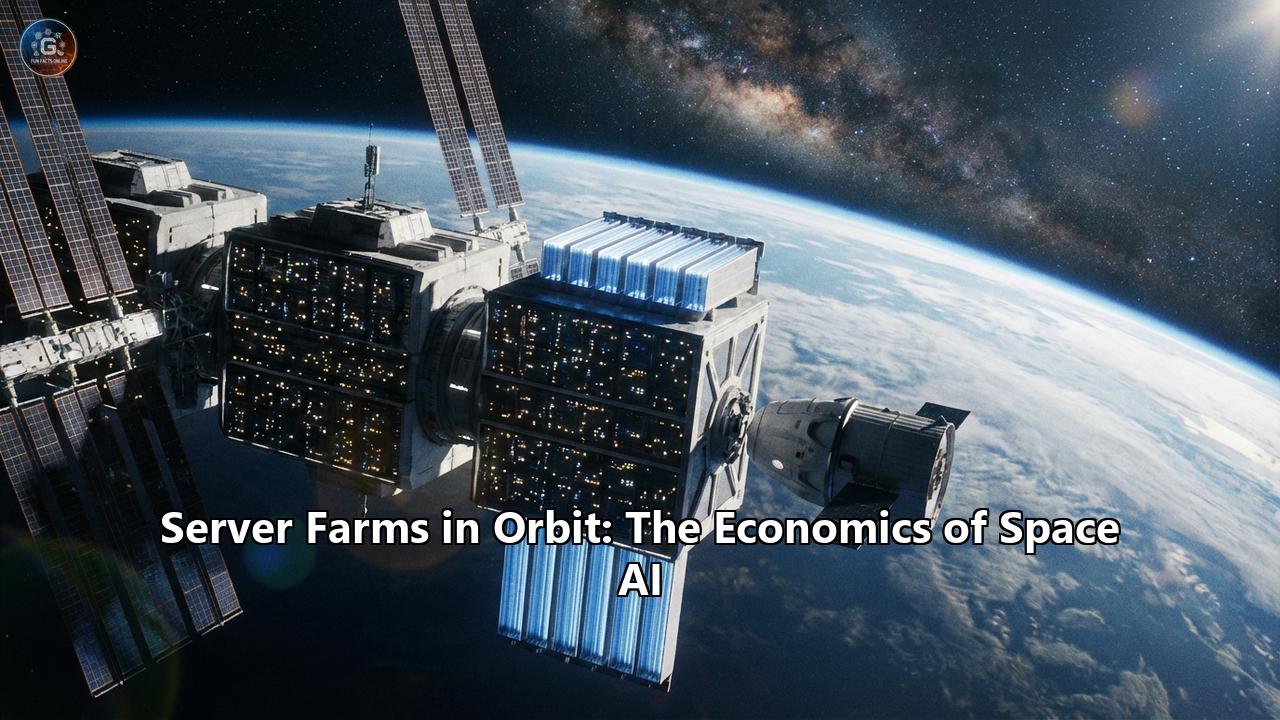
The sheer silence of the vacuum is deceptive. Up here, four hundred kilometers above the surface of the Earth, the environment is not empty; it is a roaring highway of photons, a chaotic storm of radiation, and soon, the humming, blinking heart of human intelligence.
For decades, we have used the term "The Cloud" as a metaphor. We pointed upwards to signify where our data lived, while in reality, it resided in sprawling, energy-hungry fortresses of concrete and silicon in Northern Virginia, Dublin, and Singapore. But the metaphor is about to become literal. The next great leap in computing infrastructure isn't happening on land. It is happening in the cold, dark, and infinitely powered expanse of Low Earth Orbit (LEO).
We are standing at the precipice of the Orbital Computing Era. This is not science fiction; it is an economic inevitability driven by the collision of two massive trends: the insatiable energy hunger of Artificial Intelligence, and the plummeting cost of access to space.
This is the story of Server Farms in Orbit.
Part I: The Terrestrial Bottleneck
The Energy Crisis of the AI AgeTo understand why we must go to space, we must first look at the crisis unfolding on the ground. The digital world has a physical cost, and that cost is measured in watts.
In the pre-AI era, data centers were passive libraries. They stored our photos, served our websites, and routed our emails. Their power consumption was significant but manageable. Then came the age of Generative AI. Training a model like GPT-4 requires gigawatt-hours of electricity—enough to power small towns. Running inference (answering user queries) requires even more.
The International Energy Agency (IEA) estimates that data centers' electricity consumption could double by 2026. In places like Ireland and Northern Virginia, data centers already consume a staggering percentage of the total available grid capacity. We are hitting a "Thermodynamic Wall."
1. The Land Problem:Building a gigawatt-scale data center requires hundreds of acres of land. It faces "NIMBY" (Not In My Backyard) opposition, zoning nightmares, and water rights battles.
2. The Cooling Problem:Servers turn electricity into heat. Removing that heat requires massive air conditioning systems or millions of gallons of water for evaporative cooling. In a warming world facing water scarcity, terrestrial cooling is becoming politically and environmentally toxic.
3. The Power Problem:This is the fatal blow. The power grid is archaic. Connecting a new hyperscale data center to the grid can take 3 to 5 years due to transmission line upgrades and regulatory red tape. AI cannot wait five years.
The terrestrial cloud is full. It is hot, crowded, and increasingly expensive. But look up.
Part II: The Orbital Solution
The Physics of the Ultimate Data CenterSpace offers a solution to every single bottleneck facing terrestrial computing. It is an environment of extremes, but for the prepared engineer, it is an environment of infinite abundance.
The Solar Advantage: 24/7 PowerOn Earth, solar power is intermittent. The sun sets, clouds roll in, and winter shortens the days. To run a data center on 100% renewable energy on Earth, you need massive battery banks to smooth out these dips, doubling or tripling the cost.
In orbit, the sun never sets—or rather, you can choose an orbit where it doesn't. A "Sun-Synchronous Orbit" (SSO) or a sufficiently high orbit allows for near-continuous exposure to the sun. Furthermore, without the atmosphere to filter it, solar irradiance in space is roughly 1,360 watts per square meter, significantly higher than the ~1,000 watts (peak) we get on Earth.
- Earth Solar: 20-25% capacity factor (due to night/weather).
- Space Solar: 99% capacity factor.
In space, energy is not a bill you pay to a utility company. It is free, constant, and abundant. You just have to catch it.
The Real Estate AdvantageThere are no zoning laws in the void. There are no neighbors to complain about the noise of cooling fans (sound doesn't travel in a vacuum). You can build a structure the size of Manhattan, and the only cost is the launch.
The Cooling ParadoxThis is the most common misconception. "Space is cold," people say, "so cooling servers should be free!"
Actually, space is a thermos. A vacuum is a perfect insulator. On Earth, we cool things by convection—blowing air over hot components. In space, you cannot blow air. You can only cool by radiation.
However, this is a solvable engineering challenge. By using large, unfolding radiator panels (like the ones on the International Space Station, but scaled up), heat can be dumped into the blackness of deep space (which is effectively 3 Kelvin). While the engineering is harder than on Earth, the energy cost of this cooling can be lower. There are no compressors, no chillers, just fluid pumps and the laws of black-body radiation.
Part III: The Economic Calculus
When Does It Make Sense?For decades, the idea of space servers was killed by one number: Cost per Kilogram.
In the Space Shuttle era, it cost $54,500 to put one kilogram into orbit. At that price, launching a 20kg server blade would cost over $1 million. Economic suicide.
Enter the Starship Era.
SpaceX’s relentless drive for reusability has crashed the cost of access to orbit. With the Falcon 9, costs dropped to roughly $2,700/kg. With Starship, Elon Musk targets costs as low as $100/kg or eventually $10/kg.
Let’s run the numbers for a hypothetical "Orbital AI Cluster":
- Launch Cost (Future): If a server rack weighs 1,000kg, launching it might cost $100,000.
- Energy Savings: On Earth, that rack consumes $20,000 - $50,000 of electricity per year. Over a 5-year lifespan, the electricity cost on Earth ($250,000) exceeds the launch cost ($100,000).
Lumen Orbit, a Y Combinator-backed startup, has released figures suggesting that an orbital data center could be 20x cheaper to operate than a terrestrial one over a 10-year period.
- Terrestrial 40MW Cluster (10 yrs): ~$167 million (mostly OpEx/Electricity).
- Orbital 40MW Cluster (10 yrs): ~$8.2 million (mostly CapEx/Launch).
Even if their optimism is off by a factor of five, the delta is so large that it demands attention. The primary cost shifts from Operating Expenses (monthly electric bills) to Capital Expenses (building and launching the satellite). For cash-rich tech giants, this is an attractive trade.
Part IV: The Killer Applications
Why compute in space? (Beyond Energy)We aren't just moving servers to space to save on the electric bill. Some things simply work better up there.
1. The Edge of the Ultimate Edge: Earth Observation (EO)Currently, satellites take petabytes of high-resolution images of the Earth. They are "dumb" cameras. They take a picture, store it, and wait until they pass over a ground station to download it. This downlink is slow, expensive, and bottlenecked.
- Scenario: A satellite spots a forest fire. It takes the photo. 45 minutes later, it downloads the photo to a station in Norway. 30 minutes later, the data is processed in a cloud center in Frankfurt. 2 hours later, the fire department gets the alert.
- The Orbital Solution: The satellite has an onboard AI server (like OrbitsEdge or Lumen). It processes the image in orbit. It identifies the fire instantly. It sends a tiny 1KB text message alert to the ground: "FIRE DETECTED AT COORDINATES X,Y." Latency: 2 seconds.
This is In-Orbit Edge Computing. It reduces the amount of data beamed down by 99.9%, saving millions in bandwidth costs and saving lives through speed.
2. High-Frequency Trading (HFT) & Financial BackbonesLight travels 40% faster in a vacuum than it does in glass fiber optic cables.
A laser link between two satellites (Optical Inter-Satellite Links, or OISL) can send data from New York to London faster than any undersea cable. In the world of High-Frequency Trading, milliseconds are worth billions. An orbital server farm could act as the ultimate "matching engine" for the global stock market, equidistant from New York, London, and Tokyo, providing the fairest and fastest execution venue in history.
3. Data Sovereignty & The "Swiss Bank" of the SkyThis is a legal gray area, but a potentially lucrative one. Where does data reside when it is in international waters? Or better yet, in international vacuum?
Nations are increasingly fracturing the internet with "Data Sovereignty" laws (GDPR in Europe, the Great Firewall in China). An orbital data cloud could technically operate under the jurisdiction of the launching state (per the Outer Space Treaty) or, in a more cyberpunk future, act as a neutral "Data Haven" beyond the reach of terrestrial subpoenas and seizure. While governments will fight this, the market for "offshore" (literally off-shore) secure data storage is undeniable.
Part V: The Engineering Challenges
Surviving the VoidBuilding a data center in space is not as simple as putting a Dell server in a waterproof box. The environment is hostile.
The Radiation ProblemOn Earth, the magnetosphere and atmosphere protect us from cosmic rays and solar flares. In space, high-energy particles smash into silicon chips.
- Single Event Upsets (SEUs): A particle hits a bit of memory and flips a 0 to a 1. In a video game, a pixel turns green. In a banking ledger, a million dollars vanishes.
- Latch-ups: A particle causes a short circuit that fries the chip.
Companies like OrbitsEdge are developing "SatFrames"—ruggedized enclosures that provide physical shielding. Others utilize "Software-Defined Radiation Hardening." Instead of using ancient, slow, "rad-hard" chips (which are 10 years behind current tech), they use modern NVIDIA GPUs but run three of them in parallel (Triple Modular Redundancy). If two say "yes" and one says "no," the system ignores the outlier and reboots it.
The Maintenance ProblemWhen a hard drive fails in a Google data center, a technician on a scooter replaces it in 5 minutes. In space, that hard drive is flying at 17,500 mph.
The Solution:- Redundancy: Launch with 50% more hardware than you need. As nodes die, you turn them off and switch to the backups.
- Robotics: This is the long-term vision. Service satellites equipped with robotic arms (like those being developed by ClearSpace or Astroscale) could dock with data centers to swap out module "cartridges," upgrading hardware without de-orbiting the station.
Part VI: The Key Players
The New Space RaceThe ecosystem is forming rapidly. It is a mix of agile startups and heavy industrial titans.
1. The Startups (The Aggressors)- Lumen Orbit: The current darling of the sector. They are moving fast, applying the "SpaceX methodology" to data centers. Their partnership with Nvidia suggests they are serious about high-performance compute (HPC) for AI.
- OrbitsEdge: Focused on the "packaging." They want to sell the ruggedized rack that allows anyone (HP, Dell, Cisco) to put their hardware in space. They are the "picks and shovels" provider.
- Kepler & Skyloom: Focused on the pipes. You can't have a data center without internet. They are building the optical laser backbones that will connect these orbital servers to the ground.
- NTT & SKY Perfect JSAT (Project Space Compass): The Japanese telecommunications giants are building an "Optical Data Relay" network. They view the "Space Integrated Computing Network" as critical infrastructure for Japan's future.
- Thales Alenia Space (ASCEND): A European consortium studying the environmental impact. They are less about "move fast and break things" and more about "is this sustainable for the EU's Green Deal?" Their validation of the concept adds massive credibility.
- Microsoft Azure Space: They are not building space stations (yet), but they are building the software layer (Azure Orbital) to connect satellites directly to the cloud. They are the likely first customer for a Lumen or OrbitsEdge.
- AWS Aerospace & Satellite: Similar to Azure, they are positioning themselves to be the operating system of the space economy.
Part VII: The Future Vision (2030 - 2050)
From Server Farms to Dyson SwarmsWhere does this lead?
Phase 1: The Hybrid Cloud (2025-2030)We will see "Edge Nodes" in orbit. These will process raw satellite data and handle specialized high-speed financial transactions. They will be small—size of a washing machine.
Phase 2: The Offload (2030-2035)As Starship becomes routine, we will see the first "AI Training Clusters." When OpenAI wants to train GPT-7, they might lease a dedicated orbital cluster for 6 months. The training run (which requires massive continuous power) happens in orbit. The final "weights" (the resulting model) are beamed down to Earth for consumer use.
Phase 3: The Orbital Reefs (2035-2045)Commercial space stations like Blue Origin's Orbital Reef or Voyager's Starlab will have dedicated "Data Center Modules." Just as a skyscraper has a server room in the basement, space stations will have server rooms on the truss.
Phase 4: The Lunar Backup (2050+)The ultimate disaster recovery plan. A data center in lava tubes on the Moon, powered by nuclear reactors or polar solar farms. This is the "Civilizational Backup Drive," ensuring that the sum of human knowledge survives any catastrophe on Earth.
Conclusion: The Sky is No Longer the Limit
For the entirety of human history, "industry" meant "terrestrial industry." We dug holes, burned rocks, and boiled water. We are now witnessing the decoupling of economic growth from the surface of the planet.
Moving data centers to space is not just about cheaper AI or faster stock trades. It is an environmental imperative. By offloading the most energy-intensive tasks of our civilization—computation—to the environment that can best support it, we save the biosphere. We stop boiling rivers to cool servers. We stop paving forests to build server farms.
We let the Earth be a garden, and we put the machines where they belong: among the stars, bathing in the silent, infinite power of the sun. The server farms of the future will not be in Ashburn, Virginia. They will be the new constellations, silent sentinels of silicon, thinking the thoughts of the future in the vacuum of the void.
Reference:
- https://ntt-review.jp/archive/ntttechnical.php?contents=ntr202212fa1.pdf&mode=show_pdf
- https://www.networkworld.com/article/3594676/lumen-orbit-wants-to-deploy-data-centers-in-space.html
- https://www.voragotech.com/blog/radiation-hardened-electronics-for-space-environments
- https://orbitsedge.com/press-releases/f/one-giant-step-towards-launch
- https://orbitsedge.com/in-the-news
- https://medium.com/@drjohnmillar/the-surprising-economics-of-orbital-data-centers-and-the-true-solution-9555aa3d3d24