
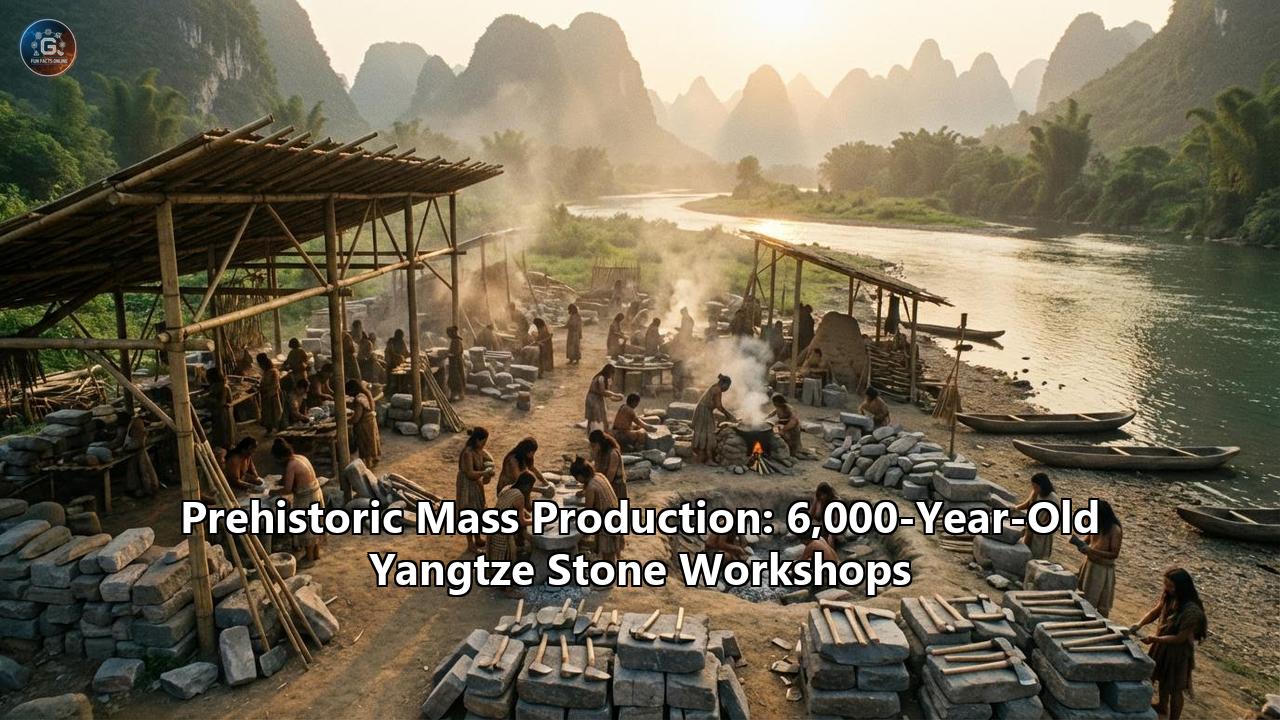
Imagine standing on the lush, humid banks of the lower Yangtze River some 6,000 years ago. Instead of the quiet, pastoral scene of early hunter-gatherers, the air is filled with a rhythmic, percussive symphony. It is the sound of stone striking stone, the grinding of quartzite against abrasive sand, and the low hum of a community engaged in coordinated labor. This is not just a settlement; it is a prehistoric factory. Long before the advent of bronze or iron, and millennia before the Industrial Revolution, the ancient inhabitants of the Yangtze River Delta were pioneering a concept that would forever change human history: mass production.
Recent archaeological breakthroughs have fundamentally rewritten our understanding of Neolithic societies. The discovery of sprawling, specialized stone tool workshops in the lower reaches of the Yangtze River—most notably the groundbreaking Fangjiazhou site—reveals that 6,000-year-old cultures possessed an astonishing level of industrial organization. Transitioning from the late Majiabang culture to the early Songze culture, these ancient artisans developed complex operational chains to manufacture quartzite ornaments and polished stone tools on a massive scale.
This is the story of how prehistoric visionaries turned raw river stones into standardized products, how their localized workshops fueled the rise of the earliest walled cities, and how their innovations laid the bedrock for Chinese civilization.
The Yangtze River Basin: A Cradle of Prehistoric Innovation
For decades, the global historical narrative often pointed to the Yellow River basin as the singular cradle of ancient Chinese civilization. However, modern archaeology has dramatically shifted this perspective, revealing the Yangtze River region as an equally vital, dynamic, and arguably more industrially advanced hub of early human development.
Around 6,000 years ago, the lower Yangtze region—stretching across modern-day Zhejiang, Jiangsu, and the Shanghai municipality—was a subtropical wetland. It was a landscape of meandering river channels, dense forests, and expansive marshes. The environment was rich in resources, providing abundant fish, waterfowl, and the crucial wild flora that would eventually be domesticated into one of the world’s most important crops: rice.
The cultures that flourished here, beginning with the early Shangshan and Kuahuqiao peoples (dating as far back as 9000–5000 BCE) and evolving into the Hemudu and Majiabang cultures (5000–3300 BCE), were pioneers of adaptation. Because the ground was constantly saturated with water, the Hemudu and Majiabang people engineered sophisticated long stilt houses, utilizing advanced mortise-and-tenon woodworking joints that are still marveled at by modern carpenters.
But to build such complex timber structures, clear dense forests for rice paddies, and process the harvests, these societies needed tools. Not just a handful of crude, chipped rocks, but highly refined, durable, and reliable instruments. This pressing agricultural and architectural need acted as the catalyst for the region's first great industrial leap. The demand for high-quality axes, adzes, and agricultural hoes, combined with a growing social desire for luxury ornaments, birthed the earliest iterations of the factory system.
Unearthing the Fangjiazhou Site: The Earliest Known Lapidary Workshop
The sheer scale of prehistoric industry was brought into sharp focus with the excavation of the Fangjiazhou site. Situated in the lower reaches of the Yangtze River, Fangjiazhou is currently recognized by archaeologists as the earliest and largest known Neolithic lapidary (stone-working) workshop in the region.
Dated precisely to between 6000 and 5600 B.P. (Before Present), the site straddles a crucial chronological boundary: the twilight of the late Majiabang Culture and the dawn of the early Songze Culture. What makes Fangjiazhou revolutionary is not merely the age of the artifacts, but the density and purpose of the site. It was not a standard residential village where a few individuals occasionally knapped flint in their spare time. It was a dedicated manufacturing hub primarily focused on the production of quartzite ornaments.
When archaeologists peeled back the layers of earth, they did not just find finished products. They found the entire life cycle of prehistoric manufacturing scattered across the ground. They discovered raw, unworked quartzite blocks brought in from local quarries; thousands of stone flakes indicative of primary shaping; broken items that had been discarded mid-production; specialized grinding slabs; and the delicate, finished ornaments themselves.
The Fangjiazhou site provides a rare, frozen-in-time snapshot of early human industrialization. It proves that by 4000 BCE, the people of the Yangtze had separated domestic life from industrial workspaces, a conceptual leap that is the foundational premise of modern manufacturing.
Chaîne Opératoire: Decoding the 6,000-Year-Old Assembly Line
To understand how these ancient workshops functioned, archaeologists employ a conceptual framework known as chaîne opératoire, or the "operational chain". This approach reconstructs the entire sequence of tool production, from the moment a raw material is selected in nature to the final polish of the finished product, and eventually, its use and discard.
At Fangjiazhou, the chaîne opératoire of quartzite ornament production was highly structured, resembling a prehistoric assembly line. Here is how the 6,000-year-old mass production process worked:
1. Material Procurement and Selection
The process began away from the workshop. Specialized laborers or miners scouted riverbeds and mountainous outcrops for quartzite—a hard, non-foliated metamorphic rock that is famously difficult to work but yields a beautifully smooth, durable finish. The raw material had to be carefully selected; stones with hidden fissures would shatter during the intense percussive flaking process, wasting valuable time.
2. Primary Flaking (The Rough Out)
Once transported to the workshop, the raw stones were handed over to artisans tasked with "knapping." Using harder hammerstones, these workers would strike the quartzite at precise angles to remove large flakes, roughly blocking out the intended shape of the ornament or tool. This stage generated massive amounts of debris, which archaeologists analyze today to understand the exact angles and force used by the ancient craftsmen.
3. Pecking and Shaping
Because quartzite is highly resistant to simple flaking, the artisans employed a technique called "pecking." By repeatedly tapping the surface with a pointed hammerstone, they pulverized the microscopic surface structure of the rock, slowly wearing it down into a refined geometric shape. This was highly labor-intensive and required immense physical endurance and rhythmic precision.
4. Grinding and Polishing
The hallmark of the Neolithic (the "New Stone Age") is the transition from chipped stone to polished stone. At workshops like Fangjiazhou, half-finished items were moved to grinding stations. Artisans used large, stationary grinding slabs and coarse sand mixed with water as an abrasive. By forcefully rubbing the artifact back and forth across the wet sand, they removed the rough marks left by pecking. The result was a spectacularly smooth, visually striking surface. Polishing not only made the ornaments beautiful but also strengthened utilitarian tools like axes by removing microscopic surface flaws where fractures could initiate.
5. Drilling and Perforation
For ornaments, the final and most delicate step was perforation. How does one drill a hole through solid stone without metal tools? The artisans of the Yangtze utilized pointed awls made of harder stone or bone. They likely employed bow drills—a device where a string is wrapped around a spinning stick. By placing wet sand beneath the spinning drill bit, the friction of the sand slowly bored through the quartzite. To prevent the stone from cracking, they drilled from both sides until the holes met in the middle, creating an hourglass-shaped perforation typical of Majiabang and Songze artifacts.
This sophisticated chaîne opératoire demonstrates that the people of Fangjiazhou were not amateur tinkerers. They possessed deep geological knowledge, mechanical ingenuity, and an understanding of workflow optimization that allowed them to produce items in volumes that far exceeded the needs of a single family or village.
The Birth of the Specialist and the Division of Labor
The existence of mass production implies a fundamental shift in the social fabric of humanity. In purely egalitarian hunter-gatherer societies, nearly everyone is a generalist. Every adult knows how to hunt, forage, build a basic shelter, and make rudimentary tools. But a factory like Fangjiazhou requires specialists.
The sheer time and skill required to master the chaîne opératoire of quartzite meant that these artisans could not spend their days standing knee-deep in rice paddies or tracking wild game. They were full-time or near-full-time craftsmen. This division of labor was made possible by the incredible agricultural success of the Majiabang and early Songze cultures. Because the rice farmers were producing a caloric surplus, they could afford to feed a class of people who produced no food themselves.
In turn, this specialization accelerated technological advancement. An artisan who spends ten hours a day grinding stone will naturally invent faster, more efficient ways to do it. They will standardise their products. At the Yangtze workshops, archaeologists see high degrees of standardization in the size, shape, and weight of the ornaments and tools produced. This uniformity is the ultimate signature of mass production.
From Luxury Ornaments to Heavy Industry
While the Fangjiazhou site was heavily focused on the production of quartzite ornaments—items of social and spiritual significance—the mass production methodologies developed there were applied to heavy industry as well.
The Majiabang and Songze cultures were terraforming their environment. They were cutting down massive trees to build stilt houses that covered thousands of square meters. They were digging irrigation canals and constructing wooden boats to navigate the river systems. To achieve this, they needed thousands of standardized stone axes, adzes, and chisels.
Workshops across the lower Yangtze basin began churning out polished stone tools with standardized cutting edges. The adze, a tool with a blade set at a right angle to the handle (much like a modern hoe), became the quintessential instrument of the era. These tools were designed for heavy timber working. By mass-producing these robust, polished tools, the Yangtze workshops effectively supplied the hardware that built the region's prehistoric infrastructure.
The Interconnected Neolithic Economy: Trade on the Ancient Superhighway
Mass production creates a surplus, and surplus is the lifeblood of trade. The thousands of stone tools and exquisite quartzite ornaments produced in the Yangtze workshops were not intended solely for local use. They were commodities.
The Yangtze River and its myriad tributaries served as an ancient superhighway. Watercraft, likely dugout canoes, transported the heavy stone goods across vast distances. An exquisitely polished quartzite ornament made at Fangjiazhou could be traded from village to village, eventually ending up hundreds of miles away.
In exchange for these manufactured goods, the workshop communities likely received raw materials, exotic foods, or other regional specialties. This trade network bound the disparate villages of the lower Yangtze into a cohesive cultural and economic sphere. It fostered "extensive cultural exchanges with surrounding areas," leading to the rapid dissemination of ideas, religious beliefs, and technological innovations.
The Societal Impact: Inequality and the Rise of Elites
One of the most profound consequences of mass production and accumulated wealth is the emergence of social hierarchy. For tens of thousands of years, human societies were largely egalitarian, with "no preserved signs of differentiated hierarchy" in the earliest periods. But as the Songze culture emerged from the Majiabang, the archaeological record reveals a dramatic shift.
The quartzite ornaments produced at Fangjiazhou were not distributed equally. They were luxury goods, symbols of status, power, and perhaps spiritual authority. As certain families or lineages gained control over the agricultural surplus, the trade networks, or the workshops themselves, they began to accumulate wealth.
This is vividly illustrated in the burial sites of the period. For instance, at the recently discovered 6,000-year-old Doushan city site in Wuxi (which transitions from Majiabang to Songze culture), archaeologists have excavated over 140 tombs. While some graves contain very little, "high-ranking tombs contained over 20 burial items, indicating the high status of their owners". These elite burials are packed with the exact items being mass-produced in regional workshops: meticulously polished jade axes, stone axes, and elaborate pottery.
The workshops inadvertently fueled inequality. By creating durable wealth in the form of high-quality stone and jade goods, they allowed elites to visually distinguish themselves from the common laborers, setting the stage for the highly stratified societies that would follow.
Beyond Stone: An Ecosystem of Prehistoric Manufacturing
The stone workshops did not operate in a vacuum. The mass production mindset permeated other facets of Yangtze Neolithic life, creating an interconnected industrial ecosystem.
The Pottery Kilns
As stone tools became standardized, so did pottery. The Majiabang and Songze cultures were renowned for their ceramics, producing red sandy pottery, tripods, cooking vessels, and water jugs. In places like Doumu village in the southern part of the Tianzhushan region, pottery traditions dating back 6,000 years utilized massive "dragon kilns" built into hillsides. These kilns allowed for the mass firing of ceramics at high temperatures. The stone workshops provided the heavy grinding stones used to crush clay and mineral tempers, while the potters provided the vessels necessary to store the water and sand used in lapidary polishing.
The Textile Industry
Alongside stone and clay, there was a flourishing textile industry. Archaeological sites from this era, including the neighboring Qujialing culture to the west, have yielded intricately painted clay whorls. These whorls were used as weights on drop spindles, allowing for the mass production of spun thread from hemp or ramie. The stone tools produced in the Yangtze workshops included tiny, razor-sharp flake tools that would have been used to harvest and process these tough plant fibers.
Advanced Woodworking
The polished stone axes and adzes mass-produced in the workshops were directly responsible for the advanced architecture of the period. With strong, sharp, and standardized tools, craftsmen could precisely cut mortise-and-tenon joints without the use of nails. This allowed for the construction of elevated stilt houses, which protected the inhabitants from the damp, flooded environment of the Yangtze wetlands and kept pests away from stored grain.
The Dawn of Urbanization: Walled Cities of the Yangtze
The industrial and agricultural boom led to a population explosion. Scattered villages began to coalesce into larger, more complex settlements. This brings us to another monumental revelation of the 6,000-year-old Yangtze cultures: the birth of the city.
The Doushan site in Wuxi, discovered by the Jiangsu provincial institute of cultural relics and archaeology, covers a staggering 250,000 square meters. Dating back around 6,000 years, it is recognized as the earliest prehistoric city site in the lower Yangtze River region.
This was not a simple village; it was a fortified urban center. Archaeological analysis suggests that the Doushan city site "may have had two layers of fortifications," including a deep protective moat. Charcoal and plant seeds recovered from this moat confirm its 6,000-year-old origins through radiocarbon dating.
The construction of a moated city requires thousands of man-hours of labor, sophisticated urban planning, and, crucially, a massive supply of high-quality earth-moving tools. The stone workshops like Fangjiazhou were the engines that made such monumental public works possible. By supplying the standardized hoes, spades, and axes needed to dig moats and cut defensive timber, the stone artisans played a direct role in the architectural defense of their burgeoning civilizations.
Setting the Stage for the Liangzhu Culture
The innovations of the Majiabang and Songze cultures—their mass production techniques, their division of labor, and their nascent social hierarchies—did not simply fade away. They served as the direct technological and cultural foundation for one of the most spectacular prehistoric societies in global history: the Liangzhu Culture (approx. 3400–2250 BCE).
Emerging a millennium after the peak of the Fangjiazhou workshops, the Liangzhu culture took the concept of lapidary mass production to an almost unfathomable extreme. While the artisans of Fangjiazhou mass-produced quartzite, the Liangzhu artisans turned their attention to nephrite (true jade)—a stone so exceptionally hard and tough that it cannot be carved; it can only be ground away using abrasive sands over hundreds of hours.
The Liangzhu people produced thousands of intricate jade bi (disks) and cong (cylinders) with extraordinarily fine incised decorations. These "technical feats requiring the highest level of skill and patience" would have been utterly impossible without the chaîne opératoire and the grinding/drilling technologies perfected by their ancestors 6,000 years ago.
The Liangzhu culture ultimately built massive, hydraulic-engineered cities and profound social hierarchies that influenced the entirety of ancient China. They are celebrated as the pinnacle of Neolithic achievement, but their success was squarely built on the blueprints drafted by the 6,000-year-old stone workshops of the Yangtze.
Modern Science Meets Ancient Stone
How do we know so much about a factory that ceased operations 6,000 years ago? The resurrection of these Yangtze stone workshops is a triumph of modern archaeological science.
- Radiocarbon Dating: Organic materials, such as charcoal from hearths, bone fragments, and rice husks found layered among the stone debris, are analyzed using Accelerator Mass Spectrometry (AMS) radiocarbon dating. This allows scientists to confidently place sites like Fangjiazhou and Doushan within the 6000–5600 B.P. window.
- Micro-wear Analysis: By placing the stone tools under high-powered electron microscopes, researchers can examine the microscopic scratches on the blade edges. Different materials (wood, bone, plant fibers) leave distinct signature striations. This tells us exactly what the mass-produced tools were being used for.
- Spatial Analysis: Archaeologists do not just collect artifacts; they meticulously map exactly where each flake of stone was found. By doing so, they can identify specific "activity areas" within the workshop—pinpointing exactly where the knappers sat, where the grinders worked, and where the finished products were stored.
- Geological Sourcing: By analyzing the mineral composition of the quartzite and jade, scientists can trace the raw materials back to their original geological outcrops, mapping the prehistoric supply chains and trade routes that fed the factories.
The Enduring Legacy of the Yangtze Artisans
Looking back at the 6,000-year-old stone workshops of the lower Yangtze River, we are forced to re-evaluate our definitions of "primitive." The Neolithic people of the late Majiabang and early Songze cultures were not merely surviving the elements; they were actively engineering their world.
Through the rigorous application of the chaîne opératoire, they transformed the painstaking art of stone crafting into a systematized industry. They pioneered the division of labor, optimizing their workflow to achieve mass production millennia before written language even existed.
The reverberations of their hammerstones shaped the trajectory of human civilization. The surplus of tools they produced allowed their societies to clear forests, cultivate vast rice paddies, and build the first moated cities like Doushan. The luxury ornaments they crafted catalyzed trade networks, stimulated the economy, and solidified the social hierarchies that would eventually govern empires.
Today, as we marvel at our modern, automated assembly lines and global supply chains, it is humbling to realize that the fundamental blueprint of industrial manufacturing was drawn up in the humid, bustling wetlands of the ancient Yangtze River. The 6,000-year-old artisans of Fangjiazhou may have worked with stone and sand, but the society they forged was truly monumental.
Reference:
- https://www.researchgate.net/publication/389829827_A_Neolithic_Lapidary_Workshop_at_the_Lower_Reaches_of_Yangtze_River_Chaine_Operatoire_of_Quartzite_Ornament_Production_at_Fangjiazhou_Site
- https://en.wikipedia.org/wiki/Iron_Age
- https://www.chinadailyhk.com/hk/article/620673
- https://www.ancientartifax.com/files/Hemudu_Facts_Details.pdf
- https://en.wikipedia.org/wiki/Neolithic_in_China
- https://greekreporter.com/2025/11/19/prehistoric-site-china-yangtze-civilization/
- https://www.ancient-origins.net/ancient-places-asia/qujialing-culture-0015937
- https://www.unesco.org/en/iggp/wudalianchi-unesco-global-geopark-0
- https://novoscriptorium.com/2019/09/27/the-neolithic-of-southern-china-middle-and-lower-yangtze-river-basin/
- https://www.metmuseum.org/essays/neolithic-period-in-china