
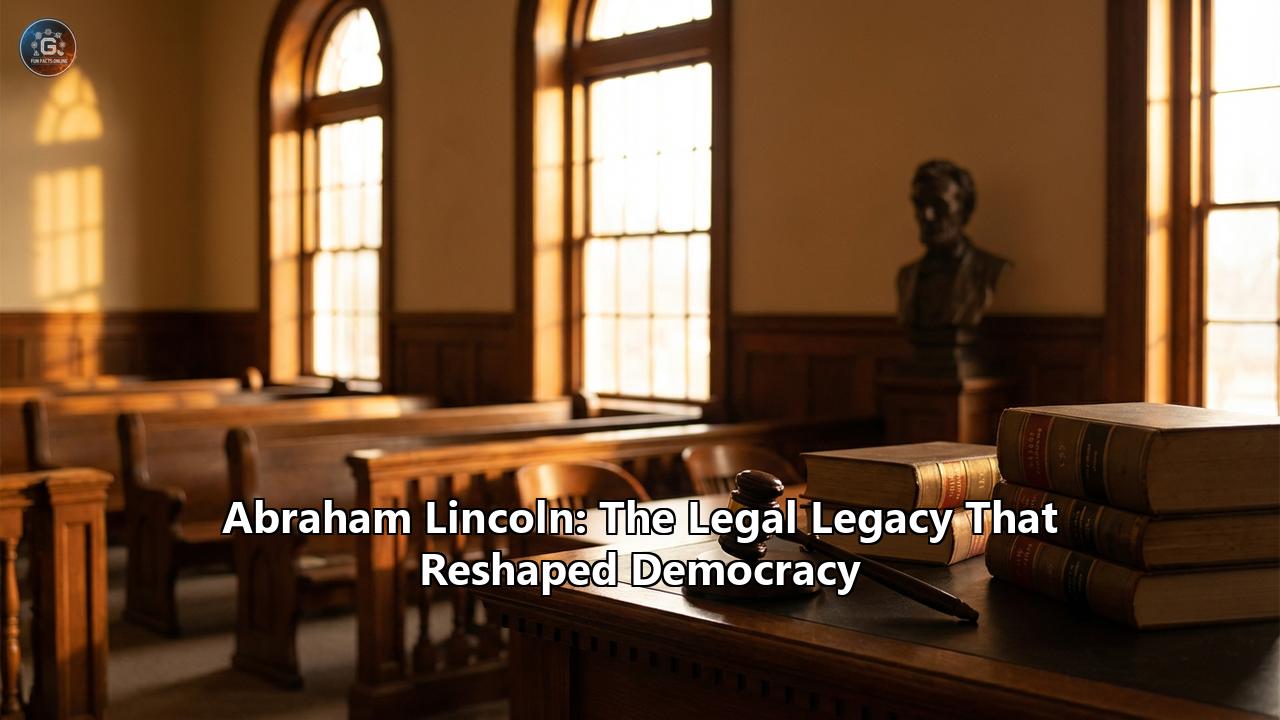
The dusty courtrooms of the Illinois Eighth Judicial Circuit seem a world away from the marble halls of Washington, yet it was on this muddy frontier that the savior of the American Union was forged. To understand Abraham Lincoln the President—the man who navigated the treacherous constitutional waters of secession, suspended habeas corpus, and issued the Emancipation Proclamation—one must first understand Abraham Lincoln the Lawyer.
For nearly twenty-five years, Lincoln did not just practice law; he lived it. He was not merely a country bumpkin spinning yarns for juries, but a sophisticated legal mind who argued over 400 cases before the Illinois Supreme Court and appeared before the United States Supreme Court. His legal career was the crucible in which his intellect, his rhetorical style, and his reverence for the rule of law were tempered. This article explores how the legal legacy of the "Prairie Lawyer" reshaped American democracy, proving that the pen and the statute book were weapons as powerful as the sword.
Part I: The Education of a Prairie Advocate
The Autodidact at the BarUnlike many of his contemporaries who were trained in the prestigious law offices of the East, Lincoln was entirely self-made. "I studied with nobody," he famously remarked. In the 1830s, the path to the bar in the frontier state of Illinois was informal. Lincoln borrowed Blackstone’s Commentaries on the Laws of England from a neighbor, reading it by the light of a burning hearth. He absorbed the common law’s logic, its insistence on precedent, and its structured approach to conflict resolution. This solitary study instilled in him a deep reliance on first principles—a habit of mind that would later allow him to dissect the arguments of secessionists with surgical precision.
Riding the CircuitThe defining experience of Lincoln’s legal life was "riding the circuit." Twice a year, he traveled the Eighth Judicial Circuit, a tract of 11,000 square miles covering fourteen counties. The court was a traveling caravan of judges and lawyers moving from town to town, often sleeping two to a bed and sharing meals in raucous taverns.
This life taught Lincoln the art of human nature. He represented farmers, merchants, and widows in disputes ranging from wandering livestock to murder. He learned to speak the language of the common man, stripping away legal jargon to reveal the simple, moral core of a case. He was not a researcher who buried his nose in books; he was a thinker who whittled away the non-essentials until only the truth remained. Judge David Davis, who presided over the circuit and would later be appointed by Lincoln to the Supreme Court, observed, "He had the power of making the jury feel as he felt."
The Partnership of Lincoln & HerndonIn Springfield, Lincoln established a practice that became one of the most respected in the state. After early partnerships with John T. Stuart and Stephen T. Logan, he famously partnered with the younger, more radical William Herndon. Their office was a chaotic mess of papers and books, but it was an intellectual powerhouse. While Herndon read the philosophers and abolitionists, Lincoln read the people and the law. They handled over 5,000 cases, a staggering volume that gave Lincoln a breadth of experience unmatched by almost any other president.
Part II: The Corporate Modernizer
Contrary to the popular image of Lincoln as a simple defender of the poor, he was a highly sought-after corporate attorney who played a pivotal role in the industrial revolution of the Midwest.
The Railroad LawyerAs the railroads began to stitch the nation together, they faced immense legal hurdles. Lincoln became a go-to counsel for the Illinois Central Railroad. In one landmark tax case, Illinois Central Railroad v. McLean County, he successfully argued that the state legislature had the power to exempt the railroad from county taxes in exchange for a percentage of its gross earnings. It was a complex constitutional argument about the hierarchy of state and local power—a precursor to his later arguments about federal supremacy over the states.
Victory was sweet, but the paycheck was sweeter—eventually. When the railroad balked at his $5,000 fee (an astronomical sum for the time), Lincoln sued his own client and won, proving he was a businessman who understood the value of his labor.
Hurd v. Rock Island Bridge Co.: The Case That Built the WestPerhaps his most significant civil case was Hurd v. Rock Island Bridge Co. (1857). The case was a proxy war between the old economy (steamboats and the South) and the new economy (railroads and the North). A steamboat, the Effie Afton, had crashed into the first railroad bridge to span the Mississippi River. The steamboat interests sued, arguing the bridge was a hazard to navigation and an illegal obstruction.
Lincoln defended the bridge company. In a courtroom packed with riverboat pilots and railroad tycoons, he didn't just argue about negligence; he argued for the future. He meticulously analyzed the currents and the geometry of the crash, proving the pilot was at fault. But his closing argument soared beyond the technicalities. He contended that Americans had a fundamental right to travel East to West as well as North to South. He positioned the railroad as an agent of national unity and Manifest Destiny. The hung jury was a victory for the bridge, ensuring that the iron horse could continue its march westward, binding the free states of the North and West together—an economic alliance that would prove decisive in the coming Civil War.
Part III: The Criminal Defender and the Almanac
While corporate law paid the bills, criminal law built the legend. Lincoln was a formidable defense attorney, known for his ability to dismantle witnesses with cross-examination.
The Almanac TrialThe most famous example is People v. Armstrong (1858). Duff Armstrong, the son of a friend who had been kind to Lincoln in his youth, was accused of murder. The key witness claimed he saw Armstrong strike the fatal blow by the light of a high, bright moon.
In a dramatic flourish that has become folklore, Lincoln produced an almanac for the night in question. He showed the jury that at the time of the murder, the moon was low in the sky and about to set—it would have been too dark for the witness to see what he claimed. The revelation destroyed the witness's credibility. Armstrong was acquitted. The case demonstrated Lincoln’s meticulous preparation and his flair for the dramatic, tools he would later use to win the court of public opinion.
Part IV: Slavery and the Constitution
Lincoln’s relationship with the law of slavery was complex and evolved over time. He was not an ideologue in the courtroom; he was an advocate who took clients as they came.
The Matson Slave CaseIn a move that troubles modern admirers, Lincoln once represented a slave owner, Robert Matson, who was trying to retrieve escaped slaves in Illinois. Lincoln argued on a technicality regarding slaves in transit. He lost the case, and the slaves were freed. This loss may have been a crucial moral awakening, forcing him to confront the legal machinery that turned humans into property.
Bailey v. CromwellConversely, in Bailey v. Cromwell, Lincoln represented a woman who had been sold as a slave in Illinois. He successfully argued that in a free state, the presumption of law was freedom—that every person was deemed free unless proven otherwise. This legal principle—that freedom is the default state of man—would become the bedrock of his political philosophy.
The Dred Scott CritiqueWhen the Supreme Court issued the Dred Scott decision in 1857, declaring that Black people could not be citizens and that Congress could not ban slavery in the territories, Lincoln the lawyer went on the attack. He did not call for open defiance of the Court; rather, he attacked the ruling's legal logic. He cited the dissenters, analyzed the history of the Founders, and argued that the decision was based on a falsified history of the Constitution. He famously distinguished between the "judgment" (which settled the specific case) and the "precedent" (which set a rule for the future). As President, he would use this distinction to ignore Dred Scott’s broader implications while legally abiding by the court's specific ruling.
Part V: The Commander-in-Chief as Lawyer
When Lincoln took the oath of office in 1861, the Union was dissolving. He treated the crisis not just as a war, but as a massive legal challenge. His primary client was the Constitution, and his brief was the preservation of the Union.
The Theory of Perpetual UnionLincoln’s response to secession was grounded in contract law. He argued that the Union was a contract between the states and the people. A contract, he noted, cannot be rescinded by only one party; it requires the consent of all. Therefore, secession was not a legal act but a "domestic insurrection." This legal fiction allowed him to treat Confederate soldiers not as foreign combatants (which would recognize the Confederacy as a nation) but as rebellious citizens subject to US law.
The Suspension of Habeas CorpusIn the early days of the war, with Washington D.C. surrounded by slave states, Lincoln made his most controversial legal decision: he suspended the writ of habeas corpus, allowing the military to arrest and hold suspected Confederate sympathizers without trial.
Chief Justice Roger Taney, the author of Dred Scott, challenged Lincoln in Ex parte Merryman, ruling that only Congress could suspend the writ. Lincoln ignored the order. In a message to Congress, he offered a brilliant lawyer’s defense: "Are all the laws, but one, to go unexecuted, and the government itself go to pieces, lest that one be violated?" He argued that the Constitution’s provision for suspension in cases of "rebellion or invasion" gave the President inherent emergency powers to save the state. It was a daring interpretation of executive power that expanded the presidency forever.
The Emancipation Proclamation: A Legal MasterpieceThe Emancipation Proclamation is often criticized for its dry, legalistic language. It lacks the soaring rhetoric of the Gettysburg Address. But this was intentional. Lincoln knew the Proclamation would be challenged in court. He drafted it not as a human rights manifesto, but as a "necessary war measure" under his authority as Commander-in-Chief.
By framing the freeing of slaves as a military seizure of enemy property (labor), he placed emancipation on firm constitutional ground. He meticulously excluded border states and occupied territories where he lacked military necessity, ensuring the order would survive judicial scrutiny. It was a lawyer’s document, designed to be ironclad.
The 13th AmendmentLincoln the lawyer knew that the Emancipation Proclamation was a temporary war measure. Once the war ended, the "military necessity" justification would vanish, and the courts might return freed people to bondage. To secure freedom permanently, he needed to change the "organic law" of the nation. He used all his political capital and legal cunning to push the 13th Amendment through Congress. It was the final closing of the loophole he had battled his entire life.
Conclusion: The Legacy of Law
Abraham Lincoln did not just save the Union; he saved the rule of law. He demonstrated that a democracy could be strong enough to survive a civil war without losing its soul. He showed that the Constitution was not a suicide pact, but a living framework that could adapt to the greatest crises.
His legal legacy is found not just in the end of slavery, but in the modern concept of the presidency—an office with the power to act decisively in emergencies. He reshaped the judiciary, appointing five Supreme Court justices who would carry his vision of a strong national government forward.
In the end, the Prairie Lawyer proved that the greatest weapon for justice is a mind disciplined by the law, a heart tethered to equity, and an unwavering belief that right makes might. His life serves as an enduring brief for the proposition that the law is the only true king of a free people.
Reference:
- https://www.quora.com/How-did-Lincoln-reason-the-Emancipation-Proclamation-was-legal
- https://www.abrahamlincolnonline.org/lincoln/education/lawhighlights.htm
- https://www.19fortyfive.com/2026/01/u-s-army-quote-of-the-day-by-abraham-lincoln-war-at-the-best-is-terrible-and-this-war-of-ours-in-its-magnitude-and-in-its-duration-is/
- https://en.wikipedia.org/wiki/Abraham_Lincoln
- https://www.illinoiscourts.gov/News/1402/Illinois-Supreme-Court-history-Illinois-Central-Railroad-taxes/news-detail/
- https://en.wikipedia.org/wiki/List_of_cases_involving_Abraham_Lincoln
- https://indianahistory.org/wp-content/uploads/51a319bce67b7f5614886cd3a4504ef7.pdf
- https://www.advocatemagazine.com/article/2018-july/lawyer-lincoln-s-trial-tactics
- https://www.lincolncottage.org/top-ten-lincoln-lawyer/
- https://millercenter.org/president/lincoln/impact-and-legacy
- https://www.loc.gov/collections/abraham-lincoln-papers/articles-and-essays/abraham-lincoln-and-emancipation/
- https://www.britannica.com/event/Emancipation-Proclamation
- https://www.mrlincolnandfreedom.org/pre-civil-war/legal-cases/index.html
- https://cupola.gettysburg.edu/cgi/viewcontent.cgi?httpsredir=1&article=1039&context=cwfac
- https://www.history.com/this-day-in-history/may-28/lincolns-suspension-of-habeas-corpus-is-challenged
- https://www.youtube.com/watch?v=Vzkh93jqpO4