
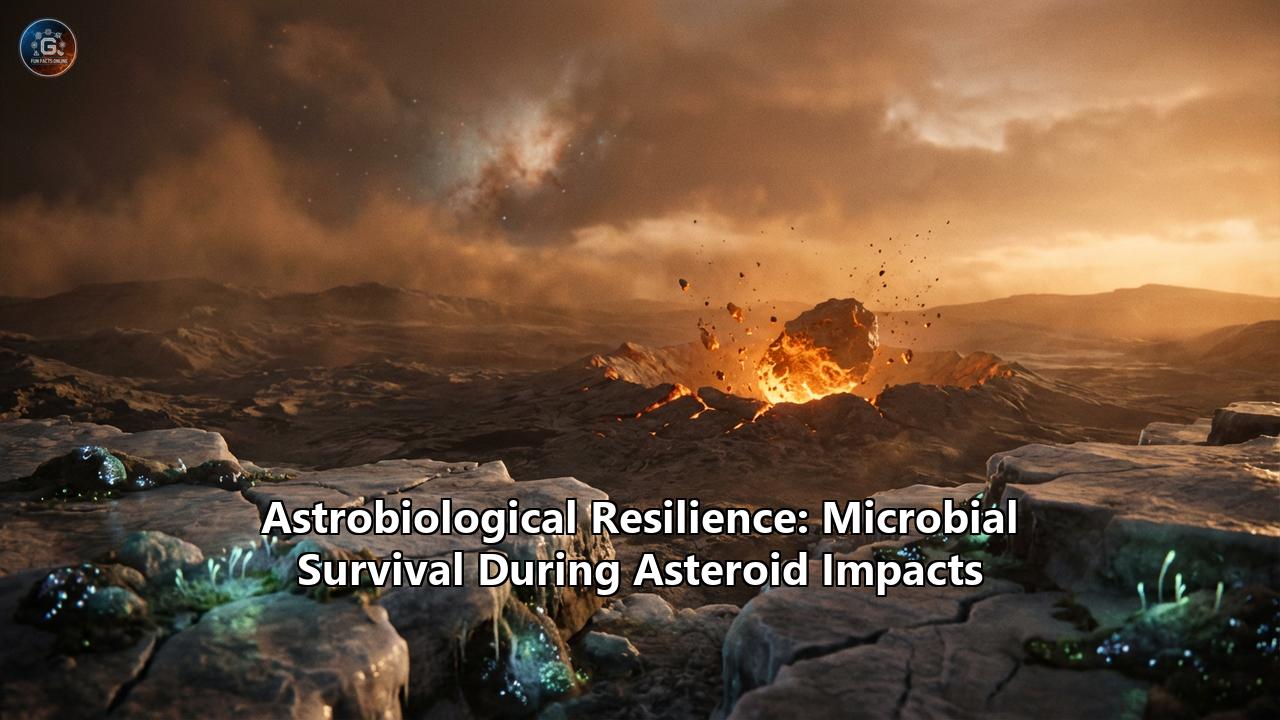
Picture a cataclysmic event: an asteroid, massive and unyielding, traveling at tens of thousands of miles per hour, slamming into the surface of a rocky planet. The sheer kinetic energy released in a fraction of a second dwarfs the most powerful nuclear arsenals on Earth. The crust shatters, billions of tons of rock are instantly vaporized, and a colossal shockwave ripples through the planet's surface. Plumes of molten ejecta are thrown high into the atmosphere, blocking out the sun and triggering a global deep freeze.
For decades, this apocalyptic scenario was viewed exclusively through the lens of destruction. Asteroid impacts were the great reset buttons of the cosmos, the bringers of mass extinctions, and the ultimate threat to biological existence. But in recent years, a radical shift has occurred in the field of astrobiology. Scientists have begun to reframe these violent cosmic collisions not just as destroyers of life, but as vital mechanisms for its preservation, transportation, and even its creation.
Welcome to the extraordinary world of lithopanspermia—the scientific theory that life can hitchhike across the solar system aboard meteorites—and the study of impact-induced habitats. At the microscopic level, life is stubbornly resilient. Through a combination of experimental shock simulations, long-term exposure missions outside the International Space Station (ISS), and geological surveys of ancient craters, we are discovering that microorganisms possess the astrobiological resilience to survive the apocalypse.
The Cosmic Billiard Game: Understanding Lithopanspermia
The concept of panspermia—the idea that life exists throughout the universe and is distributed by cosmic dust, meteoroids, and comets—has roots dating back to antiquity. However, it was only with the advent of modern planetary science that a specific sub-discipline, lithopanspermia, became a testable, empirical field of study.
Lithopanspermia hypothesizes the natural exchange of rock-dwelling organisms (endoliths) between solar system bodies. For this interplanetary biological transit to be successful, a microorganism must survive three highly distinct and deeply traumatic phases:
- Planetary Ejection: Surviving the extreme pressures, heat, and acceleration of an asteroid impact that blasts the host rock into space.
- Interplanetary Transit: Enduring the vacuum, extreme temperatures, and severe cosmic radiation of deep space over thousands or millions of years.
- Planetary Entry: Surviving the fiery descent through a new planet's atmosphere and the subsequent impact on its surface.
While the odds of a single microbe surviving this gauntlet seem astronomically low, nature operates on a scale of profound abundance. Studies estimate that billions of rocks have been ejected from Earth and Mars over the last few billion years. If even a microscopic fraction of these rocks carried viable passengers, the biological cross-pollination of our solar system might not just be possible—it might be inevitable.
Phase 1: The Ejection – Surviving the Cosmic Catapult
The first hurdle in the lithopanspermia journey is the launch. When a hypervelocity bolide (an asteroid or comet) strikes a planet, the energy transfer is incomprehensibly violent. So how could any delicate biological material survive being blasted into orbit?
The answer lies in the physics of the impact shockwave. Planetary scientist H. Jay Melosh pioneered the concept of the "spallation zone." When an impactor strikes, it sends a compressive shockwave deep into the planet’s crust. However, as this shockwave reaches the free surface of the planet surrounding the impact site, it reflects as a tensile wave. The interference between these waves creates a shallow, ring-like zone near the surface where the rock is fractured and accelerated upward at tremendous speeds—often exceeding the planet's escape velocity—while experiencing surprisingly little heat.
Rocks in the spallation zone can be catapulted into space before the catastrophic heat of the impact melt can reach them. Still, the forces they experience are brutal. Petrographic analysis of Martian meteorites found on Earth, such as the famous ALH84001, reveals that these rocks endured shock pressures ranging from 5 to 55 Gigapascals (GPa)—equivalent to 50,000 to 550,000 times the atmospheric pressure on Earth. They also experienced sudden temperature spikes up to 350°C and an acceleration on the order of 3.8 × 10⁶ m/s².
The Shock Recovery Experiments
To test whether life could actually survive this "cosmic catapult," astrobiologists and physicists have turned to high-explosive plane wave setups and two-stage light-gas guns. By taking terrestrial microorganisms, embedding them in planetary analogue rocks like gabbro (a dark, coarse-grained rock similar to the Martian crust), and subjecting them to artificial impacts, scientists have mapped out a "vital launch window" for life.
The results are nothing short of astonishing:
- Bacterial Endospores: Spores of Bacillus subtilis, a hardy soil bacterium, were found to survive shock pressures up to 45 GPa. When faced with environmental stress, Bacillus forms a tough, dormant endospore that essentially shuts down its metabolism, wrapping its DNA in protective proteins that can withstand extreme physical crushing.
- Lichens: Xanthoria elegans, a brightly colored lichen found clinging to rocks in high-alpine and polar deserts, also survived simulated impacts up to 45 GPa. Lichens are symbiotic organisms (a partnership between a fungus and an algae or cyanobacterium), and their epilithic (surface-dwelling) nature makes them surprisingly robust against sudden pressure spikes.
- Cyanobacteria: Cells of the endolithic cyanobacterium Chroococcidiopsis sp.—a master of survival in extreme dry and cold terrestrial environments—were capable of surviving shock pressures up to 10 GPa.
These experiments conclusively proved that a biological payload could indeed survive the violent ejection from a Mars-like planet. But surviving the launch is only the beginning.
Phase 2: The Interplanetary Transit – Defying the Void
Once a microbe has been forcefully evicted from its home planet, it enters the most prolonged and hostile phase of its journey: interplanetary space.
The environment of low Earth orbit and deep space is a nightmare for organic chemistry. A microbe floating in the void is subjected to extreme desiccation from the absolute vacuum, wild temperature fluctuations swinging hundreds of degrees, and a relentless barrage of solar ultraviolet (UV) radiation and galactic cosmic rays. UV radiation is particularly lethal; it directly damages the molecular bonds of DNA, causing lethal mutations and cellular disintegration.
To understand if life could wait out a transit that might take millions of years, space agencies have utilized the ultimate off-world laboratory: the International Space Station (ISS).
Conan the Bacterium and the Tanpopo Mission
In 2015, the Japanese Space Agency (JAXA) launched the Tanpopo mission (named after the Japanese word for dandelion, reflecting the dispersal of seeds on the wind). Outside the Kibo module of the ISS, researchers placed specialized exposure panels containing Deinococcus radiodurans.
Nicknamed "Conan the Bacterium," D. radiodurans is a polyextremophile listed in the Guinness Book of World Records as the world's toughest bacterium. It can survive cold, dehydration, vacuum, and acid, but its true superpower is its resistance to radiation. It possesses a highly efficient, redundant DNA repair mechanism that can reassemble its genome even after it has been shattered into hundreds of fragments by gamma rays.
The Tanpopo experiment tested the bacteria by placing them in densely packed pellets of varying thicknesses without any protective rock shielding. After one, two, and three years of direct exposure to the ravages of space, the panels were retrieved. The results, published in Frontiers in Microbiology, revealed a fascinating survival strategy: sacrifice. The bacteria on the outer layer of the microscopic pellet died rapidly under the UV bombardment. However, their dead, desiccated bodies formed a highly effective protective shield that completely insulated the microbes deep within the core of the pellet. Researchers concluded that a pellet of Deinococcus radiodurans just a millimeter thick could survive in deep space for up to 8 years, while microbes shielded within a meteorite could theoretically survive for millions of years.
The Russian "Test" and EXPOSE Missions
Similarly groundbreaking were the results from the Russian "Test" experiment, where cosmonauts collected swabs from the exterior of the ISS during spacewalks. They discovered that spore-forming bacteria (Bacillus subtilis), fungal spores (Aureobasidium pullulans), and even cyst-like cells of the archaea Methanosarcina mazei managed to survive on the exterior of the station for over two years. The extreme vacuum of space actually induced a state of natural dehydration and partial lyophilization (freeze-drying) that effectively preserved the structural integrity of the organisms.
Evolutionary Bet-Hedging
How does an organism evolve to survive an environment it has never encountered? The answer lies in an evolutionary strategy known as bet-hedging. In a genetically identical bacterial colony, there is often microscopic variation in how individual cells respond to stress. When a meteorite is ejected into space, the population faces an "all-or-nothing" bottleneck. Even if 99.99% of the organisms perish, the extreme stress acts as a hyper-accelerated evolutionary filter. The tiny fraction that survives the vacuum and radiation of Phase 2 emerges significantly more robust. By the time the organism reaches its destination, the rigors of space travel have forged it into a biological vanguard, primed for the ultimate test.
Phase 3: Planetary Entry – The Fiery Descent
If an organism successfully navigates the void, it eventually encounters the gravitational pull of a new world. As the meteorite plummets into the atmosphere, friction compresses the gases ahead of it, generating a superheated plasma envelope that can reach thousands of degrees. From the ground, it looks like a brilliant shooting star. It seems impossible that any biological cargo could survive this fiery cremation.
However, astrobiologists point to a fundamental property of thermodynamics: rocks are terrible conductors of heat.
During atmospheric entry, the intense heat is applied only for a matter of seconds to a few minutes. The outer layer of the meteorite melts and vaporizes in a process known as ablation. As the molten rock is stripped away by aerodynamic forces, it carries the heat away with it. This process creates the characteristic "fusion crust" seen on meteorites, which is usually only a few millimeters thick.
Because the transit through the atmosphere is so brief, the heat simply does not have time to penetrate the interior of the rock. The core of the meteorite remains at the ambient temperature it held in deep space—often well below freezing. If microorganisms are nested deep within the pores and micro-fissures of a rock just a few centimeters in diameter, they will experience almost no temperature shift during the descent. Upon striking the surface, the meteorite effectively acts as a biologically insulated drop-pod.
Craters as Cradles: Impact-Induced Hydrothermal Systems
The traditional narrative of astrobiology is that life forms in warm, tranquil environments—perhaps a primordial soup or a gentle deep-sea vent. But what if life’s greatest incubators are the very scars left by cosmic bombardment?
When a large asteroid strikes a water-rich planet (like early Earth or ancient Mars), the aftermath of the impact creates conditions uniquely suited for the proliferation of life. The massive kinetic energy of the impact melts the target rock, creating a churning pool of superheated magma. As the crust is shattered and brecciated (fractured into angular fragments), its porosity increases dramatically. Groundwater from surrounding aquifers rushes into the fractured rock, coming into contact with the residual heat of the impact melt.
This interaction gives birth to an impact-induced hydrothermal system.
These subterranean networks of hot, circulating water represent prime astrobiological real estate. They provide the holy trinity of habitability:
- Liquid Water: Kept flowing and unfrozen by the geological heat engine.
- Energy Gradients: Heat and chemical gradients that thermophilic (heat-loving) and chemolithotrophic (rock-eating) bacteria can exploit for metabolism.
- Nutrients: The circulating hot water dissolves minerals from the surrounding rock, enriching the fluid with iron, sulfur, silica, and vital trace elements.
Evidence from Terrestrial Craters
For years, scientists debated how long these impact-induced oases could last. If an asteroid crater cooled within a few thousand years, it might be an insignificant blip on the evolutionary timeline. However, geological studies of ancient craters have radically altered this timeline.
At the massive Sudbury Basin in Canada—a 250-kilometer-wide crater formed 1.85 billion years ago—geologists have found extensive hydrothermal mineral deposits, suggesting the system remained active for well over a million years.
Even more compelling is the data from the Lappajärvi Crater in Finland. Formed about 76 million years ago, this medium-sized, 23-kilometer-wide crater was thought to have cooled relatively quickly. But by analyzing potassium-feldspar grains—a mineral that crystallizes late in the cooling process of impact melts—scientists discovered that the Lappajärvi hydrothermal system persisted for an astonishing 1.6 million years.
A million and a half years is more than enough time for microbial life to colonize the porous, nutrient-rich rocks. It is even enough time, some biologists argue, for the building blocks of life (amino acids, lipids, and nucleotides) to concentrate and self-assemble into the very first living cells. In this view, the Late Heavy Bombardment—a period roughly 4 to 3.8 billion years ago when the inner solar system was pummeled by debris—was not an era of sterilization, but the era that seeded Earth with countless warm, protective cradles where life could experiment and evolve.
The Martian Application
The implications for Mars are profound. Mars is currently a freezing, hyper-arid desert. But the Martian surface is pockmarked with thousands of ancient craters. Remote sensing and orbital spectroscopy have detected clays, zeolites, and hydrated sulfates in the central peaks and rims of Martian craters like Holden and Toro. These are the telltale mineralogical signatures of ancient hydrothermal activity. If we are to find evidence of past life on Mars, our best bet is to send rovers not just to ancient river deltas, but into the fractured subsurface vaults of these impact craters, where hydrothermal oases may have served as the last refuge for Martian microbes as the planet’s atmosphere bled away into space.
Astrobiology, Exoplanets, and the Archipelago of Space
The synthesis of shock-survival experiments, ISS exposure data, and crater geology paints a breathtaking picture of our universe. It suggests that planetary biospheres are not necessarily closed systems.
In the field of astroecology, scientists are beginning to look at planets and moons as islands in an oceanic void. Just as birds and ocean currents carry seeds between the Galápagos Islands, asteroid impacts act as the cosmic currents carrying the spores of life between planets.
Consider the "Ocean Worlds" of our outer solar system, such as Jupiter’s moon Europa and Saturn’s moon Enceladus. Both harbor vast, deep liquid water oceans locked beneath miles of ice. If a meteorite carrying extremophiles from Earth or Mars were to strike the ice crust of Europa, the impact could create a localized melt-pool. If the biological payload survived the shock, it could theoretically slip through the fractured ice into the dark, nutrient-rich ocean below.
Looking further outward, the discovery of thousands of exoplanets in neighboring star systems expands the scope of lithopanspermia. If life can survive the ejection, transit, and entry within our own solar system, could it survive the journey between stars? As our solar system bobs up and down through the galactic plane, it routinely passes through the Oort clouds of other star systems, potentially trading billions of rocks over galactic timescales.
The Tenacity of Life
The study of astrobiological resilience during asteroid impacts fundamentally alters our relationship with the cosmos. It forces us to abandon the idea of life as a fragile, accidental spark clinging desperately to a single rock. Instead, it reveals life as a tenacious, opportunistic force—an entity capable of weaponizing cataclysm.
The very rocks that fall from the sky, heralding fire and destruction, may carry within them the microscopic architects of the next biological epoch. From the crushing 45-gigapascal shockwaves of planetary ejection, through the freezing, irradiated silence of a million-year transit, to the fiery crucible of atmospheric entry, life finds a way. And when the dust settles, the crater left behind becomes a warm, watery haven—a cradle ready to nurture the seeds of a new world.
Reference:
- https://www.researchgate.net/publication/334482354_Lithopanspermia_-_The_Terrestrial_Input_During_the_Past_550_Million_Years
- https://en.wikipedia.org/wiki/Panspermia
- https://www.research.ed.ac.uk/en/publications/microbial-rock-inhabitants-survive-hypervelocity-impacts-on-mars-/
- https://www.mdpi.com/2071-1050/2/6/1602
- https://www.researchgate.net/publication/229872780_Shock_experiments_in_support_of_the_Lithopanspermia_theory_The_influence_of_host_rock_composition_temperature_and_shock_pressure_on_the_survival_rate_of_endolithic_and_epilithic_microorganisms
- https://www.researchgate.net/publication/223364705_Experimental_evidence_for_the_potential_impact_ejection_of_viable_microorganisms_from_Mars_and_Mars-like_planets
- https://www.smithsonianmag.com/science-nature/scientists-discover-exposed-bacteria-can-survive-space-years-180975660/
- https://www.cnet.com/science/bacteria-on-the-iss-survive-the-perils-of-space-for-three-years/
- https://astrobiology.com/2024/07/survival-of-microorganisms-during-two-year-exposure-outside-the-international-space-station.html
- https://gizmodo.com/space-station-cosmonauts-find-life-in-the-vacuum-of-spa-1624978001
- https://www.researchgate.net/publication/341671693_Interplanetary_transmissions_of_life_in_an_evolutionary_context
- https://pubmed.ncbi.nlm.nih.gov/33839964/
- https://www.lpi.usra.edu/meetings/earlymars2012/pdf/7068.pdf
- https://www.sciencenews.org/article/impact-craters-may-have-been-toasty-home-early-life
- https://www.vaticanobservatory.org/sacred-space-astronomy/large-impacts-can-create-hydrothermal-systems/