
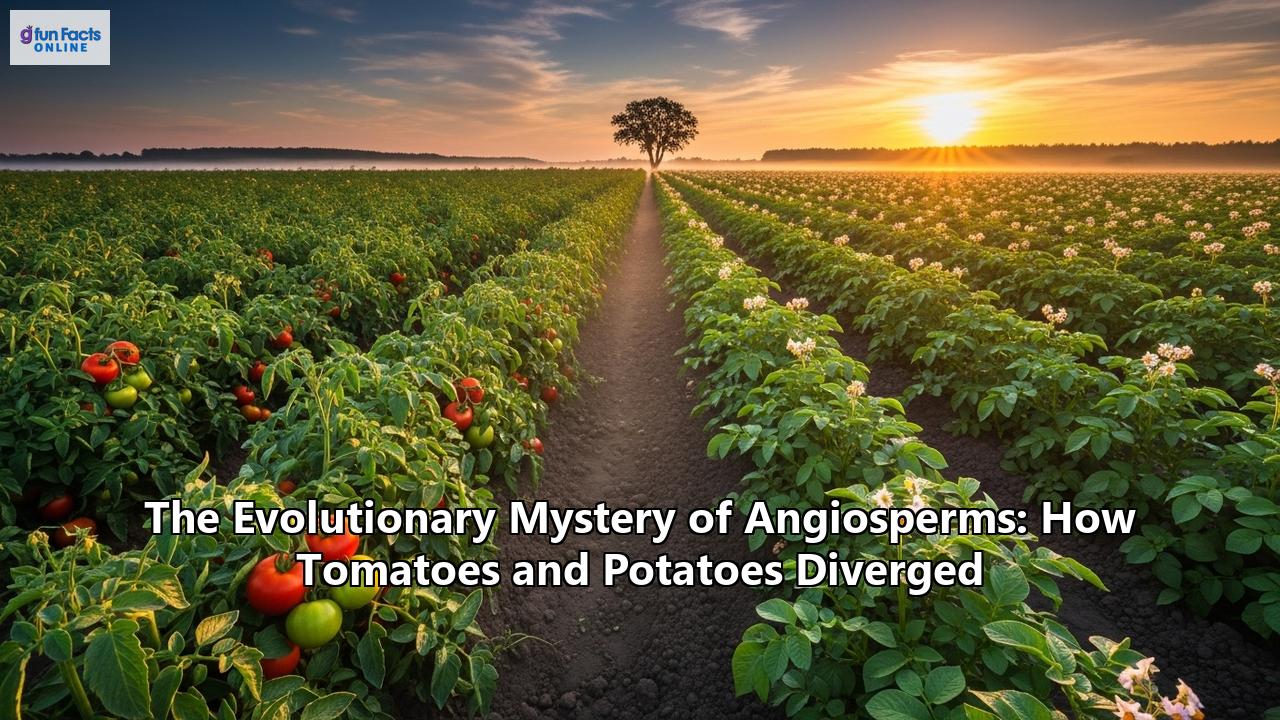
The Unlikely Cousins: How a Twist of Fate and an Ancient Hybridization Gave Rise to Tomatoes and Potatoes
In the grand, sprawling tapestry of the plant kingdom, the sudden and explosive arrival of angiosperms—the flowering plants—has long been a subject of fascination and debate, a phenomenon Charles Darwin himself famously described as an "abominable mystery." This evolutionary puzzle, centered on their rapid diversification during the Cretaceous period, has captivated scientists for generations. Yet, within this grand narrative lies a more intimate and equally compelling story of divergence, a tale of two of the world's most important food crops: the humble potato and the vibrant tomato. Though they sit on our dinner plates as distinct culinary entities, their shared history is a testament to the unpredictable and wondrous nature of evolution.
The Dawn of Flowers: A Planet Transformed
To understand the story of the tomato and potato, we must first travel back in time to a world dominated by gymnosperms like conifers and cycads. For millions of years, these hardy, non-flowering plants reigned supreme. Then, somewhere between 130 and 145 million years ago, during the Jurassic to early Cretaceous periods, a new kind of plant emerged: the angiosperm. These newcomers possessed a revolutionary set of traits, including flowers to attract pollinators and fruits to protect and disperse their seeds. This innovation proved to be a game-changer.
The fossil record shows a sudden explosion of flowering plant diversity around 100 million years ago, a period known as the Cretaceous Terrestrial Revolution. This rapid diversification, which puzzled Darwin, was likely fueled by a combination of factors, including co-evolution with insects and other animals that acted as pollinators and seed dispersers. The Earth's climate and geology were also in flux, with the breakup of supercontinents creating new environments where angiosperms could adapt and thrive. It was within this dynamic world that the stage was set for the emergence of a particularly successful and diverse family of flowering plants: the Solanaceae.
The Nightshade Family: A South American Cradle of Diversity
The Solanaceae, or nightshade family, is a large and diverse group of over 2,700 species that includes not only tomatoes and potatoes, but also eggplants, peppers, and even tobacco. The family's origins are rooted in South America, a continent that served as a cradle for its diversification. While the fossil record for Solanaceae is sparse, the oldest confirmed fossils date back to about 52 million years ago, suggesting the family is much older than previously thought. Molecular clock estimates, which use the rate of genetic mutations to estimate evolutionary time, place the family's origins even further back.
A significant event in the family's history was a whole-genome triplication that occurred approximately 81 million years ago, before the major subfamilies diverged. This event, where the entire set of chromosomes was duplicated three times, provided a wealth of new genetic material for evolution to act upon, setting the stage for the incredible diversity we see in the family today.
An Unlikely Union: The Birth of the Potato
For a long time, the close relationship between tomatoes and potatoes was a bit of a scientific puzzle. Morphologically, potato plants bear a striking resemblance to a group of wild, non-tuber-bearing species from Chile called Etuberosum. Genetically, however, they are more closely related to tomatoes. This "discordance" hinted at a more complex evolutionary story.
Recent groundbreaking research has finally unraveled this mystery, revealing a tale of ancient hybridization. Around 8 to 9 million years ago, a wild ancestor of the tomato hybridized with a plant from the Etuberosum lineage. This was not a simple cross, but an event that gave rise to an entirely new lineage: the potato. In a poetic twist, genetic analysis suggests the tomato ancestor acted as the "mother" and the Etuberosum as the "father" in this ancient pairing.
This hybridization event was the catalyst for a key innovation: the tuber. Neither the ancestral tomato nor the Etuberosum plant produced tubers. The tomato had its fruit, and the Etuberosum had thin, non-swollen underground stems. It was the combination of their genes that unlocked the potential for this new, energy-rich storage organ. Two genes, in particular, were crucial. The gene SP6A, inherited from the tomato ancestor, acts as a signal for tuberization. However, this gene only works in concert with the IT1 gene from the Etuberosum lineage, which controls the growth of the underground stems, or stolons, from which tubers develop. This genetic partnership, a legacy of that ancient hybridization, is the secret behind the potato's existence.
Diverging Paths: The Fruit and the Tuber
Following their divergence, the evolutionary paths of the tomato and potato were shaped by different selective pressures, leading to the distinct characteristics we see today.
The potato (Solanum tuberosum) focused its evolutionary strategy on the tuber, a modified underground stem that stores starch and other nutrients. This adaptation proved highly advantageous in the high-altitude environments of the Andes, where the potato was first domesticated. The tuber allowed the plant to survive harsh conditions and reproduce asexually, with new plants sprouting from the "eyes" of the tuber. The development of the tuber is a complex process regulated by a delicate interplay of hormones, including low levels of gibberellins and the involvement of cytokinins and jasmonates.
The tomato (Solanum lycopersicum), on the other hand, invested its energy in developing a fleshy, conspicuous fruit. The evolution of the fleshy fruit was a key adaptation for seed dispersal, attracting animals to eat the fruit and spread the seeds in their droppings. The development of the tomato's fruit, from its size and shape to its vibrant color and flavor, has been shaped by whole-genome triplications and the neofunctionalization of genes. For instance, the TAGL1 gene, an ortholog of a gene involved in pod shattering in other plants, has evolved a new function in tomatoes, regulating fruit ripening and the development of the fleshy pericarp.
Interestingly, while the above-ground parts of potato plants can sometimes produce small, green, tomato-like fruits, these are not edible and contain poisonous alkaloids. This serves as a reminder of their shared ancestry and the divergent evolutionary paths they have taken. Even the leaves of some heirloom tomato varieties are described as "potato-leaved," with a broader, smoother shape reminiscent of their starchy cousin.
A Human Hand in Evolution: Domestication and Diversification
The final chapter in the story of the tomato and potato is one of human influence. Both crops were domesticated in the Americas, but in different regions and at different times.
The potato was first domesticated in the Andean highlands of what is now southern Peru and northwestern Bolivia between 7,000 and 10,000 years ago. Early farmers selected for desirable traits, such as larger tubers and lower levels of toxic glycoalkaloids found in wild potatoes. This process of selection led to the incredible diversity of potato varieties still found in the Andes today, with thousands of cultivars adapted to different altitudes and climates.
The tomato has a more complex domestication history. Its wild ancestor, the small, blueberry-sized Solanum pimpinellifolium, is native to western South America. It is believed that a semi-domesticated, cherry-sized tomato, S. lycopersicum var. cerasiforme, emerged in this region, possibly without human intervention. This form then spread north to Mesoamerica, where it was further domesticated around 7,000 years ago, leading to the larger-fruited tomatoes we are familiar with today. Human selection in tomatoes has focused on traits like fruit size, shape, and flavor, but this has sometimes come at the cost of disease resistance and stress tolerance found in their wild relatives.
An Enduring Legacy
The evolutionary journey of the tomato and potato, from their shared origins in the explosive diversification of angiosperms to their divergence through a chance hybridization and their subsequent shaping by human hands, is a microcosm of the grander story of plant evolution. It is a story of innovation, adaptation, and the intricate dance between genes and the environment. So, the next time you enjoy a plate of fries with a side of ketchup, take a moment to appreciate the millions of years of evolutionary history that brought these unlikely cousins to your table. Their story is not just a scientific curiosity; it is a reminder of the profound and often surprising ways in which life on Earth has evolved and continues to evolve.
Reference:
- https://en.wikipedia.org/wiki/Tomato
- https://extension.illinois.edu/blogs/garden-scoop/2020-07-25-history-tomatoes-how-tropical-became-global-crop
- https://prizedwriting.ucdavis.edu/sites/g/files/dgvnsk15806/files/media/documents/tomato.pdf
- https://spudsmart.com/domestication-of-the-potato/
- https://roseannechambers.com/the-power-of-andean-potatoes/
- https://pmc.ncbi.nlm.nih.gov/articles/PMC2759208/
- https://www.cultivariable.com/instructions/potatoes/how-to-grow-andean-potatoes/
- https://en.wikipedia.org/wiki/History_of_the_potato
- https://www.earth.com/news/tomato-domestication-was-more-complex-than-previously-thought/
- https://tomatonews.com/tomatos-wild-ancestor-is-a-genomic-reservoir-for-plant-breeders/
- https://pmc.ncbi.nlm.nih.gov/articles/PMC1253605/
- https://en.wikipedia.org/wiki/Potato
- https://pubmed.ncbi.nlm.nih.gov/31912142/
- https://www.sci.news/genetics/solanum-pimpinellifolium-genome-09111.html
- https://www.umass.edu/news/article/research-team-traces-evolution
- https://historycooperative.org/origin-of-tomatoes/
- http://cipotato.org/wp-content/uploads/2014/09/WP18052.pdf
- https://www.thoughtco.com/potato-history-archaeological-evidence-172097
- https://www.sciencenews.org/article/potatoes-roots-ancient-tomatoes-origin
- https://www.researchgate.net/publication/6123057_Domestication_and_Breeding_of_Tomatoes_What_have_We_Gained_and_What_Can_We_Gain_in_the_Future
- https://www.researchgate.net/publication/267342703_The_Effects_of_Human_Selection_on_Elite_Tomato_Germplasm_and_Implications_for_Genome-based_Selection
- https://www.livescience.com/planet-earth/evolution/tomatoes-randomly-mated-with-another-plant-9-million-years-ago-the-result-potatoes
- https://www.theguardian.com/science/2025/jul/31/potato-evolved-from-tomato-ancestor-researchers-find
- https://academic.oup.com/mbe/article/37/4/1241/5810829
- https://www.nsf.gov/news/tomatos-wild-ancestor-genomic-reservoir-plant
- https://www.producer.com/news/tomatos-evolution-took-several-turns/
- https://anthro.utah.edu/research/archaeobotany/domestication_potato.php
- https://cwr.croptrust.org/crops/potato/
- https://btiscience.org/explore-bti/news/post/tomatos-wild-ancestor-is-a-genomic-reservoir-for-plant-breeders/
- https://www.labmanager.com/tomatos-wild-ancestor-is-a-genomic-reservoir-for-plant-breeders-24551