
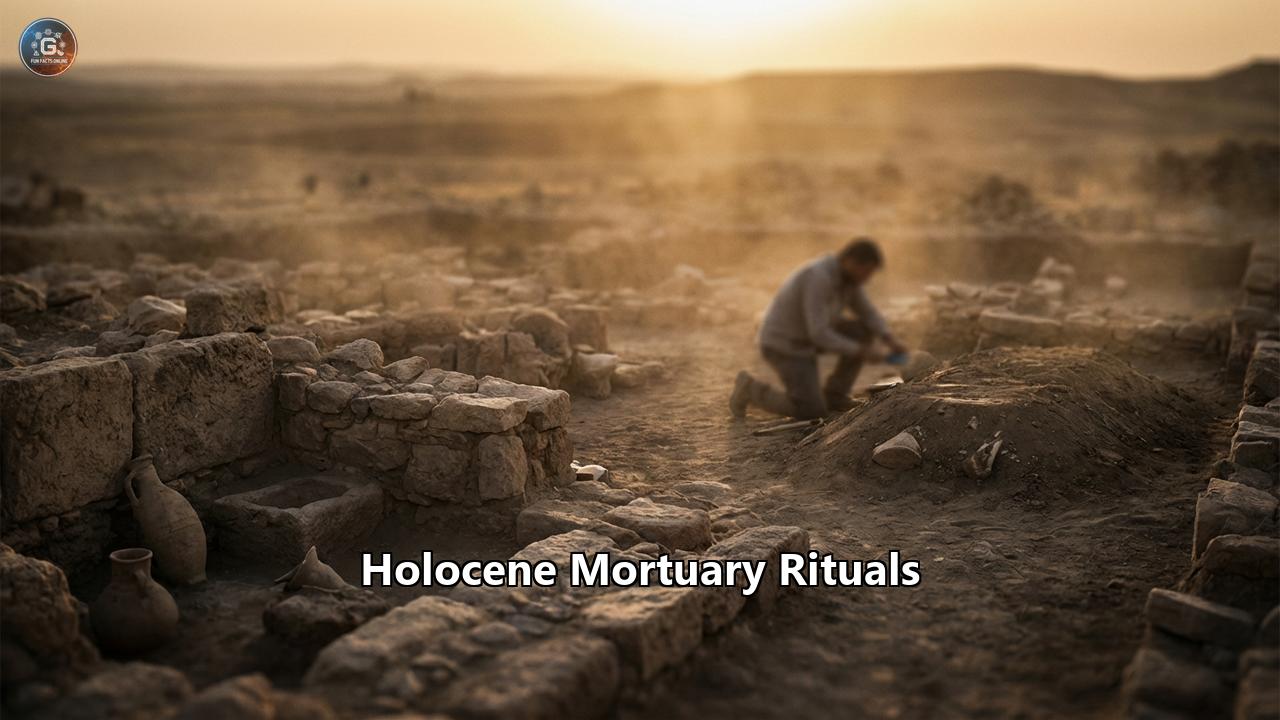
The Holocene epoch—the geological blink of an eye encompassing the last 11,700 years—represents the most dynamic chapter in the human story. It is the era of our "settling in," a time when 100,000 years of nomadic foraging coalesced into villages, cities, empires, and global networks. Nowhere is this profound transformation more visible than in how we have treated our dead.
To look at Holocene mortuary rituals is to look into a mirror of the living. The dead do not bury themselves; their interment is a calculated act by the survivors, a performance of grief, power, fear, and love. From the plastered skulls of the Levant to the jade-shrouded elites of China, and from the bog bodies of Northern Europe to the sky burials of the Himalayas, the rituals of death reveal the beating heart of human culture. They tell us when we started owning land, when we began to worship gods with names, and when we first dared to believe that our status in life could be eternalized in stone.
This article explores the evolution of mortuary practices across the Holocene, tracing the journey from the intimate, floor-bound burials of early farmers to the monumental architecture of kings and the diverse spiritual expressions that continue to shape our world today.
I. The Theoretical Lens: Reading the Silence of the Grave
Before descending into the earth, we must understand how archaeologists interpret what they find there. For decades, the study of death was dominated by processual archaeology, championed by figures like Lewis Binford and Arthur Saxe in the 1970s. They argued that a burial was a direct reflection of social organization. If a grave contained gold, weapons, and imported pottery, the occupant had high status; if it was a simple pit, they were a commoner. This "Saxe-Binford program" treated mortuary remains as data points to map social complexity—a "social persona" fossilized in the ground.
However, in the 1980s, post-processualists like Ian Hodder argued that this view was too sterile. They cautioned that the dead do not merely reflect society; they are used by the living to create it. A lavish funeral might not mean the deceased was wealthy, but rather that their heirs were desperate to claim legitimacy by staging a grand spectacle. This perspective views mortuary rituals as a theater of memory, where history is rewritten and social roles are negotiated.
Today, we use both lenses. We look at the "hardware" of the grave (bones, goods, orientation) to understand biology and economy, but we also look at the "software" (placement in the landscape, manipulation of bones, symbolic associations) to glimpse the spiritual and emotional lives of our ancestors.
II. The Early Holocene: The Hearth and the Head (11,700 – 8,000 BP)
The Holocene began with a warming world, and with it, a psychological shift. In the Near East, the Natufian culture straddled the boundary between the old hunter-gatherer ways and the coming agricultural revolution. Their burials offer the first clear evidence of a society grappling with the concept of "home."
The Skull Cult of the Levant
For the Natufians and their Pre-Pottery Neolithic successors, the dead were not banished to a distant cemetery; they were kept close—literally under the floorboards. At sites like 'Ain Mallaha and later Jericho, bodies were buried beneath the living surfaces of houses. This suggests a profound continuity between life and death; the ancestors were permanent residents of the household, their physical presence perhaps legitimizing the family's claim to the house and its resources.
This intimacy evolved into the famous "Skull Cult." After the body had decomposed, the skull would be retrieved, cleaned, and often plastered with clay to recreate the facial features of the deceased. Cowrie shells were placed in the eye sockets, giving the ancestors a wide-eyed, eternal stare. These plastered skulls were displayed in homes, serving as tangible anchors of lineage in a world where land ownership was becoming increasingly vital.
One of the most striking discoveries from this period is the "Shaman" of Hilazon Tachtit (c. 12,000 BP). In a cave in northern Israel, an elderly woman was buried with an extraordinary assemblage: 50 tortoise shells, the wing of a golden eagle, the tail of an aurochs, and a human foot. Unlike the standard burials, this was a performance of otherness. She was separated from the community by her unique spiritual role, her grave marking the earliest clear evidence of a shamanic tradition in the archaeological record.
Europe: The Mesolithic Mosaic
While the Levant turned to farming, Europe remained a continent of hunter-gatherers. Mesolithic burials here were diverse and often seasonally driven. At the Vedbæk cemetery in Denmark (c. 7,000 BP), we see the tenderness of grief frozen in time. A young woman was buried with a newborn baby placed on a swan's wing next to her—a poetic gesture of comfort for the journey into the dark.
In the Danube Gorges, at sites like Lepenski Vir, the transition to sedentism mirrored the Levant. Burials were often placed within the geometric foundations of houses, linking the dead to the architecture of the living. The "Red Lady" of Paviland (actually a Paleolithic burial, but conceptually linked to later red ochre traditions) foreshadowed the pervasive use of red ochre in Mesolithic graves, symbolizing blood, life, and vitality restored to the pale corpse.
The Green Sahara: Gobero
In North Africa, the Sahara was a lush savannah of lakes and grasslands. The site of Gobero in Niger captures the burial traditions of the Kiffian and Tenerian cultures. The most famous interment, the "Stone Age Embrace" (c. 5300 BP), features a woman and two children buried together on a bed of flowers, their limbs intertwined. Pollen analysis confirms they were laid to rest atop local hibiscus, hinting at a colorful, fragrant send-off that contradicts our modern image of the desert as a place of barren death.
III. The Mid-Holocene: Monuments for the Ancestors (8,000 – 4,000 BP)
As agriculture spread, the scale of death changed. Farming required cooperative labor and deeper ties to the land. To cement these ties, people began to build mountains for their dead.
Megalithic Europe: Houses for the Dead
From the Atlantic coast of Portugal to the Orkney Islands, the Megalithic phenomenon transformed the landscape. Communities built massive stone tombs—dolmens, passage graves, and long barrows—that served as communal ossuaries.
Newgrange in Ireland (c. 3200 BCE) is the pinnacle of this tradition. A massive kidney-shaped mound covering an acre, it houses a cruciform chamber aligned perfectly with the winter solstice sunrise. This alignment suggests that death was viewed as a temporary darkness, destined to be renewed by the solar cycle. Inside these tombs, individual identity was often erased; bodies were allowed to decompose, and bones were commingled, creating a collective "ancestral body" rather than a shrine to a specific king.The Americas: The First Mummies
While Europe piled stones, the people of the Atacama Desert in modern-day Chile and Peru developed a different obsession: the preservation of the flesh. The Chinchorro culture (c. 7000–1500 BCE) practiced the world's oldest artificial mummification, pre-dating the Egyptians by millennia.
Unlike later Andean cultures where mummification was for elites, the Chinchorro democratized preservation. They dismantled the body, removing skin and organs, reinforced the skeleton with reeds and sticks, and then reassembled it, coating the form in clay and painting it with black manganese or red ochre. The result was a rigid, statue-like effigy. The high frequency of mummified children and fetuses suggests this practice may have begun as a way for parents to cope with high infant mortality—a refusal to let the ocean or the desert claim their young.
Neolithic China: Jade and Inequality
In East Asia, the Yangshao and Dawenkou cultures of the Yellow River valley began to display stark social stratification. The egalitarianism of earlier periods vanished. At sites like Liangzhu, elites were buried with hundreds of bi (discs) and cong (tubes) made of jade—a material so hard it required months of labor to shape.
These jade objects were not just jewelry; they were ritual machines. The circular bi represented heaven, the square cong earth. By hoarding them in death, the elite claimed the power to mediate between the two realms. The urn burials of this period, particularly for children, also show a focus on containment and protection, with pottery vessels serving as "wombs" for rebirth.
IV. The Late Holocene: The Age of Kings and Cosmos (4,000 BP – Present)
As the Holocene matured, the rise of states and empires turned mortuary rituals into political theater. The dead became larger than life.
Egypt: The Industry of Eternity
No civilization is more synonymous with death than Ancient Egypt. However, their practices were not static. They evolved from the simple sand-pit burials of the Predynastic (where natural desiccation inspired artificial preservation) to the architectural arrogance of the Old Kingdom pyramids.
By the New Kingdom (c. 1550–1070 BCE), the focus shifted from the sheer size of the tomb to the hidden magic of the afterlife. The Valley of the Kings was designed to be invisible, protecting the pharaoh's gold. Inside, the walls were plastered with the Amduat and the Book of the Dead—guidebooks for the soul's perilous journey through the underworld.
The "Democratization of the Afterlife" is a key Late Holocene trend. Initially reserved for the king, the rites of Osiris—mummification, the "Opening of the Mouth" ceremony, and the judgment of the soul—trickled down to nobles and eventually to anyone who could afford a coffin. The shabti figurines placed in tombs were a labor-saving device; magical servants ready to answer the gods' call to work in the afterlife's fields so the deceased could rest.
Mesopotamia: The Great Death Pits of Ur
While Egypt built up, Mesopotamia dug down. The Royal Tombs of Ur (c. 2600 BCE), excavated by Leonard Woolley, revealed a grim reality of Sumerian power. In the "Great Death Pit," Queen Puabi was not buried alone. She was accompanied by dozens of attendants—soldiers, musicians, and servants—who were sacrificed to serve her in the next world.
Recent analysis of their skulls suggests they were not poisoned as originally thought, but bludgeoned—a violent assertion of the monarch's power over life and death. The grave goods, including the famous "Ram in a Thicket" and gold-adorned lyres, were not just treasures; they were tools to entertain and appease the gods of the underworld, a gloomy realm where the dead ate dust and clay.
The European Bog Bodies
In the wetlands of Northern Europe, the Iron Age (c. 800 BCE – 400 CE) produced one of archaeology's most haunting mysteries: bog bodies. Individuals like Tollund Man and Grauballe Man were not buried but submerged in peat bogs. The anaerobic conditions tanned their skin and preserved their serene expressions.
Most were victims of extreme violence—strangled, slit-throated, or bludgeoned. Yet, they were deposited with care. Current theory suggests they were not merely executed criminals, but high-stakes sacrifices to the bog gods, perhaps during times of crisis. The bog was a liminal space—neither land nor water—making it the perfect gateway to the supernatural.
East Asia: Ancestors and Armies
In China, the Shang Dynasty (c. 1600–1046 BCE) systematized ancestor worship. Massive bronze vessels were cast to offer food and wine to the spirits. The inscriptions on these vessels are contracts: the living offer sustenance, and the dead grant blessings.
The culmination of this tradition is the Mausoleum of the First Emperor, Qin Shi Huang (c. 210 BCE). Instead of sacrificing human retainers (as the Shang had done), the Emperor commissioned the Terracotta Army—8,000 life-sized clay soldiers. This shift from human sacrifice to simulacra represents a major ethical and economic evolution in mortuary practice, preserving the workforce while still projecting infinite power.
In Japan, the transition from the Jomon (hunter-gatherer) to the Yayoi (agricultural) period brought moated burial precincts. This evolved into the Kofun period, named after the massive keyhole-shaped burial mounds that dot the Osaka plain—some so large they rival the pyramids in volume, asserting the arrival of a centralized Yamato state.
V. Distinctive Traditions: Ships, Skies, and Towers
As cultures diversified, some developed rituals that utilized the elements—fire, air, and water—in unique ways.
Viking Ship Burials
For the Norse of the late Iron Age, the ship was the ultimate symbol of the journey. The Oseberg and Gokstad ships (9th century CE) were actual seagoing vessels dragged onto land to serve as coffins for high-status women and men. Buried with horses, dogs, tapestries, and sleighs, the ships were often covered by mounds.
In other cases, the ship was burned. The account of Ibn Fadlan, an Arab diplomat who witnessed a Rus (Viking) funeral on the Volga in 922 CE, describes a chieftain placed in his ship, surrounded by weapons and food. A slave girl, after ritually drinking and having sex with the chieftain's kinsmen, was sacrificed and placed beside him before the entire vessel was torched. This "cremation ship" ritual symbolized the transformation of matter into spirit, riding the smoke to Valhalla.
Sky Burials: The Final Generosity
In the high plateaus of Tibet and the arid expanse of Persia, the ground was often too hard to dig or too sacred to pollute.
- Zoroastrian Towers of Silence: For Zoroastrians, the elements of earth and fire are pure and must not be sullied by a decaying corpse (which is infested by the corpse-demon Nasu). The solution was the Dakhma, or Tower of Silence. Bodies were placed atop these circular stone towers, exposed to the sun and scavenging birds. The vultures would strip the flesh in hours, purifying the bones, which were then swept into a central pit.
- Tibetan Sky Burial (Jhator): In Tibet, the practice is driven by Buddhist compassion. The body is an empty vessel; the spirit has moved on. Offering the flesh to griffon vultures is a final act of dana (generosity)—feeding other living beings with one's own substance. It is a visceral reminder of impermanence, practiced on mountaintops that serve as the interface between the earthly and the celestial.
VI. The Monotheistic Shift: A New Architecture of Death
The spread of Judaism, Christianity, and Islam in the Late Holocene fundamentally rewired burial customs, moving away from grave goods and elaborate displays of status toward humility and unity.
- Judaism: Second Temple period Judaism utilized ossuaries—stone boxes for the secondary burial of bones—reflecting a belief in individual resurrection. Over time, this simplified into the plain wooden coffin or shroud burial, emphasizing that "dust thou art, and unto dust shalt thou return."
- Christianity: Early Christians in Rome dug miles of catacombs, rejecting the pagan norm of cremation in favor of bodily resurrection. The cult of martyrs led to "ad sanctos" burial—the desire to be buried as close as possible to the bones of a saint. This moved the dead from the necropolis (city of the dead) into the center of the city, under the floorboards of the parish church.
- Islam: The Islamic tradition demands simplicity and speed. There are no coffins (traditionally), no embalming, and no delay. The body is washed, shrouded in white cloth, and buried facing Mecca. It is a ritual of radical equality; king and pauper go into the earth the same way, underscoring the submission (Islam) to the divine will.
VII. Conclusion: The Holocene Legacy
From the curled skeletons of the Natufians to the vast cemeteries of the industrial age, Holocene mortuary rituals reveal a trajectory of increasing complexity, followed by a return to symbolic simplicity.
We began by burying our dead under our beds to keep them close. We moved them to megalithic houses to make them community ancestors. We elevated them to godhood in pyramids and mounds. And finally, in the modern era, we have often sequestered them in manicured lawns or sterile crematoriums, separating the living from the dead more sharply than ever before.
Yet, the core impulse remains unchanged. Whether building a pyramid or scattering ashes, the ritual is never just about disposal. It is an act of defiance against oblivion. Through our rituals, we insist that a human life matters, that memory can outlast flesh, and that even in the face of the ultimate unknown, we are not alone. The archaeology of death is, in the end, the archaeology of love.
Reference:
- https://thewarriorlodge.com/blogs/news/viking-burial-practices-from-ship-burials-to-cremation
- https://www.serenityridgemd.com/jewish-burial-practices-from-biblical-times-to-modern-traditions/
- https://www.thelivingurn.com/blogs/news/everything-you-need-to-know-about-the-tibetan-sky-burial
- https://www.battlemerchant.com/en/blog/the-fascinating-rituals-and-traditions-of-viking-burials
- https://blog.sevenponds.com/cultural-perspectives/zoroastrian-towers-of-silence
- https://slate.com/human-interest/2014/10/towers-of-silence-in-yazd-a-zoroastrian-sky-burial-site.html
- https://www.ancient-origins.net/history-ancient-traditions/zoroastrian-towers-silence-where-dead-are-left-vultures-007182
- https://www.countere.com/home/tower-of-silence-dakhma-zoroastrian-sky-burial-vultures
- https://www.pulvisurns.com/blogs/news/sky-burials-of-tibet-understanding-the-tradition-and-practices
- https://www.gototibet.com/tibetan-culture/sky-burial.html