
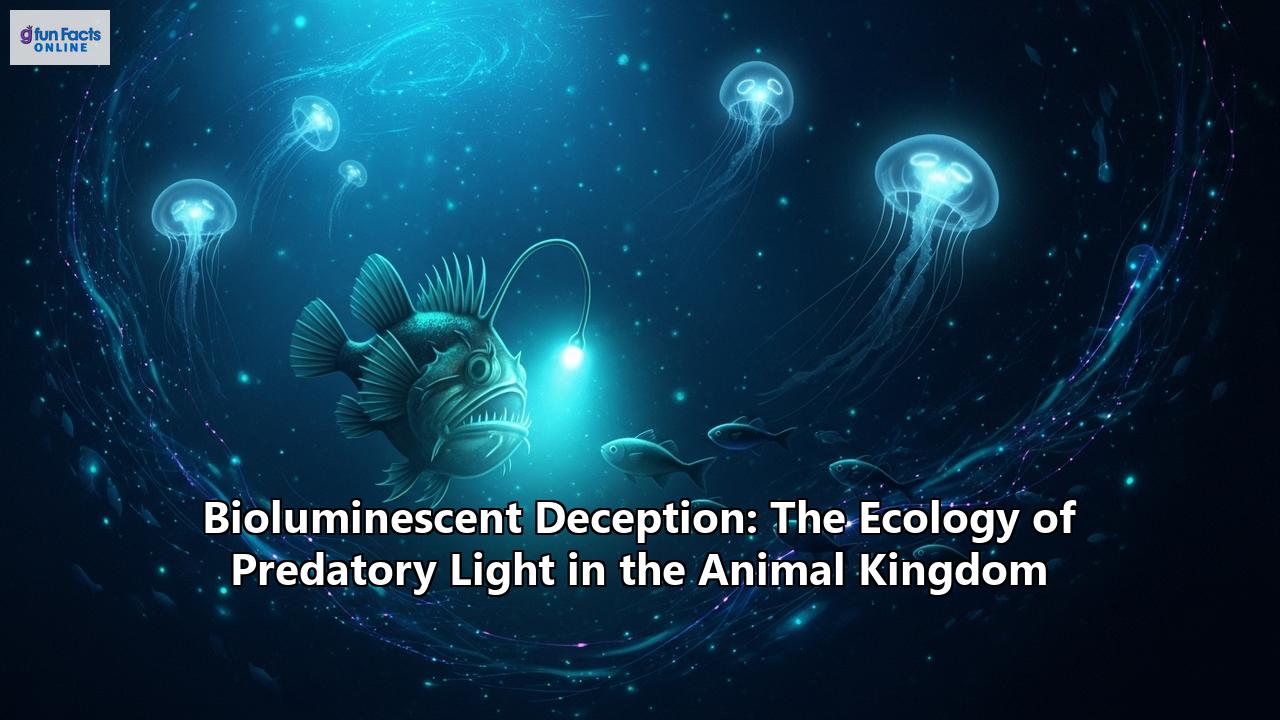
In the inky blackness of the deep ocean, a lone light beckons. To a small, unsuspecting fish, it might appear as a potential meal, a tiny, glowing crustacean dancing in the dark. Drawn by an instinct honed over millennia, it swims closer, only to be engulfed by a cavernous mouth that materializes from the void. This is not a scene from a science fiction epic, but a nightly drama that unfolds in the vast, hidden ecosystems of our planet. The deceptive glow is the work of a master of bioluminescent predation, a creature that has turned living light into a deadly weapon.
Bioluminescence, the production and emission of light by a living organism, is one of nature's most enchanting and versatile phenomena. It paints the oceans with ethereal light, sets summer nights ablaze with the twinkle of fireflies, and carpets cave ceilings with constellations of tiny "stars." While often associated with defense, mating displays, or camouflage, one of its most fascinating and ruthless applications is in the art of predation. Across the animal kingdom, from the crushing pressures of the abyss to the humid air of a forest floor, predators have evolved an astonishing array of strategies to harness light as a tool of deception, turning a simple glow into a fatal attraction.
This article delves into the captivating and often brutal world of bioluminescent deception. We will journey into the crushing depths to meet the anglerfish and the dragonfish, creatures that have perfected the art of the luminous lure. We will explore the bizarre tactics of the cookie-cutter shark, which uses a combination of camouflage and mimicry to take a bite out of some of the ocean's largest inhabitants. And we will emerge from the depths to witness the terrestrial intrigues of femme fatale fireflies and the silken, glowing snares of cave-dwelling glow-worms. Through these case studies, we will unravel the intricate ecology and evolutionary arms races that have shaped these remarkable predatory strategies, exploring not just the hunters, but the hunted, and the very chemistry that sparks this deadly light.
The Science of Living Light: A Chemical Symphony
Before we explore the diverse strategies of luminous hunters, it is essential to understand the fundamental process that makes it all possible: bioluminescence. This "cold light" is not a form of phosphorescence or fluorescence, which involve the absorption and re-emission of light from an external source. Instead, it is a chemical reaction that generates light from within the organism's own body.
The core of this reaction, in most known cases, involves two key components: a substrate called luciferin and an enzyme called luciferase. The names are generic, and different species have evolved their own unique versions of these molecules. The luciferase acts as a catalyst, speeding up the oxidation of the luciferin. This reaction produces an unstable, high-energy intermediate, which then decays to a more stable, lower-energy state. The excess energy is released not as heat, but as a photon of light. This is an incredibly efficient process, with nearly 100% of the energy being converted into light.
In some organisms, this chemical machinery is self-contained; they produce both their own luciferin and luciferase. This is known as autogenic bioluminescence. In others, the light is produced by symbiotic bacteria that live in specialized light organs, or photophores. The host organism provides the bacteria with a safe, nutrient-rich environment, and in return, gains the ability to glow. This is termed bacteriogenic bioluminescence, and as we will see, it is a common strategy among deep-sea predators like the anglerfish.
The color of the light produced can also vary. Most marine bioluminescence is blue or green, as these shorter wavelengths travel farthest through water. However, some remarkable predators have evolved the ability to produce and perceive red light, a feat that gives them a significant advantage in the deep sea. The control of the light is often just as important as its production. Animals can regulate their glow by controlling the supply of oxygen or other cofactors to the light-producing cells, or by using muscular shutters or pigmented skin to hide and reveal their photophores. This precise control allows them to deploy their light strategically, turning a simple chemical reaction into a sophisticated tool for deception and predation.
Masters of the Abyss: The Anglerfish's Deadly Lure
Perhaps no creature is more synonymous with bioluminescent predation than the deep-sea anglerfish. Dwelling in the bathypelagic zone, thousands of meters below the surface where sunlight cannot penetrate, the female anglerfish is a formidable ambush predator, a testament to evolution's ingenuity in extreme environments.
The Anatomy of Deception: The Illicium and EscaThe anglerfish's most iconic feature is its "fishing rod," a modified dorsal fin spine known as the illicium, which extends from its head. At the tip of this illicium is a fleshy, bulbous structure called the esca, which serves as the lure. This is not just a passive appendage; the anglerfish has a complex muscular system that allows it to wiggle and twitch the esca, mimicking the movements of a small prey animal to make the deception more convincing.
The light itself is not produced by the anglerfish, but by a colony of symbiotic bioluminescent bacteria, typically of the genus Photobacterium, that live within the esca. This is a classic example of a mutualistic relationship: the bacteria receive a protected, nutrient-rich environment, while the anglerfish gets a personal, self-sustaining lure. The female anglerfish can control the light, not by turning the bacteria on and off, but by regulating the flow of oxygenated blood to the esca, effectively dimming or brightening the lure as needed. Muscular skin flaps can also be used to hide and reveal the light, allowing the fish to flash its lure to attract attention or conceal it to avoid attracting larger, unwanted predators.
A Fatal Attraction in the DarkIn the vast, dark, and sparsely populated deep sea, any point of light is a powerful attractant. Small fish and crustaceans are drawn to the anglerfish's bobbing esca, likely mistaking it for a small, bioluminescent food source like a copepod or a smaller fish. As the curious prey approaches the mesmerizing glow, it is lured directly towards the anglerfish's enormous, waiting mouth, which is armed with long, inwardly-angled, fang-like teeth.
The anglerfish's entire body is built for this sit-and-wait strategy. They are often dark in color to blend in with the abyss, and their bodies are globose and non-hydrodynamic, reflecting a lifestyle that does not require speed. Their jaws and stomachs are incredibly distensible, allowing them to swallow prey up to twice their own size—a crucial adaptation in an environment where meals are few and far between. Some species have even evolved ultra-black skin that reflects less than 0.04% of light, ensuring that only the lure is visible, making the trap all the more effective.
The Bizarre World of Anglerfish ReproductionThe pressures of the deep sea have led to equally extreme adaptations in anglerfish reproduction. The large, predatory anglerfish with the glowing lure are all females. Males are diminutive by comparison, often less than an inch long, and their sole purpose is to find a mate. Lacking the lure and often having underdeveloped digestive systems, they use their large nostrils to follow the pheromones released by females.
Once a male finds a female, a truly bizarre phenomenon known as sexual parasitism occurs in many species. He bites onto her body, and their tissues and circulatory systems fuse. The male effectively becomes a permanent appendage, losing his eyes and internal organs, and transforming into little more than a "sperm factory" that receives all his nutrients from the female's blood and provides sperm on demand. This ensures that when the female is ready to spawn in the vast emptiness of the deep sea, a mate is always available. This extreme adaptation highlights the intense selective pressures of an environment where finding a partner is one of the greatest challenges to survival.
The Red Glare: The Dragonfish's Secret Weapon
While the anglerfish masters the art of the dangling lure, another deep-sea predator, the dragonfish, has evolved a different, yet equally ingenious, form of light-based predation. The Stomiidae family, commonly known as dragonfishes, are fearsome hunters of the meso- and bathypelagic zones, equipped with large jaws, formidable teeth, and an array of light-producing photophores.
A Private Wavelength of LightThe vast majority of bioluminescence in the ocean is blue-green. This is because these shorter wavelengths of light travel the farthest through water, making them the most efficient for communication and detection. Consequently, most deep-sea creatures have evolved eyes that are most sensitive to blue light and have lost the ability to perceive red light, which is filtered out in the upper layers of the ocean. Many deep-sea animals are even red in color, a perfect camouflage that renders them effectively invisible in the blue-lit depths.
This is where the dragonfish's genius lies. A few genera, including Malacosteus (the stoplight loosejaw), Aristostomias, and Pachystomias, have evolved the extraordinary ability to produce and perceive far-red light. They possess a pair of large suborbital photophores, located just beneath their eyes, that emit a beam of red light, with a peak emission beyond 700 nanometers. This gives them a massive predatory advantage. They can use their red "searchlight" to illuminate their surroundings, revealing red-pigmented prey that would be invisible to other predators. The prey, unable to see the red light, remains completely unaware that it is being targeted. It is the deep-sea equivalent of a sniper using an infrared scope.
The Chemistry of a Red-Light DistrictThe mechanism behind this red light is complex. The dragonfish's photophores initially produce blue-green light through a standard luciferin-luciferase reaction. This light is then passed through a fluorescent protein that absorbs the blue-green photons and re-emits them at a longer, red wavelength. Finally, a filter further refines the light, making it even redder.
To see this private wavelength, these dragonfish have also evolved specialized visual systems. While most deep-sea fish have only one type of visual pigment (rhodopsin) tuned to blue light, the red-light-producing dragonfish have multiple pigments, some of which are shifted towards the longer, red end of the spectrum. In a stunning example of evolutionary resourcefulness, the stoplight loosejaw (Malacosteus niger) enhances its red-light sensitivity using a chlorophyll-derived photosensitizer in its retina. It cannot produce this compound itself; instead, it is believed to acquire it from its diet, specifically from copepods that have fed on phytoplankton containing chlorophyll. In essence, the dragonfish eats its "night-vision goggles."
An Arsenal of Predatory AdaptationsBeyond their revolutionary visual system, dragonfish possess a host of other adaptations that make them top predators. Many have a chin barbel tipped with a bioluminescent lure, which they can flash to attract prey, much like an anglerfish. They can use this lure in combination with their red searchlight, creating a complex and deadly hunting strategy.
Their mouths are equally impressive. The "loosejaw" species have a jaw that is not connected to their skull by a floor of skin and bone, allowing them to open their mouths to an astonishing 120 degrees and swallow prey larger than their own head. To complement this, many dragonfish have evolved transparent teeth. This incredible adaptation prevents their fangs from scattering or reflecting any ambient bioluminescent light, keeping their lethal trap completely invisible until the moment of attack. With their ultra-black skin for camouflage, a private red searchlight, a glowing lure, and invisible teeth, the dragonfish is a supreme master of predatory deception in the abyss.
The Glowing Grazer: The Cookie-Cutter Shark's Deceptive Bite
Moving from the deep-sea ambush predators to a more mobile hunter, the cookie-cutter shark (Isistius brasiliensis) demonstrates one of the most bizarre and cunning uses of predatory bioluminescence. This small, cigar-shaped shark, typically reaching only about 50 cm in length, is not a typical predator that kills its prey. Instead, it is a facultative ectoparasite, taking non-lethal, cookie-shaped bites from much larger animals, including whales, dolphins, seals, and even great white sharks.
Camouflage and a Counterfeit TargetThe cookie-cutter shark's strategy is a masterful blend of camouflage and aggressive mimicry. The entire underside of the shark, with the exception of a distinct, dark "collar" around its throat, is covered in a dense network of tiny photophores. These light organs produce a steady, strong greenish glow, which serves as a form of counter-illumination. When viewed from below against the faint, downwelling light from the surface, this glow effectively erases the shark's silhouette, making it invisible to potential predators lurking in the depths.
However, the non-luminescent dark collar breaks this camouflage in a very specific and deceptive way. It has been proposed that this dark patch, framed by the glowing underside, mimics the silhouette of a small fish—the typical prey for the large predators the cookie-cutter shark targets. A hungry tuna or dolphin, looking up for a small meal, sees what it perceives to be a lone, small fish and approaches for an easy snack. By the time the predator realizes its mistake, the much smaller cookie-cutter shark is already in position to strike. Traveling in schools may enhance this illusion, making the collection of dark collars appear like a tempting school of small fish.
The Mechanics of a Perfect BiteThe cookie-cutter's attack is as specialized as its lure. Once the larger animal is drawn in, the shark uses its suctorial, fleshy lips to create a strong seal on the victim's body. It then anchors itself with its small, hook-like upper teeth. The real work is done by its lower jaw, which contains a single, saw-like row of large, triangular, interconnected teeth. The shark then violently twists its body, and this rotational movement allows the lower teeth to carve out a perfectly round, conical plug of flesh. This leaves a distinctive, crater-like wound on the victim, giving the shark its name.
This lifestyle is supported by a suite of other adaptations. Cookie-cutter sharks have an enormous, oil-filled liver that can make up 35% of their body weight, giving them neutral buoyancy and allowing them to hover in the water column with minimal effort while waiting for prey. They also undergo daily vertical migrations, spending the day in the deep ocean (down to 3,700 meters) and ascending to the upper layers at night to hunt, a behavior that maximizes their encounters with the surface-dwelling animals they parasitize. This unique combination of bioluminescent camouflage, aggressive mimicry, and a highly specialized feeding apparatus allows the tiny cookie-cutter shark to thrive by taking a toll on the largest and most powerful animals in the ocean.
Terrestrial Treachery: Fireflies and Glow-worms
Bioluminescent deception is not confined to the crushing depths of the ocean. On land and in freshwater environments, insects have also evolved to use living light as a predatory tool, creating enchanting displays that mask a deadly intent.
The Femme Fatale Firefly's Deadly SignalThe gentle, blinking lights of fireflies on a summer evening are typically associated with courtship and mating. Each species has a unique flash pattern, a sort of Morse code that allows males and females of the same species to find each other in the dark. Flying males flash their signal, and perched females respond with a species-specific delay, guiding the male to her location.
However, in the firefly genus Photuris, this romantic dialogue takes a sinister turn. The females of these species are the "femmes fatales" of the insect world. They have evolved the ability to engage in aggressive mimicry, perfectly imitating the flash responses of females from other genera, most notably Photinus. An unsuspecting Photinus male, seeing what he believes is the alluring response of a receptive mate, is lured towards the Photuris female. But instead of finding a partner, he finds a predator. The femme fatale seizes him with her sharp mandibles and devours him.
This predatory mimicry is remarkably sophisticated. A single Photuris female can have a repertoire of signals, allowing her to mimic the responses of multiple prey species by adjusting the timing and duration of her flashes based on the incoming male's signal. This deadly deception provides the female with more than just a meal. Photinus fireflies contain defensive steroidal pyrones called lucibufagins, which make them unpalatable to predators like jumping spiders and birds. Photuris fireflies cannot produce these chemicals themselves. By consuming Photinus males, the femme fatale sequesters these defensive compounds, incorporating them into her own body and even her eggs, thus gaining protection for herself and her offspring. This is a remarkable example of chemical usurpation, where predation provides not just nutrients, but a vital chemical defense.
The Glow-worm's Ethereal SnareAnother captivating terrestrial light show with a predatory purpose is created by glow-worms. The term "glow-worm" can refer to several types of insects, including the larviform, wingless females of some firefly species. However, the most famous predatory glow-worms are the larvae of fungus gnats, particularly those of the genus Arachnocampa found in the caves of New Zealand and Australia.
These larvae, living on the dark, damp ceilings of caves and other sheltered areas, create a breathtaking spectacle that resembles a starry night sky. But this beauty hides a deadly trap. Each larva constructs a horizontal silk nest and then deploys up to 70 vertical silk "fishing lines," each coated with sticky, mucous-like droplets. The larva then activates its bioluminescent organ, located in its abdomen, producing a steady blue-green glow.
The light serves as a powerful lure for other insects within the cave, especially small, flying insects like midges and moths that are their primary food source. The insects are likely attracted to the light, possibly mistaking it for an opening to the outside or the sky. As they fly towards the alluring glow, they become ensnared in the sticky, dangling threads. The glow-worm larva, sensing the vibrations of the trapped prey, reels in the silk line and consumes its victim. The intensity of the glow is even linked to hunger; a hungrier larva will glow more brightly, increasing its chances of attracting a meal. This strategy turns the entire colony of glow-worms into a mesmerizing and highly effective predatory web of light.
The Ecology and Evolution of Predatory Light
The diverse and often bizarre strategies of bioluminescent predators are the product of millions of years of evolution, shaped by the unique ecological pressures of their environments. The development of these luminous weapons is a story of adaptation, co-evolutionary arms races, and the exploitation of the sensory biases of other organisms.
The Prey's Perspective: A Fatal FlawPredatory bioluminescence is only effective because it successfully deceives the prey. The lure works by exploiting a pre-existing sensory bias in the target animal. In the deep sea, where food is scarce, any sign of a potential meal—such as the glow of a small bioluminescent organism—is worth investigating. Anglerfish and dragonfish capitalize on this by mimicking the very thing their prey is searching for. Similarly, the cookie-cutter shark's dark collar against its glowing body creates the illusion of a small fish, a search image hard-wired into the brains of larger predators.
On land, the deception is just as potent. Photuris fireflies exploit the highly specific and stereotyped mating signals of their prey. The Photinus male's drive to reproduce is so strong that it overrides caution, leading him into the fatal embrace of the mimic. Glow-worms in dark caves exploit the positive phototaxis of many flying insects—their innate tendency to move towards a light source, which in a normal environment would lead them to safety or open spaces.
The Evolutionary Arms RaceThe relationship between a predator and its prey is a classic example of a co-evolutionary arms race. As the predator evolves more effective hunting strategies, the prey evolves counter-strategies to avoid being eaten. This, in turn, drives the predator to further refine its tactics.
We see this clearly in the world of bioluminescent deception. The evolution of red light production in dragonfish is a direct response to the common deep-sea defense of being red-colored. As prey became invisible to blue-light predators, a new type of predator that could "see" in red gained a significant advantage. This creates a private channel of perception, a "sniper's scope" that the prey has not yet evolved to counter.
In the case of Photuris fireflies, some prey species have shown the beginnings of counter-adaptations. Males of some synchronous firefly species, for example, have been observed to be less susceptible to the lures of the femme fatale. Their highly synchronized flashing may make it more difficult for a predator to isolate and mimic an individual signal, or the males may have evolved a greater degree of caution. However, the success of the Photuris strategy, evidenced by its widespread use and the acquisition of chemical defenses, shows that the predator currently has the upper hand in this particular arms race.
The Energetics of the GlowProducing light is an energy-intensive process. For a predator to invest in this strategy, the energetic benefit of the prey captured must outweigh the cost of generating the light. This is why many bioluminescent predators are ambush hunters. The anglerfish and dragonfish remain largely motionless, conserving energy and letting the lure do the work. This is far more efficient than actively pursuing prey in the vast, empty expanse of the deep sea.
The cookie-cutter shark's strategy is also energetically savvy. By taking small, high-fat plugs of flesh from large animals, it obtains a calorie-rich meal without the massive energy expenditure required to hunt and kill such a large creature. Its neutral buoyancy further reduces the energy needed for its daily vertical migrations. For fireflies and glow-worms, the light is dual-purpose, used for both predation and mating, making the energetic investment more efficient.
Conclusion
From the crushing blackness of the abyss to the familiar glow of a summer's night, the use of light as a predatory tool is a stunning testament to the power of evolution. It is a world of cunning deception, where a gentle twinkle can be a death sentence and a beautiful glow can mask a lethal trap. The anglerfish's patient, dangling bait, the dragonfish's secret red searchlight, the cookie-cutter shark's counterfeit target, and the firefly's fatal flash all tell a similar story: in the struggle for survival, any advantage will be seized, and any sensory bias can be exploited.
These strategies reveal the intricate and often brutal dance of co-evolution. As predators refine their luminous deceptions, prey evolve to resist them, creating a perpetual arms race that drives biological innovation. Studying these interactions not only unveils some of the most remarkable adaptations in the animal kingdom but also provides a deeper understanding of the ecological principles that govern life in the planet's most extreme and hidden environments. The ghostly light of a bioluminescent predator is more than just a beautiful spectacle; it is a beacon illuminating the relentless and creative force of natural selection at work, a silent, shimmering testament to the deadly art of deception.
Reference:
- https://en.wikipedia.org/wiki/Bioluminescence
- https://www.britannica.com/science/How-Do-Fireflies-Light-Up
- http://photobiology.info/Branchini2.html
- https://www.wettropics.gov.au/fireflies
- https://www.britannica.com/story/how-do-glowworms-glow
- https://www.tamborineglowworms.com.au/how-do-glow-worms-glow.html
- https://edu.rsc.org/everyday-chemistry/how-do-fireflies-produce-light/4017472.article
- https://en.wikipedia.org/wiki/Glowworm
- https://entnemdept.ufl.edu/baldwin/webbugs/3005_5006/docs/firefly%20paper.pdf
- https://pmc.ncbi.nlm.nih.gov/articles/PMC10816684/
- https://pubmed.ncbi.nlm.nih.gov/17835312/
- https://www.avonwildlifetrust.org.uk/wildlife-explorer/invertebrates/beetles/glow-worm
- https://www.nhm.ac.uk/discover/the-glimmering-world-of-glow-worms.html
- https://en.wikipedia.org/wiki/Photuris
- https://www.showcaves.com/english/explain/Biology/GlowWorm.html
- https://en.wikipedia.org/wiki/Aggressive_mimicry
- https://www.tandfonline.com/doi/abs/10.1080/03036758.1984.10421739
- https://news.ncsu.edu/2019/07/how-fireflies-glow-and-what-signals-theyre-sending/
- https://en.wikipedia.org/wiki/Waitomo_Glowworm_Cave
- https://www.quora.com/How-does-the-bioluminescence-of-glowworms-attract-prey-and-mates
- https://pubmed.ncbi.nlm.nih.gov/17815159/
- https://www.quora.com/How-does-a-glowworm-emit-light
- https://explorersweb.com/natural-wonders-glowworm-caves/
- https://www.scienceopen.com/document_file/ebed7518-3757-416f-8ab4-d535f77f0292/PubMedCentral/ebed7518-3757-416f-8ab4-d535f77f0292.pdf
- https://www.pnas.org/doi/10.1073/pnas.94.18.9723
- https://news.cornell.edu/stories/1997/09/cornell-biologists-report-mimicry-and-murder-night
- https://www.amazinglife.bio/post/the-femme-fatales-firefly-a-deadly-beauty-of-the-firefly-world
- https://www.mdpi.com/2075-4450/15/1/78
- https://en.wikipedia.org/wiki/Arachnocampa_luminosa
- https://en.wikipedia.org/wiki/Arachnocampa
- https://www.researchgate.net/publication/227758431_Prey_attraction_by_larvae_of_the_New_Zealand_glowworm_Arachnocampa_luminosa_Diptera_Mycetophilidae
- https://www.reddit.com/r/natureismetal/comments/9pkju1/glow_worms_the_larvae_of_a_species_of_moth/