
Abstract
In the quiet revolution of photonics, a new paradigm is emerging—one that shrinks the colossal power of artificial intelligence into a footprint smaller than a grain of sand. This is the story of "The Diffractive Tip," a technological marvel where the complex, energy-hungry layers of a deep neural network are replaced by microscopic, passive structures 3D-printed directly onto the end of an optical fiber. No electricity runs through this tip. No silicon chips crunch numbers. Instead, light itself is molded, diffracted, and interfered with to perform complex classifications at the speed of light. From diagnosing cancer in real-time during an endoscopy to self-healing telecommunication signals, this technology promises to turn every strand of optical fiber into an autonomous supercomputer. This article explores the physics, the fabrication, the recent 2025 breakthroughs, and the transformative future of neural networks on a fiber end.
Part I: The Death of Latency and the Birth of Light-Speed Thought
For decades, the optical fiber has been the unsung hero of the information age—a passive pipe carrying the world’s data from continent to continent. It was a dumb conduit, a glass tunnel through which information flowed but was never understood. To process that data, it had to be converted into electricity, fed into a silicon processor, crunched by billions of transistors, and then often converted back into light. This "optical-electrical-optical" (OEO) conversion is the bottleneck of modern computing. It generates heat, consumes vast amounts of power, and introduces latency.
But what if the pipe could think?
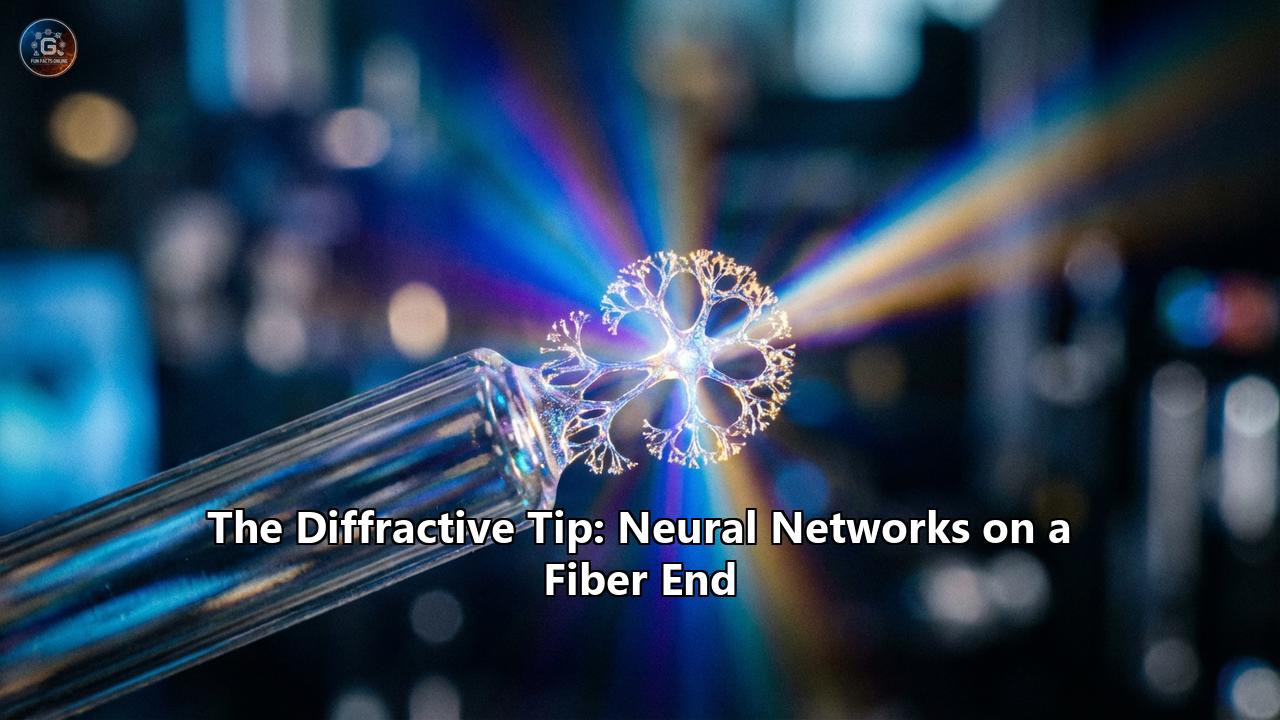
The concept of "The Diffractive Tip" answers this question. It proposes a radical shift: instead of sending data to a computer, we turn the transport medium into the computer. By fabricating complex, nano-scale diffractive elements on the tip of a fiber, we create a physical structure that acts as a Deep Neural Network (DNN). As light exits the fiber and passes through these printed layers, it diffracts—bending and interfering with itself.
This interference pattern is not random; it is a calculated mathematical operation. Just as a digital neural network multiplies inputs by weights to get an output, a diffractive optical neural network (D2NN) uses the laws of physics to "compute" the answer. When the light hits the final layer or a detector, it has already been "processed." The pattern of light is the answer.
This is "inference at the speed of light." It requires zero electrical power for the computation itself. The only energy consumed is the light source. It is the ultimate green AI, and it is happening now, on the tip of a strand of glass the width of a human hair.
Part II: The Physics of the Optical Brain
To understand how a piece of plastic or glass can "think," we must revisit the nature of light. In classical computing, a neural network consists of layers of "neurons." Each neuron takes an input, multiplies it by a "weight" (a number representing the strength of the connection), adds a bias, and passes it through a non-linear activation function.
In a Diffractive Deep Neural Network (D2NN), this mathematical abstraction becomes physical reality.
1. The Pixel as a Neuron
Imagine a tiny, transparent screen placed at the tip of the fiber. This screen is not flat; it has a rugged terrain of microscopic hills and valleys. As a wavefront of light hits this terrain, the "hills" (thicker material) delay the light's phase, while the "valleys" (thinner material) let it pass faster.
Each point on this screen acts as a secondary source of a wave, a principle known as the Huygens-Fresnel principle. The light radiating from one point interacts with light from every other point. Where peaks meet peaks, they amplify (constructive interference). Where peaks meet troughs, they cancel out (destructive interference).
By carefully designing the height of every single point on that screen, engineers can control exactly how the light interferes. A specific 3D-printed structure can be designed so that if the input light represents an image of a handwritten "3," the diffraction pattern will focus all the light onto a specific spot on a detector that corresponds to the number "3."
2. The Layers of the Mind
A single diffractive layer is like a single layer of a neural network—it can perform simple linear operations. But deep learning derives its power from depth. In the Diffractive Tip, multiple such layers are stacked on top of each other, separated by tens of microscopic wavelengths.
Light passes through the first layer, diffracts, propagates through free space (or a dedicated spacer medium), hits the second layer, diffracts again, and so on. This cascade of diffraction allows the system to approximate extremely complex, non-linear functions. The "weights" of the neural network are physically frozen into the thickness of the material. Training this network involves using a digital computer to simulate the diffraction and adjust the "height map" of the layers until the system performs the desired task. Once the design is perfected, it is printed into reality.
3. The 2025 Breakthrough: Fiber-D2NN
While earlier versions involved printing these layers on a chip, the breakthrough of 2024 and 2025, spearheaded by research groups like those at Tsinghua University and researchers in Turkey, was the integration of this logic inside and onto the fiber.
The Fiber-D2NN (Fiber-based Diffractive Deep Neural Network) utilizes the mode coupling within the fiber itself. A multimode optical fiber supports many "modes" or paths that light can take. By introducing controlled mechanical perturbations or specific index-of-refraction changes (the "weights"), researchers can force the light to mix and couple between these modes in a way that performs computation. The fiber becomes a 1D processing unit, and the tip acts as the readout layer. This effectively turns the transmission line into a deep learning processor.
Part III: Fabrication – Printing a Supercomputer on a Hair
The theoretical elegance of the Diffractive Tip is matched only by the extreme difficulty of its manufacturing. We are talking about building a skyscraper on the head of a pin, where every floor must be aligned to within a few nanometers.
1. Two-Photon Polymerization (TPP)
The hero of this manufacturing saga is a technique called Two-Photon Polymerization (TPP) or femtosecond laser 3D nano-printing. Standard 3D printers build layers by curing resin with UV light. However, the focal point of a standard UV laser is too large for the nano-scale features required for optical diffraction.
TPP uses a femtosecond laser—a laser that pulses for one quadrillionth of a second. The resin used is transparent to the laser's wavelength, meaning the beam passes right through it without curing it. However, at the very focal point of the laser, the photon density is so high that the resin molecules absorb two photons at once. This rare quantum event triggers polymerization only at that exact microscopic point (a "voxel").
By moving the laser focus in 3D space, engineers can "write" the diffractive structure directly onto the flat, cleaved end of an optical fiber. It is like using a laser pen to draw a 3D sculpture inside a drop of liquid glass.
2. The "Dip-In" Method
To print on a fiber tip, the fiber is often dipped directly into the liquid photoresist. The laser objective lens is lowered into the liquid, focusing through it to print on the fiber face. This "Dip-In" Laser Lithography (DiLL) allows for the creation of structures that are perfectly aligned with the fiber's core.
The structures printed are often towers, mesh grids, or complex phase plates that look like random noise to the human eye but are perfectly tuned lenses to the physics of light.
3. Material Challenges
The material must be optically clear, durable, and stable. The refractive index of the polymer must be precisely known. If the material shrinks by even 1% during the curing process, the "weights" of the neural network change, and the calculation fails. Recent advancements in 2024 have introduced hybrid materials—polymers doped with nanoparticles (like gold or silica) to tune the refractive index and mechanical strength, making these tips robust enough for real-world use.
Part IV: The Killer Applications
Why go through this trouble? Why not just use a GPU? The answer lies in the unique properties of the Diffractive Tip: Zero Latency, Zero Power, and Ultra-Compact Form Factor.
1. The Intelligent Endoscope: Real-Time Optical Biopsy
The most immediate and life-saving application is in medicine. Consider an endoscopy procedure to detect colorectal cancer. Currently, a doctor navigates a camera, identifies a suspicious polyp, cuts a piece off (biopsy), and sends it to a lab. The patient waits days for a result.
With a Diffractive Tip Neural Network, the endoscope doesn't just "see"; it "knows."
- The Scenario: Light illuminates the tissue. The scattered light enters the fiber tip.
- The Process: As the light enters the diffractive layers printed on the tip, it is processed. If the tissue is healthy, the light diffracts to the "left" detector. If it is cancerous, the light diffracts to the "right."
- The Result: The doctor sees a "Malignant" or "Benign" overlay on their screen in real-time, at the speed of light.
- Evidence: Research in 2024/2025 has demonstrated D2NNs capable of classifying tissue textures and specific cancer markers (like in Laryngeal cancer or LARC) with accuracies rivalling standard electronic CNNs (Convolutional Neural Networks), but with no bulky computer attached.
2. Telecommunications: The Self-Healing Signal
Our global internet backbone relies on identifying modulation formats (like QAM, PSK, OOK). As signals travel thousands of kilometers, they get distorted by noise and non-linear effects. Typically, complex Digital Signal Processing (DSP) chips at the receiver burn watts of power to clean this up.
The "Fiber-D2NN" offers a passive solution. A diffractive segment at the receiver can be trained to "undo" the distortion. It acts as an all-optical equalizer.
- 2025 Breakthrough: The Tsinghua University collaboration demonstrated a fiber neural network that successfully identified modulation formats (OOK, PAM, PSK) with 100% accuracy in noise-free conditions and high robustness in noisy ones. This was done entirely optically, avoiding the energy-heavy optical-to-electrical conversion. This could slash the energy footprint of data centers and undersea cables.
3. Robotic Surgery and Shape Sensing
In minimally invasive surgery, knowing the exact shape of a catheter inside the body is critical. Traditional methods use Fiber Bragg Gratings (FBGs) and complex algorithms.
- The Diffractive Approach: A neural network on the fiber tip can analyze the "speckle pattern"—the messy interference of light caused by the fiber bending. By training the diffractive tip to recognize these specific speckle patterns, the fiber can "feel" its own shape. It becomes a proprioceptive nerve, reporting its position to the surgical robot with micrometer precision, immune to the magnetic interference that plagues electromagnetic trackers.
Part V: The Theoretical Limit and Future Challenges
Despite the promise, the Diffractive Tip is not magic. It is bound by the laws of physics and manufacturing.
1. The Wavelength Problem
A diffractive network is typically trained for a specific wavelength (color) of light. If the light source shifts (due to temperature or laser instability), the diffraction pattern shifts, and the "answer" becomes wrong. This is the broadband challenge.
- Solution: Researchers are now designing "broadband D2NNs" that are trained to work across a range of colors. This requires deeper networks (more layers) to generalize the diffraction logic.
2. The "Fixed Brain" Limitation
Once you 3D print the tip, the neural network is frozen. It cannot "learn" new things without being physically replaced. It is a Read-Only Memory (ROM) brain.
- Future Vision: The holy grail is the Programmable Diffractive Tip. By using materials that change their refractive index with heat or electric fields (phase-change materials like GST), we could create a fiber tip that can be "updated" or "retrained" in the field. Imagine downloading a new cancer-detection algorithm and "flashing" it onto the physical tip of the endoscope.
3. Thermal Expansion
Polymers expand when heated. A 1% expansion in the diffractive layers is equivalent to stretching the brain of the computer. The interference paths change, and the accuracy drops.
- Mitigation: Developing zero-thermal-expansion photopolymers or compensating for temperature via the network design itself (training the network with "thermal noise" so it learns to ignore it).
Conclusion: The Era of Smart Matter
The Diffractive Tip represents a fundamental shift in how we view materials. We are moving from the "Age of Electronics" to the "Age of Smart Matter." We are no longer just shaping materials to be strong or transparent; we are shaping them to be intelligent.
By encoding the complex mathematics of neural networks into the microscopic topography of a fiber tip, we are distributing intelligence to the very edge of the network. We are giving eyes to the blind tools of surgery, brains to the dumb pipes of the internet, and creating a new class of sensors that compute with the pure, unadulterated speed of light.
As fabrication resolution improves and new optical materials are discovered, the definition of a "computer" will continue to blur. It will no longer be a box on a desk. It will be a transparent coating, a microscopic lens, a fiber tip—quietly, passively, and instantly solving the world's problems, one photon at a time.
Epilogue: A Day in the Life of a Smart Fiber (2035)
The year is 2035. A search-and-rescue robot snakes a thin optical tendril into the rubble of a collapsed building. The fiber tip, no larger than a grain of salt, emits a pulse of infrared light. The scattered reflection returns, passing through fifty layers of nano-printed polymer on the tip. There is no cloud connection. There is no GPU in the robot's chassis. The computation happens in the flight of the photons themselves. In less than a nanosecond, the diffractive tip processes the spectral signature of the air. The signal travels back up the fiber: "Human Breath Detected - 99.8% Confidence." The robot stops. The dig begins.(End of Article)
Reference:
- https://arxiv.org/html/2502.11885v1
- https://blog.adafruit.com/2019/08/20/optical-machine-learning-with-diffractive-deep-neural-networks-machinelearning-3dprinting-deeplearning-neuralnetworks-tensorflow-innovateucla/
- https://www.e-ce.org/journal/view.php?doi=10.5946/ce.2020.054
- https://ecancer.org/en/news/26715-new-led-based-imaging-system-could-transform-cancer-detection-in-endoscopy
- https://www.eurekalert.org/news-releases/1110940