
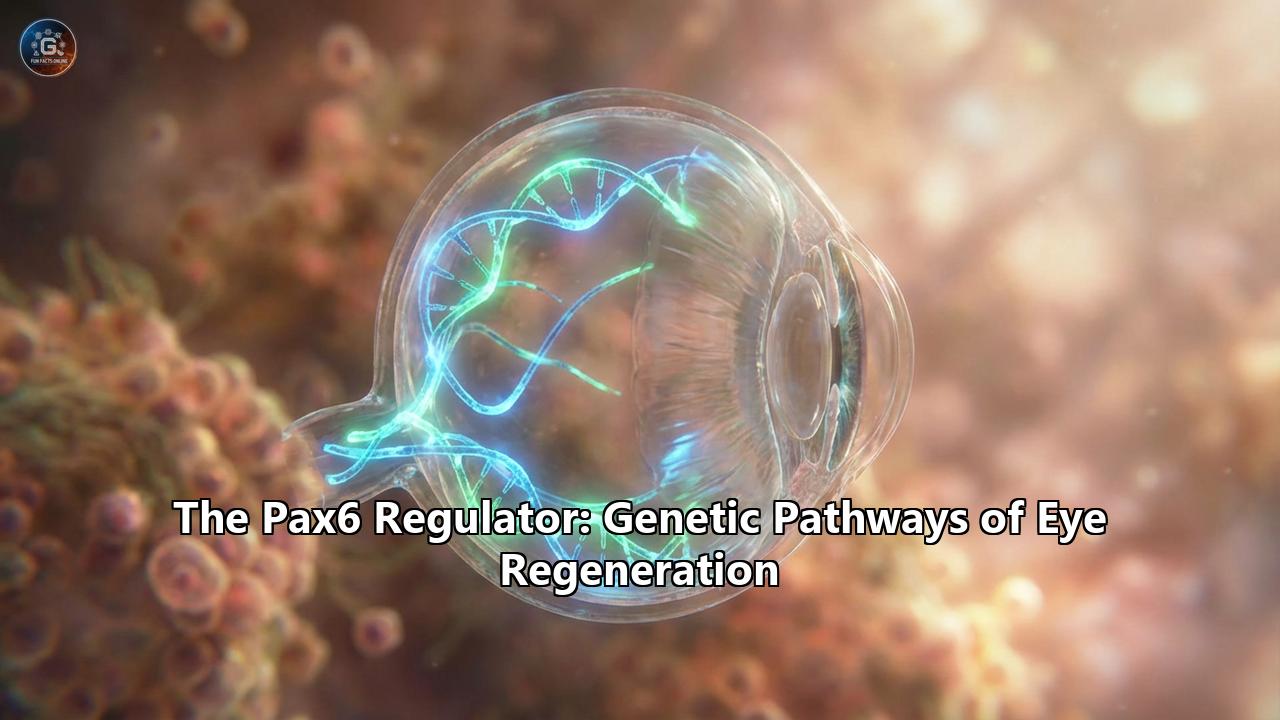
In the vast and intricate library of the genome, few chapters are as compelling or as fiercely studied as the story of the eye. For centuries, the eye was cited by theologians and philosophers as the ultimate example of "irreducible complexity"—a machine so perfect, so interdependent in its parts, that it surely could not have evolved by chance. Yet, as the molecular revolution of the late 20th century pried open the black box of genetics, a different, perhaps even more miraculous truth emerged. The eye is not a static artifact of divine engineering but the product of a dynamic, conserved, and infinitely complex genetic program. At the very center of this program sits a single gene, a "master regulator" whose presence orchestrates the symphony of sight across the animal kingdom: Pax6.
For human beings, the loss of vision is a devastating, often permanent event. Our retinas, once damaged by disease, trauma, or age, possess almost no capacity for self-repair. We scar, we degenerate, and we go blind. But this tragic biological limitation is not a universal rule of nature. In the murky ponds of North America, the red-spotted newt performs a feat that seems like magic: if you remove its lens or excise a portion of its retina, the animal does not go blind. Instead, it activates a dormant genetic sequence, rewinds the clock of cellular maturity, and grows a perfect, functional replacement within weeks.
The difference between the newt’s miraculous recovery and the human’s permanent darkness is not a difference in the parts—we share the same basic genetic toolkit. The difference lies in the wiring—the regulation, the signaling pathways, and the epigenetic locks that govern when and where genes like Pax6 are allowed to speak. This article explores the genetic pathways of eye regeneration, the pivotal role of the Pax6 regulator, and the scientific quest to unlock these dormant pathways in the human eye.
Part I: The Master Key – Biology of Pax6
To understand regeneration, we must first understand the architect. Pax6 (Paired Box gene 6) is arguably the most famous gene in developmental biology. Its discovery shattered the long-held belief that eyes evolved multiple times independently (convergent evolution). The revelation that the same gene controls eye formation in the fruit fly (Drosophila), the mouse, the squid, and the human suggested a "deep homology"—a single, ancestral origin for all seeing life.
1.1 The Molecular Anatomy of Pax6
The Pax6 gene encodes a transcription factor—a protein that binds to specific DNA sequences to turn other genes on or off. It is a molecular switch, but one of immense complexity. The Pax6 protein contains two distinct DNA-binding domains:
- The Paired Domain (PD): A highly conserved region of 128 amino acids that consists of two sub-domains (PAI and RED). This domain is unique to the Pax gene family and is responsible for the gene's ability to recognize a wide array of target sequences.
- The Homeodomain (HD): A 60-amino acid structure found in hundreds of genes (Hox genes) that regulate body patterning.
The presence of both domains allows Pax6 to act as a "bipartite" bridge, bringing together different networks of genes. It doesn't just bind to one target; it binds to hundreds, acting as a hub in a vast Gene Regulatory Network (GRN). Additionally, the protein contains a proline-serine-threonine-rich (PST) domain at the C-terminus, which acts as the transactivation domain—the part of the protein that recruits the machinery to transcribe RNA.
1.2 The "Master Control" Experiments
The reputation of Pax6 as a master regulator was cemented in the 1990s by the lab of Walter Gehring. In a series of ground-breaking experiments, they artificially expressed the mouse Pax6 gene (known as Small eye) in the legs, wings, and antennae of fruit flies. The result was the stuff of science fiction: the flies grew fully formed, compound eyes on their legs and knees. Crucially, these ectopic eyes were fly eyes, not mouse eyes. This proved that Pax6 is not a blueprint for a specific type of eye, but a universal "on" switch. It tells the tissue "build an eye here," and the tissue responds by building the type of eye encoded in its own genome.
1.3 Isoforms and Complexity
The story is not as simple as a single protein. Through a process called alternative splicing, the Pax6 gene produces multiple variations of the protein. The most notable is Pax6(5a), which includes an extra 14 amino acids inserted into the Paired Domain. This insertion alters the DNA-binding specificity of the protein, allowing it to regulate a completely different set of downstream targets. The ratio of the standard Pax6 to Pax6(5a) is critical; an imbalance in this ratio leads to severe ocular defects, highlighting that regeneration requires not just the presence of the gene, but a precise "dosage" and flavor of its protein products.
Part II: Building the Eye – Embryogenesis as a Template for Regeneration
Regeneration is often described as "recapitulating development." To regrow an eye, an animal must essentially replay the embryonic tape.
2.1 The Optic Vesicle and the Lens Placode
In the developing embryo, the eye begins as an outpouching of the neural tube called the optic vesicle. As this vesicle pushes outward, it contacts the surface ectoderm (the future skin). This contact triggers a molecular handshake mediated largely by Pax6. The surface ectoderm thickens to form the lens placode, which then invaginates to form the lens. Meanwhile, the optic vesicle folds in on itself to form the double-walled optic cup—the inner layer becomes the neural retina, and the outer layer becomes the Retinal Pigment Epithelium (RPE).
2.2 The Pax6 Gradient
During this process, Pax6 is not expressed uniformly. It forms a concentration gradient that defines territories. High levels of Pax6 are required to specify the retina and the lens. However, for the optic stalk (the future optic nerve) to form, Pax6 must be repressed by another gene, Pax2. If Pax6 remains high in the stalk, the nerve fails to form; if Pax6 is lost in the cup, the eye disappears. This delicate balance—the "Goldilocks zone" of gene expression—is exactly what must be re-established during regeneration.
Part III: The Regenerative Champions
Why can a newt regrow an eye while a human cannot? The answer lies in how these species handle the "lock" on cellular identity. In humans, once a cell becomes a retinal neuron or an iris pigment cell, it is terminally differentiated. It has exited the cell cycle forever. In regenerative species, this exit is reversible.
3.1 The Newt: Wolffian Regeneration
The most famous example of eye regeneration is found in the Urodele amphibians (newts and salamanders). If the lens of a newt is removed, a process known as Wolffian regeneration begins.
- The Source: The new lens does not grow from the remaining lens cells (which are gone). It grows from the dorsal iris pigment epithelium (IPE). These are the cells that give the newt's eye its color. They are fully differentiated, pigment-filled cells.
- Dedifferentiation: Upon injury, these IPE cells eject their nucleus-clogging pigment granules. They lose their specialized shape and revert to a stem-like state. This is dedifferentiation.
- The Role of Pax6: In the intact iris, Pax6 is expressed at low levels. Immediately after lens removal, the dorsal iris receives signals (likely FGFs and inflammatory cytokines) that cause a massive upregulation of Pax6. This surge is critical. If Pax6 is blocked, the IPE cells may proliferate, but they will never form a lens. They will just form a tumorous mass or scar tissue. Pax6 directs them to transdifferentiate—to switch lineages from pigment cell to lens cell.
3.2 The Zebrafish: The Müller Glia Awakening
Zebrafish offer a different model, one more relevant to the human retina. They regenerate the neural retina itself.
- The Source: The source of new neurons in the fish retina is the Müller glia. These are support cells that span the thickness of the retina, acting as structural and metabolic caretakers for the neurons.
- The Injury Response: When the fish retina is damaged by intense light or neurotoxins, the Müller glia detect the loss of neurons. They undergo a symmetric division: one daughter cell remains a glia, while the other becomes a multipotent progenitor.
- The Ascl1a Connection: While Pax6 maintains the identity of the progenitor pool, the "trigger" in fish is a gene called Ascl1a (Achaete-scute complex-like 1a). Ascl1a is rapidly upregulated in Müller glia after injury. It activates Lin28, a gene that represses the let-7 microRNA. Since let-7 normally keeps cells in a mature state, its removal allows the glia to "de-age" and re-enter the cell cycle.
3.3 The Flatworm: Pluripotent Reserves
Planaria (Dugesia) represent the extreme of regeneration. You can cut a planarian into 279 pieces, and each piece will regrow a whole worm, including eyes. Unlike newts (dedifferentiation) or fish (resident glia), planaria use a standing army of pluripotent stem cells called neoblasts.
In planaria, Pax6 is essential for the specification of the eye from these neoblasts. If you use RNA interference (RNAi) to silence Pax6 in a regenerating worm head, the brain and head form perfectly, but the eyes are missing. This confirms Pax6's ancient role as the specific address for "eye-ness."
Part IV: The Genetic Pathways (The Molecular Engine)
The regeneration of the eye is not a solo performance by Pax6. It is an ensemble piece involving several major signaling pathways that communicate the nature of the injury and the direction of regrowth.
4.1 The Wnt/Beta-Catenin Pathway: The Fate Switch
The Wnt pathway is one of the most crucial regulators of cell fate in the eye. During development, Wnt signaling is high in the dorsal optic cup (promoting RPE development) and low in the ventral/central cup (promoting neural retina).
- The Conflict: Pax6 and Wnt often act as antagonists. For a tissue to become a retina (or regenerate into one), Wnt signaling must be suppressed. In the chick embryo, if you artificially activate Wnt in the presumptive retina, it turns into pigmented epithelium. Conversely, removing Wnt allows RPE to transdifferentiate into retina.
- Regeneration Mechanism: In the regenerating newt lens, Wnt signaling is dynamically regulated. Initial activation may be required for proliferation, but it must be quickly dampened by Pax6 and Sox2 to allow differentiation into lens fibers.
4.2 The FGF Pathway: The Proliferation Signal
Fibroblast Growth Factors (FGFs) are the "gas pedal" of regeneration.
- Lens Induction: In the newt, the neural retina secretes FGFs. The dorsal iris, sitting close to the retina, receives this signal. This is why the lens regenerates from the dorsal iris—it is in the "FGF zone."
- Interaction with Pax6: Pax6 directly regulates the expression of FGF receptors (FGFRs). This creates a positive feedback loop: FGF signaling increases Pax6 expression, and Pax6 increases sensitivity to FGF. This loop drives the rapid expansion of the cell pool needed to build a new organ.
4.3 The Hedgehog (Shh) Pathway: Patterning the Void
Sonic Hedgehog (Shh) is the morphogen responsible for splitting the single eye field into two eyes (loss of Shh leads to cyclopia). In regeneration, Shh helps pattern the new tissue.
- Retinal Waves: As the zebrafish retina regenerates, waves of Shh expression sweep across the tissue, directing the newborn cells to become specific types of neurons (ganglion cells first, then photoreceptors).
- Pax6 Regulation: Shh is a negative regulator of Pax6 in the center of the brain but a positive maintenance factor in the periphery. Re-establishing this gradient is vital for the regenerated eye to have the correct curvature and layering.
4.4 The Hippo/YAP Pathway: Contact Inhibition
Why do human eyes scar instead of regenerating? The answer may lie in the Hippo pathway, which senses cell density. When cells are packed tightly (as in the adult eye), the Hippo pathway is active, keeping the transcriptional co-activator YAP out of the nucleus.
- Releasing the Brake: In regenerating species, injury transiently disables the Hippo pathway, allowing YAP to enter the nucleus and drive proliferation. Pax6 has been shown to interact with YAP targets to coordinate the size of the regenerating structure.
Part V: The Downstream Network – Executioners of the Pax6 Order
Pax6 sits at the top of the hierarchy, but it acts through a battery of downstream genes—the Gene Regulatory Network (GRN).5.1 The "Eye Field" Transcription Factors (EFTFs)
Pax6 does not work alone. It forms a core complex with other homeobox genes:- Rx (Retinal Homeobox): Essential for the initial proliferation of stem cells.
- Six3 and Six6: These genes repress Wnt signaling, protecting the "retina" identity from being overwritten by "brain" or "skin" identity.
- Lhx2: A LIM-homeodomain protein that functions alongside Pax6 to permit the formation of the optic cup.
In a regenerating zebrafish eye, the expression of these genes (Rx, Six3, Pax6) is re-activated in a precise temporal sequence, almost exactly mirroring embryogenesis.
5.2 Crystallins: The Building Blocks
The ultimate goal of lens regeneration is to produce crystallins—the clear, water-soluble proteins that allow the lens to refract light. Pax6 binds directly to the promoters of crystallin genes (alpha-, beta-, and gamma-crystallins). In the newt, the shift from Pax6 driving proliferation to Pax6 driving crystallin synthesis marks the end of the regenerative phase and the return to function.
5.3 Cell Cycle Regulators
For a quiescent Müller glia or pigment cell to divide, it must unlock the cell cycle. Pax6 regulates the expression of Cyclin D1 and Cyclin-dependent kinases (CDKs). It also represses p27Kip1, a cell cycle inhibitor. In mammals, this repression fails; p27Kip1 levels remain stubbornly high after injury, preventing the glia from dividing more than once.
Part VI: The Mammalian Barrier – Why We Are Blind
If humans have Pax6, Wnt, FGF, and Shh, why can’t we regenerate our eyes? The failure is not genetic absence, but epigenetic silencing.
6.1 The Epigenetic Landscape
DNA is wrapped around histone proteins. In the embryonic eye, the chromatin around regenerative genes is "open" (acetylated), allowing transcription factors like Pax6 to access the DNA. In the adult human eye, this chromatin is tightly condensed (methylated) and locked down by the Polycomb Repressive Complex.
- The Methylation Trap: When a human Müller glia is injured, it might try to activate Ascl1 or Pax6, but the promoters of these genes are buried under methyl groups. The key doesn't fit the lock.
- Zebrafish Flexibility: Zebrafish retain a "plastic" epigenetic landscape. Their injury response includes the expression of demethylases (enzymes that remove the methyl locks), allowing the regenerative program to reboot.
6.2 Gliosis vs. Regeneration
In humans, injury triggers reactive gliosis. Müller glia become hypertrophic (swollen), upregulate intermediate filaments (GFAP), and form a dense scar. This scar prevents further damage but physically blocks regeneration.
The decision between Gliosis and Regeneration is controlled by the Notch signaling pathway. Sustained, high-level Notch signaling promotes gliosis. In zebrafish, Notch is dynamically regulated—it turns on to stimulate division but then must turn off to allow differentiation. In mammals, it often gets stuck in the "on" or "off" position in a way that creates a scar.
Part VII: Therapeutic Frontiers – Hacking the Pax6 Code
The ultimate goal of this research is to restore vision in humans. Scientists are currently using the knowledge of Pax6 and its pathways to develop novel therapies.
7.1 The "Ascl1" Breakthrough
In a landmark study, researchers at the University of Washington (Tom Reh’s lab) demonstrated that the barrier is not insurmountable. By using a viral vector to force the expression of the fish gene Ascl1 in the retinas of adult mice, and simultaneously treating them with a histone deacetylase inhibitor (to loosen the chromatin), they were able to induce Müller glia to differentiate into functional interneurons.
This proved that the mammalian retina has the potential to regenerate; it just needs the right "code" to bypass the epigenetic blocks.
7.2 Pax6 Gene Therapy for Aniridia
For patients with Aniridia (a genetic condition caused by a haploinsufficiency of Pax6, leading to iris absence and corneal degeneration), the problem is a lack of Pax6 dosage.
However, gene therapy here is tricky. Pax6 is dosage-sensitive; too much is just as bad as too little. Current strategies involve:
- Nonsense Suppression: Drugs (like Ataluren) that encourage the ribosome to read through the mutation in the Pax6 gene, producing a full-length protein.
- CRISPR Activation (CRISPRa): Using a "dead" Cas9 attached to a transcriptional activator to boost the expression of the single healthy copy of Pax6 in the patient’s genome, rather than introducing a foreign gene.
7.3 Optic Cup Organoids
Perhaps the most stunning application of Pax6 biology is the creation of retinal organoids. By taking human skin cells, reprogramming them into induced pluripotent stem cells (iPSCs), and treating them with a cocktail of Pax6-inducing factors (Noggin, IGF-1), scientists can grow 3D "mini-eyes" in a dish.
These organoids spontaneously self-organize. The Pax6 field forms, the vesicle invaginates, and a layered retina develops. This confirms that the entire program for eye formation is self-contained and intrinsic to the Pax6 network. These organoids are now being used to screen drugs for retinal regeneration and to generate sheets of photoreceptors for transplantation.
Conclusion: The Future of the Regenerating Eye
The study of Pax6 has taken us from the philosophical musings on the perfection of the eye to the gritty, molecular reality of gene regulatory networks. We now know that the "miracle" of regeneration is a tangible, mechanical process—a sequence of switches, levers, and gears that can be mapped, understood, and potentially reverse-engineered.
The Pax6 regulator is the conductor of this orchestra. From the deep time of evolutionary history to the cutting edge of CRISPR therapeutics, it remains the central figure in the story of sight. While humans have evolutionarily traded regenerative capacity for stability and metabolic efficiency, the keys to the kingdom are still hidden in our DNA. By deciphering the crosstalk between Pax6, Wnt, Shh, and the epigenetic landscape, we are inching closer to a future where blindness is not a permanent sentence, but a temporary state—a glitch that can be repaired by reawakening the master regulator within.
The newt in the pond, regrowing its lens in the murky water, is no longer just a curiosity of nature. It is a blueprint. And piece by piece, gene by gene, we are learning to read it.
Reference:
- https://pubmed.ncbi.nlm.nih.gov/10766016/
- https://pmc.ncbi.nlm.nih.gov/articles/PMC1595439/
- https://pmc.ncbi.nlm.nih.gov/articles/PMC5468661/
- https://pmc.ncbi.nlm.nih.gov/articles/PMC2556859/
- https://www.jyi.org/1998-december/2001/11/28/a-review-of-the-highly-conserved-pax6-gene-in-eye-development-regulation
- https://pmc.ncbi.nlm.nih.gov/articles/PMC3544819/
- https://pmc.ncbi.nlm.nih.gov/articles/PMC4304700/
- https://pmc.ncbi.nlm.nih.gov/articles/PMC8384111/
- https://en.wikipedia.org/wiki/Sonic_hedgehog_protein
- https://pmc.ncbi.nlm.nih.gov/articles/PMC6947179/