
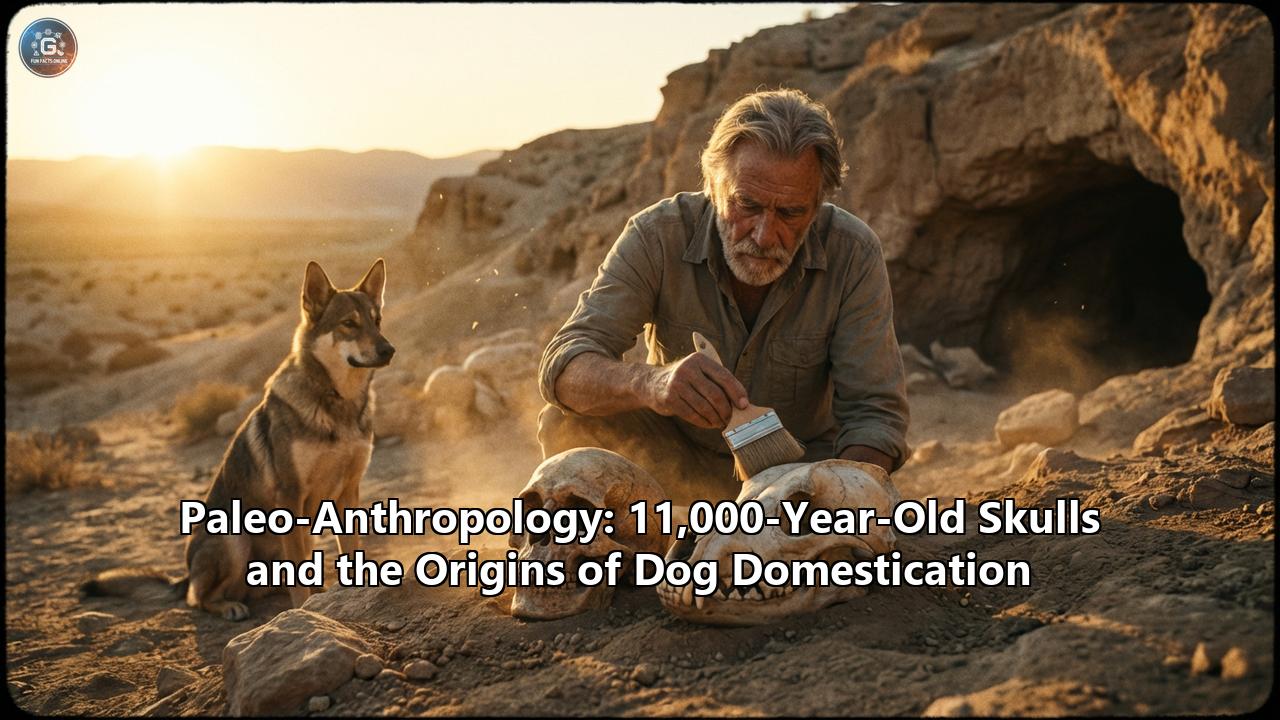
In the cold, waterlogged earth of Northwestern Russia, beneath layers of peat that have accumulated over millennia, a silent revolution lay buried. It was not a revolution of bronze swords or golden crowns, nor of great stone monuments that scrape the sky. It was a revolution of bone and spirit, preserved in the form of a skull—a canine skull, crushed by time but retaining the undeniable signature of a new era. This was not the skull of a wolf, the apex predator that had stalked the nightmares of early humans for hundreds of thousands of years. It was something else. Something smaller, wider, and curiously reshaped. It was the skull of a dog, a creature that had crossed the invisible line from wild adversary to domestic partner.
Dated to approximately 11,000 years ago, this fossil from the Veretye site is more than just a biological curiosity; it is a key that unlocks one of the most profound mysteries in human history. It speaks of a time when the glaciers were retreating, when the world was waking up from the long sleep of the Ice Age, and when humanity made a decision that would forever alter the trajectory of life on Earth: we invited the wild into our homes.
This article delves into the depths of paleo-anthropology to explore the origins of dog domestication. We will journey from the peat bogs of Russia to the arid deserts of Jordan, from the caves of the Altai Mountains to the river valleys of the Americas. We will examine the controversial "proto-dogs" of the deep Paleolithic, the functional hunters of the Neolithic, and the emotional bonds revealed by ancient burials. Through the lens of these 11,000-year-old skulls, we will reconstruct the story of how the wolf became the dog, and in doing so, how we became truly human.
Chapter 1: The Biological Enigma – Wolf vs. Dog
To understand the significance of an 11,000-year-old dog skull, one must first appreciate the biological chasm that separates Canis lupus (the gray wolf) from Canis lupus familiaris (the domestic dog). To the untrained eye, the bones might look identical. A wolf is a dog; a dog is a wolf. They share 99.9% of their DNA. They can interbreed and produce fertile offspring. Yet, in the eyes of a paleo-anthropologist, they are worlds apart.
The Morphometric KeyThe primary tool used to distinguish these ancient remains is a technique called geometric morphometrics. Unlike simple caliper measurements which just record length and width, this method maps the geometry of the skull in 3D space, analyzing the relationships between dozens of "landmarks"—specific anatomical points on the bone.
When researchers applied this technique to the Veretye skulls and others from the same era, a distinct pattern emerged. The ancient dog skulls were not merely "small wolves." They possessed a unique morphology that signaled a fundamental shift in their biology and behavior.
- The Shortened Snout: The most obvious change was rostral shortening. The long, powerful snout of the wolf, designed for bringing down elk and bison, had retracted. This crowding of the face often led to overlapping teeth, a trait rarely seen in wild wolves but common in domestic dogs.
- The Wider Braincase: While the overall brain size of dogs eventually shrank compared to wolves (a phenomenon known as the "domestication syndrome"), these early dogs often showed a widening of the cranium and the palate.
- The Orbital Angle: The angle of the eye sockets (orbits) shifted. Wolves have eyes that are angled more to the side, optimizing their peripheral vision for scanning the horizon. Dogs, even these ancient ones, began to show eyes that were oriented more forward, a trait that facilitates binocular vision and—crucially—eye contact with humans.
Why did these changes happen? The prevailing theory is that they are byproducts of selection for tameness. When humans (or the dogs themselves) selected for animals that were less aggressive and less fearful, they were inadvertently selecting for retained juvenile traits, a process called paedomorphism. A puppy has a shorter snout and wider head than an adult wolf. By selecting for "eternal puppies" in terms of behavior, humans created animals that looked like eternal puppies in terms of bone structure.
The 11,000-year-old skulls from Veretye are the "smoking gun" of this process. They prove that by this date, dogs were not just tamed wolves; they were a genetically and morphologically distinct population. They had been living apart from wolves long enough for evolution to reshape their very bones.
Chapter 2: False Dawns – The "Proto-Dog" Controversy
The story of dog domestication is not a straight line; it is a tangled web of dead ends and false starts. Before we arrive at the definitive evidence of 11,000 years ago, we must confront the ghosts of the deep past: the "proto-dogs" of the Paleolithic.
The Goyet Cave Enigma (31,700 BP)In the 1860s, a peculiar canid skull was unearthed in Goyet Cave, Belgium. For over a century, it sat in a museum drawer, mislabeled as a wolf. It wasn't until modern paleontologist Mietje Germonpré re-examined it that the scientific world was rocked. The skull was dated to 31,700 years ago—deep in the Aurignacian period, when Neanderthals had only recently vanished and modern humans were painting lions on cave walls.
The Goyet skull was robust, but it had a snout that was significantly shorter and wider than any known Ice Age wolf. Germonpré and her colleagues argued that this was a "Paleolithic dog," an animal that lived with the Aurignacian mammoth hunters.
The Altai Dog (33,000 BP)Thousands of miles away, in the Razboinichya Cave of the Altai Mountains in Siberia, another skull told a similar story. Dated to 33,000 years ago, this specimen showed even more dog-like traits. DNA analysis suggested it was more closely related to modern dogs and New World canids than to contemporary wolves. It seemed the case was closed: dogs were domesticated over 30,000 years ago.
The "Aborted" DomesticationHowever, the recent comprehensive study of 11,000-year-old skulls has cast a shadow of doubt over these ancient claimants. When the 3D morphometric data of the Veretye dogs was compared to the Goyet and Altai skulls, a clear distinction appeared. The 11,000-year-old dogs clustered tightly together as a distinct group. The 30,000-year-old "proto-dogs," however, fell into a grey area. They were not quite wolves, but they were not quite dogs either.
The leading consensus now is that these ancient creatures represent "incipient dogs" or unique "wolf ecomorphs." They may have been wolves that started down the path of domestication, scavenging off the kills of Paleolithic hunters, perhaps even traveling with them. But they were evolutionary dead ends. When the Last Glacial Maximum (LGM) hit around 26,000 years ago, the ice sheets expanded, prey became scarce, and human populations contracted. In the harsh crucible of the LGM, these early experiments in friendship likely failed. The "proto-dogs" died out, leaving no genetic legacy in modern dogs.
The lineage that would become our pets, our working partners, and our best friends did not truly establish itself until the ice began to melt. It was only after the LGM, as the world warmed, that the dog truly came to stay.
Chapter 3: The Veretye Revelation – Life in the Mesolithic Forest
This brings us back to Veretye, the site that anchors our 11,000-year timeline. Located in the forest zone of Northwestern Russia, near Lake Onega, the Veretye site offers a window into a world in transition.
The Site and the CultureThe Veretye culture (c. 9,000 BC) was a society of complex hunter-gatherer-fishers. Unlike the nomadic mammoth hunters of the previous era, these people were semi-sedentary. They built substantial dwellings of wood and bark, taking advantage of the rich resources of the boreal forest and the teeming waters of the post-glacial lakes.
Thanks to the preservation qualities of the peat bog, archaeologists have recovered not just stone tools, but organic artifacts that usually rot away: wooden bows, arrow shafts, fishing nets made of plant fiber, and magnificent tools made of bone and antler. They carved "mace-heads" with mysterious holes and created figurines that hint at a rich spiritual life, likely animistic, seeing spirits in the trees, the water, and the animals.
The Skulls of VeretyeIn this water-rich, forest-dense environment, dogs were not just luxuries; they were essential survival tools. The skulls found here, specifically the three key specimens analyzed in the recent University of Exeter/CNRS study, show a population of dogs that were already highly specialized.
These were not the uniform, generic "village dogs" one might expect. They showed variation in size and shape, suggesting that even 11,000 years ago, humans might have been unconsciously selecting dogs for different roles. A smaller, more compact dog might be better for flushing birds or fitting in a canoe. A larger, more robust dog might be needed for protection against bears or for hauling sleds.
The Veretye dogs smash the old Victorian idea that "dog breeds" are a modern invention. While they didn't have Pugs and St. Bernards, the Veretye people had dogs that were morphologically distinct from wolves and distinct from each other. They were adapting to the specific ecological niche of the Russian forest, a niche defined by their partnership with humans.
Chapter 4: The Hare Hunters of Jordan – The Functional Revolution
While the Veretye dogs were navigating the Russian taiga, a different drama was unfolding thousands of miles to the south, in the arid landscapes of the Levant. Here, at a site called Shubayqa 6 in northeastern Jordan, we find evidence of why humans might have finalized the domestication pact.
The Younger Dryas CrisisTo understand Shubayqa 6, we must understand the climate. Around 12,900 years ago, the warming world suddenly snapped back into a near-glacial state known as the Younger Dryas. The Levant, which had been lush and bountiful, became dry and cold. The large game animals that humans had relied on for millennia became scarce.
The Natufian people who lived here were forced to adapt. They couldn't just hunt gazelle anymore. They had to broaden their diet, a shift known as the "Broad Spectrum Revolution." They began to target smaller, faster prey: waterfowl, tortoises, and especially hares.
The Dog as a TechnologyCatching a gazelle requires stealth and a bow. Catching a hare requires speed and agility—traits that humans lack but wolves possess in abundance.
At Shubayqa 6, dated to roughly 11,500 years ago, archaeologists noticed a spike in hare bones. But these weren't just any bones. Many of them had been digested. They were pitted and corroded by stomach acid, but they were too large to have been swallowed by humans. They had been eaten by dogs.
This evidence paints a vivid picture of daily life. The people of Shubayqa 6 were living with dogs. These dogs were roaming the settlement, scavenging waste, and defecating on the site (which is how the digested bones were preserved). But they were more than scavengers. The explosion in hare hunting suggests that these dogs were hunting partners.
Imagine the scene: A Natufian hunter sets out into the scrubland. He cannot outrun a hare. But his dogs can. They flush the prey, drive it toward nets or simply run it down, allowing the hunter to secure the kill. In exchange, the dogs get the offal, the bones, and the safety of the campfire. This was a symbiotic relationship forged in the necessity of a changing climate. The dog was the ultimate technology for small-game hunting.
Chapter 5: Across the Land Bridge – The First American Dogs
The story of the 11,000-year-old dog is not limited to Eurasia. It is a global phenomenon that tracked the migration of humans into the New World. For decades, archaeologists believed that dogs arrived in the Americas much later than humans. But new discoveries have rewritten that timeline, linking the first Americans inextricably with their canine companions.
The Koster Site, IllinoisIn the lush Illinois River valley, the Koster site has yielded some of the most remarkable evidence of early dogs in the Americas. Deep in the archaeological horizons, researchers found the skeletons of four dogs. These were not the remains of meals; they were carefully buried in shallow pits.
Radiocarbon dating places these dogs at approximately 10,000 years ago (and potentially older depending on calibration and associated layers). These dogs were small to medium-sized, weighing between 25 and 35 pounds—compact, agile animals suited for travel.
The MigrationThe presence of domesticated dogs at Koster 10,000 years ago implies that their ancestors must have crossed the Bering Land Bridge (Beringia) with the first human migrants thousands of years earlier. There were no wolves in North America that could have been domesticated into these specific dog forms; the genetic lineage of American dogs points back to Eurasian roots.
This means that when the first Paleo-Indians trekked across the frozen wastes of Beringia, facing ice walls and megafauna, they did not do it alone. They had dogs. These dogs likely served as sentries, pack animals carrying supplies (the travois pre-dates the wheel), and hunting aides. They were the "biological engine" of the migration, helping humans conquer a new continent.
Chapter 6: The Science of Separation – Ancient DNA
The 11,000-year-old skulls provide the morphological evidence, but ancient DNA (aDNA) provides the genealogical proof. The recent sequencing of genomes from these ancient dogs has revolutionized our understanding of their history.
The Five LineagesA landmark study published in Science (referencing the work of Bergström et al. and the Exeter/CNRS team) revealed a stunning fact: by 11,000 years ago, there were already at least five distinct genetic lineages of dogs in the world.
- Neolithic Levantine: The ancestors of the dogs at Shubayqa and modern Middle Eastern breeds.
- Mesolithic Karelian: The lineage found at Veretye and other Russian sites.
- Mesolithic Baikalian: Dogs from the Lake Baikal region in Siberia.
- Ancient American: The dogs that crossed into the New World.
- New Guinea/Dingo Ancestors: The lineage that would eventually travel to Oceania.
This genetic diversity is shocking. For five distinct lineages to exist 11,000 years ago, the common ancestor of all dogs must have lived much earlier—perhaps 15,000 to 20,000 years ago. It implies that the "bottleneck" of domestication happened long before the end of the Ice Age.
It also refutes the "Dual Origin" theory which once suggested dogs were domesticated twice (once in Europe, once in Asia). The genomic data now strongly supports a single domestication event from a wolf population that is now extinct. Modern wolves are not the ancestors of dogs; they are cousins. The true "dog-father" wolf is a ghost lineage, vanished from the earth, living on only in the DNA of the Chihuahua, the Great Dane, and the Veretye fossil.
Chapter 7: From Scavenger to Soulmate – The Burial Evidence
We have spoken of skulls, genes, and hunting strategies. But what of the heart? Did these ancient people love their dogs? The archaeological record, usually so cold and objective, offers touching proof that they did.
The Ain Mallaha Puppy (12,000 BP)At the Natufian site of Ain Mallaha in Israel, predating the Shubayqa hunting dogs by a few centuries, archaeologists found a tomb that speaks across the ages. It contained the skeleton of an elderly woman. Her hand was resting gently on the body of a small puppy, curled up beside her head.
This was not a functional relationship. A puppy is useless for hunting. It is a burden. Yet, this woman—or her family—chose to bury it with her, granting it the same rites of passage as a human. It suggests that even at the very dawn of domestication, the dog was seen as a companion, a member of the social unit, a soul worthy of respect.
The Bonn-Oberkassel Dog (14,000 BP)In Germany, an even older grave contained a man, a woman, and a dog. Re-analysis of this dog's bones revealed that it had suffered from canine distemper as a puppy. It would have been sick, incapacitated, and unable to fend for itself for weeks. It should have died.
But it didn't. It survived to adulthood. The only way this is possible is if humans nursed it. They brought it water, fed it food, and kept it warm while it was useless to them. They cared for it not because of what it could do, but because of what it was. This is the earliest evidence of veterinary care, and the earliest evidence of love between species.
The Veretye and Koster BurialsAt Veretye and Koster, dogs were often buried individually or in groups, sometimes with grave goods. In the Koster site, the dogs were laid on their sides in sleeping poses, in graves that were dug specifically for them in the same cemetery as the humans. They were not discarded in the trash middens like the bones of deer or fish. They were laid to rest. This distinction—between "garbage" and "burial"—is the archaeological line between "livestock" and "kin."
Chapter 8: The "Hidden" Origin – Why We Can't Find the First Dog
If dogs were well-established and diverse 11,000 years ago, where is the first dog? Why can't we find the "missing link" skull that is 50% wolf and 50% dog?
The answer lies in the nature of evolution and the limits of preservation. The process of domestication was likely gradual. It didn't happen in a single generation. It happened over thousands of years of commensalism—wolves hanging around camps, brave individuals getting closer, humans tolerating them.
For the first few thousand years, these "proto-dogs" would have looked exactly like wolves. Their bones would be indistinguishable. It was only after they became reproductively isolated—perhaps by moving into new environments with humans, away from wild wolf packs—that their morphology began to shift.
The "proto-dogs" of Altai and Goyet might represent failed experiments, lineages that started the process but were wiped out. The true ancestors of modern dogs likely emerged from a small population of wolves in late Pleistocene Eurasia, and their bones either haven't been found or are sitting in a museum drawer, labeled "Wolf," waiting for a researcher with a 3D scanner to unlock their secrets.
Epilogue: The 11,000-Year Promise
The 11,000-year-old skulls from Veretye, Shubayqa, and beyond are not just fossils. They are the founding documents of the Anthropocene. They mark the moment when humans ceased to be just another animal in the food chain and became the architects of the biosphere.
By 11,000 years ago, the pact was sealed. We gave them fire, food, and friendship. They gave us their speed, their senses, and their loyalty. They guarded our first settlements, helped us hunt the meat that fueled our growing brains, and pulled the sleds that allowed us to conquer the Arctic.
When you look at a modern dog—whether it is a wolf-like Husky or a flat-faced Pug—you are looking at the legacy of those Mesolithic pioneers. The variety we see today, often attributed to Victorian breeders, has its roots in the deep past. The Veretye skulls prove that diversity is not new; it is ancient. The desire to shape our companions, and to be shaped by them in return, is as old as civilization itself.
In the end, the story of these skulls is not really about dogs. It is about us. It is the story of how we learned to trust the "other," how we found companionship in the wild, and how, in the cold light of the post-glacial dawn, we decided that we did not want to walk the path of history alone.
Glossary of Key Terms
- Geometric Morphometrics: A method of analyzing shape using 3D coordinates of landmarks, allowing for more detailed comparison than linear measurements.
- Paedomorphism: The retention of juvenile traits into adulthood. In dogs, this manifests as shorter snouts, wider heads, and playful behavior.
- Commensalism: A relationship where one species benefits (the dog getting food scraps) while the other is neither helped nor harmed (initially), which likely led to domestication.
- Natufian: An Epipaleolithic culture in the Levant (c. 12,500–9,500 BC) that was sedentary before the advent of agriculture, known for early dog associations.
- Younger Dryas: A return to glacial conditions around 12,900–11,700 years ago, which stressed human populations and may have accelerated dog domestication for hunting efficiency.
- Beringia: The land bridge that once connected Siberia and Alaska, across which humans and early dogs migrated to the Americas.
Reference:
- https://www.smithsonianmag.com/smart-news/people-buried-their-dogs-them-4000-years-ago-180971502/
- https://www.thestar.com.my/lifestyle/living/2026/01/05/dogs-changes-in-size-and-shape-began-at-least-11000-years-ago
- https://www.history.com/articles/early-americans-buried-their-dogs-like-family
- https://en.wikipedia.org/wiki/Paleolithic_dog
- https://www.natureasia.com/en/nmiddleeast/article/10.1038/nmiddleeast.2019.13
- https://www.sciencenews.org/article/dogs-may-have-helped-ancient-middle-easterners-hunt-small-game
- https://en.wikipedia.org/wiki/Natufian_culture
- http://socialdemocracy21stcentury.blogspot.com/2017/07/the-natufians-and-origins-of.html
- https://en.wikipedia.org/wiki/Younger_Dryas
- https://ccrs.ku.dk/news/2019/11500-year-old-animal-bones-in-jordan-suggest-early-dogs-helped-humans-hunt
- https://www.futurity.org/dogs-hunting-1958842/
- https://geneticliteracyproject.org/2018/04/25/early-north-american-settlers-brought-dogs-more-than-10000-year-ago/
- https://people.com/pets/archaeologists-discover-dog-remains-buried-next-to-human-sweden/
- https://www.forbes.com/sites/davidanderson/2019/02/08/new-analyses-reveal-humanitys-more-than-10000-year-history-with-dogs/
- https://earthsky.org/earth/dogs-arrived-in-americas-only-10000-years-ago-says-study/
- https://www.sciencedaily.com/releases/2026/01/260106001920.htm