
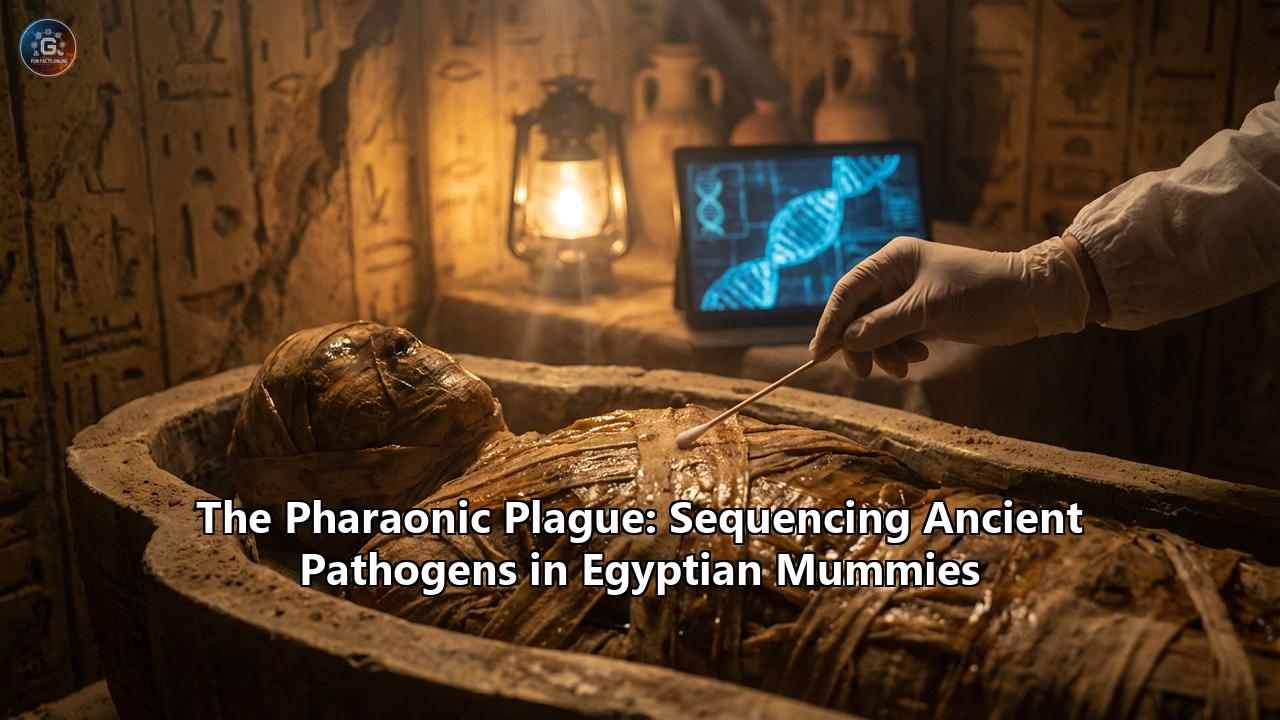
In the hushed, climate-controlled halls of the Museo Egizio in Turin and the Egyptian Museum in Cairo, a revolution is taking place. It is not fought with chariots or khopeshes, nor is it recorded on the limestone walls of temples. It is a silent revolution, taking place at the molecular level, inside the crumbling bone marrow and desiccated tissues of Egypt’s most famous dead. For centuries, Egyptologists relied on inscriptions, statues, and the physical examination of mummies to understand the lives and deaths of the Pharaohs. They looked at a withered leg and guessed "polio." They looked at a pustule-scarred face and guessed "smallpox." They read the Ebers Papyrus and imagined the fevers that swept along the Nile.
But guessing is over.
We have entered the age of Paleomicrobiology. By deploying the cutting-edge tools of Next-Generation Sequencing (NGS) and shotgun metagenomics, scientists are finally unlocking the microscopic secrets trapped within the wrappings of the mummies. They are resurrecting the genetic codes of the bacteria and viruses that plagued the ancient world, proving that the "Curses of the Pharaohs" were not supernatural spells, but very real, very biological, and often very deadly pathogens.
From the malaria that racked the body of King Tutankhamun to the Yersinia pestis bacteria recently discovered in the deep tissues of a 3,000-year-old mummy, this is the story of how modern science is rewriting the medical history of Ancient Egypt.
Part I: The Science of Resurrection
To understand the magnitude of these discoveries, we must first understand the battlefield. Ancient DNA (aDNA) is not like the pristine DNA extracted from a living blood sample. It is fragmented, chemically damaged, and overwhelmingly contaminated.
The Challenge of Time
When an organism dies, its DNA repair mechanisms cease. Enzymes inside the cell, called nucleases, begin to chop the long strands of the genome into tiny ribbons. Over thousands of years, heat—the enemy of DNA preservation—accelerates this decay. In the searing heat of the Valley of the Kings, where temperatures can soar above 40°C (104°F), the chemical bonds of the DNA molecule break down rapidly. What remains are "ghost sequences": short, battered fragments of code, often less than 50 base pairs long.
To make matters worse, a mummy is a biological crowded house. For every fragment of human DNA remaining in a sample, there are millions of fragments of bacterial and fungal DNA from the environment. A sample taken from a mummy’s rib might be 99% soil bacteria and only 1% ancient human or pathogen DNA.
The Metagenomic Revolution
In the early days of paleogenetics (the 1990s and 2000s), scientists used a technique called PCR (Polymerase Chain Reaction) to "fish" for specific genes. If they suspected malaria, they would cast a "hook" (a primer) designed to catch malaria DNA. If the hook came up empty, they concluded the disease was absent. But this method was prone to contamination and limited by what scientists expected to find.
Enter Shotgun Metagenomics. Instead of fishing for a specific shark, this technique drains the entire ocean and sorts every fish. Scientists extract all the DNA from a sample—human, bacterial, viral, plant, and fungal—and sequence it all at once. They then use powerful algorithms to match these billions of fragments against databases of known organisms.
This "unbiased" approach allows for unexpected discoveries. You might be looking for the genetic signature of a Pharaoh, but in the background noise of the data, you find the distinct genomic fingerprint of Mycobacterium tuberculosis or Yersinia pestis. It is forensic science on a scale of millennia.
Part II: The Black Death on the Nile
For decades, historians believed that the Bubonic Plague—the "Black Death" that decimated Medieval Europe—was a relatively "new" apocalyptic event, or at least one that ravaged Europe and Asia long before it touched Africa. The Ebers Papyrus (c. 1550 BCE) describes a disease that "produced a bubo, and the pus has petrified," but without biological evidence, this was mere speculation.
In December 2024, that changed forever.
A team of researchers dropped a bombshell at the European Meeting of the Paleopathology Association. They had analyzed a 3,290-year-old mummy housed in Italy’s Museo Egizio. The individual, an adult male dating back to the end of the Second Intermediate Period or the early New Kingdom, had died in agony.
The Discovery
Using shotgun metagenomics on samples from the mummy’s bone tissue and intestinal contents, the team found the unmistakable genetic signature of _Yersinia pestis_.
This was not just a trace. The abundance of DNA suggested the bacteria had flooded the man's bloodstream—a condition known as septicemic plague. This man did not just carry the disease; he died from it. This discovery represents the oldest confirmed case of the plague outside Eurasia, shattering previous timelines of the disease's spread.
The Implications
This finding rewrites the map of ancient epidemiology. It suggests that the "plague" was not a distant rumor in the time of the Pharaohs but a present and lethal danger. It lends terrifying credence to the "plague years" often associated with the end of the Bronze Age, a period of societal collapse across the Mediterranean.
How did it get there? The genetic analysis points to a transmission route involving the Nile rat (Arvicanthis niloticus). The fleas on these rats likely carried the bacteria, thriving in the grain stores that were the lifeblood of the Egyptian economy. When the grain ships sailed down the Nile, they carried death in their cargo holds.
Part III: The Boy King’s Fever
No mummy has been scrutinized more than Tutankhamun. When Howard Carter opened his tomb in 1922, he found a king surrounded by unimaginable wealth but also a king who looked... frail.
For decades, theories about Tutankhamun’s health ran wild. Was he murdered? Did he die of a chariot crash? Did he have Marfan syndrome? In 2010, a landmark study led by Zahi Hawass and published in the Journal of the American Medical Association (JAMA) finally peered into the king’s blood.
The Malaria Cocktail
The team performed genetic analysis on Tutankhamun and several family members. Deep within the 18-year-old king's tissues, they found DNA specific to _Plasmodium falciparum_—the parasite that causes the most severe form of malaria, Malaria tropica.
But it wasn’t just a single infection. The genetic diversity suggested that Tutankhamun had been infected multiple times throughout his short life. He was suffering from a severe, chronic load of malaria at the time of his death.
A Body at War with Itself
The autopsy revealed a tragic picture. Tutankhamun had a clubfoot (equinovarus) and suffered from Köhler disease II, a painful bone necrosis that was destroying the tissue in his left foot. He would have walked with a severe limp, explaining the 130 walking canes found in his tomb—many of which showed signs of heavy wear.
The genetic evidence paints a harrowing final timeline: A young man, immune-compromised by inbreeding (genetic testing confirmed his parents were brother and sister), fighting a chronic bone disease, who then contracts a virulent strain of malaria. A sudden leg fracture, likely from a fall, was the final blow. His body, weakened by the parasite, could not fight off the infection and shock. The "Boy King" didn't die from a romantic curse; he died from the biting reality of the ancient Nile ecology.
Part IV: The Pox of the Pharaohs
One of the most visually striking mummies is that of Ramses V (died c. 1157 BCE). When his mummy was unwrapped, researchers were startled by the state of his skin. His face, neck, and chest were covered in raised, pustular lesions.
For over a century, this has been the "textbook case" of Smallpox in the ancient world. If true, it would be one of the earliest examples of the disease.
The Genetic Controversy
While visual diagnosis via electron microscopy has strongly suggested smallpox (showing brick-shaped virus-like particles), definitive DNA sequencing of the Variola virus from Ramses V has remained elusive.
This highlights a major challenge in the field. Poxviruses are incredibly durable, but their DNA is not immortal. A 2016 study on a 17th-century Lithuanian child mummy provided the first complete sequence of ancient smallpox, and interestingly, that strain was distinct from modern forms. This has led some geneticists to question if the "smallpox" of Ancient Egypt was the same virus we eradicated in 1980, or an ancestral "pox-like" pathogen that later evolved into the Variola major we know.
Furthermore, a cautionary tale emerged in 2018 when researchers sequenced a 16th-century Italian mummy suspected of having smallpox based on a rash. The DNA revealed it was actually Hepatitis B, which can cause a rash known as Gianotti-Crosti syndrome. Until Ramses V’s lesions yield a full genome sequence, his diagnosis remains "highly probable" but scientifically provisional—a cold case waiting for the next leap in technology.
Part V: The Scourge of the Nile (Schistosomiasis)
While plague and smallpox grabbed headlines, the true killer of the Egyptian people was a slow, grinding parasite: the blood fluke Schistosoma.
Living in the Nile Valley meant living in contact with water. Farmers waded into irrigation canals; children played in the river; fishermen cast their nets. In doing so, they exposed themselves to the larvae of this parasite, which burrows through human skin, enters the bloodstream, and lays thousands of eggs in the organs.
The First Molecular Proof
For years, calcified eggs found in mummies were the only evidence. But recent studies have sequenced the DNA of _Schistosoma mansoni_ and _Schistosoma haematobium_ directly from the livers and kidneys of mummies.
One famous case is the mummy of Nekht-Ankh (Middle Kingdom). Molecular analysis of his liver detected S. mansoni DNA, confirming he suffered from a chronic, debilitating infection. The texts speak of the "AAA" disease (pronounced a-a-a), characterized by blood in the urine—a classic symptom of S. haematobium as the eggs tear through the bladder wall.
The sequencing of these parasites confirms that this was an endemic burden. The lethargy, anemia, and poor growth seen in so many commoner mummies were likely caused by this worm. It was a disease of the state's success: the very irrigation systems that made Egypt the "breadbasket of Rome" also turned it into a breeding ground for snails, the intermediate host of the parasite.
Part VI: Forensic DNA and the Harem Conspiracy
Not all sequencing is about disease; sometimes, it is about murder.
The Harem Conspiracy Papyrus tells the scandalous tale of a plot to slash the throat of Ramses III (c. 1155 BCE) so that a minor wife, Tiye, could place her son Pentawere on the throne. History records the trial, but for a long time, it was unclear if the coup succeeded or if the king survived.
The Screaming Mummy
In 2012, a team led by Zahi Hawass and Albert Zink performed CT scans and DNA analysis on Ramses III and a mysterious, unidentified mummy known as "Unknown Man E," often called the "Screaming Mummy" because of his open mouth and contorted face.
The CT scan of Ramses III revealed the truth: a deep, wide cut across his throat, severing the trachea, esophagus, and large blood vessels. He had been assassinated.
But who was Unknown Man E? He was buried hastily, wrapped in a ritually impure goatskin, and his body showed signs of death by strangulation or hanging. DNA analysis solved the mystery. The Y-chromosome markers and autosomal genetic fingerprinting confirmed that Unknown Man E was, indeed, the son of Ramses III.
The genetic data aligned perfectly with the historical text: Pentawere was found guilty and forced to commit suicide (likely strangulation). The DNA provided the final piece of evidence in a 3,000-year-old regicide investigation, identifying the victim and the perpetrator.
Part VII: The White Plague (Tuberculosis)
Tuberculosis (TB) is often called the "Captain of All These Men of Death." It leaves tell-tale signs on bones, specifically "Pott’s Disease," where the bacteria eat away the vertebrae, causing the spine to collapse.
Geneticists have successfully amplified Mycobacterium tuberculosis complex DNA from Egyptian mummies dating back to the Early Dynastic period (c. 3000 BCE). One particular study of a high-status tomb in Thebes found that TB was not just a disease of the poor; it afflicted the wealthy, who lived in crowded palaces just as it did the workers in crowded villages.
Interestingly, the strains sequenced from ancient Egypt appear to be ancestral to modern human TB, but distinct from M. bovis (cattle TB). This challenges the old theory that humans got TB from domesticating cows. Instead, the genomic data suggests TB may have been a human disease that we gave to animals, or that the two evolved in parallel.
Part VIII: The Future of the Past
The field of paleomicrobiology is accelerating. We are moving from identifying single pathogens to reconstructing entire microbiomes.
Recent studies on the dental calculus (hardened plaque) of mummies are revealing the complex communities of bacteria that lived in their mouths. These "fossilized" bacterial colonies tell us about their diet (rich in carbohydrates from bread and beer, leading to cavities), their oral health, and even the opportunistic pathogens that lived in their respiratory tracts.
We are also beginning to see the first successful sequencing of ancient viruses beyond smallpox, such as Hepatitis B and potentially ancient strains of Human T-lymphotropic virus (HTLV).
Why It Matters
Why spend millions sequencing the diseases of the dead? Because pathogens evolve. By sequencing the Plasmodium in King Tut or the Yersinia in a 3,000-year-old mummy, we are building a "family tree" of these killers. We can see how they mutated over thousands of years to evade our immune systems.
In an era of emerging pandemics, this deep-time perspective is invaluable. It helps us understand the clockwork of mutation and transmission. The mummies of Egypt are no longer just silent witnesses to history; they are biological archives, waiting to warn us about the future by revealing the microscopic monsters of the past.
The Pharaohs sought eternal life. In a strange, scientific twist, they have achieved it. Their genes—and the genes of the things that killed them—are speaking to us again.
Reference:
- https://www.researchgate.net/figure/dentification-of-Plasmodial-DNA-in-18th-Dynasty-Mummies_fig7_41451669
- https://egittolizzando.altervista.org/wp-content/uploads/2021/11/Insights-from-ancient-DNA-analysis-of-Egyptian-human-mummies-clues-to-disease-and-kinship.pdf
- https://www.archaeology.wiki/blog/2013/04/03/the-mummy-and-the-harem-coup/
- https://www.auajournals.org/doi/10.1097/01.JU.0001008760.25751.09.04
- https://www.eurekalert.org/news-releases/770996
- https://www.nationalgeographic.com/history/article/ramesses-iii-murder-mystery