
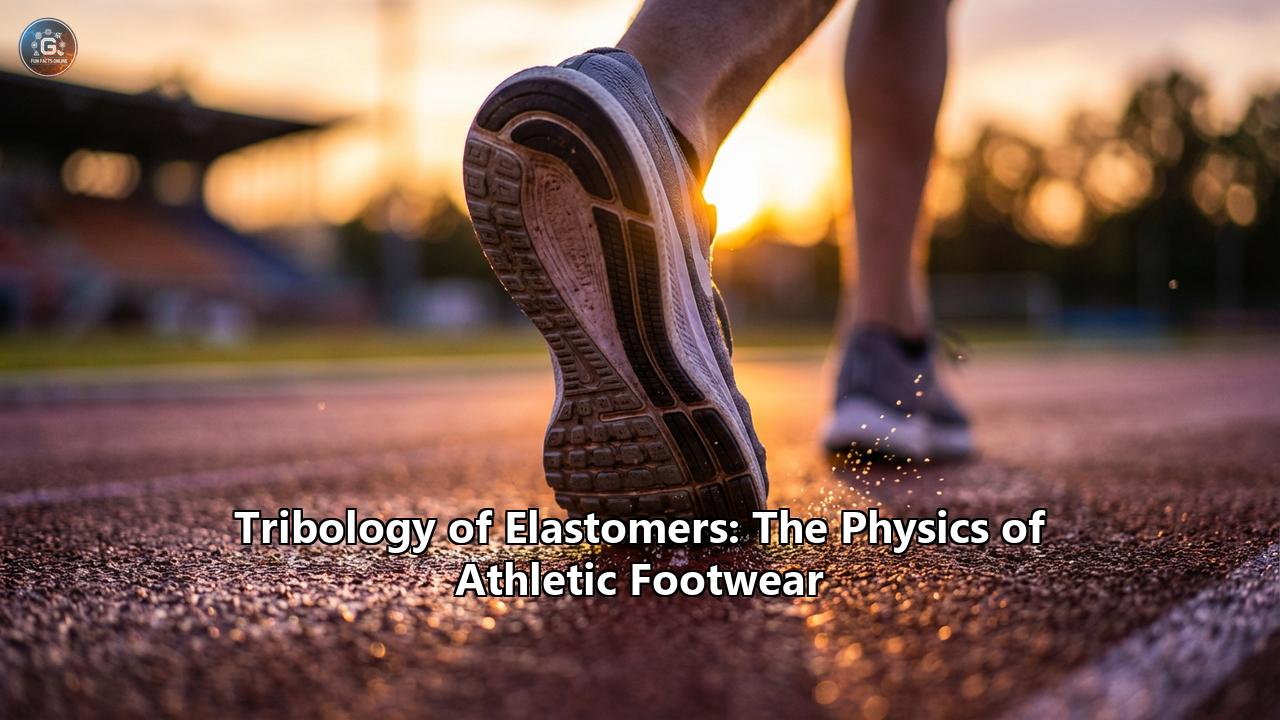
The difference between a gold medal and a devastating injury often comes down to a few microscopic points of contact. When a sprinter explodes out of the starting blocks, a basketball player executes a razor-sharp crossover, or a tennis player slides to retrieve a drop shot, the success of their movement is governed by an invisible, high-stakes battle of physics occurring right beneath their feet.
This is the realm of footwear tribology—the complex science of friction, wear, and lubrication—and it is largely dictated by the extraordinary properties of elastomers.
While casual observers focus on the athlete’s biomechanics, sports scientists and footwear engineers are obsessed with the microscopic interactions between the shoe's outsole, the midsole cushioning, and the ground. By mastering the tribology of elastomers (rubber-like polymers), engineers have revolutionized athletic performance, transforming shoes from simple protective coverings into highly tuned performance engines.
This comprehensive exploration delves into the physics of athletic footwear, unpacking how viscoelastic foams absorb impact, how rubber compounds generate traction, and how the relentless forces of friction eventually tear these materials apart.
1. The Foundation: What is Tribology?
Tribology, derived from the Greek word tribos (meaning "to rub"), is the study of interacting surfaces in relative motion. It rests on three foundational pillars:
- Friction: The resistance to motion when two surfaces slide against one another.
- Wear: The progressive loss or deformation of material from a surface as a result of mechanical action.
- Lubrication: The introduction of a substance (like water, sweat, or oil) that alters the friction and wear between surfaces.
In the context of athletic footwear, tribology is a delicate balancing act. If a shoe has too little friction, the athlete slips, losing energy and risking catastrophic injury. If a shoe has too much friction, it can “lock” the foot to the ground during a dynamic movement, forcing the athlete’s joints—often the knee or ankle—to absorb the rotational forces, famously leading to anterior cruciate ligament (ACL) tears.
The goal of a footwear tribologist is not to maximize friction, but to optimize the Available Coefficient of Friction (ACOF) for specific movements, surfaces, and environmental conditions. To achieve this, engineers rely on a specific class of materials: elastomers.
2. Elastomers: The Magic Molecules of Footwear
An elastomer is a polymer with viscoelasticity—meaning it exhibits both viscous (fluid-like) and elastic (solid-like) characteristics when undergoing deformation. At a molecular level, elastomers look like a tangled bowl of spaghetti. Long macromolecular chains are loosely cross-linked together. When you apply stress to the material, the chains uncoil and stretch out. When you remove the stress, the cross-links snap the chains back to their original tangled state.
In athletic shoes, elastomers are used in two primary areas: the outsole (the rubber bottom that grips the ground) and the midsole (the foam layer that cushions and returns energy).
The Evolution of Midsole Elastomers
- EVA (Ethylene-Vinyl Acetate): For decades, EVA was the gold standard for running shoes. It is lightweight, relatively cheap, and provides decent cushioning. However, EVA is prone to "packing out"—losing its elasticity over time as the microscopic gas bubbles trapped inside the foam break down.
- TPU (Thermoplastic Polyurethane): Popularized by Adidas’ "Boost" technology, TPU foams are made of thousands of expanded pellets fused together. TPU is heavier than EVA but offers far superior durability and energy return. It is also highly resistant to temperature fluctuations, remaining bouncy in the freezing cold and stable in the blazing heat.
- PEBA (Polyether Block Amide / Pebax): The current crown jewel of athletic footwear. PEBA foams are lighter than EVA and bouncier than TPU. They are the driving force behind the modern "Super Shoe" revolution, offering energy return rates upwards of 85%, compared to the 60-70% seen in traditional EVA.
Viscoelasticity and Hysteresis
The most critical physical property of a midsole elastomer is its hysteresis. In physics, hysteresis is the difference between the energy absorbed by a material when it is compressed and the energy released when it expands.
If you drop a golf ball onto a concrete floor, it bounces almost all the way back up (low hysteresis). If you drop a ball of putty, it splats and stays there (high hysteresis).
When a runner lands, the shoe’s elastomer compresses, absorbing the kinetic energy of the impact (acting as a shock absorber). A fraction of a second later, the foam expands as the runner pushes off. Because of hysteresis, some energy is lost as heat. If a foam has high hysteresis, it feels plush and “squishy” but drains energy from the athlete. If it has low hysteresis, it feels bouncy and fast. The genius of modern PEBA elastomers is their astonishingly low hysteresis, allowing athletes to maintain their speed while minimizing muscular fatigue.
3. The Physics of Grip: How Rubber Interacts with the Ground
While the midsole handles vertical forces, the outsole is responsible for horizontal forces. The friction between an elastomer outsole and a playing surface is far more complex than the simple friction you learn about in high school physics (which is typically governed by Coulomb's Law).
Because rubber is soft and viscoelastic, its friction is composed of two distinct mechanisms: Adhesion and Hysteresis.
Adhesive Friction: The Molecular Cling
When a smooth rubber sole presses against a smooth hardwood basketball court, the surfaces come into incredibly close contact. At a microscopic level, intermolecular attractive forces—primarily Van der Waals forces—create temporary bonds between the polymer chains in the rubber and the molecules of the floor.
When the athlete attempts to slide their foot, these microscopic bonds must be broken. This breaking of bonds generates adhesive friction. Adhesion is highly dependent on the real area of contact. Softer rubbers conform better to microscopic surface irregularities, increasing the contact area and thereby increasing adhesive grip. This is why indoor court shoes use very soft, tacky rubber.
Hysteresis Friction: The Micro-Deformation
No surface is perfectly smooth. Even a freshly paved asphalt track is covered in microscopic peaks and valleys (asperities). When an elastomer slides over a rough surface, the rubber is forced to deform around these asperities.
As the rubber compresses against a bump and then expands as it passes over it, the viscoelastic nature of the material comes into play. Because of the material's internal hysteresis, the rubber does not rebound instantaneously. This delayed recovery creates an asymmetrical pressure distribution—higher pressure on the front side of the bump and lower pressure on the back. This pressure differential results in a physical resistance to sliding, known as hysteresis friction.
On rough outdoor surfaces like concrete or trail paths, hysteresis is the dominant friction mechanism. The softer the rubber, the deeper the asperities penetrate, and the higher the hysteresis friction.
The Dynamic Coefficient of Friction (DCOF)
To quantify traction, tribologists measure the Dynamic Coefficient of Friction (DCOF). For indoor sports, the ideal DCOF generally sits between 0.6 and 1.1.
However, traction is not static. A fascinating small-scale tribology study on sports footwear demonstrated that the contact angle of the shoe drastically changes the DCOF. When a shoe is flat on the ground, the DCOF might be 0.9. But when the shoe is tilted—such as when a basketball player initiates a hard lateral cut on the edge of their foot—the DCOF can spike to between 1.4 and 1.65 on polyurethane (PU) flooring. This sudden, dramatic increase in friction on the lateral edge is a leading culprit behind non-contact lower-limb injuries, as the foot effectively "catches" the floor, sending violent rotational torque up into the knee.
4. The Threat of Lubrication and the Geometry of Tread
Friction behaves predictably in a vacuum, but sports are played in the real world, where sweat, rain, dust, and mud act as lubricants. The introduction of a fluid between the shoe and the surface shifts the tribological system into what is known as the boundary lubrication regime or, in extreme cases, elastohydrodynamic lubrication.
The Stribeck Curve and Hydroplaning
When water sits on a running track, a fast-moving shoe can trap the water underneath the sole. Because water is incompressible, it generates hydrodynamic pressure. If this upward pressure exceeds the downward force of the runner, the shoe lifts completely off the ground—a phenomenon identical to a car hydroplaning. The friction coefficient plummets to near zero, resulting in a slip.
The Role of Tread Engineering
To combat lubrication, footwear engineers manipulate the macroscopic geometry of the outsole. Treads and grooves serve exactly the same purpose on a shoe as they do on a car tire: they provide a channel for fluid to escape. By giving the water somewhere to go, the tread allows the rubber blocks to penetrate the fluid film and establish contact with the ground.
- The Supremacy of the Herringbone: In sports like basketball and tennis, multidirectional traction is paramount. Extensive robotic slip-testing on various court surfaces has repeatedly proven that the "herringbone" (zigzag) and circular tread patterns are the undisputed kings of traction. Why? Because the sharp, angled edges of the herringbone pattern act like microscopic windshield wipers. As the foot slides, the rigid edges scrape away sweat and dust, breaking the fluid film and allowing the rubber to grip the hardwood.
- Surface Nuances: Testing reveals that hardwood floors consistently offer higher traction than synthetic or PU floors. Under dry conditions, an elite basketball shoe with a herringbone tread might yield an Available Coefficient of Friction (ACOF) of 0.57. However, introduce even a small amount of water or sweat, and that ACOF can instantly drop to 0.41 or as low as 0.14 on certain patterns, pushing the athlete dangerously close to the threshold of a slip.
- Contact Pressures: Research has shown a strong correlation between shoe outsole features, contact pressure, and friction. Outsole features that distribute pressure effectively tend to increase hysteresis friction. Interestingly, lowering the contact pressure (by spreading the load over a wider, flatter surface area) can actually increase hysteresis friction under boundary lubrication conditions.
5. Wear and Tear: The Inevitable Breakdown of Elastomers
The very forces that provide traction are the same forces that destroy the shoe. Wear is a tribological inevitability, and understanding how elastomers break down is crucial for predicting a shoe's lifespan. An outsole losing its tread doesn't just look bad; research indicates that high wear (e.g., a wear scar of 800 mm²) is associated with friction reductions of up to 38% and a massive 500% increase in fluid force during slipping.
There are three primary wear mechanisms at play in athletic footwear:
1. Abrasive Wear
This is the "sandpaper" effect. When the softer rubber outsole slides against rough, hard asperities (like asphalt or concrete), microscopic chunks of the elastomer are literally gouged or sliced away. The severity of abrasive wear depends on the hardness of the rubber compound and the sharpness of the ground's asperities. To mitigate this, companies mix carbon black or silica into their rubber compounds, significantly increasing the material's tear resistance.
2. Fatigue Wear
Unlike abrasion, fatigue wear occurs over time due to repeated stress cycles. Every time a runner takes a step, the elastomers in the sole are stretched, compressed, and twisted. Over thousands of miles, this repeated cyclic loading causes microscopic cracks to form within the polymer matrix. Eventually, these micro-cracks propagate and link together, causing large flakes of rubber to peel away from the shoe (delamination).
3. Thermal Degradation
Perhaps the most fascinating wear mechanism in elastomers is thermal breakdown. Remember hysteresis—the energy lost as heat during deformation? During a strenuous workout, the constant compression and expansion of the TPU or EVA foam, combined with the sliding friction of the rubber, generates significant internal heat. Because elastomers are poor thermal conductors, this heat cannot easily escape.
At elevated temperatures, the thermal energy reduces the cohesive energy in the subsurface of the polymer, weakening the molecular bonds. This makes the elastomer substantially more susceptible to crack initiation and structural collapse. Conversely, at very low temperatures, polymers like polyurethane transition from a ductile state to a brittle state, making them prone to rapid cracking upon impact.
6. Sport-Specific Tribology
Because no two sports demand the same biomechanics, the tribological engineering of footwear is heavily segmented.
Running: Forward Propulsion and Energy Economy
Running is fundamentally a linear sport. The tribological goal is to maximize longitudinal friction (to prevent slipping during the push-off phase) while minimizing the weight of the outsole rubber. Running shoes usually feature blown rubber in the forefoot (which is softer, lighter, and adds cushioning) and highly durable carbon rubber in the heel (to withstand the high abrasive forces of heel-striking). The treads are typically horizontally aligned to resist forward-backward slipping.
Basketball and Court Sports: Multidirectional Chaos and the "Squeak"
Basketball requires intense acceleration, violent deceleration, and lateral pivots. The outsoles are flat to maximize the surface area for adhesive friction.
One of the most recognizable aspects of court tribology is the "squeak." This sound is the acoustic manifestation of the stick-slip phenomenon. When a player plants their foot, the high-friction rubber sticks to the floor, stretching the elastomer molecules. As the player's momentum pushes forward, the force exceeds the static friction threshold, causing the rubber to snap back and slip. It immediately catches and sticks again. This cycle of sticking and slipping happens hundreds of times per second, vibrating the shoe at an audible frequency. A loud squeak is literally the sound of high-frequency tribological adhesion.
Field Sports (Soccer/American Football): Penetrative Traction
On soft surfaces like natural grass or synthetic turf, the friction between flat rubber and the ground is insufficient. Therefore, tribologists utilize penetrative traction via cleats or studs. Here, friction is generated by the physical interlocking of the cleat plunging into the soil matrix.
The tribology of cleats is highly sensitive to the playing surface. On natural grass, if a player twists their knee, the soil will eventually yield, allowing the cleat to tear through the dirt, releasing the rotational pressure. On artificial turf, however, the synthetic fibers and rubber infill have a much higher coefficient of rotational friction. The turf does not yield. As a result, the rotational forces bypass the shoe and are transferred directly to the player's ligaments, explaining the statistical spike in lower-body joint injuries on artificial surfaces.
7. The "Super Shoe" Revolution: A Tribological Masterpiece
No discussion of modern footwear physics is complete without examining the "Super Shoe" era, which began in 2017 with the Nike Vaporfly 4% and has since resulted in the shattering of nearly every long-distance running record.
Super shoes are a triumph of elastomer science and biomechanical engineering, relying on two core components:
- Massive Stacks of PEBA Foam: The ultralight, high-rebound Pebax foam minimizes hysteresis. By returning over 85% of the compressive energy, the foam acts as a mechanical spring. The high stack height also effectively increases the runner's leg length, shifting their biomechanical leverage.
- The Rigid Carbon Fiber Plate: Embedded deep within the soft viscoelastic foam is a curved, stiff carbon fiber plate.
From a physics perspective, the carbon plate does two things. First, it stabilizes the thick, squishy foam, preventing excessive lateral deformation that would waste energy. Second, it alters the mechanics of the metatarsophalangeal (MTP) joint (the base of the toes). Normally, the MTP joint bends during toe-off, requiring energy from the calf muscles. The rigid plate acts as a lever, stiffening the joint and acting like a teeter-totter, rolling the runner forward and drastically reducing the energetic cost of running.
This system creates a unique internal tribological environment. The rigid plate and the soft elastomer are constantly pushing against each other, requiring advanced adhesives to prevent internal delamination (wear) from the massive sheer forces generated during a marathon.
8. The Future of Footwear Tribology
As we look toward the future, the intersection of tribology, material science, and manufacturing technology promises to push athletic performance even further.
- Algorithmic 3D Printing: Companies are moving away from solid foams and experimenting with 3D-printed elastomer lattices. By using generative design algorithms, engineers can tune the exact stiffness, hysteresis, and friction coefficient of every individual square millimeter of a shoe’s midsole. A runner could have a shoe mathematically perfectly tuned to their specific foot-strike and body weight.
- Adaptive Elastomers: The next frontier involves smart materials, such as shear-thickening fluids (STFs) or magnetorheological elastomers. These materials change their physical properties on demand. Imagine an elastomer that remains soft and highly cushioned during a light jog, but the instant the material detects the high-impact shear forces of a sprint, the molecules lock together, transforming into a rigid, high-energy-return platform.
- Sustainable Tribology: The dark side of footwear friction is microplastics. As elastomer outsoles wear away, millions of tons of microscopic synthetic rubber particles are left on roads and courts, eventually washing into the ecosystem. The future requires high-performance, bio-based elastomers—derived from algae, dandelion roots, or fully biodegradable polymers—that match the frictional and wear-resistant properties of TPU without the environmental toll.
Conclusion
The next time you watch an elite athlete execute a physics-defying maneuver, take a moment to look at their feet. The magic of that movement isn't just in their muscles or their mindset. It is happening at the microscopic level, in the invisible battleground where polyurethane meets hardwood, and rubber meets asphalt.
Through the rigorous application of tribology, the manipulation of molecular hysteresis, and the mastery of viscoelastic foams, athletic footwear has transcended its origins as mere clothing. Today's sports shoes are finely tuned instruments of physical science—marvels of engineering that allow humanity to run faster, jump higher, and push the very limits of what the human body can achieve.
Reference:
- https://www.mdpi.com/2673-3161/6/3/54
- https://www.researchgate.net/publication/263720763_Tribology_friction_and_traction_understanding_shoe-surface_interaction
- https://www.researchgate.net/publication/256913372_Relationship_between_wear_rate_and_mechanical_fatigue_in_sliding_TPU-metal_contacts
- https://fileserver-az.core.ac.uk/download/pdf/159128930.pdf
- https://d-scholarship.pitt.edu/41416/13/HemlerSL_ETDPitt2021.pdf
- https://pmc.ncbi.nlm.nih.gov/articles/PMC7365588/
- https://www.academia.edu/98183117/The_influence_of_shoe_floor_contact_area_load_and_velocity_on_dynamic_friction_in_indoor_sports_footwear_a_small_scale_tribology_study