
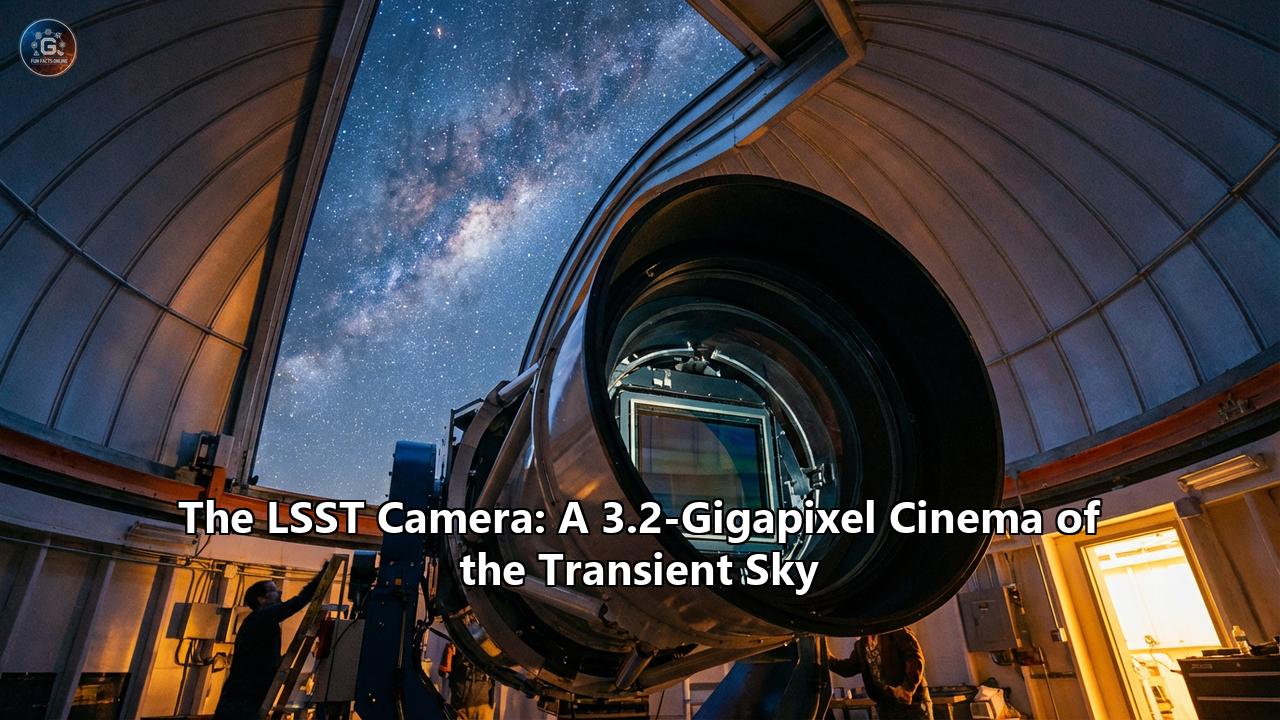
The Atacama Desert in Chile is one of the driest places on Earth. Here, the air is so thin and the skies so impossibly clear that the Milky Way casts a shadow on the ground. It is here, atop the flattened peak of Cerro Pachón, that a new era of astronomy has just begun. The dome of the Vera C. Rubin Observatory has opened, and inside it sits a technological titan: the LSST Camera.
This is not merely a telescope; it is a time machine and a motion picture camera combined. For centuries, astronomy was a discipline of static snapshots—long exposures of single objects, frozen in time. The Rubin Observatory changes everything. It is designed to capture the "transient sky," a universe that is constantly moving, flickering, exploding, and evolving.
At the heart of this observatory lies the LSST Camera, a device of such staggering complexity and power that it redefines the limits of human engineering. It is the largest digital camera ever constructed for astronomy, a 3.2-gigapixel behemoth the size of a small car, capable of spotting a golf ball on the Moon from Earth.
This article explores the engineering marvel of the LSST Camera, the scientific revolution it is currently unleashing as the full survey begins in early 2026, and the profound mysteries of the dark universe it aims to solve.
Part I: The Eye of the Titan
The Engineering of the World’s Largest Digital CameraTo understand the scale of the LSST (Legacy Survey of Space and Time) Camera, one must abandon standard comparisons. It is not simply "better" than previous cameras; it is in a different weight class entirely. The camera body is roughly 5.5 feet (1.65 meters) by 9.8 feet (3 meters) and weighs a crushing 6,200 pounds (2,800 kilograms).
The 3.2-Gigapixel Focal PlaneThe "retina" of this mechanical eye is its focal plane. Unlike the sensor in a high-end DSLR, which might measure 36mm across, the LSST focal plane is a distinct circular array spanning 25 inches (64 centimeters) in diameter. It is composed of 189 individual Charge-Coupled Device (CCD) sensors, each offering 16 megapixels of resolution.
These sensors are not mounted individually. They are grouped into 21 "rafts," modular square towers that house nine sensors each, along with their dedicated electronics. This modularity was a critical design choice. If a sensor were to fail during the camera’s decade-long mission, a single raft could theoretically be serviced, though the procedure is so delicate it is reserved for emergencies.
The engineering tolerance required to assemble this focal plane is mind-bending. The surface of the 189 sensors had to be flat to within a fraction of the width of a human hair. Any deviation would throw the telescope's fast f/1.2 optics out of focus. The gap between the sensors is a mere 100 microns, meaning the "dead space" in the images is negligible. To capture an image, the camera operates in a "step-and-repeat" mode, covering the entire southern sky every three nights.
The Optical Marvel: Lenses and FiltersLight entering the camera passes through three massive fused-silica lenses, designated L1, L2, and L3. The first lens, L1, is the largest high-performance optical lens ever fabricated, measuring 5.1 feet (1.57 meters) in diameter. The raw glass took five years to shape and polish.
The optical system is designed to provide an exceptionally wide field of view—9.6 square degrees. To put that in perspective, a single exposure covers an area of the sky equivalent to 40 full moons arranged in a grid. This wide field is essential for the survey’s speed; without it, mapping the entire sky would take decades rather than days.
Between the lenses sits the filter exchange system, a robotic carousel that holds five massive optical filters (u, g, r, i, z, y), each weighing nearly 90 pounds. These filters allow astronomers to slice the light into different colors, from the ultraviolet (u-band) to the near-infrared (y-band). A separate mechanism can swap a sixth filter into the carousel during the day. This automated dance happens continuously throughout the night, with the changer swapping filters in under two minutes to match the scientific goals of the moment.
The Cryostat: A Cold HeartTo detect the faint whispers of photons from galaxies billions of light-years away, the sensors must be kept in absolute darkness and extreme cold. The focal plane is housed inside a cryostat, a vacuum chamber that keeps the sensors cooled to -100°C (-148°F). This deep freeze suppresses "dark current," the thermal noise that would otherwise drown out the signals from distant stars.
The heat generated by the readout electronics—a considerable 1,100 watts—must be wicked away efficiently without causing vibrations that would blur the images. This is achieved through a newly developed clean refrigerant system that circulates fluid through the back of the raft towers, a feat of thermal engineering that took years to perfect.
Part II: The Data Firehose
Processing 20 Terabytes a NightWhen the shutter opens, the LSST Camera acts less like a telescope and more like a firehose of data. It takes a 15-second exposure, reads out the data in two seconds, and moves to the next patch of sky. This cadence generates approximately 20 terabytes of raw data every single night. Over the ten-year survey, the archive will swell to 60 petabytes of images and catalogs.
The 60-Second RaceThe most time-critical aspect of the Rubin Observatory is its "Transient Alert" system. The universe is full of things that go bump in the night—supernovae, variable stars, asteroids, and gravitational wave events. Many of these are short-lived. A flash of light might last only minutes.
To catch these fleeting events, the observatory has set a grueling requirement: 60 seconds.
From the moment the shutter closes on an image, the system has one minute to:
- Transfer the massive image file from the summit in Chile to the Data Facility in the US.
- Process the image to remove instrumental artifacts.
- Subtract a "template" image (an older image of the same spot) to reveal what has changed.
- Identify any new sources (changes in brightness or position).
- Send out an alert to the global astronomical community.
This pipeline effectively runs a "spot the difference" game on a cosmic scale, millions of times a night.
The Rise of the BrokersBecause no single human—or even a large team—can read 10 million alerts per night, the Rubin Observatory relies on "Community Brokers." These are third-party software systems, such as Pitt-Google, ANTARES, and Fink, that ingest the full stream of alerts.
These brokers act as the filtering layer. An astronomer interested in supernovae doesn't want to see alerts for asteroids. The broker uses machine learning algorithms to classify the alerts in real-time. It might flag one alert as "likely Type Ia Supernova" and another as "Near-Earth Object."
This automated infrastructure fundamentally changes the day-to-day life of an astronomer. Instead of traveling to a telescope to take data, they will wake up to a filtered feed of targets delivered to their inbox or smartphone, ready for follow-up observation.
Part III: The Four Science Pillars
The Rubin Observatory was designed with four primary scientific themes in mind, each addressing a fundamental question about our place in the universe.
1. Probing Dark Energy and Dark Matter
The "Dark Universe" makes up 95% of the cosmos, yet we have no idea what it is. Dark matter holds galaxies together; dark energy pushes the universe apart.
The LSST Camera is the ultimate tool for "Weak Gravitational Lensing." As light from distant galaxies travels to Earth, it passes by massive clumps of dark matter. The gravity of this dark matter bends the light slightly, distorting the shape of the background galaxies. By measuring the minute distortions in the shapes of billions of galaxies, astronomers can map the 3D distribution of dark matter across the universe.
Furthermore, by seeing how this distribution has changed over billions of years, they can infer the properties of dark energy. If dark energy is a "Cosmological Constant," the expansion history will look one way. If it evolves over time, the map will look different. The sheer volume of galaxies—estimated at 20 billion—will reduce statistical errors to near zero.
2. Taking Inventory of the Solar System
Before Rubin, we had identified roughly 800,000 asteroids. The LSST is expected to increase that number to over 5 million. This includes:
- Near-Earth Objects (NEOs): Identifying potentially hazardous asteroids that could impact Earth. The survey aims to find 90% of all NEOs larger than 140 meters.
- Main Belt Asteroids: Mapping the debris between Mars and Jupiter to understand the formation of the solar system.
- Kuiper Belt Objects (KBOs): Charting the icy bodies beyond Neptune.
Deep in the outer reaches of the solar system, some KBOs exhibit strange orbital clustering, suggesting they are being shepherded by the gravity of a massive, unseen planet—Planet Nine.
Searching for Planet Nine is like looking for a needle in a haystack, but the LSST is the ultimate magnet. Simulations suggest that if Planet Nine exists and is not in the dense star field of the Milky Way, Rubin has a 95% chance of detecting it. The challenge is distinguishing the slow-moving, faint planet from the millions of background stars and artifacts.
3. The Transient Optical Sky
This is the "Cinema" aspect. By imaging the sky repeatedly, Rubin creates a time-lapse movie.
- Supernovae: Rubin will discover millions of supernovae, allowing for population studies that were previously impossible.
- Variable Stars: Understanding the life cycles of stars by watching them pulsate and flare.
- Kilonovae: The mergers of neutron stars. These events produce gold and platinum and are the optical counterparts to gravitational waves. Rubin’s wide field of view increases the chance of catching the optical "flash" of a gravitational wave event detected by LIGO/Virgo.
4. Mapping the Milky Way
Rubin will map the position and brightness of billions of stars in our own galaxy. This will allow astronomers to conduct "Galactic Archaeology"—tracing the history of the Milky Way by identifying streams of stars that were torn from smaller dwarf galaxies that our galaxy cannibalized billions of years ago.
Part IV: The Exotic Frontier
What Else Might We Find?While the four pillars are the guaranteed returns, the most exciting prospect of the LSST is the unknown. The survey opens up a vast discovery space for "exotic" phenomena.
Interstellar Objects (ISOs)In 2017, the object 'Oumuamua zipped through our solar system, followed by Comet Borisov in 2019. These were the first confirmed visitors from other star systems. We now know that interstellar space is likely teeming with these ejected wanderers.
The LSST is a game-changer for ISOs. Recent models predict it could detect anywhere from a few to 70 interstellar objects per year.
We are already seeing the fruits of this new era. In July 2025, the ATLAS survey discovered a new candidate, designated 3I/ATLAS (the third confirmed interstellar object). With Rubin coming online, we will be able to track objects like 3I with unprecedented precision. In fact, calculations show that in January 2026, 3I/ATLAS is aligning with the Earth-Sun axis, providing a rare opportunity for Rubin to measure its "opposition surge"—a brightening effect that reveals the texture of its surface. Rubin will likely find "Dark Comets" or "Dark ISOs"—objects that don't offgas like comets but pass through on hyperbolic orbits, invisible to smaller telescopes.
Tidal Disruption Events (TDEs)Occasionally, a star wanders too close to a supermassive black hole and is shredded by tidal forces—a process vividly termed "spaghettification." As the stellar debris rains down onto the black hole, it flares brightly.
Before Rubin, we found these events largely by luck. Rubin is expected to find between 3,000 and 8,000 TDEs per year. This massive sample size will allow us to study the demographics of black holes in dwarf galaxies, which are currently hard to measure. It will also help us understand the physics of accretion disks in real-time.
Fast Radio Bursts (FRBs)FRBs are millisecond-long blasts of radio energy from deep space. While radio telescopes detect them, finding their "optical counterpart" (a flash of visible light accompanying the radio burst) has been the Holy Grail of the field. Finding an optical flash would pinpoint the host galaxy and the exact progenitor object (likely a Magnetar). Rubin’s rapid cadence makes it one of the best hopes for catching an FRB "in the act" in optical light.
Part V: The Construction Odyssey
Building the LSST Camera was a saga of endurance.
The Sensor ChallengeThe contract to build the 189 sensors was split between two vendors to ensure redundancy. The sensors are "deep depletion" CCDs, much thicker than standard chips (100 microns vs 10-20 microns). This thickness allows them to capture more near-infrared light, which is crucial for measuring the redshift of distant galaxies. However, thick chips are harder to manufacture and more prone to "blooming" (pixels leaking charge).
The Cleanroom DisasterThe project was not without its heart-stopping moments. In 2023, during the final integration at SLAC National Accelerator Laboratory in California, a main water supply line in the cleanroom burst. Water sprayed near the camera housing.
The team had to execute an emergency shutdown. The camera was shrink-wrapped in protective plastic, but the humidity spike was a major threat to the delicate electronics. A subsequent investigation showed that while the camera was safe, a cryostat vacuum pump had failed, and a feedthrough leaked. It took months of painstaking testing to recertify the system, delaying the shipment to Chile.
The Journey to the SummitIn mid-2024, the camera was packed into a custom-built, shock-absorbing shipping container. It was flown to Chile on a specialized cargo plane, then loaded onto a truck for the winding, treacherous drive up the Andes mountains to the 8,900-foot summit of Cerro Pachón.
The installation in early 2025 was a "millimeter-precision" operation. A custom lift raised the 3-ton camera to the telescope floor, where it was inserted into the center of the secondary mirror assembly. The clearance on either side was less than an inch.
Part VI: The New Way of Doing Science
The Rubin Observatory represents a paradigm shift in the culture of science.
Democratization of DataIn the past, telescope time was a precious resource hoarded by Principal Investigators. If you applied for time on the Hubble, the data was yours exclusively for a year (the "proprietary period").
Rubin has no proprietary period for its alert data. The moment an alert is generated, it is public to the world. The nightly images are available to all data-rights holders (the entire US and Chilean astronomical communities, plus international partners) immediately.
The Rubin Science Platform (RSP)Because the data volume is so massive (petabytes), you cannot download the data to your laptop. You have to take your code to the data. The Rubin Science Platform is a cloud-based ecosystem where astronomers log in, run Python notebooks, and query the database remotely. This levels the playing field; a student at a small university with a Chromebook has the same access to the data as a professor at Harvard with a supercomputer.
Conclusion: The Decade of Discovery
As we stand in early 2026, the full survey is just spinning up. The first "Data Preview" releases have already teased us with images of dazzling depth—nebulae revealing new intricate structures, and star clusters resolving into millions of individual points of light.
Over the next ten years, the LSST Camera will record the greatest movie ever made. It will catalogue 37 billion stars and galaxies. It will likely find the hazardous asteroid that has our name on it—or prove that we are safe for the next century. It might reveal the existence of a ninth planet in our backyard. It will certainly map the invisible scaffolding of dark matter that shapes our universe.
But the most exciting discovery is the one we haven't predicted. With a field of view this wide and a cadence this fast, we are looking at the universe in a way no human eye—biological or mechanical—ever has. We are opening the shutter on the unknown.
Welcome to the era of the Rubin Observatory. The show is about to begin.
Reference:
- https://academic.oup.com/mnras/article/542/3/2238/8237458
- https://www6.slac.stanford.edu/news/2025-06-23-ever-changing-universe-revealed-first-imagery-nsf-doe-vera-c-rubin-observatory
- https://en.wikipedia.org/wiki/Planet_Nine
- https://www.universetoday.com/articles/what-are-the-chances-that-the-next-generation-lsst-could-find-new-planets-in-the-solar-system
- https://rubinobservatory.org/news/first-imagery-rubin
- https://astrobites.org/2024/11/18/kilonova-rates-o4-versus-o5/
- https://arxiv.org/abs/2310.17575
- https://www.youtube.com/watch?v=a-ztVhY3_wc
- https://arxiv.org/abs/2104.09727