
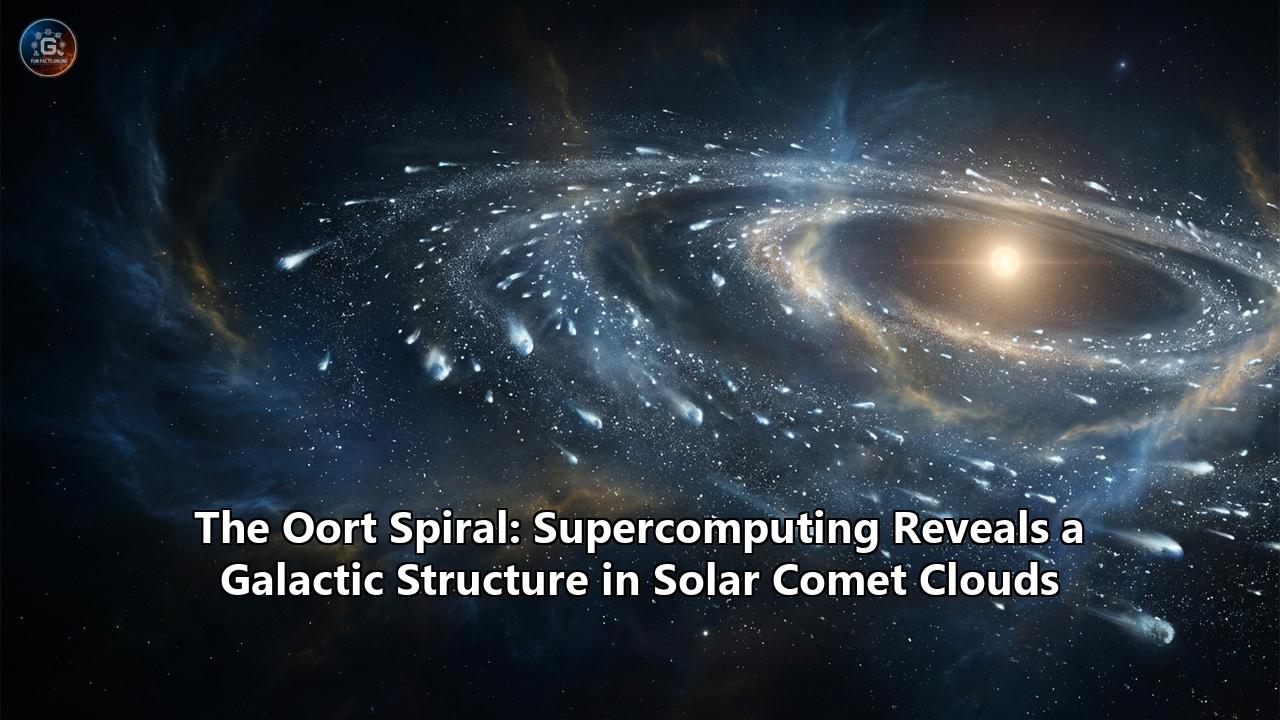
In the vast, silent expanse where the Sun’s dominance fades into the interstellar dark, a ghost has been hiding for billions of years. It is a structure of immense scale and delicate geometry, composed not of stars, but of trillions of frozen worlds. For nearly a century, astronomers believed the boundary of our solar system was a chaotic, spherical shell—a shapeless halo of comets known as the Oort Cloud. They were wrong.
Recent breakthroughs in high-performance supercomputing have peeled back the darkness of the outer solar system to reveal something startlingly ordered. The Oort Cloud is not merely a sphere; deep within its heart lies a colossal, distinct structure. It is a spiral.
Stretching over 15,000 astronomical units (AU) and mirroring the grand design of the Milky Way itself, this "Oort Spiral" has fundamentally altered our understanding of how our solar system interacts with the galaxy. It is a discovery that bridges the gap between planetary science and galactic dynamics, revealing that our home system is not an isolated island but a vessel sculpted by the tides of the galaxy it sails through.
Part I: The Edge of the Map
To understand the magnitude of this discovery, we must first appreciate the mystery that has surrounded the Oort Cloud since its inception.
The Cometary Paradox
In the early 20th century, the architecture of the solar system seemed deceptively simple: eight planets (then nine), an asteroid belt, and a scattering of comets. However, the comets presented a paradox. Comets are "dirty snowballs"—volatile bodies of ice and dust. When they approach the Sun, they sublime, losing mass to brilliant tails. A comet trapped in a short orbit should evaporate within a few million years. Yet, the solar system is 4.6 billion years old, and new comets appear constantly.
Where were they coming from?
In 1950, the Dutch astronomer Jan Oort proposed a solution. He calculated that there must be a vast reservoir of icy bodies loosely bound to the Sun, extending nearly halfway to the next star, Proxima Centauri. This "cloud" would be spherical, a natural consequence of comets being scattered randomly by the giant planets and then nudged by passing stars. For 75 years, this was the textbook definition: the Oort Cloud was a featureless, spherical halo, the chaotic "attic" of the solar system.
The Invisible Realm
The problem with the Oort Cloud is that it is strictly theoretical. No telescope has ever seen an object inside it. The distance is too great; the objects are too dark. The cloud begins roughly 2,000 to 5,000 AU from the Sun (where 1 AU is the Earth-Sun distance) and extends out to 100,000 AU. For comparison, Voyager 1, humanity’s most distant probe, is only about 160 AU from home.
Because we could not see it, we assumed it was simple. Nature, however, rarely tolerates simplicity on such a grand scale.
Part II: The Engine of Discovery
The revelation of the Oort Spiral did not come from a telescope. It came from silicon.
In the mid-2020s, a team of researchers led by Dr. David Nesvorný of the Southwest Research Institute (SwRI) embarked on an ambitious project. They wanted to simulate the evolution of the solar system over its entire 4.5-billion-year history, not just tracking the planets, but following the paths of millions of "test particles"—digital stand-ins for comets.
This is a problem of "N-body" physics. If you have two objects, calculating their orbits is simple. Add a third, and it becomes complex. Add millions, and subject them to the gravity of the Sun, four giant planets, the Milky Way’s disk, and random passing stars, and the math becomes a nightmare.
The Pleiades Supercomputer
To crack this problem, the team turned to NASA’s Pleiades supercomputer, a high-performance computing (HPC) behemoth located at the Ames Research Center. Pleiades is capable of quadrillions of calculations per second. It allowed the researchers to compress eons of cosmic time into weeks of processing.
The simulation began with the solar system in its infancy. It watched as Jupiter, Saturn, Uranus, and Neptune migrated through the primordial disk of debris. The giant planets acted as gravitational slingshots, scattering icy planetesimals outward.
Then, the simulation did something previous models had struggled to do with such fidelity: it handed control over to the galaxy.
The Galactic Tide
Gravity is infinite in reach, but it weakens with distance. As a comet is thrown 1,000 AU from the Sun, the Sun’s grip loosens. At this distance, the gravity of the Milky Way itself—the collective pull of billions of stars and dark matter—begins to tug at the comet. This is the "Galactic Tide."
The tide is not uniform. The Milky Way is a flat disk, and its gravity pulls differently depending on whether an object is above, below, or within the plane of the galaxy.
As the supercomputer crunched the numbers, a pattern emerged from the chaos. The test particles in the outer Oort Cloud (beyond 20,000 AU) did indeed form a random sphere, scrambled by passing stars. But in the inner Oort Cloud (between 1,000 and 10,000 AU), the particles were doing something unexpected. They were not clustering randomly. They were organizing.
Part III: The Spiral Revealed
When the data was visualized—a task undertaken with the help of experts at the American Museum of Natural History—the researchers were stunned.
Floating in the digital void was a clear, unambiguous spiral.
It looked remarkably like a miniature galaxy. The structure possessed two distinct "arms" comprising billions of simulated comets. This spiral disk was roughly 15,000 AU across. However, unlike the Milky Way, which is flat, the Oort Spiral was oriented strangely. It lay perpendicular to the galactic plane and was tilted relative to the solar system’s ecliptic.
The "S" Shape
The structure is often described as S-shaped. It consists of two streams of debris that have been shepherded into a coherent wake.
Why a spiral? The answer lies in the slow, rhythmic dance between the solar system and the galaxy. As the Galactic Tide pulls on these distant comets, it induces "Kozai-Lidov cycles." These are orbital resonances that trade a comet's eccentricity (how oval its orbit is) for inclination (how tilted it is).
For comets in the inner Oort Cloud, the Galactic Tide acts like a filter. It strips away objects in unstable orbits and corrals the survivors into specific orbital "lanes." Over billions of years, these lanes coalesced into the spiral arms we see in the simulations. The spiral is essentially a gravitational wake—a fossil record of the friction between the Sun’s gravity and the Galaxy’s pull.
Part IV: A Universe of Spirals
The discovery prompted a question famously asked by the researchers: "Why does the universe love spirals?"
We see spirals everywhere: in the shell of a nautilus, in the pattern of hurricanes, in the accretion disks around black holes, and most majestically, in galaxies like our own.
However, the Oort Spiral forms for a different reason than a galaxy. A spiral galaxy, like the Milky Way, maintains its arms through "density waves"—ripples of gravitational pressure that move through the disk, compressing gas and triggering star formation. The stars move in and out of the arms like cars moving through a traffic jam.
The Oort Spiral is different. It is a "kinematic" structure. It is formed by the specific orbital mechanics of individual bodies responding to a tidal force. It is less like a traffic jam and more like iron filings aligning with a magnet.
Despite the different mechanics, the visual rhyme is poetic. The solar system, a tiny speck within a spiral galaxy, is surrounded by a spiral of its own. It is a fractal repetition of form, a "mini-galaxy" guarding the edge of our star’s domain.
Part V: The Implications
The confirmation of the Oort Spiral—currently a robust theoretical model awaiting observational proof—has profound implications for astronomy.
1. The History of the Solar System
The spiral acts as a forensic crash site. Its shape is determined by the mass of the giant planets and the history of their migration. If Neptune had migrated differently, or if there were a hidden "Planet Nine" lurking in the darkness, the shape of the spiral would be distorted.
By refining our models of the spiral, we can constrain the early movements of the planets with unprecedented precision. The Oort Spiral is a 15,000-AU-wide footprint left by the infant solar system.
2. The Hunt for Planet Nine
For a decade, astronomers have hunted for a hypothetical massive planet far beyond Neptune, inferred from the clustering of extreme Trans-Neptunian Objects (TNOs). The Oort Spiral complicates this search.
The spiral structure itself creates clustering. It creates "clumps" of objects that could mimic the gravitational signal of a hidden planet. Astronomers must now disentangle the signal of the spiral from the signal of Planet Nine. Conversely, if Planet Nine exists, its gravity would likely shear or warp the spiral arms, providing a new way to pinpoint its location.
3. Interstellar Emissaries
In 2017, the object 'Oumuamua passed through our solar system—the first confirmed interstellar visitor. We now realize that if every star has an Oort Cloud, and if those clouds form spirals that are susceptible to galactic tides, then stars are likely "leaking" comets constantly.
The spiral structure suggests that the ejection of comets into interstellar space happens in preferred directions, along the arms of the spiral. When we look for future interstellar visitors, we shouldn't look randomly; we should look along the "exhaust ports" of nearby stars' Oort Spirals.
Part VI: Seeing the Invisible
The most frustrating aspect of the Oort Spiral is that we cannot simply take a picture of it. The comets are too faint, too cold, and too spread out. If you were floating inside one of the spiral arms, you wouldn't know it. The nearest comet would be millions of miles away, a speck darker than charcoal against the black sky.
However, the structure is not undetectable.
The Rubin Observatory
The Vera C. Rubin Observatory, which began full operations in the mid-2020s, is key. Its Legacy Survey of Space and Time (LSST) is designed to map the solar system in unprecedented depth. While it cannot see the main Oort Cloud, it can see the "scattered disk" and the innermost fringes of the cloud.
By analyzing the orbits of thousands of newly discovered distant objects, astronomers hope to find the "roots" of the spiral arms. If the distribution of these objects matches the supercomputer predictions, it will be the smoking gun confirming the spiral's existence.
Occultation Events
Another method involves "occultations." As these distant comets pass in front of background stars, they block the light for a split second. By monitoring millions of stars simultaneously, automated telescopes can detect these winks. A concentration of occultations in specific patches of the sky would reveal the density of the spiral arms.
Part VII: The Philosophy of Structure
There is a philosophical weight to this discovery. For most of human history, we viewed the solar system as a clockwork mechanism, isolated and self-contained. The planets moved because of the Sun; the moons moved because of the planets. The stars were merely a backdrop—a wallpaper of fixed lights.
The Oort Spiral shatters this isolation. It is a physical manifestation of the galaxy’s touch. It proves that the "edge" of our solar system is not a wall, but a membrane—a zone where the Sun’s authority gives way to the collective will of the Milky Way.
The spiral is perpendicular to the galaxy, standing upright like a wheel rolling along the galactic plane. This orientation tells a story of vertical forces, of the bobbing motion of our sun as it orbits the galactic center, plunging up and down through the galactic disk every 30 million years. This "galactic z-motion" is imprinted in the very shape of the cloud.
Conclusion: A New Geometry
The Oort Spiral is a triumph of modern supercomputing. It represents a shift from "observation-first" astronomy to "simulation-first" discovery. We found the structure in the code before we found it in the sky.
As we move through 2026 and beyond, the search for the Oort Spiral will intensify. It reminds us that even in our own backyard, there are giants hiding in the dark. The solar system is not just a sphere of planets; it is a complex, spiraling organism, trailing long arms of ice through the void, shaped by the gravity of a hundred billion stars.
We are not alone; we are woven into the fabric of the galaxy, and the proof is written in a spiral of ice fifteen trillion miles wide.
Reference:
- https://supercarblondie.com/nasa-supercomputer-reveals-strange-structure-oort-cloud/
- https://www.discovermagazine.com/the-oort-cloud-forms-a-spiral-at-the-outskirts-of-our-solar-system-47164
- https://www.newsweek.com/facts-new-nasa-discovery-edge-solar-system-2037219
- https://timesofindia.indiatimes.com/science/nasas-supercomputer-reveals-unexpected-spiral-at-the-outer-limits-of-the-solar-system/articleshow/118548539.cms
- https://www.space.com/the-universe/solar-system/nasa-supercomputer-finds-billions-of-comets-mimicking-the-milky-ways-shape-the-universe-seems-to-like-spirals
- https://in.mashable.com/science/90373/mini-spiral-galaxy-may-be-taking-shape-at-the-edge-of-our-solar-system
- https://www.sciencealert.com/surprise-spiral-shape-revealed-in-the-darkness-surrounding-the-solar-system
- https://www.researchgate.net/publication/390615232_A_Spiral_Structure_in_the_Inner_Oort_Cloud
- https://www.youtube.com/watch?v=VZ1DxIakPnQ
- https://www.livescience.com/space/nasa-supercomputer-reveals-strange-spiral-structure-at-the-edge-of-our-solar-system
- https://www.popularmechanics.com/space/solar-system/a63919025/scientists-think-theyve-uncovered-mysterious-arms-near-the-boundary-of-the-solar-system/