
When we gaze up at the night sky, we are conditioned to believe that the universe is defined by its light. For millennia, humanity has charted the cosmos by connecting the glowing dots of stars, mapping the swirling nebulas, and cataloging the brilliant spirals of distant galaxies. But modern astrophysics has revealed a humbling truth: everything we can see, touch, and interact with—every star, planet, comet, and cloud of cosmic dust—makes up a mere fraction of the universe's true mass. The vast majority of the cosmos is ruled by a phantom.
This invisible architect is known as dark matter, a mysterious substance that emits no light, reflects no illumination, and casts no physical shadow, yet exerts a gravitational grip powerful enough to hold galaxies together. While scientists have long known that dark matter acts as the hidden scaffolding of the universe, directly observing its elusive nature has remained one of science's greatest challenges.
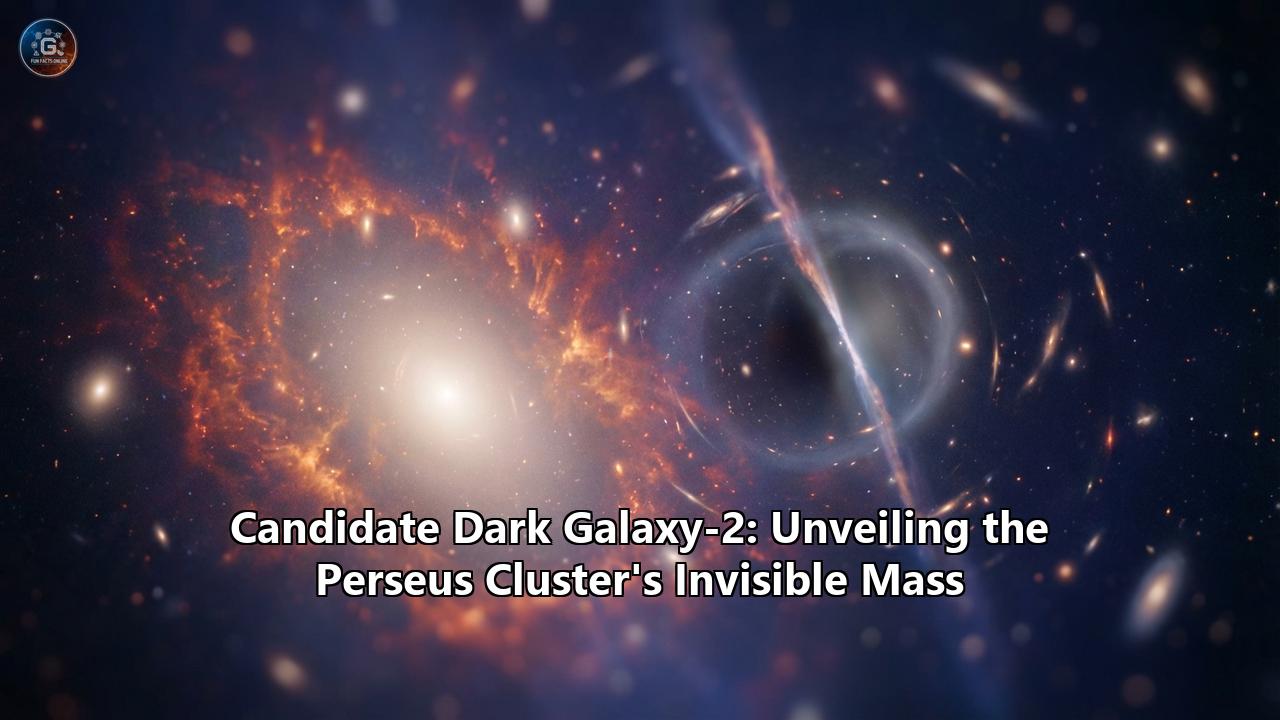
Now, a groundbreaking discovery has pulled back the cosmic curtain. Deep within the Perseus galaxy cluster, roughly 245 to 300 million light-years away from Earth, astronomers have uncovered a cosmic ghost. Known as Candidate Dark Galaxy-2 (CDG-2), this extraordinary object is a galaxy composed of up to 99.98% dark matter. It is an entity so devoid of starlight that it is practically invisible, betraying its existence only through a tight-knit family of ancient star clusters that are inextricably bound to its hidden mass.
This discovery is not just a triumph of modern telescopic power; it is a fundamental paradigm shift. CDG-2 is the very first galaxy to be discovered solely through the presence of its globular clusters, a revelation that threatens to rewrite the cosmic census and challenges our deepest understanding of how galaxies are born, how they survive, and how they ultimately fade into the dark.
The Invisible Architect: Understanding Dark Matter
To appreciate the sheer magnitude of the CDG-2 discovery, one must first understand the enigma of dark matter. In the 1930s, Swiss astronomer Fritz Zwicky observed the Coma Cluster of galaxies and noticed something perplexing: the galaxies were moving far too rapidly. Based on the amount of visible light they emitted, there simply wasn't enough "normal" mass to generate the gravity required to keep the cluster from flying apart. Zwicky proposed the existence of dunkle Materie, or dark matter, to account for the missing gravity.
Decades later, in the 1970s, Vera Rubin confirmed this anomaly by measuring the rotation rates of individual spiral galaxies. She found that stars at the outer edges of these galaxies were orbiting at the same speed as stars near the dense, luminous centers. According to the laws of Newtonian physics, these outer stars should have been flung out into the void. The only logical explanation was that the galaxies were embedded in massive, invisible halos of dark matter.
Today, we know that dark matter makes up roughly 85% of all matter in the universe. It does not interact with electromagnetic forces—meaning it does not absorb, reflect, or emit light. We only know it is there because of its profound gravitational influence on the visible universe. It bends light through gravitational lensing, dictates the motion of stars, and forms the cosmic web upon which galaxies are constructed.
Yet, in almost all known galaxies, dark matter and normal, baryonic matter (the stuff that makes up stars, gas, and dust) coexist. The Milky Way, for instance, is heavily influenced by its dark matter halo, but it still blazes with the light of hundreds of billions of stars.
CDG-2, however, is altogether different. It is a galaxy where the light went out—or perhaps, where it never truly ignited.
The Perseus Cluster: A Violent Cosmic Metropolis
The story of CDG-2 takes place in the Perseus Cluster (Abell 426), one of the most massive objects in the known universe. Located in the constellation of Perseus, this colossal structure contains thousands of galaxies swimming in a multi-million-degree cloud of X-ray-emitting gas.
Galaxy clusters like Perseus are incredibly violent environments. They are the bustling metropolises of the cosmos, where the gravitational traffic is chaotic and unforgiving. As galaxies plunge through the dense intra-cluster medium at millions of miles per hour, they are subjected to "ram-pressure stripping"—a brutal cosmic headwind that literally blows the star-forming gas and dust right out of them. Furthermore, the immense gravitational tidal forces exerted by neighboring massive galaxies can physically tear smaller galaxies apart in a process known as "galaxy harassment."
It is within this harsh, turbulent environment that astronomers set out to look for ultra-diffuse galaxies (UDGs)—galaxies that are physically as large as the Milky Way but have only a fraction of the stars, rendering them incredibly faint.
To search this vast cosmic haystack, researchers relied on data from the PIPER survey (Program for Imaging of the PERseus cluster). But rather than looking for the faint smudge of a galaxy itself, a team led by Dayi (David) Li, a brilliant astrostatistics researcher and post-doctoral fellow at the University of Toronto, decided to look for breadcrumbs left in the dark.
The Breadcrumbs: Globular Clusters as Cosmic Beacons
If you cannot see a dark galaxy, how do you find it? The answer lies in globular clusters.
Globular clusters are incredibly dense, spherical collections of ancient stars, bound tightly together by gravity. A single globular cluster can contain hundreds of thousands to millions of stars packed into a relatively small area. Because of their immense density and strong internal gravity, globular clusters are incredibly resilient. They can survive the tidal forces and ram-pressure stripping that would normally rip a loose galaxy apart.
The Milky Way is orbited by over 150 of these ancient stellar cities. Massive galaxies at the center of the Perseus cluster can have tens of thousands. Because globular clusters almost exclusively form and exist in the gravitational embrace of a host galaxy, finding a group of them together usually means a galaxy is nearby.
Dr. Li and his colleagues developed a sophisticated statistical model—adapting a Poisson cluster process, specifically the Neyman–Scott process—to scan the PIPER data for highly unusual, concentrated groupings of globular clusters floating seemingly alone in the intra-cluster void.
In early 2025, the algorithm flagged an anomaly.
Suspended in an apparently empty region of the Perseus cluster were four globular clusters, huddled closely together. In the turbulent environment of a galaxy cluster, unattached globular clusters usually drift apart over time, scattered by the gravitational pull of larger passing bodies. The fact that these four remained in a tight, stable orbit meant only one thing: they were being anchored in place by a massive, unseen gravitational force.
The researchers calculated the odds of a random spatial alignment and found it to be statistically near-impossible. Something massive was hiding in the dark, holding these four stellar beacons in its grasp.
The Triumvirate of Telescopes: Unveiling the Ghost
To prove that this was not merely a statistical fluke, the scientific community needed visual evidence. Confirming the existence of a galaxy that emits virtually no light requires the absolute limits of modern optical technology. Astronomers turned to a formidable trio of observatories: the NASA/ESA Hubble Space Telescope, the European Space Agency's (ESA) Euclid space observatory, and the ground-based Subaru Telescope operated by the National Astronomical Observatory of Japan in Hawaii.
- The Hubble Space Telescope: Hubble’s Advanced Camera for Surveys (ACS) and Wide Field Camera 3 (WFC3) were responsible for the initial high-resolution imaging that pinpointed the exact locations and characteristics of the four globular clusters. Hubble’s legendary precision was essential in confirming that these were indeed ancient, bound star clusters and not background artifacts.
- The Euclid Space Observatory: Launched specifically to map the dark universe and investigate the nature of dark matter and dark energy, Euclid’s wide-field imaging is optimized for detecting large, diffuse, and incredibly faint structures. Euclid’s Early Release Observations of the Perseus cluster provided a completely independent dataset to verify the anomaly.
- The Subaru Telescope: Perched high on Mauna Kea in Hawaii, Subaru’s Hyper Suprime-Cam possesses immense light-gathering capabilities and has a history of detecting massive dark matter structures, including dark matter "bridges" within the Perseus cluster.
By meticulously stacking the images from these three powerful instruments and pushing image processing techniques to their absolute limits, an astonishing detail emerged. Surrounding the four brilliant pinpricks of the globular clusters was a glow—a remarkably faint, ghostly, and diffuse halo of starlight.
The structure had no bright spiral arms. It had no dense central bulge. It was nothing more than a whisper of light. But the presence of this diffuse emission, perfectly matching the morphology of the globular cluster orbits, provided the definitive proof: the unseen anchor was real.
Candidate Dark Galaxy-2 had officially been found. "This is the first galaxy detected solely through its globular cluster population," Dr. Li noted, marking a historical milestone in observational astronomy.
Anatomy of an Enigma: The Physics of CDG-2
When the data was analyzed and published in The Astrophysical Journal Letters in early 2026, the physical characteristics of CDG-2 stunned the astronomical community.
CDG-2 is estimated to have a dark matter halo mass of approximately 5.7 × 10^10 solar masses. To put that into perspective, it has enough mass to rival a small-to-medium-sized galaxy. Yet, it produces an abysmal amount of light. The entire galaxy has a luminosity equivalent to roughly 6 million Sun-like stars. For comparison, our Milky Way galaxy radiates with the light of hundreds of billions of suns.
The disparity between its immense mass and its microscopic light output means that CDG-2 is composed of 99.94% to 99.98% dark matter. It is one of the most heavily dark matter-dominated objects ever discovered in the history of astronomy.
Perhaps even more fascinating is the distribution of the tiny amount of visible light it does possess. Under conservative astronomical assumptions, the four globular clusters discovered by the Hubble Space Telescope represent the entirety of CDG-2's globular cluster population. Yet, these four tiny, dense balls of stars account for a staggering 16% of the galaxy's total visible light. The remaining 84% of its light comes from a highly diffuse, nearly imperceptible smattering of stars spread thinly across the massive dark matter halo.
How does a galaxy become so dark? Where is the normal matter—the gas and dust that should be churning out new stars?
Astrophysicists believe that CDG-2's extreme state is a direct result of its environment. Billions of years ago, CDG-2 may have begun its life as a relatively normal, albeit diffuse, galaxy. However, as it fell into the gravitational meat grinder of the Perseus cluster, it was subjected to the severe cluster dynamics.
The intense ram-pressure from the hot intra-cluster gas acted like a blowtorch, forcefully stripping CDG-2 of its free-floating hydrogen gas. Without gas, the galaxy lost its ability to form new stars. Simultaneously, the tidal forces from passing giant galaxies likely stripped away many of the galaxy's looser outer stars.
What survived this cosmic weathering was the core dark matter halo—which is immune to gas pressure and interacts only gravitationally—and the four ultra-dense globular clusters, whose intense internal gravity allowed them to ride out the storm, clinging fiercely to their dark matter host. CDG-2 is essentially the fossilized skeleton of a galaxy, stripped to its barest bones.
Rewriting the Cosmic Census
The confirmation of Candidate Dark Galaxy-2 is sending shockwaves through the field of cosmology because of what it implies about the rest of the universe.
For decades, our estimates of the total number of galaxies in the universe—currently thought to be anywhere from hundreds of billions to a few trillion—have been based on exactly what our telescopes can see: light. We count the glowing disks, the bright ellipticals, and the irregular starburst galaxies. We extrapolate those numbers across the deep field volumes.
But CDG-2 proves that there are massive, galaxy-sized structures hiding in the dark, wholly undetectable by traditional visual surveys. If a galaxy holding the mass of tens of billions of suns can be practically invisible, emitting less light than a single dense star cluster, how many more are out there?
Astronomers now face the distinct possibility that the universe is teeming with a hidden population of dark galaxies. Overlooking these ghostly structures could lead to wildly incorrect estimates of the total galaxy count, as well as an incomplete understanding of how mass is distributed across the cosmic web.
The technique pioneered by David Li and his team—using statistical models to hunt for bound groupings of globular clusters as "signposts" for dark galaxies—opens up an entirely new frontier in observational astronomy. Instead of looking for the light of a galaxy, astronomers can now search for the gravitational footprint it leaves on the few surviving objects trapped within its well. Already, the team has identified additional dark galaxy candidates using this method, suggesting that CDG-2 is not an isolated freak of nature, but a representative of an entirely new class of cosmic objects.
A Laboratory for Dark Matter Physics
Beyond revising the cosmic census, CDG-2 provides an unprecedented natural laboratory for testing the fundamental theories of physics.
Because standard galaxies are choked with normal matter—churning gas, exploding supernovae, and intense stellar radiation—the behavior of their dark matter halos is incredibly complex to model. The "baryonic feedback" from exploding stars can actually push dark matter around, blurring the lines between how dark matter naturally behaves and how it is influenced by the normal matter inside it.
CDG-2 is devoid of these complications. With 99.98% of its mass consisting of dark matter, and with star formation having ceased billions of years ago, its dark matter halo is remarkably pristine. It is a pure, undisturbed gravitational well.
By studying the precise orbits and velocity dispersions of the four globular clusters trapped within CDG-2, astrophysicists can measure the exact density profile of the dark matter halo. This will allow scientists to test competing theories of dark matter. Does it behave like Cold Dark Matter (CDM), which predicts a dense, spiky core at the center of the galaxy? Or does it align more with Self-Interacting Dark Matter (SIDM) theories, which suggest dark matter particles might bounce off one another, creating a smoother, shallower core?
CDG-2's dark, silent environment makes it one of the most important test subjects ever discovered for understanding the very fabric of our universe.
Looking to the Future: The Dark Universe Detective
The discovery of CDG-2 is just the vanguard of a coming revolution in dark universe exploration. The European Space Agency’s Euclid observatory, prominently involved in confirming CDG-2, is only at the beginning of its six-year mission. Dubbed the "dark universe detective," Euclid is actively charting the shapes, distances, and motions of billions of galaxies across 10 billion light-years of space, explicitly to map the distribution of dark matter and dark energy.
As Euclid continuously sweeps the heavens, combined with the unparalleled infrared depth of the James Webb Space Telescope (JWST) and the upcoming launch of the Nancy Grace Roman Space Telescope, we are likely entering a golden age of dark galaxy discovery.
The algorithmic techniques that isolated the four lonely globular clusters in the Perseus cluster will be unleashed on datasets spanning the entire sky. It is highly probable that in the coming years, catalogs of dark galaxies will be compiled, revealing vast, invisible archipelagos scattered in the spaces between the bright galaxies we know today.
The New Cosmos
For generations, astronomy has been a science of illumination. We built larger mirrors and more sensitive detectors to capture the faintest whispers of ancient light. But Candidate Dark Galaxy-2 reminds us that light is only part of the story, a glittering veneer stretched thinly over a universe dominated by the unseen.
The discovery in the Perseus cluster forces us to reevaluate our place in the cosmos. It teaches us that empty space is rarely empty, that darkness has structure, and that even when a galaxy's light has been extinguished, its gravitational spirit remains. By following the breadcrumbs left by four solitary star clusters, humanity has taken a profound step into the shadows, proving that we no longer need to see a galaxy to know that it is there.
Reference:
- https://en.wikipedia.org/wiki/CDG-2
- https://www.thenews.com.pk/latest/1393095-hidden-dark-galaxy-traced-by-ancient-star-clusters-could-rewrite-the-cosmic-galaxy-count
- https://nasaspacenews.com/2025/05/a-tear-in-the-cosmos-the-dark-matter-link-that-no-one-expected/
- https://gizmodo.com/this-galaxy-is-99-dark-matter-and-basically-invisible-2000723695
- https://en.clickpetroleoegas.com.br/astronomos-descobrem-galaxia-escura-com-99-de-materia-escura-localizada-no-aglomerado-perseu-e-com-brilho-superficial-muito-baixo-flpc96/
- https://www.esa.int/Science_Exploration/Space_Science/Hubble_Euclid_Subaru_uncover_dark_galaxy
- https://arynews.tv/dark-galaxy-anchored-by-star-clusters-discovered-by-astronomers
- https://www.thebrighterside.news/post/nearly-invisible-galaxy-may-be-built-mostly-of-dark-matter-hubble-finds/
- https://www.sciencealert.com/astronomers-say-theyve-found-their-strongest-dark-galaxy-candidate-yet
- https://www.sciencedaily.com/releases/2026/02/260221000307.htm
- https://science.nasa.gov/asset/hubble/dark-galaxy-cdg-2-near-perseus-cluster/
- https://www.esa.int/ESA_Multimedia/Images/2026/02/Dark_galaxy_CDG-2_near_Perseus_Cluster_annotated
- https://esahubble.org/images/heic2605b/
- https://svs.gsfc.nasa.gov/14924
- https://www.space.com/astronomy/dark-universe/hubble-telescope-discovers-rare-galaxy-that-is-99-percent-dark-matter