
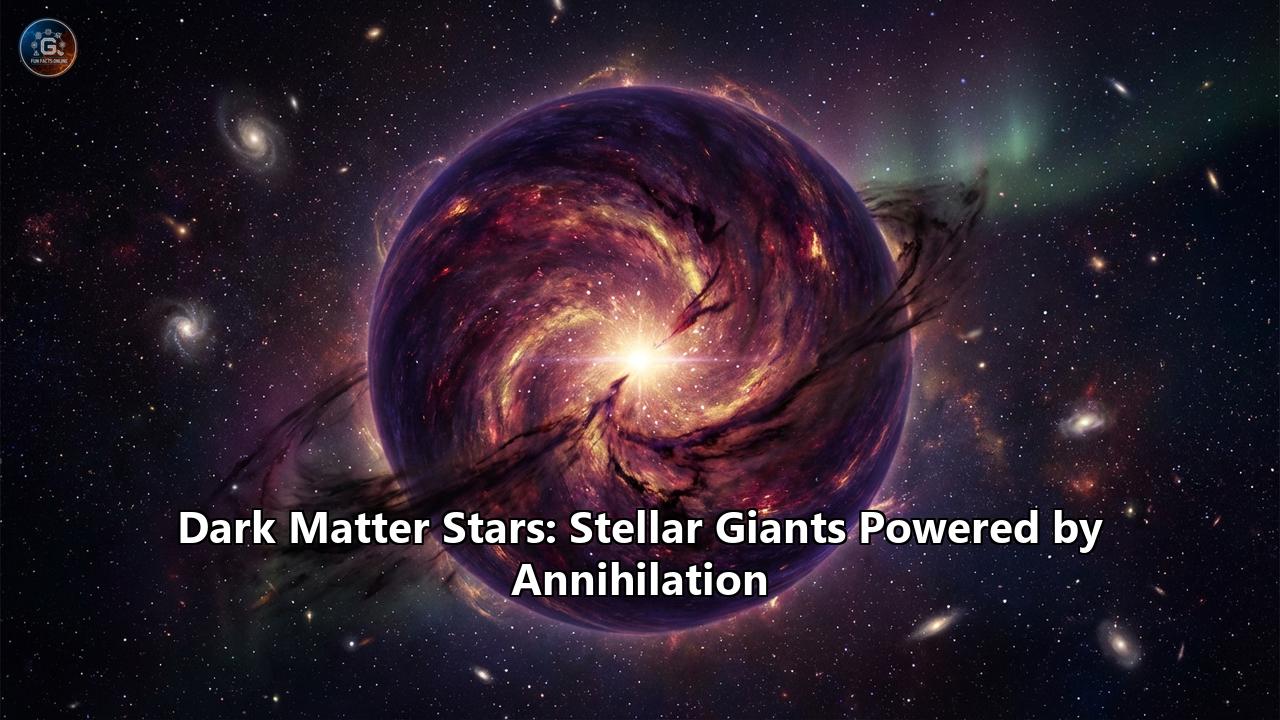
The dawn of the universe was not the silent, gradual awakening astronomers once imagined. It was a time of monsters.
In the deep, obsidian void just a few hundred million years after the Big Bang, giants walked the cosmos. They were not galaxies, though they shone with the brilliance of a billion suns. They were not stars as we know them, fusing atoms in fiery cores. They were something far stranger, far more ancient, and far more terrifying in their sheer scale. They were the Dark Stars.
For decades, these celestial behemoths existed only in the equations of theoretical physicists—ghosts haunting the margins of our understanding of stellar evolution. But now, the James Webb Space Telescope (JWST) has peered back into the murky depths of the "Cosmic Dawn" and found things that shouldn't exist: galaxies that are too bright, black holes that are too massive, and points of light that defy classification. The answer to these impossibilities may well be the Dark Star, a stellar object powered not by nuclear fire, but by the annihilation of the most mysterious substance in the universe: dark matter.
This is the story of the universe’s first giants, the "impossible" stars that may have seeded the cosmos with supermassive black holes, and how their discovery could rewrite the history of everything we know.
Part I: The Crisis at the Edge of Time
To understand why the Dark Star hypothesis has moved from the fringe to the forefront of astrophysics, we must first understand the crisis currently gripping cosmology.
For a long time, the standard model of the early universe—known as Lambda-CDM—was comfortable and orderly. It told us that after the Big Bang, the universe was a hot soup of particles that expanded and cooled. Eventually, gravity pulled clumps of dark matter together, forming "halos." Inside these halos, hydrogen and helium gas gathered, cooled, and collapsed to form the first stars, known as Population III stars.
These Population III stars were theorized to be massive—perhaps 100 times the mass of our Sun—hot, and short-lived. They burned through their fuel and exploded, seeding the universe with the first heavy elements like carbon and oxygen. From their ashes, normal stars and galaxies slowly built up over billions of years. Supermassive black holes (SMBHs), the monsters lurking at the centers of modern galaxies, were thought to grow slowly from smaller "seeds" left behind by these first stars, feeding on gas and merging over eons.
The Webb Telescope Broke the StoryThen came JWST. Launched with the promise of seeing the "first light," it delivered a shock. When it looked back to redshifts of z=10, z=12, and even z=14 (corresponding to just 300-400 million years after the Big Bang), it didn't find a sleepy nursery of infant proto-galaxies. It found a metropolis.
- The "Impossible" Early Galaxies: JWST found galaxies that were already massive, fully formed, and incredibly bright. Some contained as many stars as the modern Milky Way but existed when the universe was less than 5% of its current age. There simply wasn't enough time in the standard model for gravity to pull that much normal matter together so quickly.
- The Black Hole Problem: Even more disturbing were the black holes. Quasars powered by black holes with masses millions to billions of times the mass of the Sun were found less than a billion years after the Big Bang. In the standard accretion model, a black hole has a speed limit on how fast it can eat (the Eddington limit). To get that big, that fast, they would have had to start as seeds much larger than a collapsing normal star could provide, or eat faster than physics allows.
- "Blue Monsters" and "Little Red Dots": Astronomers began categorizing strange new objects. "Blue Monsters" are ultra-compact, ultra-bright objects that look like galaxies but are concentrated in a tiny radius. "Little Red Dots" are dense, mysterious sources that look like red, dust-shrouded compact galaxies or quasars.
The universe was too bright, too massive, and too mature, too soon. The timeline was broken.
Enter the Dark Star.
Part II: What is a Dark Star?
A Dark Star is not "dark" in the visual sense. In fact, if you were to see one, it would be the brightest single object your eyes had ever beheld. The name refers to its power source.
In the standard picture, a star is a battle between gravity and fusion. Gravity tries to crush the star's gas inward; nuclear fusion in the core pushes outward, creating a balance called hydrostatic equilibrium.
A Dark Star is different. It forms in the same early dark matter halos, but it interacts with the dark matter in a unique way.
The WIMP MiracleDark matter makes up about 85% of the matter in the universe. We don't know exactly what it is, but the leading candidate is the WIMP (Weakly Interacting Massive Particle). WIMPs have a special property: they are their own antiparticles. When two WIMPs collide, they annihilate, converting their entire mass into pure energy (gamma rays, electrons, positrons, neutrinos).
In the dense environment of the early universe, specifically at the center of a dark matter halo, the density of dark matter is incredibly high. As the first clouds of hydrogen and helium gas collapse into this center to form a star, they pass through this dense "fog" of dark matter.
The WIMPs are dragged along by the collapsing gas. As the density spikes, the WIMPs start colliding with each other frantically. The annihilation releases a flood of energy. This energy is trapped by the thick cloud of hydrogen gas.
The Heating MechanismThis dark matter heating acts as a pressure source. It heats the gas cloud, pushing outward against gravity. Crucially, this happens before the gas becomes dense and hot enough to ignite nuclear fusion.
The result is a star that is "frozen" in a state of gravitational collapse. It is supported not by fusion, but by the steady, gentle heating of dark matter annihilation throughout its volume.
Because this energy source is so efficient, the star doesn't need to be compact. It stays enormous. A Dark Star is a giant, puffy cloud of hydrogen and helium, glowing with the brilliance of annihilation.
Vital Statistics of a Dark Star:- Radius: Massive. A Dark Star can have a radius of 10 to 100 Astronomical Units (AU). For comparison, the distance from Earth to the Sun is 1 AU. If you placed a Dark Star in our solar system, it would swallow everything out to the orbit of Pluto and beyond.
- Mass: Because they don't get hot enough to blow away their outer layers (like normal massive stars do), they can keep accreting gas indefinitely. They can grow to 1 million solar masses or more.
- Temperature: Surprisingly cool. The surface temperature is only about 10,000 Kelvin (similar to a standard A-type star like Vega or Sirius, or slightly hotter than the Sun).
- Luminosity: Unfathomable. A supermassive Dark Star can be 1 billion to 10 billion times more luminous than the Sun. A single Dark Star can outshine an entire galaxy of normal stars.
Part III: The Evidence in the Data
The Dark Star hypothesis was proposed in 2007 by Katherine Freese, Douglas Spolyar, and Paolo Gondolo. For 15 years, it was a beautiful mathematical possibility. With JWST, it has become a tangible candidate for reality.
In 2023 and 2024, a team of astrophysicists analyzing JWST data identified several objects that fit the Dark Star profile better than the galaxy profile. These candidates—specifically JADES-GS-z13-0, JADES-GS-z12-0, and JADES-GS-z11-0—were originally classified as some of the most distant galaxies ever seen.
But when researchers looked closer, they found anomalies:
- Point Sources: Despite the telescope's immense resolution, these "galaxies" looked unresolved, like single points of light rather than extended structures.
- Spectral weirdness: Their light curves didn't perfectly match the profile of a standard population of young stars.
When the team modeled these objects as Supermassive Dark Stars rather than galaxies, the data fit perfectly. The "Blue Monsters" mentioned earlier—those ultra-bright, compact objects defying explanation—might not be galaxies at all. They might be single, solitary Dark Stars screaming across the cosmic dark.
The "Little Red Dots" ConnectionThe mysterious "Little Red Dots" found by JWST are another piece of the puzzle. These objects are compact, red, and dense. The mainstream explanation is that they are active galactic nuclei (black holes) reddened by dust. However, the Dark Star theory offers an alternative:
Some Dark Stars, as they evolve or if they are less massive, might appear cooler and redder. Or, we might be seeing the "end game" of a Dark Star—the moment the dark matter fuel runs out and the star begins its catastrophic collapse (more on that later). The "red" could be the signature of the cooling gas envelope as the internal support vanishes.
Part IV: The Ultimate Black Hole Seeds
Perhaps the most compelling reason to believe in Dark Stars is that they solve the biggest headache in modern cosmology: The Origin of Supermassive Black Holes.
As mentioned, we see billion-solar-mass black holes just shortly after the Big Bang.
- Scenario A (Standard): You start with a Pop III star (100 solar masses), it collapses into a 100 solar mass black hole. To get to 1 billion solar masses, it has to eat gas constantly at the maximum physical limit for 500 million years without pausing. This is statistically highly unlikely.
- Scenario B (Direct Collapse): A massive gas cloud collapses directly into a black hole without forming a star. This requires very specific, rare conditions (no cooling, no metals, nearby radiation sources) that shouldn't be common enough to explain the number of black holes we see.
Here is where the Dark Star shines. A Dark Star is a unique "incubator."
- It forms at the center of a halo.
- It grows to 1 million solar masses because it is cool and puffy, so it doesn't blow away its food supply.
- It lives for millions of years, powered by dark matter.
- Eventually, the dark matter in the halo is depleted or the star moves out of the dense center.
- The Collapse: Without the heat from annihilation, gravity instantly wins. The 1-million-solar-mass cloud collapses. Because it is so massive, it doesn't stop at being a neutron star. It doesn't even stop at being a normal black hole.
- It collapses directly into a 100,000 to 1,000,000 solar mass black hole.
This gives the universe a massive "head start." Instead of starting with a 100-mass seed, you start with a 1,000,000-mass seed. Growing from 1 million to 1 billion in a few hundred million years is easy. It explains the quasars, it explains the "impossible" masses, and it explains why they are in the centers of galaxies (because that's where the dark matter density was highest).
If Dark Stars are real, they are the ancestors of the monsters that anchor our own Milky Way today. Sagittarius A, the black hole at the center of our galaxy, may be the corpse of a Dark Star.
Part V: The Physics of Annihilation
For the physics enthusiasts, the mechanism of a Dark Star is a fascinating subversion of stellar mechanics.
The Gamow LimitIn normal stars, fusion requires temperatures of millions of degrees to overcome the Coulomb barrier (the electrostatic repulsion between protons). This is why normal stars must contract until their cores are dense and hot.
WIMP HeatingDark matter annihilation requires no heat to start. It only requires density. The rate of energy production per unit volume scales with the square of the dark matter density ($\rho_{DM}^2$) and the annihilation cross-section ($\langle \sigma v \rangle$).
$$ \Gamma_{ann} \propto \frac{\rho_{DM}^2 \langle \sigma v \rangle}{m_{\chi}} $$
Even though dark matter is only a tiny fraction of the star's mass (less than 1%—the rest is hydrogen), the energy released by matter-antimatter annihilation is $E=mc^2$. This is roughly 1,000 times more efficient than nuclear fusion (which only converts about 0.7% of mass to energy).
Because this heat is generated throughout the star (or in a large core region) and is trapped by the opacity of the hydrogen gas, the star establishes hydrostatic equilibrium at a much larger radius. The surface temperature $T_{eff}$ is determined by the Stefan-Boltzmann law:
$$ L = 4 \pi R^2 \sigma T_{eff}^4 $$
Since the Luminosity ($L$) is high (due to high mass and annihilation power) and the Radius ($R$) is enormous (due to the puffy nature), the Temperature ($T$) settles at a modest ~10,000 K.
This low temperature is crucial. Normal supermassive stars (if they formed via fusion) would be so hot ($100,000 K+$) that they would produce intense UV radiation. This radiation would ionize the surrounding gas and blow it away, starving the star and stopping its growth. Dark Stars are too cool to produce this "feedback." They are gentle giants, allowing gas to keep falling onto them, feeding them until they become titanic.
Part VI: The Future of the Hunt
How do we prove they are real?
We have candidates, but candidates are not confirmation. The astronomical community is currently engaged in a high-stakes hunt for the "Smoking Gun."
1. The Helium-II LineThe most promising signature is a specific spectral line: HeII $\lambda$1640.
Because Dark Stars are cool on the surface but may have different internal ionization profiles or surrounding nebulae, their spectrum should look different from a galaxy of young stars. A standard galaxy has many hot, massive stars producing specific ratios of hydrogen and helium emission lines. A Dark Star, being a single object with a specific temperature profile, should show a strong absorption or emission feature at 1640 Angstroms (in the UV rest frame), which gets redshifted into the infrared for JWST.
Recent analysis of the JADES candidates has shown hints of this HeII feature, strengthening the case.
2. MicrolensingIf a Dark Star passes behind a galaxy cluster, its light might be magnified by gravitational lensing. If the object is a star (a point source) versus a galaxy (an extended source), the "caustic crossing" (when the lens magnification spikes) will look very different. A single star can be magnified by factors of thousands, creating a sudden, sharp spike in brightness that a galaxy cannot replicate.
3. Gravitational WavesThe collapse of a Dark Star into a black hole would be a massive event. While it might be too spherically symmetric to produce strong gravitational waves on its own, the subsequent mergers of these massive seeds would produce a "hum" in the gravitational wave background that future detectors like LISA (Laser Interferometer Space Antenna) will be able to hear.
4. The Roman Space TelescopeNASA’s upcoming Nancy Grace Roman Space Telescope will have a field of view 100 times larger than Hubble. While JWST is a sniper rifle looking at tiny patches of sky, Roman is a shotgun. It could find thousands* of Dark Star candidates, allowing for statistical analysis that could rule out the "random galaxy" hypothesis.
Part VII: Conclusion
We stand at a precipice in our understanding of the cosmos. For a century, we believed the story of the universe was written in the language of nuclear fusion. We thought stars were the first light, and black holes were their graves.
But the universe is stranger than our stories. The Dark Star hypothesis suggests that the first chapter of cosmic history was written not by light, but by the darkness itself. It suggests that the mysterious substance that holds our galaxy together—dark matter—was once the fuel that illuminated the void.
If Dark Stars are confirmed, they solve the impossible puzzles of the early universe. They explain the monsters at the dawn of time. They connect the physics of the subatomic (WIMPs) to the physics of the immense (Supermassive Black Holes). They tell us that we, the inhabitants of a universe dominated by fusion stars, are living in the "aftermath" era—a quieter, dimmer cosmos that exists in the wake of the giants.
The "Blue Monsters" and "Little Red Dots" in the Webb images are whispering a new truth to us: The dark is not empty. It is alive with fire.
Reference:
- https://scoap3-prod-backend.s3.cern.ch/media/files/81717/10.1016/j.physletb.2023.138341.pdf
- https://entechonline.com/jwst-blue-monsters-dark-stars-early-universe/
- https://russpain.com/en/analysis/dark-stars-may-unlock-the-mysteries-of-the-early-universe-and-black-holes-369620/
- https://utw11314.utweb.utexas.edu/research/dark-stars/
- https://arxiv.org/abs/1501.02394
- https://www.youtube.com/watch?v=pT68W_UVxTo
- https://www.spacedaily.com/reports/Dark_star_theory_links_JWST_early_universe_anomalies_999.html
- https://www.space.com/astronomy/black-holes/what-are-dark-stars-scientists-think-they-could-explain-3-big-mysteries-in-the-universe
- https://ned.ipac.caltech.edu/level5/Sept17/Freese/Freese6.html
- https://en.wikipedia.org/wiki/Reionization
- https://www.gadgets360.com/science/news/dark-stars-could-explain-supermassive-black-holes-blue-monsters-and-little-red-dots-10765516
- https://en.wikipedia.org/wiki/Weakly_interacting_massive_particle
- https://www.researchgate.net/publication/1760644_WIMP_Annihilation_and_Cooling_of_Neutron_Stars
- https://www.mpg.de/25316826/black-hole-stars
- https://www.space.com/astronomy/black-holes/james-webb-space-telescopes-mysterious-little-red-dots-may-be-black-holes-in-disguise
- https://repository.usfca.edu/cgi/viewcontent.cgi?article=1043&context=phys
- https://www.youtube.com/watch?v=V0Z7i8Mm7Ow