
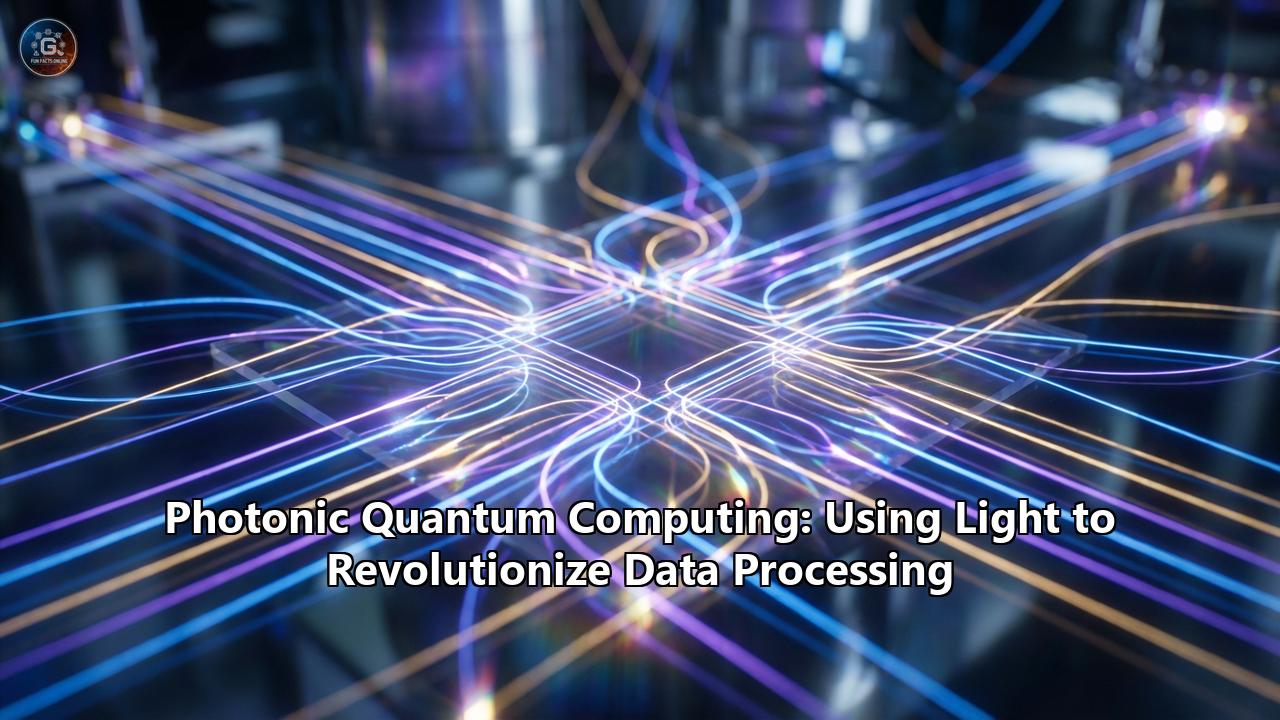
Imagine a computer that calculates not with electrical currents, but with the fundamental particles of light. A machine that taps into the bizarre, counterintuitive laws of quantum mechanics to solve problems in seconds that would take today’s most powerful classical supercomputers millennia to crack. This isn't science fiction; it is the fast-approaching reality of photonic quantum computing.
As we navigate through 2026, the global quantum computing race has shifted gears. While early headlines were dominated by superconducting circuits housed in colossal, chandelier-like dilution refrigerators, a new champion has emerged from the glowing world of optics. Photonic quantum computing—using photons to process, route, and store data—is revolutionizing how we think about scaling quantum power. It offers a viable, accelerated pathway to millions of qubits, room-temperature processing, and seamless integration with existing global fiber-optic networks.
To understand why light is poised to win the quantum race, we must dive deep into the physics, the engineering breakthroughs, the software ecosystems, and the fierce commercial landscape that is currently redefining the limits of human computation.
The Quantum Leap: Why Light?
For decades, the standard approach to building a quantum computer relied on superconducting qubits or trapped ions. These platforms have achieved remarkable milestones, but they face immense physical hurdles. Superconducting qubits are notoriously fragile. The slightest temperature fluctuation or stray electromagnetic field can cause "decoherence," collapsing the delicate quantum state and destroying the calculation. To prevent this, these systems require extreme cryogenic cooling—operating at temperatures colder than deep space, hovering just fractions of a degree above absolute zero. As you add more qubits to scale up the computer's power, the cooling requirements and the complex wiring become an engineering nightmare.
Enter the photon.
Photons are the elementary particles of light. They have no mass, they travel at the universe's ultimate speed limit, and they barely interact with their environment. In the realm of quantum computing, this aloofness is their greatest superpower. Because photons do not readily interact with each other or with stray magnetic fields, they are incredibly resistant to decoherence. A photon can carry delicate quantum information—encoded in its polarization, its path, or its arrival time—across vast distances without losing its quantum state.
Crucially, the actual processing of photonic qubits can occur at room temperature. The complex waveguides, beam splitters, and phase shifters that make up a photonic quantum chip do not need to be buried inside a million-dollar cryogenic freezer. While it is true that the highly sensitive detectors used to "read" the final output of the calculation still require cooling, the computational core itself can sit on a standard server rack.
Furthermore, because our modern telecommunications infrastructure is already built on fiber-optic cables, photonic quantum computers are inherently "network-ready." Transferring a quantum state from one machine to another in a different city is an organic extension of the technology, laying the foundational bedrock for the future Quantum Internet.
The Anatomy of a Photonic Quantum Computer
Building a quantum computer out of light requires three fundamental pillars: generation, manipulation, and detection.
1. The Source: Generating QubitsYou cannot use a standard lightbulb or even a traditional laser to run a quantum computer. You need highly specialized components that can generate either single photons on demand or specialized "squeezed states" of light.
One leading method involves "artificial atoms" or semiconductor quantum dots. When excited by a laser, these nanoscale structures emit exactly one photon at a time. Another approach, known as Spontaneous Parametric Down-Conversion (SPDC), fires a high-energy laser into a specialized crystal, occasionally splitting a single high-energy photon into two entangled lower-energy photons. Today’s industry leaders have refined these sources to fire billions of times per second with astonishing deterministic accuracy.
2. The Circuit: Sculpting LightOnce generated, the photons must be manipulated to perform logical operations (quantum gates). This is achieved using silicon photonics—a technology originally developed for high-speed internet routing. The photons travel through microscopic tunnels etched into silicon chips, known as waveguides. By placing two waveguides incredibly close together, engineers can create a "beam splitter," allowing a photon's wave function to split and travel down two paths simultaneously—a quantum superposition. Phase shifters, which slightly alter the speed of light in a specific waveguide using heat or electrical fields, allow engineers to manipulate the interference patterns of the photons, executing complex algorithms.
3. The Detectors: Reading the AnswerAfter the light has navigated the labyrinth of the quantum chip, the final state must be measured to extract the answer. This is the domain of Superconducting Nanowire Single-Photon Detectors (SNSPDs). These microscopic wires are cooled to cryogenic temperatures so that they have zero electrical resistance. When a single photon strikes the nanowire, it breaks the superconductivity for a fraction of a nanosecond, creating a tiny electrical pulse. This pulse is the final classical output—the answer to the quantum equation.
The Paradigm Shift: Measurement-Based Quantum Computing (MBQC)
If you follow traditional quantum computing, you are likely familiar with the "circuit model." In this model, qubits sit stationary in a processor while logic gates are sequentially applied to them. Photons, however, refuse to sit still; they are always moving at the speed of light.
To solve this, photonic quantum computing relies on a revolutionary architecture known as Measurement-Based Quantum Computing (MBQC). In MBQC, the computation does not start by feeding data into a blank slate of qubits. Instead, the machine first generates a massive, highly entangled web of photons known as a "cluster state." This cluster state acts as a universal canvas.
The actual computation is performed solely by measuring the photons in a very specific, adaptive sequence. Because measuring a quantum particle destroys its superposition, the act of measurement itself sculpts the remaining entangled web, steering the quantum information through the logic of the algorithm. It is akin to taking a solid block of marble (the cluster state) and using a chisel (measurements) to carve out the specific algorithm you need. This paradigm is perfectly suited for light, turning the photon's ephemeral nature into a computational advantage.
The Commercial Vanguard: Who is Building the Future in 2026?
The theoretical elegance of photonic quantum computing has rapidly transitioned into hard-nosed industrial engineering. As of early 2026, the market is dominated by three main juggernauts, each pushing the boundaries of what is possible.
PsiQuantum: The Quest for a Million Qubits
Based in Silicon Valley, PsiQuantum has adopted a bold, all-or-nothing strategy. Rather than building small, noisy prototypes, PsiQuantum is aiming straight for utility-scale, fault-tolerant quantum computing—a machine with over 1 million physical qubits.
The industry rallied behind this vision in late 2025 when PsiQuantum successfully raised a staggering $1 billion in Series E funding, led by BlackRock, Baillie Gifford, and Temasek, pushing the company's valuation to $7 billion. This immense war chest is currently funding the construction of the world's first utility-scale quantum computing sites in Brisbane, Australia, and Chicago. To handle the immense cooling requirements for their detectors and system stabilization, PsiQuantum recently partnered with Linde Engineering to deliver one of the largest bespoke cryogenic plants ever designed for quantum technology.
PsiQuantum’s core thesis relies on leveraging existing tier-1 semiconductor foundries. By using the exact same manufacturing processes used to print chips for laptops and smartphones, they can manufacture proprietary quantum photonic chips and high-performance barium titanate optical switches by the millions. In February 2026, the company appointed computing veteran Victor Peng, former President of AMD, as Interim CEO to guide this massive industrial scaling phase.
But hardware is only half the battle. In January 2026, PsiQuantum partnered with Airbus to tackle one of aerospace engineering’s most notoriously difficult tasks: computational fluid dynamics (CFD). Using PsiQuantum's 'Construct' software suite, the teams are developing fault-tolerant quantum algorithms to simulate non-trivial incompressible fluid flows over aircraft wings. If successful, this will allow Airbus to design radically more efficient, aerodynamic planes without relying on physical wind tunnels or approximations from classical supercomputers.
Xanadu: Silicon Integration and Squeezed Light
Canada’s Xanadu has carved out a distinct and highly successful path in the photonic landscape. Instead of single photons, Xanadu uses "squeezed states" of light—a Continuous Variable (CV) approach that allows them to encode more information into the amplitude and phase of the light waves.
Xanadu’s momentum in early 2026 has been nothing short of explosive. In a massive financial milestone, the company announced a business combination agreement with Crane Harbor Acquisition Corp. to become publicly traded on the Nasdaq and Toronto Stock Exchange, with a capitalization of roughly $500 million.
On the hardware front, Xanadu achieved a monumental breakthrough in June 2025 by demonstrating the first-ever Gottesman-Kitaev-Preskill (GKP) qubits on an integrated photonic chip. GKP qubits are highly sought after in the quantum world because they possess built-in error resistance, mapping the quantum information onto a grid-like structure in phase space that inherently corrects for tiny shifts and noise.
To manufacture these advanced chips at scale, Xanadu expanded its strategic collaboration with Tower Semiconductor in February 2026. Together, they co-engineered a unique, high-volume production flow for Xanadu's custom ultra-low loss silicon nitride (SiN) material stack, proving that quantum photonic circuits can be churned out in traditional analog semiconductor foundries.
Furthermore, Xanadu is solving immediate, high-value industrial problems. In February 2026, they partnered with Mitsubishi Chemical to solve a massive bottleneck in next-generation microchip manufacturing. As classical chips get smaller, the semiconductor industry relies on Extreme Ultraviolet (EUV) lithography. However, precise modeling of how EUV light interacts with photoresist materials is incredibly difficult to simulate classically. Xanadu developed a novel quantum simulation algorithm, targeting early fault-tolerant machines with fewer than 500 logical qubits, to accurately simulate radiation-induced blurring in EUV lithography, paving the way for the next generation of classical microchips.
Xanadu is also dominating the software stack. Their open-source framework, PennyLane, has become the de facto standard for quantum machine learning. In February 2026, Xanadu successfully integrated PennyLane and its Catalyst compiler with the Munich Quantum Toolkit (MQT). This integration connects PennyLane’s user-friendly Python interface with decades of high-performance classical compilation technology from Europe, ensuring that as quantum algorithms scale exponentially in complexity, the software can compile and route the instructions without bottlenecking the hardware.
Quandela: Europe’s Photonic Unicorn
Across the Atlantic, France's Quandela is securing Europe's technological sovereignty in the quantum age. Founded as a spin-off from the Centre for Nanoscience and Nanotechnology in Paris, Quandela utilizes a Discrete Variable (DV) approach, relying on highly efficient semiconductor artificial atoms to fire single photons deterministically.
Quandela's rise has been meteoric. In 2025, they launched "Belenos," a 12-qubit photonic quantum computer that delivered 4,000 times more computing power than their previous generation. Following this, they successfully delivered a customized 12-qubit universal system named "Lucy" to the Très Grand Centre de calcul (TGCC) of the CEA in France, integrating it directly with the Joliot-Curie supercomputer to enable hybrid HPC-quantum workflows for European researchers.
In February 2025, Quandela shocked the industry by publishing a scientific paper detailing a breakthrough that reduces the number of components required for fault-tolerant calculations by a factor of 100,000. By optimizing how their semiconductor quantum emitters generate entangled states, Quandela dramatically shrank the physical footprint required to achieve logical, error-corrected qubits.
Their focus is heavily bent toward Artificial Intelligence. In July 2025, Quandela forged a landmark partnership with Mila, the renowned Quebec Artificial Intelligence Institute founded by Yoshua Bengio. Together, they are developing hybrid Quantum Machine Learning (QML) models, exploring how the immense state-space of a photonic quantum computer can be used to train and optimize neural networks faster and more efficiently than classical GPUs.
In recognition of their aggressive hardware scaling and vital industrial partnerships across finance, aerospace, and AI, Quandela was awarded the prestigious DIGITALEUROPE Future Unicorn Award in February 2026.
Overcoming the Bottlenecks: Photon Loss and Error Correction
While the advantages of light are undeniable, the photonic approach is not without its unique engineering nightmares. The most pressing enemy of a photonic quantum computer is not decoherence, but photon loss.
Every time a photon passes through a beam splitter, turns a corner in a waveguide, or enters a fiber-optic cable, there is a tiny probability that it will be absorbed or scattered. In a circuit requiring thousands of sequential operations, losing even a fraction of your photons means losing the entire calculation.
To combat this, companies are engineering ultra-low-loss materials. Moving beyond standard silicon, the industry is increasingly utilizing silicon nitride (as seen in Xanadu's work with Tower Semiconductor) and lithium niobate, which allow photons to glide through the chip with minimal friction.
Additionally, error correction protocols are being uniquely adapted for light. Because generating a single photon at the exact microsecond you need it is probabilistically difficult, engineers use "multiplexing." They fire dozens of photon sources simultaneously; if one fails, optical switches instantly route a successful photon from an adjacent source into the computational circuit. Combined with advanced error-correcting codes like Xanadu's on-chip GKP qubits, the industry is rapidly transitioning from "noisy" intermediate-scale quantum (NISQ) devices into the era of true Fault-Tolerant Quantum Computing (FTQC).
Transforming Industries: The Real-World Applications
As utility-scale fault-tolerant systems come online between 2028 and 2030, the real-world applications of photonic quantum computing will trigger paradigm shifts across global industries.
Aerospace and Fluid Dynamics: As evidenced by the PsiQuantum and Airbus partnership, simulating the exact behavior of fluids and aerodynamics is computationally exhausting. A fault-tolerant photonic system will allow aerospace engineers to perfectly simulate turbulence and airflow, leading to aircraft designs that dramatically reduce drag, cut fuel consumption, and lower global carbon emissions. Pharmaceuticals and Drug Discovery: Nature is inherently quantum mechanical. Simulating how complex protein molecules fold and how experimental drugs bind to specific receptors requires analyzing electron interactions that quickly overwhelm classical computers. Photonic quantum computers will allow biochemists to model new life-saving drugs virtually, slashing the R&D timeline from decades down to months. Next-Generation Artificial Intelligence: The intersection of Quantum Computing and AI (Quantum Machine Learning) is arguably the most anticipated technological convergence of the 21st century. As Quandela and Mila are currently exploring, quantum systems can process multidimensional data spaces simultaneously. This could vastly accelerate the training of Large Language Models (LLMs) and generative AI, while drastically reducing the catastrophic energy consumption currently required by massive GPU server farms. Cybersecurity and the Quantum Internet: A photonic quantum computer naturally interfaces with fiber optics. In 2025, networking startups like IonQ (in collaboration with the US Air Force Research Laboratory) demonstrated breakthroughs in converting quantum signals to telecommunication wavelengths, laying the groundwork for the Quantum Internet. Because photonic quantum computers can directly transmit entangled photons over these networks, they will enable absolute, physically unbreakable encryption protocols—securing global financial networks against both classical and quantum hacking threats.The Economic Horizon
The transition from lab experiments to industrial manufacturing has catalyzed a massive influx of capital. The global photonic quantum computing market is currently experiencing remarkable growth momentum. Projections indicate that worldwide revenues will reach $1.1 billion by 2030, with an explosive expansion forecasted to hit over $7 billion by 2036.
This compound annual growth rate reflects a broader enterprise awakening. Governments and multinational corporations realize that quantum computing is no longer a speculative academic exercise; it is a critical pillar of national security and economic sovereignty. The ability to operate at room temperature, leverage existing telecommunications infrastructure, and utilize legacy CMOS semiconductor foundries positions photonics as the most scalable, cost-effective quantum modality on the market.
The Dawn of the Photonic Era
We are standing on the precipice of a computational revolution. For half a century, silicon-based classical computing has shaped human progress, bound by the rigid binary laws of zeros and ones. But as Moore's Law slows and our computational demands for AI, climate modeling, and medical research skyrocket, a new paradigm is required.
Photonic quantum computing is answering that call. By harnessing the ethereal, frictionless properties of light, engineers are bypassing the cryogenic limitations of older quantum models. With companies like PsiQuantum, Xanadu, and Quandela achieving unprecedented milestones in 2025 and 2026—from billion-dollar funding rounds and million-qubit roadmaps to fault-tolerant chip integrations and high-volume foundry manufacturing—the timeline for quantum utility is accelerating faster than anyone predicted.
We are no longer just dreaming of a quantum future; we are actively carving it out of silicon, illuminating the path forward with the power of light. The age of photonic quantum computing is here, and it is set to change the world.
Reference:
- https://postquantum.com/quantum-computing-companies/quandela/
- https://siliconangle.com/2025/09/10/quantum-computing-startup-psiquantum-raises-1b-aiming-build-1m-qubit-scale-machine/
- https://www.psiquantum.com/news-import
- https://www.goodwinlaw.com/en/news-and-events/news/2025/11/announcements-tech-goodwin-advises-psiquantum-on-series-e-financing
- https://www.psiquantum.com/news-import/airbus
- https://www.photonics.com/Articles/PsiQuantum-Teams-with-Airbus/a71862
- https://www.globenewswire.com/news-release/2026/02/25/3245099/0/en/Xanadu-and-Mitsubishi-Chemical-Make-Breakthrough-Quantum-Algorithms-for-Next-Generation-Semiconductor-Manufacturing.html
- https://quantumzeitgeist.com/xanadu-pennylane-quantum-software/
- https://www.xanadu.ai/blog/the-photonic-qubit-of-the-future
- https://towersemi.com/2026/02/19/02192026/
- https://www.taiwannews.com.tw/en/news/6309109
- https://vivatech.com/news/quantum-startups-driving-innovation-at-viva-tech?ca=ALLYEAR-FB&utm_source=RS&utm_medium=FB&utm_campaign=ALLYEAR25
- https://quantumcomputingreport.com/quandela-delivers-12-qubit-lucy-photonic-quantum-computer-to-europes-cea-tgcc/
- https://www.quandela.com/about-us/newsroom/quandela-announces-a-100000-reduction-in-the-number-of-components-needed-for-fault-tolerant-calculations-a-major-breakthrough-for-photonic-quantum-computing/
- https://mila.quebec/en/news/quandela-and-mila-join-forces-to-develop-hybrid-artificial-intelligence-and-quantum-computing
- https://www.digitaleurope.org/news/quandela-and-sateliot-win-digitaleuropes-future-unicorn-and-dual-use-technology-awards-2026/
- https://www.optica-opn.org/home/industry/2025/september/ionq_announces_quantum_networking_breakthrough/
- https://www.futuremarketsinc.com/the-global-photonic-quantum-computing-market-2026-2036/