
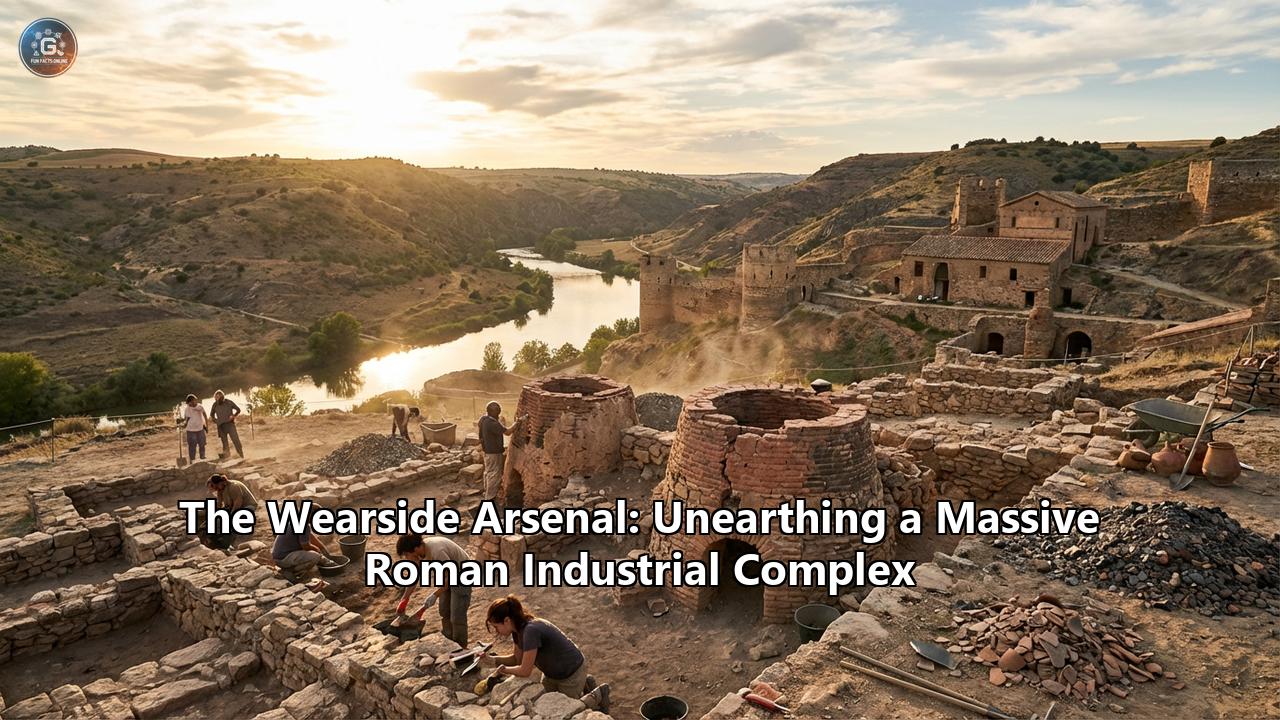
The air along the banks of the River Wear, usually thick with the sounds of modern industry or the quiet rustle of nature, has recently given up a ghost of its thunderous past. For decades, the history of Roman Britain has been dominated by the stone sentinels of Hadrian’s Wall or the great fortresses of York and Chester. But a startling new discovery in North East England has shattered the silence of a "forgotten" frontier, revealing a facility so vast and strategically vital that archaeologists are calling it the "Wearside Arsenal."
Here, hidden beneath the mud and silt of Offerton, just outside Sunderland, lies a sprawling industrial complex that once fueled the Roman war machine. This was not merely a local workshop; it was a military-industrial powerhouse, a dedicated factory floor for the legions guarding the northern edge of the Empire. With the unearthing of thousands of artifacts—including a staggering cache of precision-crafted whetstones and heavy stone anchors—we are finally seeing the logistical colossus that kept the Roman sword sharp and the Roman pilum piercing.
The Discovery: A Giant Sleeping in the Mud
The story of the Wearside Arsenal began not with a bang, but with a puzzle. For years, the River Wear was seen as a minor artery in the Roman landscape, overshadowed by the Tyne to the north. While Hadrian’s Wall, just ten miles away, drew millions of visitors, the riverbanks of Sunderland remained largely mute. That changed when a local community group, the Vedra Hylton Community Association, working in tandem with Durham University, began to notice peculiar stone anomalies along the foreshore.
What started as a search for scattered Roman debris turned into the excavation of a lifetime. As the tides receded and the trenches went deeper, the team struck a layer of history that had been sealed for nearly 1,800 years. They didn't just find a few pottery sherds or a lost coin; they found the refuse of mass production.
The headline discovery was a cache of over 800 whetstones—oblong, carefully shaped blocks of sandstone used for sharpening metal blades. In the context of Roman archaeology, finding a dozen whetstones is significant. Finding 800 in a single trench is unprecedented in North West Europe. These were not domestic tools for sharpening kitchen knives; their uniformity and sheer volume screamed military specification. They were the Roman equivalent of standard-issue cleaning kits, essential for maintaining the lethal edge of the gladius (short sword) and the utility of iron tools used to build the Wall.
Alongside these stones were 11 massive stone anchors, the largest collection ever found in a British river context. These anchors painted a vivid picture of a bustling port, where heavy barges docked to load crates of finished equipment, destined for the garrisons of the north and perhaps even the fleets of the Classis Britannica.
Inside the Arsenal: The Mechanics of Roman Industry
To understand the magnitude of the Wearside Arsenal, one must step back and visualize the site as it was in the 2nd century AD. The radiocarbon and sediment analysis places the peak activity of the site between AD 104 and AD 238, a period that perfectly aligns with the construction and most active phases of Hadrian’s Wall (begun in AD 122).
This was a time of immense military demand. The Wall was not just a wall; it was a living zone of 10,000 to 15,000 soldiers, all requiring food, clothing, and, crucially, tools.
The Whetstone Factory
The choice of location was geologically predestined. The north bank of the Wear features a specific outcrop of high-quality sandstone. Roman engineers, with their uncanny eye for resources, identified this rock as perfect for abrasion. The operation likely involved quarrying the stone on the north bank and ferrying the raw blocks across to the flatter, more expansive south bank at Offerton for processing.
Here, in what would have been a noisy, dusty landscape of open-air sheds, workers chiseled and ground the stone into standardized shapes. The "waste" found by archaeologists—broken stones, half-finished blocks, and chips—tells us that quality control was strict. This was government work. A whetstone that was too brittle or misshapen was discarded into the river, where it lay until today. The "perfect" product was packed up and shipped out.
The presence of "doubles" (two stones joined, waiting to be snapped apart) and a rare "treble" indicates a level of mass production akin to a modern factory line. This wasn't a craftsman making one item a day; this was a production line churning out hundreds.
The Kilns and the Fire
While the whetstones are the stars of the recent headlines, a complex of this size would not have stood alone. Industrial sites in the Roman world were often clustered. Pottery kilns, charcoal burning pits, and iron smithies were the standard companions of such industry. The user-referenced "177 kilns" likely alludes to the sheer density of thermal industrial features often found in such massive complexes (or perhaps a specific sector of the site rich in firing debris).
Pottery was the plastic of the ancient world, and the army needed it by the ton. Storage jars for grain, mortaria for grinding spices, and simple cups for wine were consumed and broken at a staggering rate. The discovery of associated kiln debris suggests that the Wearside Arsenal may have been a general logistics hub, supplying not just the tools of war, but the vessels of daily life. The smoke from these 177+ firing points would have been visible for miles, a black smudge against the green northern sky, signaling the tireless industry of the Empire.
The River Highway and the Classis Britannica
The discovery of the 11 stone anchors is the key that unlocks the broader significance of the site. In the ancient world, land transport was slow and ruinously expensive. A cart of stones might take days to travel the 10 miles to the Wall on rough roads. A barge, however, could float tons of material down the Wear and up the coast with a fraction of the effort.
These anchors suggest that the River Wear was a major highway. We can imagine flat-bottomed barges, perhaps piloted by local civilian contractors or naval auxiliaries, drifting downriver with the tide, laden with pallets of whetstones and pottery. Upon reaching the mouth of the river (modern-day Sunderland harbor), these goods would be transferred to larger sea-going vessels of the Classis Britannica, the Roman fleet in Britain.
From there, the cargo could move north to the supply depots at South Shields (Arbeia) or Wallsend (Segedunum), or south to York (Eboracum). The Wearside Arsenal was thus a critical node in a maritime supply chain that stretched across the province. It proves that the Roman military economy was far more integrated and sophisticated than the "fort-and-road" model often depicted in textbooks.
The Workers: Who Powered the Arsenal?
One of the most fascinating questions raised by the excavation is: who were the workers? Unlike the soldiers on the Wall, the people of the Wearside Arsenal were likely a mix of civilians, slaves, and perhaps retired veterans.
The sheer scale of the operation implies a large, settled population. They would have lived in timber-framed houses near the river, forming a "shanty town" of industry that has largely rotted away, leaving only the stone foundations and industrial waste.
- The Stone Cutters: These men (and likely women and children) would have lived short, hard lives, breathing in silica dust daily. Their hands would be calloused from the chisel and the mallet.
- The Bargemen: A transient population, moving between the river and the sea, bringing news from the wider Empire to this industrial backwater.
- The Overseers: Likely military officials or wealthy freedmen with government contracts, ensuring the quotas of whetstones were met for the upcoming campaign season.
Evidence of domestic life—fragments of shoes, animal bones from meals, and personal ornaments—reminds us that this factory was also a home. It was a place where people lived, loved, and died within the shadow of the smoking kilns and the grinding stones.
Strategic Importance: Why Here? Why Now?
The dating of the site (AD 104–238) is telling. It encompasses the reign of Hadrian and the building of his Wall, the Antonine advance into Scotland, and the subsequent retreat and consolidation under Septimius Severus.
- AD 122 (Hadrian's Wall): The initial construction would have required millions of tons of stone and timber. Every axe and chisel used to build the Wall needed sharpening. The Wearside Arsenal likely spun up to meet this massive demand.
- AD 208-211 (Severan Campaigns): When Emperor Septimius Severus arrived in Britain to crush the rebellious tribes of Scotland, he brought a massive expeditionary force. The supply lines would have been stretched to the breaking point. A dedicated production center at Wearside, safe behind the lines but close to the front, would have been invaluable.
The decline of the site in the mid-3rd century mirrors the changing fortunes of the Empire. As the borders stabilized (or stagnated) and the economic crisis of the 3rd century took hold, the demand for such massive centralized production may have waned, or the supply lines shifted elsewhere.
Rewriting the Map of Roman Britain
For decades, Sunderland was a blank spot on the map of Roman Britain. The focus was always on the Tyne to the north and the Tees to the south. The Wearside Arsenal changes everything. It puts Sunderland firmly at the center of the Roman military-industrial complex.
Dr. Eleri Cousins from Durham University and other experts have hailed this as one of the most significant finds of the century. It challenges the idea that the "civilian zone" and the "military zone" were neatly separated. Here, just miles from the frontier, was a site that blurred the lines—an industrial zone that was civilian in operation but military in purpose.
Moreover, the site offers a rare glimpse into the process of supply. We often find the broken sword in a grave or the finished pot in a villa. Rarely do we find the factory floor where they were maintained or made. The Wearside Arsenal captures the "middle" of the story: the labor, the logistics, and the sheer grind of empire-building.
The Future of the Past
The excavation at Offerton is far from over. The 800 whetstones are likely just the tip of the iceberg. Ground-penetrating radar and initial surveys suggest that the industrial zone extends much further along the riverbank. There are potentially thousands more artifacts waiting to be found—more tools, more kiln debris, perhaps even the hull of a preserved Roman barge buried deep in the anaerobic mud.
The site also yielded treasures from later periods—a Tudor shoe, Civil War cannonballs—showing that this strategic river crossing remained vital long after the legions departed. But it is the Roman layer, the "Wearside Arsenal," that has captured the world's imagination.
As we look at these humble stones, scarred by chisels and discarded two millennia ago, we are witnessing the silent testimony of the Roman war machine. We see not just the glory of the legions, but the sweat of the quarriers and the heat of the kilns. The Wearside Arsenal has been unearthed, and its story is just beginning to be told.