
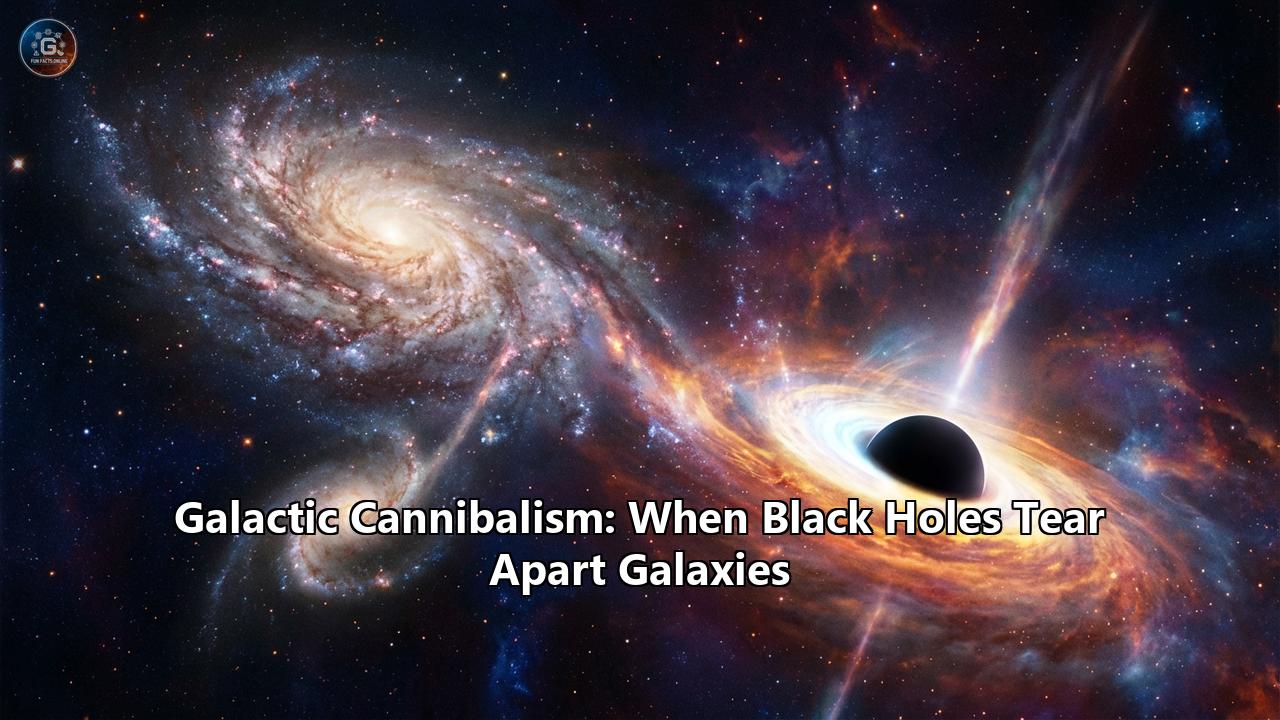
In the silent, velvet blackness of intergalactic space, a violent drama is unfolding. It is a story not of creation in a vacuum, but of destruction as the primary engine of growth. We often picture galaxies as lonely, majestic islands of starlight—static, serene pinwheels floating in the void. This "island universe" theory, once the dominant view of astronomy, could not be more wrong. The universe is not a museum of static art; it is a chaotic ecosystem where the strong devour the weak, where neighbours tear each other apart, and where the majestic spirals we admire are merely the temporary survivors of a cosmic food chain. This is the reality of Galactic Cannibalism.
When gravity bridges the gap between two galaxies, the result is a cataclysm that defies human timescales. It is a slow-motion car crash lasting hundreds of millions of years, ripping stars from their orbits, shredding gas clouds, and waking the sleeping monsters—supermassive black holes—at the galactic cores. This process is not a rare anomaly; it is the fundamental mechanism of evolution in our universe. You, the Earth you stand on, and the Milky Way galaxy you call home are the products of this violence. We are the debris of a billion-year-old feast.
This comprehensive exploration will take you deep into the mechanics of this cosmic violence. We will journey from the terrifying physics of tidal forces to the invisible drag of dark matter. We will witness the recent discoveries from the James Webb Space Telescope that have rewritten the history of the early universe. We will stare into the event horizons of merging black holes and fast-forward billions of years to the inevitable doom of our own galaxy.
Part I: The Physics of the Dance
To understand how a galaxy—a structure hundreds of thousands of light-years across—can "eat" another, we must first abandon our intuitive understanding of collision. In our daily lives, collisions are solid. Cars crash, billiard balls click, tectonic plates grind. But galaxies are not solids; they are ghosts made of light and gravity. A galaxy is essentially empty space. If the Sun were a ping-pong ball in New York, the nearest star would be another ping-pong ball in Atlanta. When two galaxies "collide," the stars themselves almost never physically touch. They pass through each other like two swarms of bees.
If the stars don't hit, how does the violence happen? The answer lies in the invisible fabric that binds them: Gravity.
The Tidal Grip
The primary weapon of a cannibal galaxy is the tidal force. We are familiar with tides on Earth—the Moon’s gravity pulls the ocean on the near side of Earth more strongly than the ocean on the far side, stretching the planet into a slightly football-like shape. In the context of galaxies, this force is scaled up to apocalyptic proportions.
As a small dwarf galaxy approaches a massive giant like the Milky Way, the gravitational pull on its "front" (the side facing the giant) is significantly stronger than the pull on its "back." This differential force stretches the dwarf galaxy. It is spaghettified, pulled into a long, thin stream of stars. Simultaneously, the dwarf galaxy’s own gravity is overwhelmed. The stars at its edges are no longer bound to their home; they are liberated, stripped away to become solitary wanderers in the halo of the predator galaxy.
This process, known as tidal stripping, is the first stage of digestion. The predator galaxy literally peels the victim apart, layer by layer. The stripped stars form "stellar streams"—long ribbons of light that wrap around the cannibal galaxy like the bandages of a mummy. We see these scars clearly around the Milky Way today, remnants of meals eaten billions of years ago.
Dynamical Friction: The Drag of the Ghost
If gravity only pulled things, orbiting galaxies might just swing past each other and escape, like a comet slingshotting around the Sun. But they don't. They spiral inward, doomed to merge. What slows them down?
The answer is a phenomenon called Dynamical Friction, often referred to as "Chandrasekhar friction" after the astrophysicist Subrahmanyan Chandrasekhar who first described it in 1943. It is a concept that seems almost magical because it creates drag without air, water, or contact.
Imagine a massive object—say, a dwarf galaxy—moving through a sea of smaller particles. In this case, the "sea" is the dark matter halo and the field of stars of the larger galaxy. As the dwarf galaxy moves forward, its gravity pulls the surrounding dark matter and stars toward it. By the time these particles fall toward the dwarf, the dwarf has moved on. The result is a concentration of mass—a "wake" of high density—trailing behind the moving galaxy.
This wake exerts a gravitational pull backward on the dwarf galaxy. It acts like a gravitational anchor. The dwarf galaxy feels a constant drag force, leeching away its orbital energy. It slows down. As it slows, it loses altitude, dropping deeper into the gravity well of the larger galaxy. The more massive the invader, the stronger the wake it creates, and the faster it sinks. This is why major mergers happen relatively quickly in cosmic time, while tiny satellite galaxies can orbit for billions of years before finally being swallowed.
Violent Relaxation: Order from Chaos
One of the great mysteries of galactic cannibalism was the "memory loss" problem. When two spiral galaxies—delicate, flat disks with intricate arms—smash together, the result is almost always a blob. These blobs are Elliptical Galaxies. They are smooth, featureless, and structurally boring compared to their parents. How does the intricate structure of a spiral turn into the smooth randomness of an ellipse?
The mechanism is called Violent Relaxation.
In a normal, stable galaxy, the gravitational field is smooth and constant. Stars follow predictable orbits. But during a merger, the gravitational field fluctuates wildly. The "floor" of spacetime is shaking. As the two cores spiral around each other, the gravitational potential changes rapidly ($d\Phi/dt$). This fluctuation changes the energy of individual stars. Some stars gain energy and are thrown out to the fringes; others lose energy and sink to the core.
Crucially, this scattering depends on the star’s position, not its mass. It is a "collisionless" thermalization. The stars are shuffled so thoroughly that they lose all memory of their original orbits. The flat plane of the spiral disk is destroyed, replaced by a 3D swarm of stars buzzing in random directions—the definition of an elliptical galaxy. Violent relaxation is the blender that homogenizes the universe.
Part II: The Monsters in the Dark
While the stars dance and die, a darker, more potent drama occurs at the very center of the merging galaxies. Almost every massive galaxy hosts a Supermassive Black Hole (SMBH) at its core, a singularity with the mass of millions or billions of suns. When galaxies merge, these monsters are brought together.
Waking the Dragon
In an isolated galaxy, the central black hole is often dormant. It has already eaten the gas in its immediate vicinity and sits quietly, invisible to the rest of the universe. This is the current state of Sagittarius A, the black hole at the center of the Milky Way.
But a merger changes everything. As the galaxies collide, tidal forces act like a cosmic spoon, stirring up vast clouds of cold gas. Shock waves ripple through the interstellar medium, robbing the gas of its angular momentum. Instead of orbiting safely, the gas falls inward, funneling directly into the mouth of the supermassive black hole.
The result is an Active Galactic Nucleus (AGN) or a Quasar. The black hole begins to feed at a rate that defies imagination. As gas spirals into the event horizon, it heats up to millions of degrees, shining brighter than all the stars in the galaxy combined. This is the "scream" of a dying galaxy.
Recent studies suggest that this feeding frenzy is not just a side effect; it is a regulator. The energy released by the AGN—in the form of relativistic jets and X-ray winds—can blow the remaining gas out of the galaxy entirely. By eating too fast, the black hole starves the galaxy of the fuel needed to make new stars. This process, known as "quenching," ensures that the resulting elliptical galaxy will be "red and dead," composed only of aging stars with no new births.
The Black Hole Mosh Pit
It’s not just gas that feeds the monster. The accretion disk—the ring of fire around the supermassive black hole—becomes a trap for smaller objects. Stellar-mass black holes (remnants of dead stars) can get caught in this disk.
In 2024 and 2025, simulations and gravitational wave detections began to support the terrifying hypothesis of "cannibalistic baby black holes." In the dense gas of the accretion disk, these smaller black holes are forced into similar orbits. Unlike in open space, where they might pass each other by, the gas in the disk creates drag (dynamical friction again), causing them to migrate toward each other. They merge, growing larger and larger, potentially forming "intermediate-mass black holes" before they are eventually swallowed by the central supermassive one. It is a cannibalistic hierarchy: big black holes eating small black holes, which are eating stars, all inside a galaxy eating another galaxy.
The Final Chirp
Eventually, the two supermassive black holes from the parent galaxies will meet. Driven together by dynamical friction, they form a binary pair. They orbit each other, seemingly locked in a death spiral. However, there is a theoretical hurdle known as the "Final Parsec Problem." Dynamical friction works well when the black holes are far apart, moving through a sea of stars. But once they get very close (within a parsec, or about 3 light-years), they have kicked away all the nearby stars. There is nothing left to create drag. Theoretically, they should stall and orbit forever.
Yet, we know they merge. The universe vibrates with the sound of these mergers. The solution likely involves gas drag from the accretion disk or triaxial shapes of the galaxy centers that keep refilling the "loss cone," feeding new stars to the binary to keep the friction going.
When they finally merge, the energy released is cataclysmic. For a fraction of a second, the merger of two supermassive black holes radiates more energy (in the form of gravitational waves) than all the stars in the observable universe combined. This "chirp" ripples through spacetime, permanently deforming the geometry of the galaxy.
Part III: Anatomy of a Murder
To visualize this process, let us look at the "fossil record" of the sky. Astronomers have identified galaxies at every stage of cannibalism, allowing us to reconstruct the timeline of the crime.
Stage 1: The Approach (The Bridge builders)
Example: The Whirlpool Galaxy (M51)In the early stages, the two galaxies are distinct. M51 is a classic grand-design spiral, but at the tip of one of its arms lies a small, yellowish blob—the dwarf galaxy NGC 5195. It is passing behind M51. The gravitational interaction has triggered a density wave in M51, making its spiral arms stand out in brilliant relief. A "bridge" of gas and dust connects the two, a pipeline transferring matter from the victim to the host.
Stage 2: The Contact (The Tides of War)
Example: The Mice Galaxies (NGC 4676)Here, the collision is underway. The "Mice" are two spiral galaxies that have passed through each other. The result is shocking tidal distortion. Long, straight tails of stars stream out from the main bodies, giving the system its rodent-like appearance. These tails are formed by the "slingshot" effect of the collision. They are the spray of debris from the impact. In these tails, gas is compressed, triggering the formation of massive blue star clusters—"beads on a string."
Stage 3: The Peak (The Starburst)
Example: The Antennae Galaxies (NGC 4038/4039)This is the most famous example of a merger in progress. Two spirals have locked cores and are indistinguishable as separate objects. The system is a chaotic mess of pink and blue. The pink is ionized hydrogen gas; the blue is the light of millions of newborn stars.
When the gas clouds of two galaxies collide, they don't pass through each other like stars. They crash. Shock waves propagate through the clouds, causing them to collapse. The Antennae are undergoing a Starburst. They are forming stars at a rate dozens of times higher than the Milky Way. It is a final blaze of glory. Supernovae are exploding like popcorn, enriching the chaotic mix with heavy metals.
Stage 4: The Aftermath (The Ring of Fire)
Example: The Cartwheel GalaxySometimes, the geometry of the hit matters. If a small galaxy punches a "bullseye" straight through the center of a spiral disk, it creates a ring galaxy. The impact sends a ripple of gravitational disruption outward, like a stone thrown in a pond. This ripple compresses the gas as it moves, creating an expanding ring of brilliant star formation, leaving the center relatively empty. The Cartwheel is a snapshot of this shockwave in action.
Stage 5: The Corpse (The Shells)
Example: Centaurus A (NGC 5128)Centaurus A looks like a normal elliptical galaxy, except for a thick, twisted lane of dust slashing across its center. This dust lane is the "smoking gun"—the undigested remains of a spiral galaxy that was eaten relatively recently (in cosmic terms). Deep imaging of elliptical galaxies often reveals "shells"—faint, concentric ripples in the halo. These shells are the phase-mixed remnants of stars that were sloshed back and forth during the merger, like ripples in a bathtub that haven't quite settled.
Part IV: The James Webb Revolution
The launch of the James Webb Space Telescope (JWST) in 2021 changed the narrative of galactic cannibalism. Before JWST, we believed that the early universe (the first billion years) was a place of small, chaotic, "baby" galaxies that slowly merged to form big ones over roughly 13 billion years. This "hierarchical model" was the standard.
JWST smashed this timeline.
The "Too Massive" Problem
In 2023 and 2024, JWST discovered galaxies at redshift z=7 to z=10 (less than 800 million years after the Big Bang) that were shockingly massive. Some appeared to have stellar masses comparable to the Milky Way. This should be impossible. There simply wasn't enough time for small blobs to merge enough times to build such giants.
One proposed solution is Hyper-Cannibalism. The early universe was denser than it is today. Mergers may have happened at a frenetic pace, with gas-rich protogalaxies collapsing into each other in rapid succession.
The Quintet at the Dawn of Time
In a landmark discovery (referenced in 2025 literature), JWST imaged a "Quintet" of galaxies merging just 800 million years after the Big Bang. This tight knot of five interacting galaxies proved that group cannibalism started very early. These early mergers were likely the seeds of the first massive galaxy clusters.
ZS7: The Primordial Monster
Perhaps the most disturbing find was "ZS7," a system where JWST detected the signature of a merging black hole when the universe was only 740 million years old. This confirms that the monsters were awake and feeding almost as soon as the first stars turned on. It implies that "Direct Collapse" black holes—formed not from dying stars, but from the direct collapse of massive gas clouds—might have been the seeds for these early mergers.
Part V: Our Local Crime Scene
We cannot look at these events with detachment. We are living inside a crime scene. The Milky Way is a cannibal.
The Victim List
Our galaxy is surrounded by the debris of its victims. The Sagittarius Dwarf Spheroidal Galaxy is currently being digested. It loops over the poles of the Milky Way, and every time it passes through the disk, it loses more mass. Its stars have been stripped into the "Sagittarius Stream," a river of stars that wraps around the entire sky.
In 2018, the Gaia space telescope revealed a massive hidden structure in our galaxy's halo: the Gaia-Enceladus (or "Gaia Sausage"). This is the remnant of a major galaxy that the Milky Way ate about 10 billion years ago. The collision was head-on. It puffed up the Milky Way's disk and filled the halo with stars moving in highly eccentric orbits. We also have the Helmi Stream, the Sequoia, and the Kraken—all names given to the ghosts of galaxies we have consumed.
The Current Meal
Right now, the Milky Way is harassing the Large and Small Magellanic Clouds. These two satellite galaxies are visibly distorted. The "Magellanic Stream," a massive ribbon of hydrogen gas, trails behind them, ripped out by the Milky Way’s tides. They are spiraling in. Eventually, they will be shredded and added to our bulk.
The Future: Milkomeda
But there is always a bigger fish. While we eat the dwarfs, a leviathan is approaching us. The Andromeda Galaxy (M31) is larger than the Milky Way and is heading toward us at 110 kilometers per second.
In about 4.5 billion years, the sky will change. Andromeda will grow to fill the horizon. The collision will not be a direct hit at first; we will pass through each other, likely losing our spiral arms in the process. The night sky will be filled with the chaotic formations of tidal tails. Our solar system will likely be flung to the outskirts, far from the center.
Over the following 2 billion years, the two galaxies will perform the dance of dynamical friction. The cores will spiral in and merge. The supermassive black holes will coalesce. The beautiful spirals will be destroyed. The result will be a single, massive elliptical galaxy, often nicknamed Milkomeda.
Any civilization looking up from a planet in Milkomeda will see a very different universe. The dust lanes will be gone. The blue stars of the spiral arms will be gone, replaced by the yellow-red glow of aging stars. The night sky will be a uniform haze of starlight.
Part VI: The End of the Universe
Galactic cannibalism is the primary driver of the universe's long-term evolution. We are moving from an era of "Field Galaxies" (isolated spirals) to an era of "Cluster Galaxies" (giant ellipticals).
In the far future, billions of years from now, the expansion of the universe (driven by Dark Energy) will accelerate. Distant galaxy clusters will move away from us faster than the speed of light, vanishing from view. Meanwhile, gravity will bind the Local Group (Milky Way, Andromeda, and their satellites) ever tighter.
Eventually, Milkomeda will eat everything in its gravitational reach. It will become a lonely island in an empty void. This leads to the "Island Universe" scenario. Future astronomers, born 100 billion years from now, might look up and see only their own galaxy. They will have no evidence of the Big Bang, no view of other galaxies, no concept of an expanding universe. The evidence of our cosmic origins will have been erased by the very process of cannibalism that built their home.
Galactic cannibalism is destructive, yes. It tears apart the beautiful symmetry of spirals. It ignites quasars that sterilize galaxies. But it is also creative. It drives the mixing of elements. It triggers the starbursts that created the heavy metals in your blood. It builds the massive gravitational anchors that hold the structure of the universe together.
We are the children of this violence. And in the end, we will be consumed by it. The dance continues, silent and relentless, in the dark.
Deep Dive: The Mathematics of the Merger
For those who wish to understand the engine under the hood, we must look at the virial theorem and the timescales involved.
The Merger Timescale ($t_{merge}$)How long does it take for a satellite to sink? We can estimate this using the dynamical friction formula.
$$ t_{merge} \approx \frac{1.17}{\ln \Lambda} \frac{r_i^2 v_c}{G M_{sat}} $$
Here, $r_i$ is the initial radius, $v_c$ is the circular velocity of the host, $M_{sat}$ is the mass of the satellite, and $\ln \Lambda$ is the Coulomb logarithm (representing the ratio of maximum to minimum impact parameters).
The key takeaway from this equation is the dependence on mass ($M_{sat}$). The time is inversely proportional to the mass of the satellite.
- Heavy Satellite: $M_{sat}$ is large $\rightarrow$ $t_{merge}$ is small. It sinks like a stone.
- Light Satellite: $M_{sat}$ is small $\rightarrow$ $t_{merge}$ is huge. It orbits for eons.
This explains why the Milky Way still has tiny dwarf satellites (like Draco or Ursa Minor) orbiting it after 13 billion years. They are too light to feel enough friction to sink. But the Magellanic Clouds are heavy; their days are numbered.
The Virial Theorem and Size GrowthWhen galaxies merge, the size of the resulting galaxy ($R_f$) often grows surprisingly large. If we assume the merger conserves total energy and is "dry" (no gas to radiate energy away), the Virial Theorem tells us:
$$ E_{total} = - \frac{G M^2}{2R} $$
If two identical galaxies merge ($M + M = 2M$), and energy is conserved ($E + E = 2E$), the math suggests the radius should double ($R \to 2R$).
However, observations show that massive elliptical galaxies are often larger than this simple prediction. This is because mergers are rarely perfectly efficient. Energy is transferred from the orbital motion of the pair to the internal "puffiness" of the stars. This "heating" of the stellar orbits causes the galaxy to expand significantly, creating the diffuse, fluffy envelopes we see in giant ellipticals like M87.
Chemical Archaeology: Reading the Bones
How do we know a galaxy ate a neighbor if we missed the event? We use Metallicity Gradients.
- Normal Spirals: The center is metal-rich (many generations of stars), and the outskirts are metal-poor. It’s a steep gradient.
- Cannibals: When a merger happens, the gas and stars are mixed. The pristine, metal-poor gas from the outskirts is driven to the center, diluting the core. The metal-rich stars from the core are flung to the outskirts.
The result is a "flattened" metallicity gradient. If we look at a galaxy and the chemical composition is roughly the same from the core to the edge, we know it has undergone a major mixing event—a merger. This is how we identified the Gaia-Enceladus merger in the Milky Way; the stars had a distinct chemical signature (an abundance of alpha-elements vs iron) that didn't match the native stars of the galactic disk.
The Human Perspective: Why It Matters
It is easy to feel insignificant when discussing the collision of objects weighing $10^{42}$ kilograms. But galactic cannibalism is the reason we are here.
The rate of star formation in the universe peaked about 10 billion years ago, a period known as "Cosmic Noon." This peak was driven by the high frequency of galaxy collisions. These collisions compressed gas clouds, triggering the formation of billions of stars, including the ancestors of our Sun.
Without these violent mixings, many galaxies would have used up their gas slowly and quietly. The heavy elements—carbon, oxygen, iron—forged in the hearts of stars would have remained trapped in the cores of galaxies. Mergers act as cosmic distributors. They fling chemically enriched material into the intergalactic medium. They mix the "soot" of dead stars with fresh hydrogen gas, creating the chemically complex environments necessary for rocky planets and organic chemistry.
We are made of starstuff, yes. But we are also the survivors of galactic war. Our Sun formed in a galaxy that was being shaped, thickened, and enriched by the consumption of its neighbors. The iron in your blood may well have originated in a dwarf galaxy that was torn apart by the Milky Way billions of years before the Earth was born.
Galactic cannibalism is not just a spectacle of destruction. It is the metabolism of the universe. It is the process that drives the evolution of structure, the birth of quasars, the redistribution of elements, and the ultimate fate of the cosmos. As we look up at the band of the Milky Way tonight, we are not looking at a static painting. We are looking at a snapshot of a predator in mid-meal, digesting the past to build the future.
Reference:
- https://esawebb.org/news/weic2413/
- https://www.space.com/james-webb-space-telescope-evolved-galaxy-early-universe
- https://curious-droid.com/1002/violent-relaxation-calming-the-galactic-neighborhood/
- https://en.wikipedia.org/wiki/Dynamical_friction
- https://ned.ipac.caltech.edu/level5/March11/Bournaud/Bournaud3.html
- https://astronomy.swin.edu.au/cosmos//Dynamical+Friction
- https://pages.astro.umd.edu/~rmushotz/ASTRO620/QM_chap2.pdf
- https://academic.oup.com/mnrasl/article/521/1/L24/7036798
- https://www.emergentmind.com/papers/1707.06488