
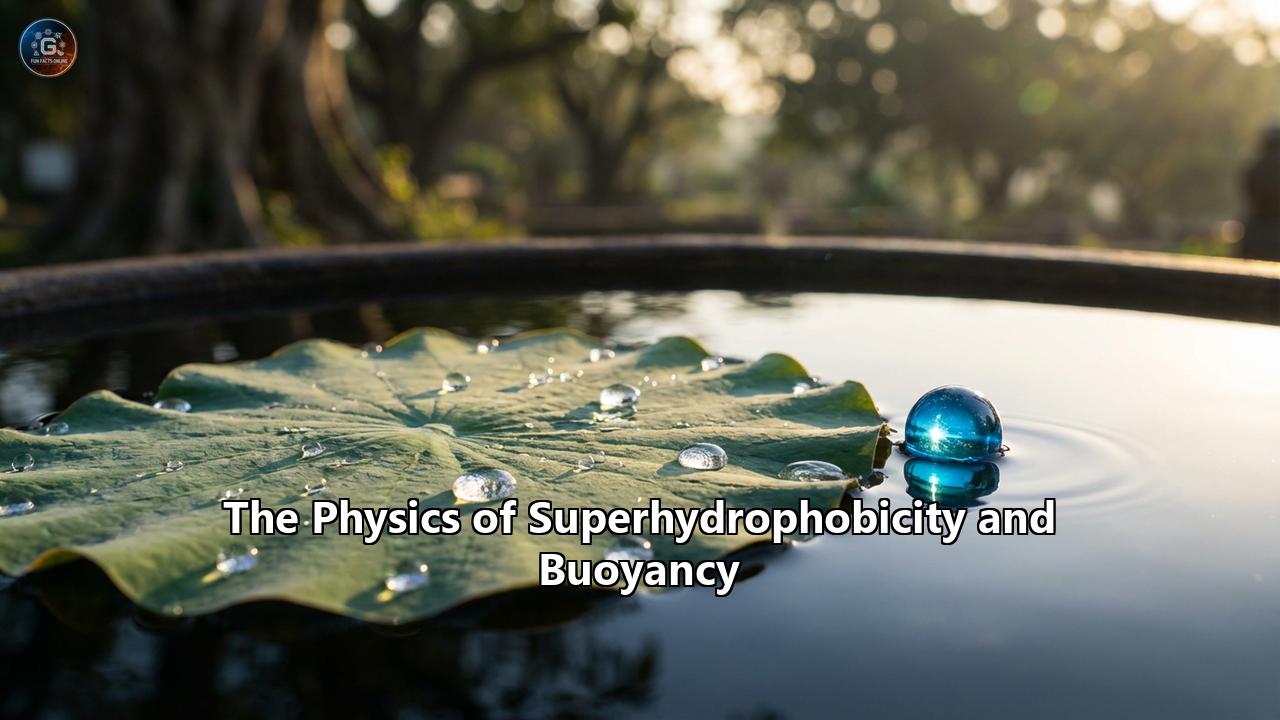
The concept of an object that refuses to sink—a material that, no matter how often it is submerged, damaged, or punctured, relentlessly returns to the surface—has long been the stuff of maritime legend and engineering fantasy. For centuries, our understanding of buoyancy was dictated by the rigid arithmetic of Archimedes: a battle between the weight of an object and the weight of the water it displaces. But in the last few decades, and with accelerating breakthroughs culminating in 2025 and 2026, a new variable has entered this equation: the physics of superhydrophobicity. By engineering surfaces at the micro- and nanoscale to repel water with extreme prejudice, scientists are not just helping ships float; they are fundamentally altering the boundary conditions of fluid dynamics.
This is the story of that revolution. It is a journey that takes us from the humble lotus leaf to the legs of a water strider, through the complex thermodynamics of trapped air layers known as plastrons, and into the laser-etched laboratories where "unsinkable" metals are now a reality.
Part I: The Microscopic Landscape of Wetting
To understand why a metal structure can refuse to sink, we must first understand what happens when water meets a solid surface. To the naked eye, this interaction seems simple: water either spreads out (wetting) or beads up (non-wetting). But at the molecular level, this is a violent struggle of forces, governed by the laws of thermodynamics and surface chemistry.
The Contact Angle and Young’s Equation
The fundamental metric of this interaction is the contact angle ($\theta$). Imagine a single droplet of water resting on a flat surface. If the water loves the surface (hydrophilic), it spreads out, forming a contact angle of less than 90 degrees. If it fears the surface (hydrophobic), it pulls itself into a sphere to minimize contact, creating an angle greater than 90 degrees.
For over two centuries, this behavior was described by Young’s Equation, formulated by Thomas Young in 1805. It balances the interfacial tensions between the solid, liquid, and gas phases:
$$ \gamma_{sv} = \gamma_{sl} + \gamma_{lv} \cos\theta $$
Where:
- $\gamma_{sv}$ is the surface tension between the solid and vapor (air).
- $\gamma_{sl}$ is the surface tension between the solid and liquid.
- $\gamma_{lv}$ is the surface tension between the liquid and vapor.
However, Young’s equation assumes a perfectly smooth, chemically homogeneous surface—something that exists only in idealized physics problems. In the real world, surfaces are rough, and this roughness is the secret key to superhydrophobicity.
Wenzel vs. Cassie-Baxter: The Tale of Two States
When we roughen a hydrophobic surface, we don't just change its texture; we amplify its chemistry. This phenomenon leads to two distinct wetting regimes that are critical for understanding buoyancy.
- The Wenzel State: In this state, water penetrates every groove, pit, and valley of the rough surface. The water "wets" the roughness fully. If the surface is chemically hydrophobic, roughness makes it more hydrophobic, but the water is still pinned to the surface. A droplet in the Wenzel state might look spherical, but it is sticky. It won’t roll off; it clings. This is disastrous for buoyancy because there is no trapped air.
- The Cassie-Baxter State: This is the "magic" state. Here, the surface roughness is so extreme and the features so small (often nanoscale pillars or hairs) that the water droplet sits on top of the peaks, suspended by surface tension. Beneath the droplet, in the valleys of the roughness, air is trapped. The droplet is effectively resting on a composite surface made of 5% solid and 95% air. Since the contact angle of water on air is 180 degrees, the macroscopic contact angle becomes enormous—often exceeding 150 or 160 degrees. This is superhydrophobicity.
In the Cassie-Baxter state, water barely touches the solid. It glides across a cushion of air with almost zero friction. For buoyancy, this trapped air is the holy grail. It adds volume without adding mass, and it prevents the water from ever truly touching the hull of the object.
Part II: The Physics of the Plastron
The layer of air trapped in the Cassie-Baxter state has a name: the plastron. Originally a term used by entomologists to describe the thin films of air that allow aquatic insects to breathe underwater, it has been co-opted by physicists and material scientists.
The plastron is not merely a passive bubble; it is a dynamic thermodynamic shield. Its stability is the single most important factor in creating unsinkable materials.
Archimedes 2.0: The Buoyancy of Air Films
Archimedes' Principle states that the buoyant force on an object is equal to the weight of the fluid it displaces.
$$ F_b = \rho_{fluid} \cdot V_{displaced} \cdot g $$
Conventionally, $V_{displaced}$ is just the volume of the solid object. But with a superhydrophobic surface maintaining a stable plastron, the object effectively behaves as if it is larger than it is. The trapped air layer displaces water, contributing significantly to the buoyant force.
For a microscopic hair or a nanostructured surface, this effect is profound. A dense metal object can float if it can trap enough air to lower its effective density below that of water. The air acts as an invisible life jacket, one that is chemically bonded to the surface of the metal.
The Battle Against Hydrostatic Pressure
The challenge, however, is keeping the air there. As a superhydrophobic object is pushed deeper underwater, the hydrostatic pressure increases. This pressure tries to force water into the rough grooves, collapsing the plastron and forcing a transition from the slippery Cassie-Baxter state to the sticky Wenzel state.
This transition is often irreversible. Once the air is gone and the surface is wet, the buoyancy bonus is lost, and the object sinks. The physics of preventing this collapse involves the Laplace Pressure difference across the air-water interface.
$$ \Delta P = \frac{2\gamma}{R} $$
Where $\gamma$ is the surface tension of water and $R$ is the radius of curvature of the meniscus sagging between the surface features. To withstand high pressures (deep water), the surface features must be incredibly small (nanoscale), making $R$ very small and the resisting pressure $\Delta P$ very high. This is why simple roughness isn't enough; "unsinkable" materials require sophisticated nano-engineering to create energy barriers so high that water simply cannot force its way into the grooves.
Part III: Biological Masters of the Interface
Long before humans began etching aluminum with lasers, evolution was solving these physics problems. Nature provides three distinct blueprints for superhydrophobicity and buoyancy, each solving a specific survival challenge.
1. The Lotus Leaf: Self-Cleaning Buoyancy
The "Lotus Effect" is the most famous example. The leaf of Nelumbo nucifera is covered in microscopic bumps (papillae), which are themselves covered in nanoscale wax crystals. This hierarchical structure (micro + nano) ensures a stable Cassie-Baxter state. While the primary function is self-cleaning (rain droplets roll off, picking up dirt), it also aids in buoyancy. If a lotus leaf is submerged, it shines like silver—a telltale sign of the total reflection of light off the trapped air layer (the plastron). This air layer prevents the leaf from becoming waterlogged and rotting, ensuring it always returns to the surface.
*2. The Water Spider (Argyroneta aquatica): The Physical Gill
The diving bell spider takes the concept of the plastron and weaponizes it for respiration. It spins a web underwater and fills it with air carried from the surface on its abdomen. Its abdomen is covered in velvety hydrophobic hairs that trap a thin layer of air.
This plastron does more than provide buoyancy; it acts as a physical gill. As the spider consumes oxygen from the bubble, the partial pressure of oxygen ($PO_2$) drops below that of the surrounding dissolved oxygen in the water. Oxygen then diffuses from the water into the bubble, replenishing the supply. Simultaneously, carbon dioxide diffuses out. In stagnant, oxygen-rich water, a spider can remain submerged for days, its buoyancy and breathing supported entirely by the physics of surface tension.
3. The Salvinia Paradox: The Eggbeater Effect
Perhaps the most sophisticated biological model comes from the floating fern Salvinia molesta. Its leaves are covered in complex hairs that look exactly like tiny eggbeaters.
For years, scientists were puzzled. Superhydrophobic surfaces are usually slippery, but Salvinia needs to be stable on the water surface. The solution is the Salvinia Paradox: the tips of the eggbeater hairs are hydrophilic (water-loving), while the rest of the whisker is superhydrophobic (water-repelling).
This architecture creates a unique pinning effect. The hydrophilic tips grab the water surface, pinning the air layer in place so it cannot slip away, while the hydrophobic distinct cage traps a massive volume of air. This prevents the air bubble from migrating or coalescing and detaching. It is a masterpiece of fluid engineering—using a "water-loving" anchor to secure a "water-hating" shield.
Part IV: Engineering the Unsinkable
Inspired by these biological marvels, materials science has moved from imitation to innovation. The quest for the "unsinkable ship" has moved from large watertight compartments (which failed the Titanic) to microscopic surface treatments.
The Rochester Breakthrough (2019-2026)
A pivotal moment in this field came from the laboratory of Professor Chunlei Guo at the University of Rochester. His team developed a technique to make ordinary metal "unsinkable" using femtosecond laser processing.
The Technique:Using extremely short, high-energy laser pulses, the team etched microscopic and nanoscale structures directly onto the surface of aluminum. This created a hierarchical surface similar to the lotus leaf but carved into solid metal. The result was a surface so superhydrophobic that it appeared pitch black because the structures were trapping light as well as air.
The Geometry:However, a flat superhydrophobic surface isn't enough. If forced underwater for a long time, the air eventually dissolves. The researchers innovated a geometric solution inspired by the diving bell spider and fire ant rafts. They created two parallel superhydrophobic surfaces facing inward, or a tube etched on the inside.
This geometry protects the air pocket. The surface tension forces keeping the water out are bolstered by the macroscopic trapped volume of air.
- Divided Volume: In their 2026 update, they introduced a divider in the middle of the tube. This ensures that even if the tube is vertical, the air bubble doesn't just float out the top. The "divider" acts as a geometric lock for the plastron.
- Resilience: The most stunning demonstration involved punching the metal full of holes. In a traditional vessel, a puncture is fatal. Water rushes in, displacing air. But in the Rochester tubes, the superhydrophobic interior surface repels the entering water. The water forms a meniscus at the hole but refuses to spread into the tube. The air remains trapped, and the metal structure floats, even when riddled with perforations.
This effectively decouples buoyancy from structural integrity. A ship hull built on these principles wouldn't sink even if torn open by an iceberg, provided the internal surface area remained superhydrophobic.
Part V: Drag Reduction and the Slip Boundary
Buoyancy is static; shipping is dynamic. The same physics that keeps things floating also helps them move.
In classic fluid dynamics, the No-Slip Condition is dogma. It states that fluid flowing past a solid surface has zero velocity right at the wall. The water molecules effectively stick to the hull. This creates a boundary layer of shearing fluid, which is the primary source of skin-friction drag.
Superhydrophobic surfaces violate this dogma. Because the water is resting on a plastron of air (which has a viscosity 50 times lower than water), the water can slide over the surface. This introduces a Slip Length ($\lambda$)—a theoretical distance into the wall where the velocity profile extrapolates to zero.
The Mechanism:- Air Lubrication: The ship hull is effectively coated in a thin layer of gas. The water glides over this gas layer rather than grinding against the metal.
- Turbulence Suppression: High-friction surfaces generate turbulent eddies that suck energy from the ship. Superhydrophobic surfaces can delay the transition to turbulence or reduce the intensity of turbulent bursts near the wall.
Experiments have shown drag reductions of 20% to over 50% for superhydrophobic coatings. For the global shipping industry, which burns hundreds of millions of tons of bunker fuel annually, this is a trillion-dollar opportunity. A 10% reduction in drag translates to massive fuel savings and a significant cut in global carbon emissions.
Part VI: The Achilles Heel – Durability and Stability
If the physics is so perfect, why aren't all ships coated in this material today? The answer lies in the brutal reality of the ocean.
1. The Weakness of the Cassie-Baxter State:The Cassie-Baxter state is metastable. It is a precarious balancing act.
- Pressure Spikes: A wave slapping the hull can generate local pressure spikes that exceed the Laplace pressure, forcing water into the nanopores (wetting transition). Once the surface is wet, the drag reduction vanishes and buoyancy decreases.
- Gas Dissolution: According to Henry’s Law, gas dissolves in liquid proportional to pressure. Over time, the plastron dissolves into the surrounding undersaturated seawater. The diving bell spider solves this by fetching more air; a ship coating cannot easily "fetch" air if the plastron collapses.
Nanostructures are delicate. A barnacle scraping the hull, a collision with floating debris, or even the sheer shear force of high-speed water can shear off the microscopic pillars that create the roughness. Once the texture is smoothed out, the superhydrophobicity is gone.
Solutions on the Horizon:- Self-Healing Surfaces: Researchers are developing coatings with reservoirs of hydrophobic agents (like fluorinated wax) that can migrate to the surface to repair damage. Others use shape-memory polymers that can "spring back" to their rough structure when heated.
- Active Air Replenishment: Some designs propose "active plastrons," where the ship's hull bleeds a tiny amount of compressed air through micropores to replenish the dissolving layer, effectively maintaining the superhydrophobic state indefinitely.
- Armor-Plated Microstructures: Designing "re-entrant" geometries (like mushroom shapes) where the fragile tips are protected by robust ridges, ensuring that mechanical abrasion hits the armor, not the functional nano-texture.
Part VII: Future Horizons
The convergence of buoyancy physics and superhydrophobicity is leading us toward a future that looks like science fiction.
- Ocean Energy Harvesting: The Rochester team demonstrated that these superhydrophobic tubes can float and bob with high responsiveness. This makes them ideal for wave energy converters, which need to be lightweight, buoyant, and immune to corrosion.
- Unsinkable Sensor Networks: We can deploy vast networks of ocean-monitoring sensors encased in unsinkable metal shells. They could drift for years, immune to biofouling (bacteria struggle to adhere to superhydrophobic surfaces) and sinking, beaming back data on climate change.
- Medical Micro-Robots: Inside the human body, superhydrophobic drag reduction could allow micro-robots to swim through the bloodstream with minimal energy, delivering drugs to precise locations.
Conclusion
The physics of superhydrophobicity and buoyancy teaches us that the boundary between "sink" and "float" is not a hard line drawn by gravity, but a fluid frontier negotiated by surface tension, roughness, and air. By manipulating matter at the nanoscale, we have found a way to cheat Archimedes—or rather, to recruit the very air around us as a structural partner.
From the evolutionary genius of the Salvinia fern to the laser-etched laboratories of modern physics, we are witnessing the birth of a new class of materials. These are materials that do not just exist in the water but dictate terms to it. They promise a future of cleaner shipping, safer naval architecture, and a deeper understanding of the delicate dance where water meets the world.
Deep Dive: The Mathematical Physics of the Plastron
To truly appreciate the engineering feats described above, one must delve into the rigorous mathematical framework that governs these phenomena. The stability of the plastron is not magic; it is a calculable thermodynamic equilibrium.
1. The Thermodynamic Energy Barrier
The transition from the suspended Cassie-Baxter state (buoyant) to the wetted Wenzel state (non-buoyant) involves overcoming an energy barrier. We can model the total free energy ($E$) of the system as a function of the penetration depth of the liquid into the surface grooves.
The energy of the Cassie-Baxter state ($E_{CB}$) is given by:
$$ E_{CB} = f_{sl}\gamma_{sl} + f_{lv}\gamma_{lv} $$
where $f_{sl}$ is the fraction of the solid in contact with liquid, and $f_{lv}$ is the fraction of the liquid in contact with vapor (the air pocket).
The energy of the Wenzel state ($E_{W}$) is:
$$ E_{W} = r \gamma_{sl} + (r-1)\gamma_{sv} $$
where $r$ is the roughness factor (actual surface area / projected area).
For a surface to be superhydrophobic, $E_{CB}$ must be the global minimum, or at least a deep local minimum. If $E_{W} < E_{CB}$, the Wenzel state is thermodynamically preferred, and the plastron is "metastable." It exists only until a perturbation (pressure wave, vibration) pushes the system over the energy barrier.
Design Implication: To make a truly unsinkable metal, engineers must maximize the energy barrier. This is done by using re-entrant geometries—structures that get wider at the top than at the bottom (like mushrooms or nails).In a re-entrant geometry, for the water to penetrate, the meniscus must curve significantly, increasing the liquid-vapor surface area. This costs energy ($\gamma_{lv} \cdot \Delta A$), creating a massive barrier that prevents the water from wetting the surface even if $E_{W}$ is lower. This is why the "eggbeater" shape of Salvinia* and the "mushroom" structures in advanced synthetic coatings are superior to simple pillars.
2. Critical Pressure and the Breakthrough
The critical breakthrough pressure ($P_c$) is the hydrostatic pressure required to force the meniscus to touch the bottom of the texture. For a pore of width $w$ and a contact angle $\theta$:
$$ P_c \approx -\frac{2\gamma_{lv} \cos\theta}{w} $$
This equation dictates the manufacturing tolerances.
- If $w$ (pore size) is 100 micrometers, $P_c$ is low (a few centimeters of water depth).
- If $w$ is 100 nanometers, $P_c$ becomes massive (tens of meters of water depth).
This explains why the University of Rochester team used femtosecond lasers. They needed to create features in the nanometer range to ensure that the "unsinkable" tubes could withstand the pressure of deep submersion without the plastron collapsing. The laser pulses, lasting only $10^{-15}$ seconds, ablate metal without melting the surrounding area, creating crisp, deep nanostructures that act as an impenetrable shield against water pressure.
3. Diffusion Dynamics: The Lifespan of a Bubble
Even if the meniscus holds, the air inside can dissolve. The lifetime of a plastron ($\tau$) is governed by the diffusion of gas into the water.
$$ \frac{dm}{dt} = -D A \frac{C_s - C_\infty}{\delta} $$
Where:
- $D$ is the diffusion coefficient of air in water.
- $A$ is the surface area of the meniscus.
- $C_s$ is the saturation concentration of gas at the interface (higher at depth due to pressure).
- $C_\infty$ is the concentration in the bulk water.
In deep water, $C_s \gg C_\infty$, so the gas rushes out.
However, superhydrophobic surfaces reduce $A$. In the Cassie-Baxter state, the contact area between the air and the hungry water is limited to the tiny menisci at the tips of the roughness. This drastically slows down diffusion. Furthermore, the "Unsinkable Tube" geometry creates a "macro-plastron" reservoir where the volume-to-surface-area ratio is huge, extending the lifetime of the bubble from minutes to years. This geometric protection is what makes the technology viable for long-term naval applications.
Engineering Challenges: The Road to Commercialization
While the physics is sound, scaling this technology from a lab bench to a Panamax container ship involves overcoming significant hurdles.
1. The Durability Crisis
Standard ASTM testing for coatings (like ASTM D4060 for abrasion resistance) is brutal. A superhydrophobic coating based on delicate nanotextures typically fails after just a few cycles of abrasion. The "lotus leaf" structure is fragile; if you rub a lotus leaf, it becomes wet.
- Solution: Armor-Plated Superhydrophobicity. A major trend in 2025 is "armored" surfaces. Imagine a microscopic grid of hard ceramic walls. Inside each grid cell, the delicate superhydrophobic nanostructures are nestled. If a heavy object scrapes the surface, it slides along the top of the ceramic walls, leaving the functional nanostructures in the valleys untouched. This approach preserves the air layer even under heavy mechanical wear.
2. Biofouling: The Living Enemy
Marine life loves surfaces. Bacteria form biofilms (slime), followed by algae, and then barnacles. A biofilm fills the nanostructures, displacing the air and destroying the superhydrophobicity.
- Solution: Amphiphilic Polymers. New research combines superhydrophobicity with chemical antifouling. By grafting zwitterionic polymers (which strongly bind water molecules to form a hydration shell) onto the tips of the superhydrophobic texture, scientists create a surface that confuses bacteria. The tips look like water (preventing attachment), while the valleys remain dry (maintaining buoyancy).
3. Manufacturing at Scale
Laser etching is slow and expensive. You cannot femtosecond-laser a 300-meter ship hull.
- Solution: Scalable Lithography and Spray Coatings. Innovations in soft lithography and roll-to-roll imprinting are allowing the creation of superhydrophobic textures on adhesive films that can be applied to ships like wallpaper. Additionally, sprayable superhydrophobic paints using hydrophobic nanoparticles in a robust epoxy binder are nearing commercial viability. These paints self-assemble into the required hierarchical structure upon drying.
The Final Verdict: A New Age of Maritime Physics
The convergence of fluid mechanics, surface chemistry, and nanomanufacturing has brought us to the threshold of a new era. We are no longer limited to the passive buoyancy of wood or hollow steel. We are engineering active interactions between solids and fluids.
The "unsinkable" metal is just the beginning. The principles of superhydrophobicity—drag reduction, corrosion resistance, and buoyancy enhancement—will redefine how we interact with the roughly 71% of our planet that is covered in water. Whether it is a sensor that floats forever, a ship that glides on a cushion of air, or a pipeline that never corrodes, the physics of the plastron is changing the rules of the game. We are witnessing the end of "wetting" as an inevitability and the rise of the dry, buoyant future.
Reference:
- https://aaltodoc.aalto.fi/items/1315e974-bc90-4ced-9911-908c10978e6c
- https://research.birmingham.ac.uk/en/publications/predicting-plastron-thermodynamic-stability-for-underwater-superh/
- https://royalsocietypublishing.org/rsif/article/18/185/20210676/90163/The-impact-of-raindrops-on-Salvinia-molesta-leaves
- https://www.researchgate.net/publication/382258579_Advances_in_Self-Healing_Silica-based_Superhydrophobic_Coatings
- https://archive.aps.org/dfd/2022/a35/6/
- https://www.sciencedaily.com/releases/2011/11/111110151701.htm
- https://winvertebrates.uwsp.edu/kaminski_361_2015.html
- https://journals.biologists.com/jeb/article/216/2/164/11640/Physical-gills-in-diving-insects-and-spiders
- https://www.researchgate.net/publication/231928040_Underwater_breathing_The_mechanics_of_plastron_respiration
- https://www.sciencenews.org/article/diving-spiders-make-their-own-gills
- https://en.wikipedia.org/wiki/Salvinia_effect
- https://www.mimuw.edu.pl/~pbmucha/publ/2003/acap-org.pdf
- https://www.researchgate.net/publication/276369901_Assessing_durability_of_superhydrophobic_surfaces
- https://arxiv.org/pdf/0905.0648