
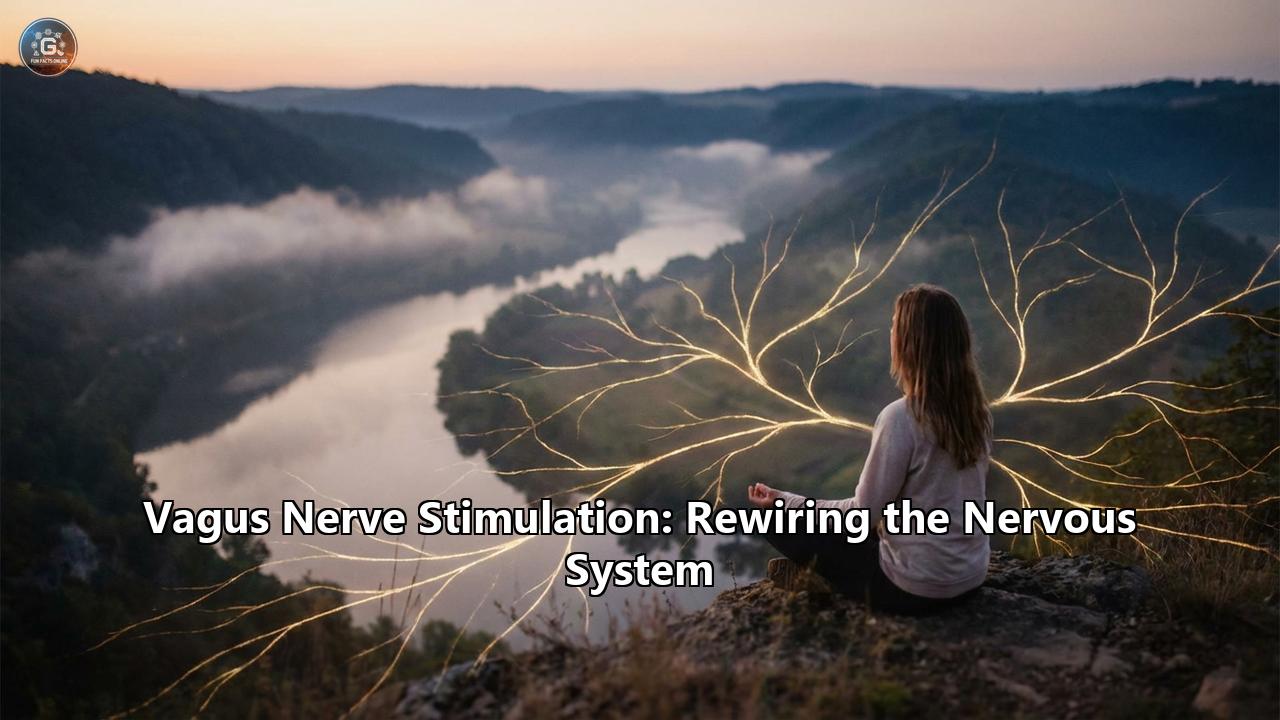
The human body is an electrical machine. For centuries, medicine has treated it largely as a chemical one, pouring drugs into the system to tweak receptors and alter pathways. But running silently beneath the skin, governing everything from the beat of your heart to the calm of your mind, is a vast, complex wiring system. At the center of this bio-electrical network lies the Vagus Nerve.
Often called the "superhighway" of the body, the Vagus Nerve is not just a single nerve but a complex bundle of fibers that serves as the primary connector between the brain and the major organs. It is the architect of the mind-body connection, the physical manifestation of "gut feelings," and the master switch for the parasympathetic nervous system—the body’s "rest and digest" mode. In recent years, our understanding of this nerve has exploded, moving from simple anatomy to the forefront of a medical revolution known as bioelectronic medicine. We are discovering that by stimulating this nerve, we can potentially "rewire" the nervous system, treating conditions as diverse as epilepsy, depression, stroke, autoimmune diseases, and even the lingering effects of Long COVID.
This is the story of the Vagus Nerve, the science of stimulating it (VNS), and how unlocking its power might just be the future of human health.
Part I: The Wandering Superhighway
Anatomy of the Tenth Cranial Nerve
The name "Vagus" comes from the Latin for "wandering," a fitting title for the longest and most complex of the twelve cranial nerves. Designated as Cranial Nerve X (CN X), it does not simply exit the brain and find a single target. Instead, it meanders.
Originating in the medulla oblongata of the brainstem, specifically from four key nuclei—the dorsal nucleus (parasympathetic output), the nucleus ambiguus (motor output to the heart and larynx), the nucleus of the solitary tract (sensory input), and the spinal trigeminal nucleus (pain and temperature)—it exits the skull through the jugular foramen. From there, it travels down the neck within the carotid sheath, sandwiched between the carotid artery and the jugular vein.
As it descends, it branches out like a tree root system. In the neck, it sends fibers to the vocal cords (the recurrent laryngeal nerve), allowing us to speak and breathe. In the thorax, it wraps around the heart and lungs, controlling heart rate and respiratory depth. Passing through the diaphragm with the esophagus, it enters the abdomen, where it fans out to innervate the stomach, liver, spleen, pancreas, kidneys, and the small and large intestines.
The 80/20 Rule: A Sensory Network
A common misconception is that the Vagus Nerve is primarily a command center, sending orders from the brain to the body. In reality, the Vagus is a listening device. Approximately 80% of its fibers are afferent (sensory), meaning they carry information from the body to the brain. Only 20% are efferent (motor), carrying signals from the brain to the body.
This distinction is crucial. It means your brain is constantly receiving a flood of data from your organs: the acidity of your stomach, the beat-to-beat variability of your heart, the presence of inflammatory proteins in your liver, and the stretching of your gut. This constant stream of "interoceptive" data forms the basis of how we feel physically and emotionally. When you have a "gut feeling" that something is wrong, it is not a metaphor; it is your Vagus Nerve transmitting visceral data to the brain's insular cortex.
The Parasympathetic Master Switch
The autonomic nervous system (ANS) acts as the body's autopilot, divided into two primary branches:
- The Sympathetic Nervous System (SNS): The "fight or flight" system, driven by adrenaline and cortisol. It prepares the body for action—dilating pupils, accelerating the heart, and shunting blood to muscles.
- The Parasympathetic Nervous System (PNS): The "rest and digest" (or "feed and breed") system. This is the domain of the Vagus Nerve.
When the Vagus is active, it acts as a brake on stress. It releases a neurotransmitter called acetylcholine, which tells the heart to slow down, digestion to ramp up, and the immune system to chill out. High "vagal tone"—the strength of your vagus nerve activity—is associated with better emotional regulation, faster recovery from stress, and lower inflammation. Low vagal tone is linked to chronic stress, anxiety, inflammation, and cardiovascular disease.
Part II: The Polyvagal Theory & The Ladder of Response
For decades, the autonomic nervous system was viewed as a simple see-saw: stress goes up, relaxation goes down. But in 1994, Dr. Stephen Porges introduced the Polyvagal Theory, a groundbreaking framework that added depth and nuance to our understanding of safety and trauma.
The Three Circuits
Porges proposed that we don't just have two modes (fight/flight vs. relax), but three distinct evolutionary stages of neural control, which he likens to a ladder:
- Ventral Vagal (The Top of the Ladder):
Evolutionary Age: Newest (Mammalian).
Function: Social Engagement and Safety.
Physiology: When we are in this state, the myelinated (insulated) fibers of the Vagus Nerve are active. We feel safe, calm, and connected. Our heart rate is regulated, our facial muscles are expressive, and we can tune into the human voice (thanks to the connection between the Vagus and the middle ear muscles). This is the state of "connection."
- Sympathetic (Middle of the Ladder):
Evolutionary Age: Older (Reptilian/Mammalian transition).
Function: Mobilization (Fight or Flight).
Physiology: If the brain detects danger (a process Porges calls "neuroception"), the Ventral Vagal brake is lifted, and the sympathetic system takes over. Heart rate spikes, and we prepare to defend ourselves or run. Social engagement turns off; facial expressions become flat or aggressive.
- Dorsal Vagal (The Bottom of the Ladder):
Evolutionary Age: Oldest (Ancient Reptilian).
Function: Immobilization (Freeze/Shutdown).
Physiology: If the threat is overwhelming and we cannot fight or flee, the primitive, unmyelinated fibers of the Vagus Nerve take over. This triggers a massive shutdown. Heart rate drops drastically (bradycardia), digestion stops, and we may faint or dissociate. In nature, this is the mouse playing dead in the cat's mouth. In humans, this manifests as extreme depression, dissociation, or trauma-induced numbness.
Trauma as a "Rewiring" Issue
The Polyvagal Theory reframed trauma not as a psychological failure, but as a physiological one. Trauma survivors often get "stuck" in the lower rungs of the ladder. Their nervous system has been rewired to perceive constant threat. They may oscillate between high anxiety (Sympathetic) and numb depression (Dorsal Vagal), rarely accessing the safety of the Ventral Vagal state.
Vagus Nerve Stimulation (VNS), therefore, offers a potential pathway back up the ladder. By stimulating the nerve, we may be able to manually engage the safety signals that the brain has stopped generating on its own.
Part III: The Gut-Brain Axis & The Inflammatory Reflex
While Porges was mapping the psychology of the nerve, another pioneer, Dr. Kevin Tracey, was uncovering its molecular secrets. His discovery of the Inflammatory Reflex changed immunology forever.
The Discovery of the Cholinergic Anti-Inflammatory Pathway
In the late 1990s, Tracey and his team were experimenting with a drug to block inflammation in the brain of rats during a stroke. To their surprise, they found that the drug also blocked inflammation in the spleen and liver—organs far away from the brain. How did the signal get there so fast? It couldn't be hormones; they move too slowly through the blood. It had to be a nerve.
They cut the Vagus Nerve and repeated the experiment. The anti-inflammatory effect disappeared.
They discovered that the brain monitors inflammation levels via Vagus afferents. When it detects a threat (like bacteria or injury), it sends a signal down the Vagus efferents. This signal travels to the spleen, where it instructs T-cells to release acetylcholine. This acetylcholine binds to the alpha-7 nicotinic acetylcholine receptor on macrophages (immune cells).
This binding is the "off switch." It stops the macrophages from producing pro-inflammatory cytokines like TNF-alpha and IL-6. This mechanism is the Cholinergic Anti-Inflammatory Pathway. It proved that the nervous system controls the immune system—a concept that was previously considered heresy in medicine.
The Microbiome Connection
The Vagus Nerve is also the primary communication line for the Gut-Brain Axis. Your gut is home to trillions of bacteria (the microbiome) that produce metabolites like short-chain fatty acids (SCFAs), neurotransmitters (like serotonin and GABA), and immune signaling molecules.
Recent research, including studies on "germ-free" mice, shows that these bacterial products directly activate Vagus Nerve receptors in the gut lining. For example, Lactobacillus rhamnosus has been shown to reduce anxiety in mice, but only if the Vagus Nerve is intact. If the nerve is severed, the probiotic has no effect on the brain. This suggests that "rewiring" the nervous system also requires attending to the garden of the gut, as the Vagus is the gardener.
Part IV: Medical Applications – The FDA & The Implant Revolution
The ability to manually hijack this system has led to the development of Vagus Nerve Stimulation (VNS) devices. These are often referred to as "pacemakers for the brain."
1. Epilepsy: The First Frontier (1997)
The first FDA approval for VNS came in 1997 for drug-resistant epilepsy. In patients where medication failed to stop seizures, surgeons implanted a small pulse generator (similar to a heart pacemaker) under the skin of the chest. A lead wire was threaded up to the neck and wrapped around the left Vagus Nerve.
How it works: The device delivers regular electrical pulses (e.g., 30 seconds on, 5 minutes off) to the nerve. This desynchronizes the abnormal electrical activity in the brain that causes seizures. Efficacy: Approximately 50-60% of patients see a significant reduction in seizure frequency (by at least 50%). Importantly, the effect tends to improve over time, suggesting a long-term neuroplastic "rewiring" rather than just a temporary interruption. New Tech: The latest generation of devices (like the SenTiva system) are "closed-loop." They monitor the patient's heart rate. Since heart rate often spikes just before a seizure (ictal tachycardia), the device can auto-trigger a burst of stimulation to stop the seizure before it fully starts.2. Treatment-Resistant Depression (2005)
In 2005, the FDA approved VNS for Treatment-Resistant Depression (TRD). This approval was controversial at the time due to mixed trial results, but long-term data has shown that for a subset of patients who do not respond to antidepressants or therapy, VNS can be life-changing.
Mechanism: Chronic depression is often linked to low metabolic activity in the limbic system and prefrontal cortex. VNS increases blood flow and neurotransmitter release (norepinephrine and serotonin) in these mood-regulating centers. It essentially "wakes up" the depressed brain.3. Stroke Rehabilitation (2021)
This is one of the most exciting recent developments. In 2021, the FDA approved the MicroTransponder Vivistim system for chronic stroke rehabilitation.
The Concept: Paired Plasticity.Neuroplasticity—the brain's ability to rewire itself—requires specific chemical triggers. When we learn a new skill, our brain releases acetylcholine and norepinephrine to "save" that neural pathway. VNS triggers the release of these exact chemicals.
The Protocol: A stroke survivor performs a rehabilitation exercise (like lifting a cup) while simultaneously receiving a burst of VNS. The VNS tells the brain, "This movement is important, save this connection!" Results: Clinical trials showed that patients receiving paired VNS recovered significantly more hand and arm function than those doing rehab alone, even years after their stroke.4. Obesity (2015)
The FDA approved the Maestro Rechargeable System for obesity. By stimulating the Vagus Nerve, the device aims to block the signals of hunger from the stomach to the brain, promoting early satiety (feeling full). However, this application has seen mixed commercial success compared to the booming market of GLP-1 agonists (like Ozempic), but the bioelectronic approach remains a key area of research.
Part V: The Non-Invasive Revolution (tVNS)
Implanting a device in the chest requires surgery and carries risks (infection, vocal cord paralysis). This led to the development of Transcutaneous Vagus Nerve Stimulation (tVNS)—stimulating the nerve through the skin.
The Ear (Auricular VNS or taVNS)
The ear is the only place on the human body where a cranial nerve surfaces directly through the skin. The Cymba Concha (the deep inner curve of the ear) is innervated by the auricular branch of the Vagus Nerve (Arnold's Nerve).
Devices: Devices like the Nurosym, Parasym, or Xen use an earpiece to deliver electrical signals to this spot. Use Cases: Research is exploding in this area for treating Long COVID, POTS (Postural Orthostatic Tachycardia Syndrome), anxiety, and atrial fibrillation. It offers a "wearable" way to access the cholinergic anti-inflammatory pathway.The Neck (Cervical tVNS)
Handheld devices, most notably the
gammaCore, stimulate the nerve directly through the neck muscles. Approvals: The FDA has cleared gammaCore for the treatment of Cluster Headaches and Migraines. By blocking pain signaling pathways and reducing inflammation in the trigeminal vascular system, it can abort these excruciating headaches in minutes.Part VI: Emerging Frontiers – Inflammation & Long COVID
The most profound potential of VNS lies in treating chronic inflammatory diseases and dysautonomia.
Rheumatoid Arthritis & Crohn’s Disease
Following Kevin Tracey's discovery of the inflammatory reflex, clinical trials began using VNS implants for Rheumatoid Arthritis (RA) and Crohn's Disease.
Results: In a landmark study published in PNAS, patients with drug-resistant RA who received VNS implants saw significant reductions in TNF-alpha levels and disease severity. Some achieved remission after failing all biologic drugs. This proves that "bioelectronics" can replace or augment "pharmaceuticals."Long COVID and Dysautonomia
Long COVID is increasingly viewed as a condition of Vagus Nerve dysfunction. The virus may directly infect the nerve or cause an autoimmune reaction that damages it, leading to "dysautonomia"—a malfunctioning autopilot.
Symptoms: Brain fog, fatigue, heart rate spikes (POTS), and digestive issues—all classic signs of low vagal tone. Therapy: Pilot studies using taVNS (ear stimulation) have shown promise in reducing fatigue and brain fog in Long COVID patients. By manually boosting parasympathetic activity, VNS helps re-regulate the autonomic nervous system, dampening the chronic "fight or flight" loop that keeps these patients sick.Part VII: Biohacking – Rewiring Yourself Naturally
You do not need a surgical implant or a $600 device to stimulate your Vagus Nerve. The biohacking community, aligning with ancient wisdom traditions, has identified robust "natural" protocols to increase vagal tone. The primary metric for tracking this is Heart Rate Variability (HRV).
HRV: The Gold Standard Metric
HRV is the variation in time between heartbeats. If your heart beats like a metronome (low HRV), it means your Sympathetic system is dominating—you are stressed and rigid. If the gaps vary (high HRV), it means your Vagus Nerve is active, constantly micro-adjusting the heart rate to breath and demand. High HRV = High Vagal Tone = High Resilience.
1. Breathwork: The 5.5 Protocol
The Vagus Nerve connects the diaphragm to the brain. Deep, slow breathing is the fastest way to manually engage the PNS.
The Mechanism: Respiratory Sinus Arrhythmia (RSA). When you inhale, the vagal brake lifts (heart speeds up). When you exhale, the Vagus activates (heart slows down). Long exhalations trigger the Vagus. The Protocol (Resonant Frequency Breathing):- Breathe in for 5.5 seconds.
- Breathe out for 5.5 seconds.
- This creates a rate of 5.5 breaths per minute.
- Do this for 10-20 minutes daily.
- Result: This frequency synchronizes heart rate and brain waves, maximizing HRV.
2. Cold Exposure (The Wim Hof Method)
Acute cold exposure stimulates the Vagus Nerve via the "mammalian diving reflex." When cold water hits the face (specifically the forehead and nose area), the body reflexively slows the heart rate to preserve oxygen.
The Protocol:- Beginner: Splash ice-cold water on your face for 30 seconds in the morning.
- Intermediate: Finish your shower with 30-60 seconds of cold water, focusing on the back of the neck and chest.
- Advanced: Ice baths (1-3 minutes at 50°F/10°C).
- Note: The key is to suppress the gasp reflex. Force yourself to breathe slowly and deeply during the cold shock. This trains the Vagus Nerve to maintain calm under extreme stress.
3. Vocal Activation: Humming and Chanting
The Vagus Nerve passes through the vocal cords and the inner ear. Vibration in the throat stimulates the nerve mechanically.
The Science of "Om": A study published in the International Journal of Yoga* compared "Om" chanting to simple rest. The chanting group showed significant deactivation of the limbic system (amygdala) and vagal activation. The Protocol:- Humming, singing loud music, or chanting.
- The vibration must be felt in the chest and throat.
- "Bee Humming Breath" (Bhramari Pranayama): Close ears with thumbs, cover eyes with fingers, and hum like a bee on the exhale.
4. The Manual Reset (Eye Movements)
Stanley Rosenberg, a somatic therapist, popularized a simple exercise to reset the ventral vagal state by utilizing the connection between the Vagus and the suboccipital muscles (base of the skull).
The Basic Exercise:- Lie on your back, interlace fingers behind your head.
- Keep your head still. Look as far to the right as possible with just your eyes.
- Hold for 30-60 seconds until you swallow, yawn, or sigh (signs of a vagal shift).
- Repeat to the left.
This simple movement releases tension in the neck that can compress the Vagus and signals safety to the brainstem.
Part VIII: The Future of Bioelectronic Medicine
We are currently in the "Model T" era of Vagus Nerve Stimulation. The devices are clunky, and the stimulation is often "open-loop," firing blindly regardless of what the body is doing.
Targeted Plasticity Therapy (TPT)
The future is Targeted Plasticity. As seen in stroke rehab, VNS is most powerful when paired with an event. Researchers are exploring TPT for:
- PTSD: Pairing VNS with exposure therapy to "overwrite" the fear memory with a safety signal.
- Tinnitus: Pairing VNS with specific audio tones to retrain the auditory cortex to ignore the "ringing" frequency.
- Learning: The military (DARPA) is investigating if VNS can accelerate language learning and skill acquisition in soldiers by priming the brain for neuroplasticity.
The Electroceutical Future
Imagine a future where you don't take a pill for your arthritis or your Crohn's disease. Instead, you have a microscopic implant on your Vagus Nerve, controllable via your smartphone. When your smartwatch detects your inflammation markers rising or your HRV dropping, it auto-adjusts the stimulation to bring you back to homeostasis.
Companies like Galvani Bioelectronics (a partnership between Google's Verily and GSK) are racing to map every fiber of the Vagus Nerve to create these precise, organ-specific treatments.
Conclusion: The conductor of the Symphony
The Vagus Nerve is more than just a wire; it is the conductor of the body's symphony. For too long, we have lived in a world dominated by the Sympathetic nervous system—loud, fast, aggressive, and inflammatory. We have ignored the conductor, leaving the orchestra to play in discordant chaos.
Whether through high-tech implants for epilepsy and stroke, wearable tech for anxiety and Long COVID, or ancient practices of breath and cold for daily resilience, the goal is the same: to strengthen the Vagus. To rewire the nervous system back toward safety, connection, and recovery.
In the end, Vagus Nerve Stimulation teaches us a profound lesson about health: The body has the innate power to heal itself, to lower its own inflammation, and to calm its own anxiety. sometimes, it just needs a little spark to remember how.
Reference:
- https://www.traumatherapistinstitute.com/blog/Polyvagal-Theory-Explained-Simply
- https://www.frontiersin.org/journals/neuroscience/articles/10.3389/fnins.2018.00049/full
- https://badgut.org/information-centre/a-z-digestive-topics/the-brain-gut-microbiome-axis/
- https://www.verywellmind.com/polyvagal-theory-4588049
- https://en.wikipedia.org/wiki/Polyvagal_theory
- https://www.lawsonpsychology.com.au/understanding-polyvagal-theory/
- https://www.researchgate.net/publication/322986233_The_Vagus_Nerve_at_the_Interface_of_the_Microbiota-Gut-Brain_Axis
- https://www.wimhofmethod.com/vagus-nerve-stimulation
- https://www.parasym.co/long-covid-autonomic-dysfunction.html
- https://experiments.springernature.com/articles/10.1007/978-1-0716-3465-3_3
- https://pmc.ncbi.nlm.nih.gov/articles/PMC12082064/
- https://www.psychologytoday.com/us/blog/talking-about-trauma/202206/polyvagal-theory-approach-understanding-trauma
- https://www.polyvagalinstitute.org/whatispolyvagaltheory
- https://pubmed.ncbi.nlm.nih.gov/12508119/
- https://pmc.ncbi.nlm.nih.gov/articles/PMC4367209/
- https://www.news-medical.net/news/20250211/Study-shows-a-clear-causal-relationship-between-gut-microbiota-and-vagal-nerve-activity.aspx
- https://oxygenadvantage.com/blogs/science/how-to-stimulate-the-vagus-nerve-with-breathing-exercises
- https://scienceinhealth.com/es/2025/11/04/vagus-nerve-stimulation-long-covid-evidence-device-comparison/
- https://scienceinhealth.com/fr/2025/05/06/hacking-heartbeat-harmony/
- https://www.r1se.co.uk/blog/nervoussystemreset
- https://www.nicabm.com/topic/polyvagal-theory-explained/