
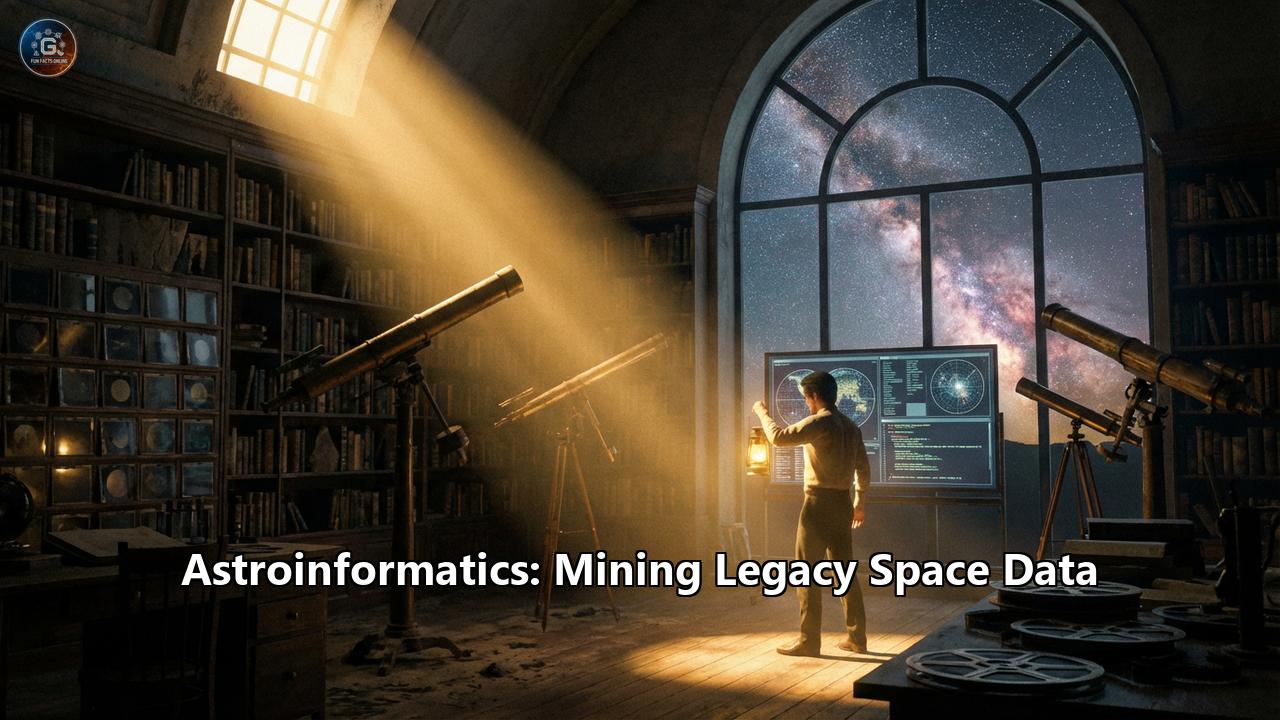
The Universe Never Forgets: How AI and Archivists are Resurrecting the Cosmos of the Past
The Universe is the ultimate hard drive. Every photon that has ever been emitted, every gravitational wave that has rippled through spacetime, and every silent orbit of a frozen rock carries information. For centuries, humanity has been recording these events, first with ink on parchment, then with chemical emulsions on glass, and finally with silicon sensors. But for a long time, much of this data was locked away—stored in damp basements, forgotten on dusty shelves, or trapped on magnetic tapes for which the drives no longer exist.
This is the story of Astroinformatics and the resurrection of legacy space data. It is a scientific detective story where the crime scene is the entire sky, the evidence is a century old, and the detectives are a mix of artificial intelligence, dedicated archivists, and thousands of citizen scientists working from their living rooms.
By mining the "dark data" of the past, astronomers are discovering that the history of the night sky is far more dynamic, violent, and mysterious than we ever imagined. We are building a time machine, not of brass and quartz, but of pixels and algorithms, allowing us to go back and witness events that happened long before we knew to look for them.
Part I: The Sleeping Giants
The Era of Glass and Emulsion
To understand the revolution of today, we must appreciate the Herculean efforts of yesterday. From the late 19th century until the 1990s, the primary medium for astronomical data was the photographic glass plate.
Astronomers would coat a pane of glass with light-sensitive silver halide emulsion, load it into a telescope, and expose it to the night sky for hours. The result was a negative image: black stars on a clear background. These plates were robust, dimensionally stable, and incredibly high-resolution.
The sheer scale of these archives is staggering.
- Harvard College Observatory (HCO): Houses over 550,000 glass plates taken between 1885 and 1992. This collection covers both the northern and southern hemispheres and constitutes the world's only continuous record of the entire sky for a century.
- Sonneberg Observatory (Germany): Holds approximately 300,000 plates, crucial for understanding variable stars.
- Other Archives: From the Palomar Observatory in California to the UK Schmidt Telescope archives in Australia, millions of these plates exist worldwide.
The "Dark Data" Problem
For decades, these plates were "read" by human eyes—often the famous "Harvard Computers," women like Henrietta Swan Leavitt and Annie Jump Cannon who made fundamental discoveries about the scale of the universe using magnifying loupes and wire grids.
But as the digital age dawned, these plates became "dark data." They were heavy, fragile, and difficult to query. You couldn't "Control-F" the sky of 1910 to find an asteroid. If you wanted to know if a star had dimmed fifty years ago, you had to physically travel to Cambridge, Massachusetts, walk into the stacks, find the specific plate log, locate the glass, and examine it under a microscope.
The information was there, but it was inaccessible. Worse, it was rotting.
A peculiar affliction known as "Gold Disease" (or micro-spotting) began to plague many collections. The silver in the photographic emulsion would oxidize and migrate, creating golden-hued blemishes that ate away at the stars. Mold, humidity, and simple glass breakage threatened to erase the sky of the 20th century forever.
The astronomy community realized that if they didn't act, they would lose the "prequel" to the modern universe.
Part II: The Digital Renaissance
DASCH: Digitizing a Century
The counter-attack against entropy began with projects like DASCH (Digital Access to a Sky Century @ Harvard). Launched in the early 2000s and completing its massive scanning run in 2024, DASCH was an industrial-scale effort to digitize the Harvard plates.
Engineers built a custom, high-speed laser scanner capable of digitizing two plates simultaneously with radiometric precision. This wasn't just taking a picture of a picture; it was scientific photometry. The scanner measured the density of the silver grains to determine exactly how bright a star was in 1895.
The result is a dataset of petabyte scale. The DASCH pipeline had to solve complex problems:
- Astrometry: Matching the stars on a distorted 1900s plate to modern star catalogs (like Gaia) to figure out exactly where the telescope was pointing.
- Photometry: Calibrating the non-linear response of old chemical emulsions to measure stellar brightness accurately.
- Defect Removal: Distinguishing between a new supernova and a scratch on the glass or a fleck of dust.
Now, instead of walking into a basement, an astronomer can log into StarGlass (the modern interface for DASCH) and download the light curve of a star spanning 100 years in seconds.
The Virtual Observatory (VO)
Digitizing the images is only step one. Step two is making them talk to each other.
In the early 2000s, the astronomical community coalesced around the idea of the International Virtual Observatory Alliance (IVOA). The goal was to create a set of standards—like the HTTP of the internet—for astronomy.
- FITS (Flexible Image Transport System): The standard file format that keeps metadata (telescope info, date, coordinates) attached to the image.
- ADQL (Astronomical Data Query Language): A SQL-like language that allows a researcher to ask questions like, "Show me all X-ray sources from the Chandra telescope that are within 1 arcsecond of an infrared source from the WISE telescope."
The VO allows a researcher to sit at their laptop and overlay a radio map from 2020 on top of a digitized glass plate from 1920. This interoperability is the backbone of astroinformatics, turning isolated archives into a single, federated digital universe.
Part III: Tales from the Crypt (Discoveries)
The true measure of this technology is the science it enables. By mining legacy data, we are rewriting history.
1. Solar System Archaeology: The Pre-Discovery of Pluto
When Clyde Tombaugh discovered Pluto in 1930, it was the result of a grueling, year-long search. But Pluto had been photographed before—we just didn't know it.
Using modern orbital mechanics, astronomers calculated where Pluto should have been in the early 20th century. They then queried the digitized archives of the Yerkes Observatory and Lowell Observatory.
- The Result: They found faint images of Pluto on plates from 1909 and 1915.
- The Tragedy: In 1915, Percival Lowell, who had spent his life searching for "Planet X," unknowingly captured it on film. However, Pluto was fainter than he expected, and it was lost in the grain of the emulsion and the density of the background stars. He died never knowing he had succeeded.
Today, these "pre-covery" images are vital. They extend the observation arc of Pluto by nearly 20 years, allowing for ultra-precise calculation of its orbit.
2. The Case of Tabby's Star
In 2015, the star KIC 8462852 (Boyajian's Star, or "Tabby's Star") became the most mysterious object in the galaxy. It dipped in brightness by up to 22% in irregular intervals, leading to wild theories ranging from comet swarms to "Alien Megastructures."
To understand if this was a new phenomenon or a long-term behavior, astronomers turned to the DASCH archives. They analyzed over 1,000 photographic plates of the star's location dating back to 1890.
- The Controversy: One study claimed the star had been fading secularly (gradually) for a century. Another study using Sonneberg plates argued the dimming was a calibration artifact.
- The Resolution: While the century-long trend remains debated, the archival data proved that the star does not show the massive, deep dips seen today in the historical record, suggesting the current event is a relatively rare phase in the star's life. This ruled out several stable scenarios and pointed toward transient events like a dissolving moon or cometary breakup.
3. Exoplanets Hiding in the Noise
The Kepler Space Telescope spent four years staring at a patch of sky to find planets. When the mission ended, the data was archived. But the pipeline used to process that data was designed to be conservative—it threw out "noisy" signals to avoid false positives.
Astroinformaticians and AI researchers recently went back into the "rejected" Kepler data.
- Kepler-160: A star known to have two planets. By applying a new, more sensitive algorithm to the legacy data, a team led by the Max Planck Institute found a third candidate, KOI-456.04. This potential planet is Earth-sized and orbits in the habitable zone of a Sun-like star—a mirror image of the Earth-Sun system that the original software missed.
The lesson? The data isn't exhausted just because the mission is over.
Part IV: The Rise of the Machines (AI & ML)
Legacy data is messy. Glass plates have scratches, mold, and non-linear chemical responses. Early digital data has "bit rot" and instrument noise. This is where Artificial Intelligence shines.
"AnomalyMatch" and the Hubble Archive
The Hubble Space Telescope has been operating for over 30 years. Its archive is a treasure trove, but it is too vast for human eyes to check every pixel.
In 2024, researchers from the European Space Agency (ESA) deployed an AI tool called AnomalyMatch.
- The Method: Instead of training the AI to look for known objects (like galaxies or stars), they used "unsupervised learning." They taught the AI what "normal" space looked like and told it to flag anything "weird."
- The Find: The AI scanned the Hubble Legacy Archive and flagged 1,400 anomalies. These included gravitational lenses (ripples in spacetime), ring galaxies, and merging systems that had been completely overlooked by previous studies.
Cleaning the Past
Generative Adversarial Networks (GANs)—the same technology used to create deepfakes—are now being used to clean historical data.
- De-noising: AI can learn the difference between the "grain" of a 1920s photographic plate and the light of a star. It can digitally "develop" the plate again, removing scratches and boosting the signal-to-noise ratio, effectively upgrading a 100-year-old telescope into a modern instrument.
Part V: The Human Element (Citizen Science)
Algorithms are powerful, but the human brain is still the best pattern recognition machine in the universe for nuanced tasks. This has led to the rise of Citizen Science—crowdsourcing the mining of data.
Zooniverse: The Modern "Harvard Computers"
The platform Zooniverse hosts dozens of astronomy projects where the public analyzes legacy data.
- Galaxy Zoo: Volunteers classified millions of galaxies from the Sloan Digital Sky Survey. The human eye could spot "blue ellipticals" and "green peas"—rare galaxy types that automated code missed because it wasn't programmed to look for them.
- Backyard Worlds: Planet 9: This project asks users to flip through "blink comparators" of images from the WISE satellite (an infrared survey). The goal is to find brown dwarfs (failed stars) and the hypothetical Planet Nine in the outer solar system.
Success: Citizen scientists have discovered dozens of brown dwarfs, including some of the coldest and oldest ever found. These volunteers are listed as co-authors on peer-reviewed papers.
This is a democratization of science. A high school teacher in Tasmania or a graphic designer in London can discover a new world simply by looking at data that professional astronomers were too busy to check.
Part VI: The Future of the Past
We are standing on the precipice of the "Petabyte Era" of astronomy. The Vera C. Rubin Observatory (formerly LSST) will soon begin a 10-year survey of the sky, generating 20 terabytes of data every night. It will produce a "movie" of the universe.
But a movie is meaningless if you don't know the backstory.
This is why legacy mining is critical. When the Rubin Observatory spots a star flaring in 2026, the first question will be: "Has it done this before?"*
The answer lies in the glass plates of 1926, the digitized logs of 1950, and the magnetic tapes of 1990.
The Long Baseline
In astronomy, Time is the most valuable dimension. Some phenomena take centuries to unfold.
- Proper Motion: Stars move. By comparing a plate from 1890 with a Gaia observation from 2020, we have a 130-year baseline. This allows us to measure the 3D velocity of stars with incredible precision, mapping the gravitational potential of the Milky Way.
- Supernova Echoes: We can look at the locations of historical supernovae recorded by ancient civilizations and see if the progenitor star was visible on early plates, or look for light echoes reflecting off nearby dust clouds.
The Living Archive
The future of astroinformatics is the "Living Archive." It won't be a static library where you check out files. It will be an active ecosystem where AI agents continuously crawl through the data, cross-referencing old plate scans with new neutrino detections, looking for correlations that span centuries.
Conclusion
Astroinformatics has turned the history of astronomy into a renewable resource. It teaches us that scientific data does not expire; it only awaits better questions and better tools.
The glass plates that astronomers carefully exposed in the freezing cold of Victorian nights are no longer just artifacts; they are active research sites. The pixels beamed back by Voyager and Kepler are still speaking to us, revealing secrets they held for decades.
In mining this legacy space data, we realize that the Universe is not just what we see tonight. It is a four-dimensional tapestry, and thanks to the marriage of silicon and glass, we can finally see the whole picture. The sky of the past is not dead; it is merely waiting to be downloaded.
Reference:
- https://www.zooniverse.org/about/publications
- https://www.smithsonianmag.com/air-space-magazine/are-these-1909-photos-oldest-known-pictures-pluto-180955930/
- https://en.wikipedia.org/wiki/Pluto
- https://lowell.edu/views-of-pluto-from-the-past-to-the-present/
- https://www.zooniverse.org/projects/marckuchner/backyard-worlds-planet-9/about/research
- https://noirlab.edu/public/products/citizenscienceprograms/citizenscienceprogram003/