
The universe has a way of outpacing our wildest science fiction. For decades, we looked up and imagined worlds of rock, ice, and gas—cousins to Earth, Mars, and Jupiter. We searched for water, the universal solvent of life as we know it, and oxygen, the breath of our existence. But in the deep dark between the stars, nature has cooked up something far more alien, something that challenges the very chemistry of planetary formation.
Welcome to the era of the Carbon Worlds.
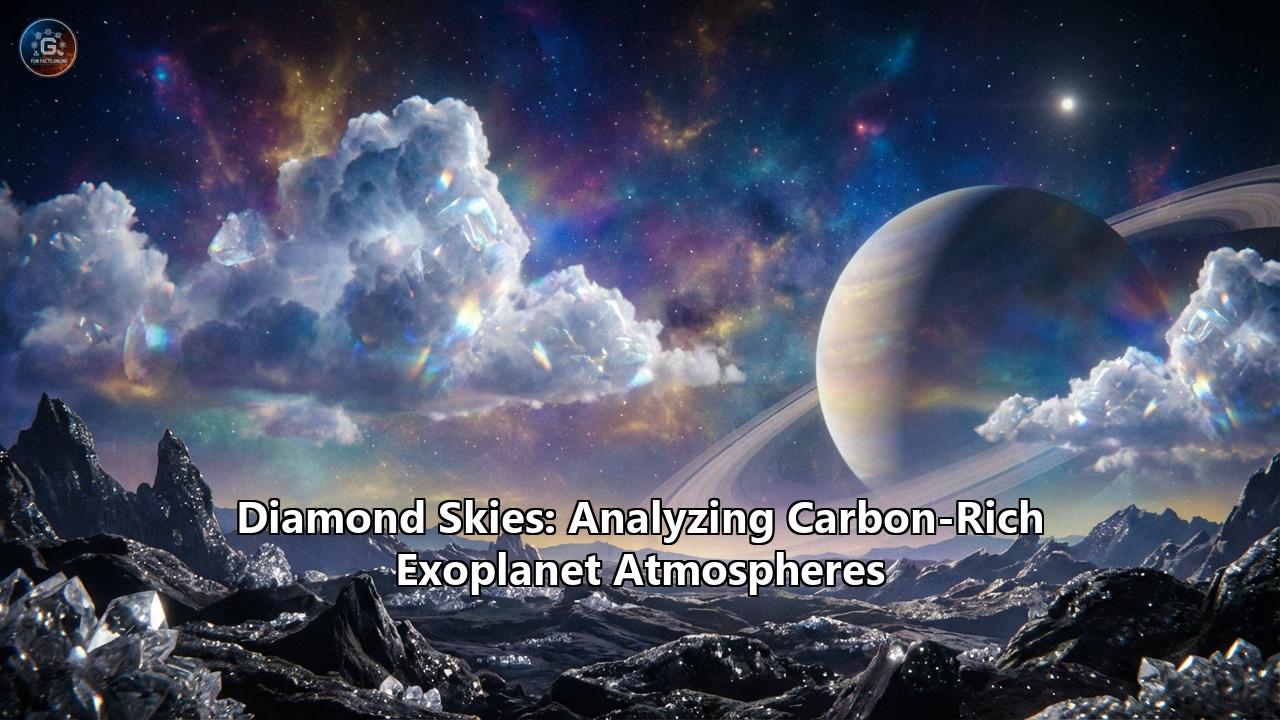
In the dying days of 2025, the astronomical community was rocked by the discovery of PSR J2322-2650b, a world that defies nearly every rule in the planet-hunting handbook. But this "lemon-shaped" oddity is just the latest crown jewel in a treasure chest of discoveries that have revealed a class of exoplanets where the skies are smoggy with soot, the mountains may be made of graphite, and the rain... the rain is pure diamond.
This is the story of those diamond skies. It is a journey into the crushing pressures of alien atmospheres, the delicate dance of spectroscopy, and the revolutionary eyes of the James Webb Space Telescope (JWST) that have finally peeled back the haze.
Part I: The Lemon at the Edge of Physics
The Discovery of PSR J2322-2650bIt began with a flicker in the data. Astronomers using the James Webb Space Telescope were training its golden mirrors on a pulsar—a rapidly spinning neutron star, the crushed core of a dead sun—located 700 light-years away. Pulsars are precision clocks, blasting beams of radiation that sweep across the cosmos like a lighthouse. When something tugs on a pulsar, that clock skips a beat.
The "tug" in the J2322-2650 system was violent. Orbiting this city-sized stellar corpse was a planet the mass of Jupiter, but whipping around its host at a suicidal proximity. The gravitational tidal forces were so immense that the planet was literally being pulled apart, stretched into an oblong, rugby-ball shape—or, as the press affectionately dubbed it, a "lemon."
But the shape was only the beginning. When JWST’s Near-Infrared Spectrograph (NIRSpec) tasted the light filtering through the planet’s edge, it didn't find the usual water vapor or silicate clouds. It found carbon. Rivers of it.
The atmosphere of PSR J2322-2650b is a chemical nightmare. It is dominated by helium and pure molecular carbon ($C_2$ and $C_3$), a composition that shouldn't exist in standard planetary formation models. In the crushing depths of its atmosphere, where pressures mount to millions of times that of Earth, this carbon doesn't just sit there. Models suggest it condenses. It crystallizes.
On the dayside, temperatures soar to 3,700°F (2,040°C), vaporizing everything. But as winds screech toward the permanent nightside at supersonic speeds, the carbon cools. It forms clouds of soot, blacker than the darkest coal. And as that soot falls, compressed by the gravity of a Jupiter-mass world, it undergoes a phase change. The soot hardens. It becomes clear. It becomes a diamond hail, falling into a magma ocean of liquid carbon.
This is not a rare anomaly; it is a window into a new kind of planetary science.
Part II: The Chemistry of the Carbon Cosmos
The C/O Ratio: The Universe’s Most Important FractionTo understand why a planet would rain diamonds, we have to look at the kitchen where planets are cooked: the Protoplanetary Disk.
When a star forms, it leaves behind a swirling disk of gas and dust. For years, we assumed that most of these disks looked like ours: rich in oxygen. In our Solar System, oxygen is the bully. It grabs every loose carbon atom it can find to form carbon monoxide (CO) or carbon dioxide ($CO_2$). Whatever oxygen is left over bonds with hydrogen to make water ($H_2O$) or silicon to make rocks (silicates).
Because oxygen outnumbers carbon here (a Carbon-to-Oxygen ratio, or C/O ratio, of about 0.5), our planets are made of silicate rocks (Earth, Mars, Venus) or water-ice and gas (Jupiter, Saturn). There is very little "free" carbon left to do anything interesting.
But the galaxy is diverse. Some stars form in clouds that are richer in carbon. If a protoplanetary disk has a C/O ratio greater than 0.8, the chemistry flips.
In these systems, carbon becomes the bully. It grabs all the oxygen to make CO. But now, there is leftover carbon. This free carbon has no oxygen to bond with. So, instead of forming silicate rocks (sand, granite, quartz), it bonds with itself or with metals.
- Instead of sand (silicon dioxide), you get Silicon Carbide (SiC) — carborundum.
- Instead of granite mountains, you get Graphite mountains.
- Instead of water oceans, you might get tar or liquid hydrocarbons.
- And deep underground, where pressure is high, you get Diamond.
Marc Kuchner and Sara Seager, two pioneers of exoplanet science, coined the term "Carbon Planet" in 2005. For years, it was a hypothesis. Now, it is an observed reality.
Part III: 55 Cancri e – The Diamond Super-Earth
Before the "Lemon Planet," there was 55 Cancri e.
Located 41 light-years away, this "Super-Earth" (about twice the width of Earth and eight times its mass) orbits its star so closely that a year lasts just 18 hours. It is tidally locked, meaning one side faces the star in an eternal, scorching day, while the other is frozen in endless night.
For a long time, we thought 55 Cancri e was a water world. But in 2011, detailed measurements of its radius and mass suggested it was too dense to be water, but too light to be pure iron. The math pointed to a composition that was largely carbon.
The Surface of a Diamond WorldImagine standing on the nightside of 55 Cancri e (in a very sturdy spacesuit). The ground beneath your feet wouldn't be dirt. It would likely be a crude form of graphite—pencil lead. As you walk toward the terminator line (the border between day and night), the ground changes.
The intense heat from the dayside and the internal pressure from the planet’s mass act like a forge. The graphite crust likely thickens and compresses. Kilometers beneath the surface, geologists believe there is a mantle not of molten silicate rock, but of diamond.
In 2024, observations detected a secondary atmosphere around this world, likely outgassed from a bubbling magma ocean. But this isn't silicate lava; it is a slurry of carbides and carbon. The atmosphere is rich in carbon monoxide (CO) and hydrogen cyanide (HCN)—a deadly, toxic blanket.
Recent data from JWST in late 2025 has complicated the picture, suggesting the planet might be losing and regrowing this atmosphere, a cycle of destruction and rebirth driven by the star's flares. But the core truth remains: 55 Cancri e is a gemstone world, a celestial jewel worth more than the GDP of the entire Earth, yet utterly uninhabitable.
Part IV: WASP-12b – The Pitch-Black Eater
If 55 Cancri e is a diamond, WASP-12b is the velvet box.
WASP-12b is a "Hot Jupiter"—a gas giant orbiting perilously close to its star. It is so hot (4,000°F) that it glows faintly red, but its most striking feature is its albedo.
WASP-12b is pitch black. It reflects almost no light.
Why? Because its atmosphere is a carbon trap.
Discovered to be the first "Carbon-Rich" world, WASP-12b has a C/O ratio greater than 1. Its atmosphere is dry—remarkably depleted of water vapor. Instead, it is filled with Methane ($CH_4$) and Acetylene ($C_2H_2$).
Methane is a powerful greenhouse gas, but acetylene is the key to the darkness. In high-temperature atmospheres, acetylene acts as a precursor to soot. Just as a candle flame produces black soot when there isn't enough oxygen to burn the wax completely, WASP-12b's atmosphere is constantly "burning" in a low-oxygen environment, generating a haze of carbon nanoparticles.
This soot absorbs starlight efficiently, heating the planet even further and causing it to swell up like a pufferfish. It is a world of smoke and shadow, where the clouds are made of charcoal.
Part V: The Physics of Diamond Rain
From Neptune to the ExoplanetsThe idea of "Diamond Rain" didn't start with exoplanets; it started in our own backyard.
Uranus and Neptune, the "Ice Giants" of our solar system, are blue not because of water, but because of methane in their atmospheres. Deep inside these planets, thousands of kilometers down, the pressure becomes unimaginable.
In 2017, and later refined in 2022 and 2024, scientists at the SLAC National Accelerator Laboratory recreated these conditions on Earth. They took plastic (polystyrene, which is just hydrogen and carbon, similar to methane) and blasted it with high-powered lasers to create shockwaves.
For a split second, they created the pressure of a planetary core.
The result? Tiny nanodiamonds.
The experiment proved that under high pressure and temperature (warm dense matter physics), carbon atoms strip away from hydrogen and clump together. They form diamond crystals. Being heavier than the surrounding hydrogen-helium fluid, these diamonds sink.
The "Hail" of the GodsOn a planet like PSR J2322-2650b or deep inside a carbon-rich gas giant, this process is supercharged.
- Upper Atmosphere: Methane and soot clouds swirl. Lightning strikes might turn methane into soot (carbon powder).
- Middle Atmosphere: As the soot falls, pressure mounts. The soot compresses into graphite (flakes).
- Deep Interior: The pressure exceeds 1 million atmospheres. The graphite structures collapse. They re-arrange into a tetrahedral lattice. They become diamonds.
- The Drop: These diamonds, potentially centimeters or even meters across—"diamond bergs"—fall through the fluid layers toward the core.
- The Graveyard: Near the core, temperatures might get so high that the diamonds melt, creating a sea of liquid carbon.
It is a weather cycle of unimaginable luxury and violence.
Part VI: The Eye of the Beholder – How JWST Sees the Invisible
How do we know all this? We can't travel 700 light-years to catch a falling diamond.
We use Transmission Spectroscopy.
When an exoplanet passes in front of its star (a transit), a tiny sliver of starlight passes through the planet's atmosphere on its way to Earth.
The gases in the atmosphere act like stained glass. Methane blocks specific colors of infrared light. Carbon dioxide blocks others. Water blocks others.
The JWST AdvantageBefore JWST, the Hubble Space Telescope could see water vapor well, but it was blind to many of the carbon signatures which glow in the mid-infrared.
JWST carries two key instruments for this work:
- NIRSpec (Near-Infrared Spectrograph): This instrument breaks light down into a rainbow of infrared colors. It is incredibly sensitive to Methane ($CH_4$), Carbon Dioxide ($CO_2$), and Carbon Monoxide (CO). It was NIRSpec that sniffed out the carbon-heavy spectrum of WASP-39b and the "lemon" planet.
- MIRI (Mid-Infrared Instrument): MIRI sees heat. It can detect cooler molecules and dust. It is crucial for finding the soot and PAHs (Polycyclic Aromatic Hydrocarbons—basically space smog) that indicate a high carbon world.
By analyzing the "missing" light in the spectrum, astronomers can reconstruct the chemical formula of the atmosphere. If they see a huge spike in methane and almost no water, they know the C/O ratio is high. If they see the signature of acetylene, they suspect soot.
Part VII: The Black Widow Systems
A New Class of Carbon Formation?The discovery of PSR J2322-2650b introduces a terrifying new mechanism for creating carbon planets: Stellar Cannibalism.
The "Lemon Planet" orbits a pulsar. This system is a "Black Widow"—named because the pulsar usually eats its companion star.
However, in this case, the companion is a planet.
One theory for its extreme carbon richness is that the planet is the stripped core of a white dwarf or a massive star that died. White dwarfs are the carbon/oxygen ash left over from a star like our Sun. If a pulsar stripped away the outer layers of hydrogen from a white dwarf companion, it might leave behind a diamond-rich core that effectively becomes a planet.
Alternatively, the planet formed from the supernova debris itself—a "Zombie Planet" assembled from the carbon entrails of a dead star.
This "second-generation" planet formation suggests that the universe recycles. It turns dead stars into diamond worlds.
Conclusion: The Periodic Table of the Imagination
The discovery of diamond skies and carbon worlds forces us to rewrite our definitions of "planet."
We are moving away from a binary view (Rocky vs. Gas Giant) to a chemical spectrum.
- Silicate Worlds: (Earth, Mars) – Made of sand and rust.
- Carbon Worlds: (55 Cancri e, PSR J2322-2650b) – Made of soot, tar, and diamond.
- Ocean Worlds: (K2-18b) – Made of water and hydrogen.
As we look deeper into 2026 and beyond, the search is no longer just for "Earth 2.0." We are finding worlds that are distinctly, beautifully, and terrifyingly un-Earth-like.
We have found the mines of Solomon floating in the void. We have found skies where the clouds are made of gems. And we have only just opened our eyes.
The universe, it turns out, prefers its jewelry in the sky.
Reference:
- https://www.universetoday.com/articles/wasp-12b-a-carbon-rich-giant
- https://economictimes.indiatimes.com/news/international/us/james-webb-telescope-discovers-a-cosmic-oddity-a-lemon-shaped-exoplanet-that-has-scientists-stunned/articleshow/126042625.cms?from=mdr
- https://www.discovermagazine.com/weird-lemon-shaped-exoplanet-discovered-orbiting-a-bizarre-star-48449
- https://scitechdaily.com/what-the-heck-is-this-astronomers-discover-entirely-new-type-of-exoplanet-with-bizarre-atmosphere/
- https://www.space.com/10446-scorching-hot-alien-planet-abounds-carbon.html
- https://science.nasa.gov/photojournal/signature-of-a-carbon-rich-planet/
- https://www.webpronews.com/jwst-reveals-lemon-shaped-exoplanet-with-diamond-rich-atmosphere-orbiting-white-dwarf/
- https://www.404media.co/scientists-discover-black-widow-exoplanet-that-defies-explanation/
- https://en.wikipedia.org/wiki/Carbon_planet
- https://www.space.com/james-webb-space-telescope-diamond-super-earth-exoplanet-atmosphere
- https://www.universetoday.com/articles/first-super-earth-atmosphere-detected
- https://www.earth.com/news/diamond-planet-55-cancri-e-has-signs-of-an-atmosphere/
- https://planets.ucf.edu/wasp-12b-the-first-carbon-rich-exoplanet/
- https://nerdist.com/article/it-rains-diamonds-on-some-planets-in-our-solar-system-hydrogen-carbon/
- https://www.youtube.com/watch?v=U1hdcoPplws
- https://www.aanda.org/articles/aa/pdf/2022/03/aa41468-21.pdf
- https://arxiv.org/abs/2202.01151