
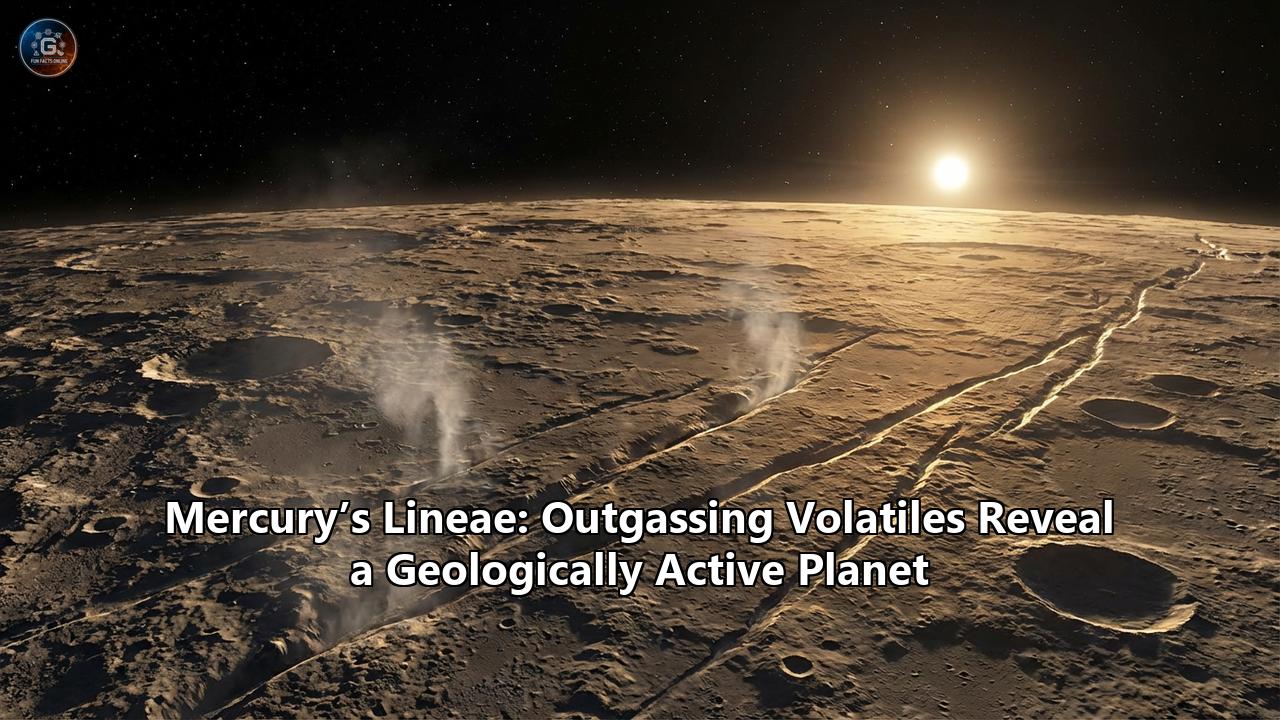
For decades, humanity looked upon the innermost world of our solar system and saw little more than a dead, silent rock. Battered by eons of meteoritic bombardment and baked by the relentless, blinding glare of the Sun, Mercury was long considered the planetary equivalent of a fossil—a static, airless vault preserving the solar system's ancient history, but entirely devoid of modern geological vitality. It was treated as a close cousin to our own Moon: a heavily cratered, geologically inert sphere where the only changes were the occasional impacts of wayward asteroids.
However, the cosmos has a remarkable knack for upending our assumptions. A revolutionary wave of planetary science has entirely dismantled the "dead planet" hypothesis. Through the ingenious application of modern artificial intelligence to archival spacecraft data, researchers have unveiled a stunning reality: Mercury is a dynamically active world. It is a planet that is still "breathing," exhaling volatile elements from deep within its crust and painting its sun-scorched surface with fresh, bright streaks.
The discovery of these features—formally known as lineae—proves that Mercury is not merely a relic of a turbulent past, but a world experiencing ongoing geological modification today. As scientists prepare for the arrival of the next generation of spacecraft to the innermost planet, these outgassing volatiles are forcing us to rewrite the textbooks on planetary formation, thermal evolution, and the very definition of what makes a planet "active."
The Illusion of a Dead World
To understand the magnitude of this recent discovery, one must first understand how deeply entrenched the "dead Mercury" paradigm truly was. When NASA's Mariner 10 spacecraft first flew past Mercury in 1974 and 1975, it captured images of a desolate, crater-pocked landscape. Given its proximity to the Sun—where daytime surface temperatures can soar to a lead-melting 800 degrees Fahrenheit (430 degrees Celsius)—scientists logically assumed that any volatile materials (chemicals with low boiling points, such as water, carbon dioxide, sulfur, and potassium) would have been cooked away billions of years ago.
Without volatile elements, a planet loses its geological "engine". On Earth, volatile compounds mixed into magma lower its melting point and drive explosive volcanic eruptions; they are the gas that makes the planetary soda fizz. Without them, a planet's interior is expected to cool, solidify, and eventually lock the surface into a permanent state of rigor mortis. For a long time, the scientific consensus held that Mercury had lost its volatile inventory almost immediately after its formation 4.5 billion years ago, perhaps blown away by intense early solar winds or boiled off by a catastrophic giant impact.
But hints of a more complex reality began to emerge when NASA's MESSENGER (MErcury Surface, Space ENvironment, GEochemistry, and Ranging) spacecraft entered orbit around the planet in 2011. MESSENGER carried highly advanced spectrometers and cameras that mapped the planet's surface chemistry in unprecedented detail. To the astonishment of the planetary science community, MESSENGER detected abundant amounts of volatile elements like sulfur, potassium, and sodium locked within Mercury's surface.
Even more intriguingly, MESSENGER photographed peculiar, bright, irregular depressions scattered across crater floors and walls. Scientists dubbed these features "hollows" and theorized that they were the result of volatile materials sublimating (turning directly from a solid into a gas) and escaping into space, causing the ground above to collapse. Yet, while the hollows suggested that Mercury had retained volatiles much longer than anticipated, the exact timeline of their formation—and whether the planet was still losing these volatiles today—remained fiercely debated.
AI Unlocks the Secrets of the Lineae
The definitive proof of Mercury's present-day geological pulse arrived in January 2026, courtesy of a groundbreaking study published in the journal Nature Communications Earth & Environment. Led by Dr. Valentin Bickel from the Center for Space and Habitability (CSH) at the University of Bern, and conducted in collaboration with the Astronomical Observatory of Padua (INAF), the research team set out to investigate a rare, poorly understood surface feature on Mercury: slope streaks, or lineae.
Prior to this study, scientists had only spotted a tiny handful of these bright linear streaks sliding down the slopes of Mercury's craters. Because they were so few in number, they were largely treated as geological oddities rather than global phenomena. But Bickel and his team suspected there was more to the story. They turned to advanced machine learning and deep learning algorithms to meticulously comb through an archive of approximately 100,000 high-resolution images taken by the MESSENGER spacecraft between 2011 and 2015.
The AI's processing power allowed the researchers to conduct the first-ever systematic global inventory of Mercury's slope lineae. The results were nothing short of spectacular. The algorithms identified roughly 400 distinct bright streaks that had previously evaded human detection.
"Until now, lineae on Mercury had not been systematically mapped and studied; only a small handful of streaks were known," Dr. Bickel stated following the study's publication. "With the image analysis, we were able to create the first census, i.e. a systematic inventory, of slope streaks on Mercury".
By mapping the distribution, shape, and location of these 400 streaks, the researchers were able to perform a geostatistical analysis that illuminated exactly how and why they form. The data revealed that these bright streaks are not the result of ancient tectonic shifts or long-dead lava flows; instead, they are the active scars of an ongoing process.
The Mechanics of Mercury’s Outgassing
What exactly is creating these bright streaks across Mercury's battered face? The geostatistical analysis provided a compelling answer: the continuous outgassing of subsurface volatile materials.
The researchers discovered a distinct pattern in the global distribution of the lineae. These streaks occur preferentially on the sun-facing slopes of relatively young impact craters. Furthermore, these craters tend to cut deep through thick volcanic deposits, exposing the underlying bedrock which is rich in volatile elements.
This specific environmental clustering is the key to unraveling the mystery. Because the streaks appear predominantly on sun-facing slopes, solar heating acts as the primary trigger. When a space rock slams into Mercury, it creates a young impact crater and fractures the bedrock beneath it. These fracture networks act as deep subterranean chimneys, providing a clear pathway for volatile-rich materials trapped deep within the planet's interior to migrate upward toward the surface.
As the intense solar radiation of the sun-facing slopes warms these exposed fracture zones, the volatile elements (likely sulfur or other light, easily vaporized compounds) undergo a phase change. They expand, turn into gas, and escape into the vacuum of space. This process of outgassing alters the surface chemistry and physically disturbs the local regolith, leaving behind sharp, fresh-looking, bright streaks of altered material that cascade down the crater slopes.
Adding weight to this mechanism is the observation that many of the newly discovered slope lineae originate directly from the "hollows"—the bright, rimless depressions that dot the crater floors. "Most of the streaks appear to originate from bright depressions, so-called 'hollows'," Bickel explained. "With our analysis, we were therefore able to propose that slope lineae are probably formed by the outgassing of volatiles such as sulphur or other light elements, that are sourced from the interior of the planet".
The implications of this mechanism are profound. On other celestial bodies, such delicate surface streaks are known to erode and fade relatively quickly due to space weathering, micrometeorite impacts, and solar wind bombardment. The fact that these lineae feature sharp, fresh-looking textures implies that they are not ancient relics. They are actively forming and evolving right now.
"Our findings paint a completely different, dynamic picture of the supposedly dead, dry and boring planet Mercury," Bickel noted. The planet is quite literally venting its internal chemistry into space, maintaining a slow but steady exhalation of elements that have somehow survived the infernal heat of the inner solar system for billions of years.
Rewriting the Volatile Budget
The discovery of the lineae does more than just prove Mercury is geologically active; it offers scientists a tangible metric to calculate the planet's "volatile budget".
A planet's volatile budget is a measure of how much volatile material it originally possessed, how much it has lost over time, and how much remains locked in its crust and mantle. For a long time, reconstructing Mercury's interior composition and thermal evolution has been a highly speculative endeavor. Because scientists believed the planet was entirely depleted of volatiles, models of its formation were skewed toward catastrophic scenarios.
For example, to explain why Mercury has an abnormally large, dense iron core that makes up about 85% of its radius, early astronomers proposed the "Giant Impact Hypothesis". This theory suggested that Mercury was once a much larger protoplanet, but a colossal collision with another planetary body violently stripped away its lighter, rocky outer mantle, leaving only the dense core behind. Another theory proposed that the intense heat of the young, highly active Sun simply vaporized the outer layers of the planet. Both of these violent, high-heat scenarios would have inevitably driven off all volatile elements early in the planet's history.
The continuous outgassing evidenced by the slope lineae strikes a heavy blow against these models. If Mercury were stripped of its outer layers in a catastrophic, melting event, it should not have a volatile-rich bedrock today. The fact that sulfur and other light elements are currently venting from deep fracture networks means that Mercury somehow held onto a vast reservoir of these materials from its very birth.
"As the streaks on Mercury are presumably caused by the outgassing of volatile material, they could be a promising indicator of Mercury's 'volatile budget', i.e. how much volatile material the planet is continuously losing," Bickel explained. By studying the global distribution of the streaks and modeling the transport of volatiles, researchers can now begin to reverse-engineer the exact volume of light elements still hiding in Mercury's mantle. Furthermore, this ongoing loss of material helps explain the origins of Mercury's extremely tenuous atmosphere—known as an exosphere—which must be continuously replenished by material escaping from the surface to prevent it from being entirely stripped away by the solar wind.
Echoes of Explosions: The Pyroclastic Past
To fully appreciate the significance of Mercury's modern-day outgassing, it is helpful to look back at the planet's violent, explosive history. The gentle venting of sulfur gas today is merely the quiet continuation of a much more aggressive geological past.
Before the lineae were cataloged, scientists found the first undeniable proof of Mercury's volatile wealth in the form of ancient volcanic ash. In 2014, a team of researchers led by Timothy Goudge from Brown University conducted a detailed study of 51 distinct pyroclastic sites distributed across Mercury's surface.
On Earth, explosive volcanism (like the devastating 1980 eruption of Mount St. Helens) is driven entirely by volatiles. As magma rises from the deep interior, the decreasing pressure causes dissolved volatiles (like water and carbon dioxide) to flash from a liquid phase into a gas. This sudden, massive expansion of gas creates immense pressure, eventually bursting through the overlying rock in a violent explosion of magma and ash.
Because Mercury was thought to be bone-dry, scientists originally assumed it could not host explosive volcanism. Yet, the MESSENGER spacecraft returned high-resolution images of volcanic vents surrounded by widespread deposits of pyroclastic ash. Goudge's team analyzed the degradation and erosion of the craters where these vents were located to establish a chronological timeline of the explosions.
Astoundingly, the researchers found that these violent eruptions were not restricted to the chaotic early days of the solar system. Some of the pyroclastic deposits were found in relatively young craters dating to between 3.5 and 1 billion years old. "These ages tell us that Mercury didn't degas all of its volatiles very early," Goudge stated at the time. "It kept some of its volatiles around to more recent geological times".
We now know, thanks to the recent discovery of the lineae, that this timeframe extends all the way to the present day. While the planet may no longer possess the internal heat required to drive massive, mountain-shattering pyroclastic explosions, the deeply buried volatiles are still there, slowly seeping out through the cracks in a dying, but not yet dead, world.
Chaotic Terrains and Hidden Habitats?
The realization that Mercury has a volatile-rich crust has led to some of the most fascinating and radical theories in modern planetary science—including whispers of environments that might, under highly specific conditions, share characteristics with habitable zones.
In 2020, researchers from the Planetary Science Institute, led by Alexis Rodriguez, published a study on Mercury's "chaotic terrain". This region consists of massive, jumbled, fractured landscapes filled with towering mesas and deep valleys. For decades, the prevailing theory held that this chaotic terrain was formed by seismic shockwaves rippling through the planet following a massive asteroid impact on the opposite side of the globe (the Caloris basin impact).
However, Rodriguez's team used laser altimetry data to show that the chaotic landforms continued to develop and collapse for at least 1.8 billion years after the Caloris basin formed, rendering the earthquake hypothesis impossible. Instead, they proposed that the chaotic terrain was the result of massive subterranean volatile deposits heating up and turning to gas. As vast quantities of underground volatiles sublimated and escaped, the overlying crust lost its structural support and collapsed inward, creating the jumbled, chaotic landscape we see today.
"As opposed to having a bone-dry crust with a few spots that are volatile-rich, we are looking at a volatile-rich crust to depths of at least a couple of kilometers," Rodriguez noted.
While the exact composition of all these volatiles remains unknown, the presence of significant subsurface volatile reservoirs raises tantalizing questions. We already know that Mercury hosts deposits of water ice hidden in the permanently shadowed craters at its north pole. If water was among the volatiles trapped deep within the planet's crust, shielded from the sun's radiation and warmed by geothermal heat, could there have been subsurface environments capable of supporting basic prebiotic chemistry?
While proposing past habitability on a planet hot enough to melt lead is highly speculative, the sheer abundance of deep-crustal volatiles demands that we keep an open mind. At the very least, it highlights how a dynamic, shifting crust driven by outgassing can drastically reshape the topography of a world. The bright slope lineae currently snaking down Mercury's craters are simply the micro-scale, modern-day equivalent of the massive volatile collapses that forged the chaotic terrain billions of years ago.
The BepiColombo Vanguard
The 2026 census of Mercury's slope lineae represents the absolute limit of what scientists can achieve using the archival data from the MESSENGER mission. To truly understand the nature of Mercury's outgassing, the scientific community desperately needs new, higher-resolution data.
Fortunately, that data is on our cosmic doorstep.
Currently racing through the inner solar system is the BepiColombo mission, a joint endeavor between the European Space Agency (ESA) and the Japan Aerospace Exploration Agency (JAXA). Launched in October 2018, the ambitious mission consists of two distinct spacecraft traveling together: the Mercury Planetary Orbiter (MPO) and the Mercury Magnetospheric Orbiter (Mio). After a long, complex seven-year journey involving multiple planetary gravity assists, BepiColombo is scheduled to finally insert itself into orbit around Mercury in November 2026.
BepiColombo is armed with a suite of next-generation instruments perfectly suited to solve the mystery of the lineae and the outgassing volatiles. Among the most critical of these instruments is the BepiColombo Laser Altimeter (BELA), designed and built in part by the Physics Institute of the University of Bern.
BELA is a marvel of remote sensing technology. Once in orbit approximately 1,000 kilometers above Mercury's surface, BELA will fire rapid laser pulses down to the planet. By measuring the exact time it takes for the laser light to bounce back to the spacecraft, BELA will map the topography of Mercury with an astonishing precision of about 10 centimeters.
This unprecedented level of detail will allow scientists to map the bright streaks, the hollows, and the impact fracture networks in true three-dimensional high definition. Researchers will be able to measure the exact depth of the hollows, calculate the volume of material that has been lost to space, and monitor the sun-facing slopes for real-time topographical changes.
"The researchers now hope that they will be able to clearly prove their assumption about the activity of lineae with new images of Mercury, which the BepiColombo mission... should provide," noted the University of Bern. If BepiColombo observes changes in the lineae or the hollows during its orbital mission, it will represent the first real-time observation of geological outgassing on the innermost planet. Furthermore, BepiColombo's advanced spectrometers will sniff the planet's tenuous exosphere, allowing scientists to directly capture and analyze the chemical signature of the volatiles escaping from the fracture networks. This will definitively answer whether the planet is bleeding sulfur, sodium, potassium, or even more complex molecular compounds into the void.
Implications for the Broader Cosmos
The revelation that Mercury is a geologically active, outgassing planet extends far beyond the confines of our own solar system. It provides a critical data point for the booming field of exoplanetary science.
In recent years, astronomical observatories and space telescopes have discovered thousands of exoplanets orbiting distant stars. A large percentage of these discoveries are "hot Earths" or "super-Mercuries"—small, rocky planets situated incredibly close to their host stars. Astronomers have often assumed that these deeply roasted worlds must be entirely desiccated, stripped of all their volatile elements, and geologically dead.
However, Mercury stands as a defiant counter-example. If a small, heavily irradiated planet like Mercury can retain a vast inventory of volatile elements deep within its crust for 4.5 billion years—and continue to outgas those elements to drive modern geological activity—then the rocky exoplanets of the galaxy might be far more dynamic and complex than our current models suggest. Mercury's lineae demonstrate that a planet's surface may be a hellscape, but its interior can remain a vibrant, shifting chemical reservoir capable of continually resurfacing the world.
Furthermore, the mechanics of volatile retention on Mercury challenge our fundamental understanding of how planetary building blocks coalesce in the protoplanetary disk. The survival of elements with low boiling points so close to the Sun implies that the materials that accreted to form Mercury must have been incredibly rich in volatiles from the very beginning, or that the planet formed further out and migrated inward. It forces astrophysicists to recalibrate the thermal gradients of the early solar system.
A Living Hellscape
We are currently witnessing a paradigm shift in planetary geology. The traditional view of a static, boring, dead rock floating near the Sun has been permanently shattered.
Through the lens of machine learning and the diligent analysis of archival imagery, we have uncovered a world that is still fighting against the dying of the light. Mercury's surface is scored with the bright, striking lineae of volatile outgassing—a slow, steady exhalation of the planet's internal essence. Driven by the intense solar radiation baking the slopes of young impact craters, the subsurface reservoirs of sulfur and other light elements vaporize, rise through fractured bedrock, and carve fresh streaks into the ancient crust.
As we count down the months to the arrival of the BepiColombo mission in late 2026, the scientific community is bracing for even more astonishing discoveries. We are no longer sending probes to a planetary graveyard. We are sending them to an active laboratory of planetary evolution, where the violent impacts of the cosmos meet the gentle, persistent outgassing of an unyielding world.
Mercury's bright streaks are a powerful reminder that in the grand theatre of the solar system, appearances can be deceiving. Beneath the cratered, scorched, and silent facade of the innermost planet lies a dynamic, volatile heart—one that continues to beat, billions of years after we assumed it had stopped.
Reference:
- https://mediarelations.unibe.ch/media_releases/2026/media_releases_2026/streaks_mercury/index_eng.html
- https://www.spacedaily.com/reports/Bright_streaks_reveal_Mercury_still_geologically_active_999.html
- https://www.iflscience.com/its-alive-mercurys-slopes-and-craters-show-signs-of-active-geology-82357
- https://www.sciencealert.com/strange-bright-lines-on-mercury-suggest-its-not-dead-after-all
- https://www.kjzz.org/2020-03-19/content-1494041-mercurys-chaotic-terrain-hints-volatile-past-potential-habitability
- https://www.astronomy.com/science/ancient-volcanic-explosions-shed-light-on-mercurys-origins/
- https://www.iflscience.com/scientists-discover-evidence-mercury%E2%80%99s-explosive-volcanic-history-24151
- https://www.spacedaily.com/Mercury_Rising.html
- https://www.hou.usra.edu/meetings/mercury2018/pdf/6121.pdf