
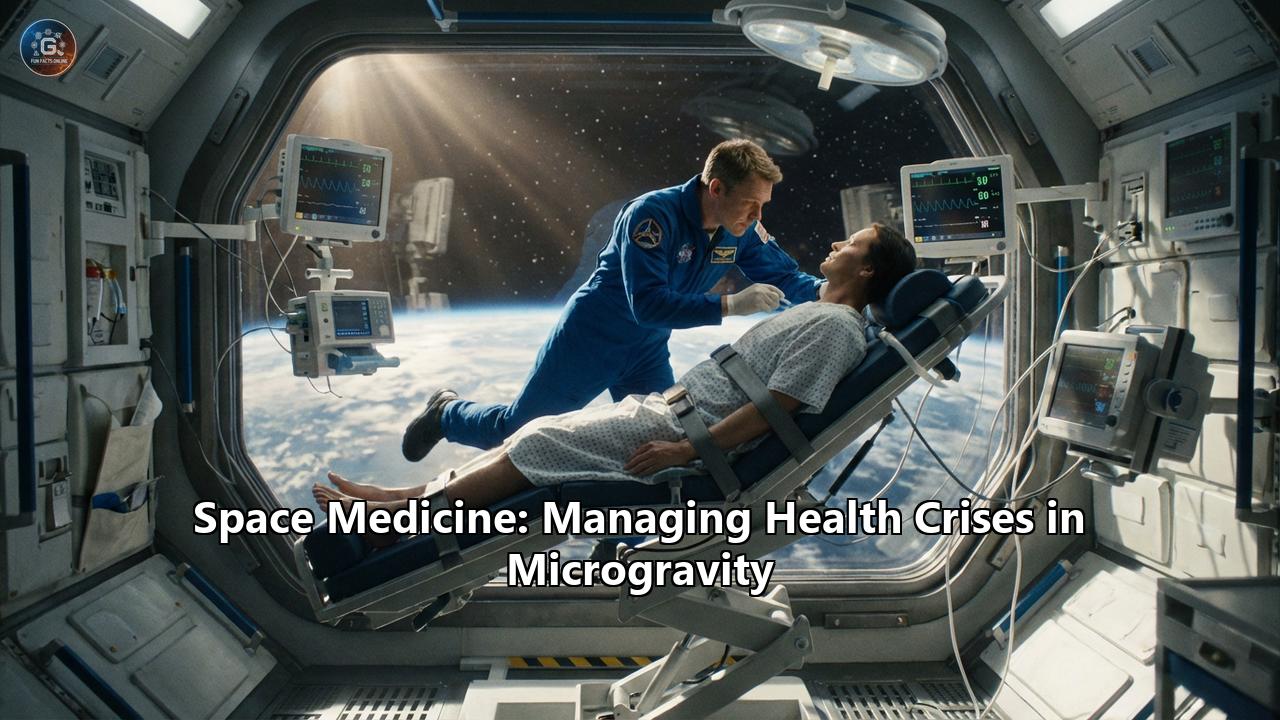
Introduction: The Fragile Human in the Void
In the vacuum of space, the human body is an anomaly. We are biological machines calibrated for a 1G environment, protected by a thick atmosphere and a comforting magnetic field. When we strip away these protections and place a human being in the microgravity environment of Low Earth Orbit (LEO) or the deep void of interplanetary space, the body begins to rebel. Fluids shift, bones dissolve, muscles wither, and the heart reshapes itself.
For decades, space medicine has been a discipline of prevention and monitoring. Astronauts are the most screened, studied, and healthy individuals on the planet. But as we transition from the era of the International Space Station (ISS)—where Earth is a mere three-hour ambulance ride away—to the era of Artemis and Mars, the paradigm must shift. We are moving from "camping trips" where we can pack everything we need, to true settlement and exploration where we must be self-reliant.
Managing a health crisis in microgravity is not simply about having the right pills; it is about reimagining medicine for a world where liquids don't pour, open wounds form floating spheres of blood, and CPR is physically impossible without special equipment. This article explores the physiological cascade of spaceflight, the history of medical crises in orbit, and the futuristic technologies—from aqueous immersion surgery to pharmacy-on-a-chip—that will keep us alive on the Red Planet.
Part I: The Physiological Cascade
To understand how to treat a crisis in space, one must first understand the "new normal" of the astronaut's body. A medical baseline on Earth is irrelevant in orbit.
1. The Great Fluid Shift and "Puffy Face, Bird Legs"
Within moments of reaching microgravity, the hydrostatic pressure gradient that pulls blood into our legs vanishes. Approximately two liters of fluid—blood, lymph, and interstitial fluid—migrate from the lower body to the chest and head. Astronauts often joke about the "puffy face, bird legs" syndrome, but medically, this is a significant event.
- Baroreceptor Confusion: The carotid baroreceptors interpret this flood of fluid as a massive increase in blood volume. The body responds by dumping fluid. Kidneys work overtime to excrete water, leading to a rapid reduction in plasma volume (up to 20%). The astronaut becomes paradoxically dehydrated while feeling full.
- Neuro-Ocular Issues: This fluid shift is the primary suspect in Spaceflight Associated Neuro-ocular Syndrome (SANS). The increased intracranial pressure pushes against the back of the eye, flattening the globe and swelling the optic nerve. On a long-duration mission, this could mean a pilot losing visual acuity just when they need it most—during a manual landing on Mars.
2. The Cardiovascular Remodel
The heart, relieved of the duty to pump against gravity, grows lazy. Over a six-month mission, the heart can atrophy, losing muscle mass. Its shape changes from an elongated oval to a spherical ball.
- Arrhythmias: This structural remodeling, combined with electrolyte imbalances, increases the risk of heart rhythm irregularities. "Space arrhythmias" have been documented since the Apollo era, often appearing during periods of high stress or intense physical activity (EVA).
3. The Musculoskeletal Dissolution
Without the constant load of gravity, the body decides that a heavy skeleton is an unnecessary energy expenditure.
- Bone Demineralization: Astronauts can lose 1-1.5% of their bone mass per month, particularly in the weight-bearing bones of the hips and spine. This calcium isn't just disappearing; it's flooding the bloodstream (hypercalcemia) and filtering through the kidneys, drastically increasing the risk of renal stones—a potentially mission-ending medical emergency.
- Muscle Atrophy: The "anti-gravity" muscles (calves, back, and neck) degrade rapidly. Even with two hours of resistive exercise a day, returning astronauts often require weeks of rehabilitation to stand without fainting.
Part II: Medical Crises in History
While NASA and Roscosmos act with extreme caution, spaceflight has not been without its medical dramas. These incidents serve as case studies for what can go wrong and how limited our current capabilities are.
1. The Apollo 7 "Mutiny"
A head cold in space is a misery that terrestrial dwellers can scarcely imagine. Without gravity to drain the sinuses, mucus accumulates, causing severe pressure and pain. During Apollo 7, Commander Wally Schirra developed a severe head cold. The pressure was so intense that he feared blowing his eardrums out during reentry. The crew refused to wear their helmets during the descent—a direct violation of Mission Control orders—so they could perform the Valsalva maneuver to clear their ears. It highlights a simple truth: minor ailments on Earth can become major operational hazards in space.
2. The Salyut 6 Toothache
In 1978, Cosmonaut Yuri Romanenko aboard Salyut 6 developed a severe toothache. For two weeks, he endured excruciating pain. There were no dental drills, no forceps, and no effective protocols for treatment. He had to wait until his return to Earth for relief. This incident led to the rigorous dental screening (Class I, II, III) we see today. A dental abscess on a Mars mission, nine months from Earth, could be fatal if the infection spreads to the brain.
3. The EVA Near-Drowning
In 2013, Italian astronaut Luca Parmitano nearly drowned during a spacewalk outside the ISS. A water leak in his suit's cooling system caused water to migrate into his helmet. In microgravity, water doesn't slosh; it sticks. A blob of water adhered to his face, covering his eyes, nose, and mouth. He was blinded and choking, unable to wipe the water away. He managed to navigate back to the airlock by memory and feel. It was a stark reminder that in space, even the life-support systems can become lethal.
4. The ISS Blood Clot
During a routine ultrasound study on the ISS, a deep vein thrombosis (DVT) was discovered in the jugular vein of an astronaut. This was a medical first. Treating a clot in space is a high-wire act. If the clot dislodges, it could cause a pulmonary embolism or stroke. If you treat it with blood thinners, you risk internal bleeding in an environment where trauma care is virtually impossible. The NASA medical team, consulting with experts on Earth, rationed the limited supply of enoxaparin (a blood thinner) on board until a resupply ship could arrive. The astronaut had to inject themselves for months, a terrifying reality of "telemedicine" where the doctor is 250 miles down and the pharmacy is empty.
Part III: The Challenge of Trauma and Surgery
One of the greatest fears for a Mars mission medical officer is trauma. A hull breach, a machinery accident, or a fall on the Martian surface could result in blunt force trauma or penetrating injuries.
1. CPR in Microgravity: The Physics Problem
Cardiopulmonary Resuscitation (CPR) relies on body weight. On Earth, you kneel beside the victim and use gravity to help compress the chest 2 inches deep. In space, if you push on a patient's chest, you float away.
- The Handstand Method: The current NASA protocol involves the rescuer placing their feet against the ceiling (or opposite wall) and performing a "handstand" on the patient's chest to generate force. It is exhausting and difficult to maintain.
- The Evetts-Russomano Method: A technique where the rescuer wraps their legs around the patient's torso (like a bear hug) and uses their core muscles to compress.
- The Future: Mechanical Pistons: Recent studies suggest that manual CPR in space is largely ineffective for long durations. The future of space CPR lies in automated mechanical piston devices—machines that strap to the chest and deliver perfect, rhythmic compressions without the need for gravity or rescuer stamina.
2. Surgery: Managing the Floating Mess
Performing surgery in zero-G is a nightmare of fluid dynamics.
- The Containment Problem: On Earth, blood pools in the wound. In space, it forms floating domes that can break off and drift around the cabin, contaminating equipment and carrying biohazards.
- Organ Behavior: Without gravity, organs don't stay put. Intestines float freely, obscuring the surgical field.
- The Solution: AISS: The Aqueous Immersion Surgical System (AISS) is a transparent, fluid-filled dome that seals over the surgical site. The surgery is performed robotically or through gloved ports inside this liquid environment. The pressure of the fluid stops bleeding (tamponade effect), and suction devices can cycle the fluid to keep the view clear. It essentially turns open surgery into a form of arthroscopy.
3. Anesthesia in the Void
General anesthesia is risky. It suppresses respiration and cardiovascular function—two systems already compromised by microgravity. Furthermore, volatile anesthetic gases (like sevoflurane) would contaminate the station's recycled air supply.
- Regional Anesthesia: The preferred method for space surgery is regional anesthesia (nerve blocks) using ultrasound guidance. It numbs the specific area without knocking the patient out, preserving their ability to protect their own airway.
Part IV: The Pharmacy of the Future
A mission to Mars takes 3 years round-trip. Most drugs on Earth have a shelf-life of 12-24 months. By the time astronauts reach Mars, their antibiotics and painkillers may have degraded into useless—or toxic—compounds due to radiation and time.
1. The Degradation Problem
Radiation is the enemy of complex molecules. High-energy cosmic rays can shatter the chemical bonds of pharmaceuticals. Studies have shown that critical drugs like epinephrine (for allergic reactions) and antibiotics lose potency rapidly in space. You cannot pack a 3-year supply of drugs if they only last 18 months.
2. Astropharmacy: Brewing Drugs in Space
We cannot take everything with us, so we must make it there.
- Bio-Manufacturing: NASA is experimenting with genetically modified Bacillus subtilis spores. These spores are incredibly hardy and can survive the radiation of deep space. When a drug is needed, the astronaut activates the spores with a nutrient solution. The bacteria are programmed to synthesize specific drugs—like human growth hormone, insulin, or antibiotics.
- Cell-Free Systems: Even more advanced is "biologic teleportation." Instead of living cells, we use just the cellular machinery (ribosomes, DNA, enzymes) freeze-dried on a chip. You add water and the genetic code for the drug you want, and the chip synthesizes the protein on demand.
- Pharmacy-on-a-Chip: DARPA's "Pharmacy on Demand" (PoD) project aims to miniaturize the chemical synthesis plant. A device the size of a microwave could carry precursors and "print" small molecule drugs (like ibuprofen or ciprofloxacin) whenever required.
Part V: Psychological Crises and the "Space Tape" Protocol
The psychological strain of a Mars mission—isolation, confinement, no real-time communication with family—is the "red risk" for mission planners. A psychotic break in a small capsule is a catastrophic safety threat.
1. The Reality of Space Madness
While astronauts are screened for mental toughness, the brain changes in space. Sleep deprivation, CO2 buildup (which can cause anxiety), and the sheer existential dread of being millions of miles from Earth can trigger acute psychiatric events.
2. The Protocol
NASA has a specific, if grim, checklist for an astronaut who becomes violent or suicidal.
- Step 1: Verbal de-escalation (difficult with a communication delay of 20 minutes to Earth).
- Step 2: Physical Restraint. This involves duct tape. The crew is instructed to bind the patient’s wrists and ankles with tape and secure them to a bunk with bungee cords.
- Step 3: Chemical Sedation. The medical kit contains injectable antipsychotics (like haloperidol) and benzodiazepines. The goal is to induce deep sedation until the crisis passes.
- Step 4: Ketamine? Recent reviews suggest ketamine might be the ideal space drug for acute suicidality. It acts instantly (unlike antidepressants which take weeks) and can be administered intranasally.
Part VI: The Future - Smart Medical Bays and 3D Health
By 2040, the medical bay of a Martian transport will look nothing like the cramped quarters of the ISS.
1. The Smart Surgical Bay
Imagine a medical suite lined with robotic arms. An AI-driven "Medical Officer" (an advanced version of a Clinical Decision Support System) continuously monitors the crew via wearable sensors. If a trauma occurs, the AI guides the crew—most of whom are not surgeons—through the procedure using augmented reality (AR) glasses. The robotic arms stabilize the patient and the instruments, canceling out the vibrations and drift of microgravity.
2. 3D Bioprinting
If an astronaut suffers a severe burn or bone fracture, we won't just bandage it; we will print new tissue. The BioFabrication Facility (BFF) on the ISS is already testing this. In microgravity, printing tissue is actually easier than on Earth because you don't need scaffolding to hold soft tissue shapes against gravity. We could print skin grafts or bone patches using the astronaut's own stem cells.
3. Reproductive Health: The Elephant in the Room
As we talk about "settlement," we must talk about reproduction. We currently have no idea if a fetus can develop normally in 0.38G (Mars gravity). Radiation poses a severe risk to germ cells (sperm and eggs). Future Mars missions will likely carry cryopreserved gametes (sperm and eggs frozen on Earth) as a genetic insurance policy, and "conception" might be a strictly regulated medical procedure involving artificial wombs or heavy radiation shielding.
Conclusion
Space medicine is the ultimate high-wire act. It is a discipline that demands we master the oldest of human arts—healing—in an environment that is fundamentally hostile to life. The technologies we develop to keep astronauts alive on the way to Mars—telemedicine, autonomous surgery, portable drug manufacturing—will revolutionize healthcare on Earth, bringing hospital-grade capabilities to the most remote villages and disaster zones. We go to space to explore the universe, but in doing so, we learn the deepest secrets of our own fragile biology.
Reference:
- https://pmc.ncbi.nlm.nih.gov/articles/PMC9240807/
- https://www.quora.com/What-processes-are-in-place-to-deal-with-an-astronaut-going-mad-or-attacking-someone-on-a-space-station
- https://www.reddit.com/r/todayilearned/comments/4ert2l/til_nasa_has_a_detailed_set_of_written_procedures/
- https://www.theguardian.com/science/2014/oct/05/hallucinations-isolation-astronauts-mental-health-space-missions
- https://www.tampabay.com/archive/2007/02/25/psychosis-in-space-nasa-has-checklist/
- https://www.researchgate.net/publication/269177862_Air_Medical_Retrieval_of_Acute_Psychiatric_Patients
- https://www.sciencealert.com/scientists-say-its-time-to-learn-more-about-sexual-health-in-space