
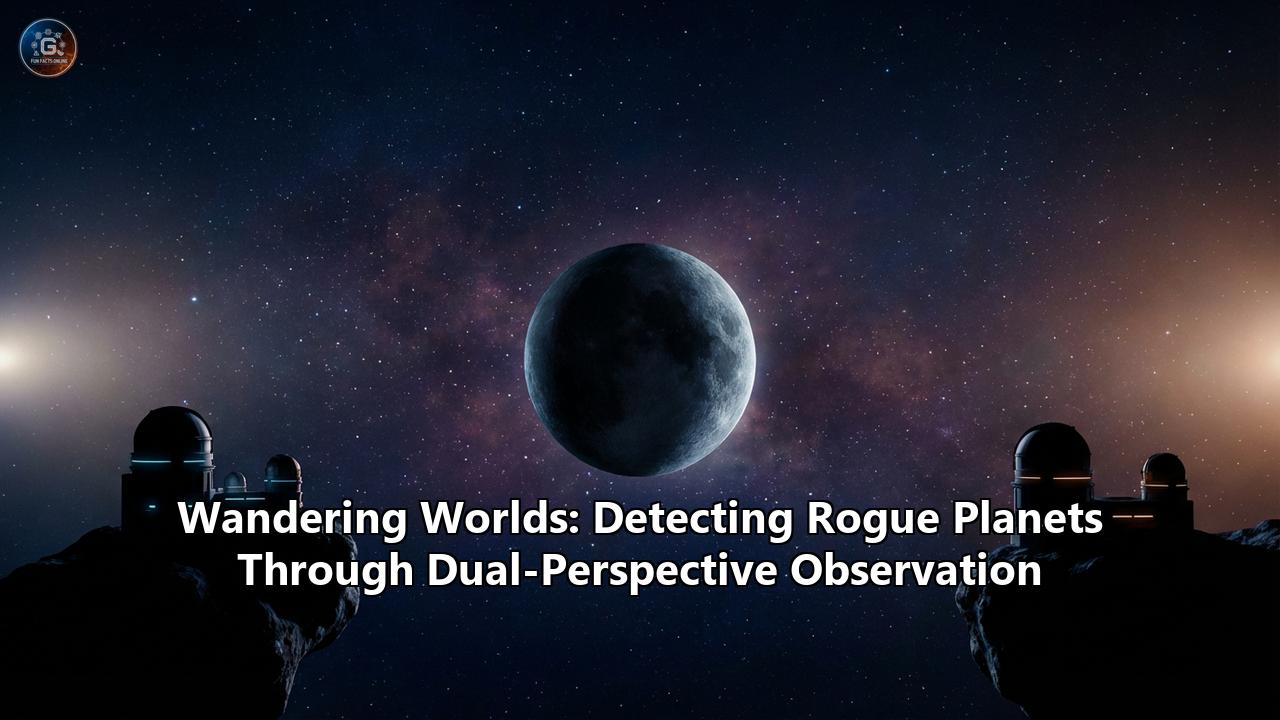
The galaxy is not merely a collection of stars, but a vast, silent ocean of invisible worlds. For centuries, our understanding of the cosmos was tethered to the light of suns; we believed that to be a planet was to be a subordinate, an orbital companion bound by gravity to a stellar master. We were wrong.
In the dark voids between the stars, a phantom population outnumbers the visible systems. These are the rogue planets—nomads, orphans, free-floaters—worlds that have been violently ejected from their birthplaces or formed in solitary confinement within collapsing gas clouds. For decades, they were mathematical ghosts, existing only in simulations and the rare, ambiguous flicker of a distant star. They were undetectable by conventional means, hiding in the eternal night of interstellar space.
But the dark is no longer impenetrable. We have entered a new epoch of discovery, defined not by looking at light, but by watching how gravity bends it. The date is January 4, 2026, and the astronomical community is currently reeling from a breakthrough that has transformed rogue planets from theoretical curiosities into tangible, weighed, and measured worlds. Through the ingenious application of Dual-Perspective Observation—a technique effectively giving humanity "stereo vision" on the cosmos—we have begun to map the wandering worlds.
This is the story of that revolution. It is a story of how ground-based telescopes in the desolate deserts of Earth and sentinels parked a million miles away in the silence of space have synchronized their gaze to catch the invisible. It is a chronicle of the "Saturnian Drifter," the first rogue planet to have its mass and distance precisely nailed down through this method, and a look ahead at the trillions of siblings waiting to be found.
Part I: The Invisible Majority
To understand the magnitude of the dual-perspective breakthrough, one must first grasp the sheer difficulty of the hunt. Traditional exoplanet detection methods are useless here. The Transit Method, which has gifted us thousands of worlds like those found by the Kepler telescope, relies on a planet passing in front of its host star, dimming its light. A rogue planet has no star to dim. The Radial Velocity Method looks for the wobble of a star caused by a planet's tug. A rogue planet tugs on nothing but the vacuum. Direct Imaging seeks the faint glow of a planet, but without a nearby star to illuminate it or a young, hot core to radiate heat, rogue planets are colder than the frozen voids they traverse.
They are the ultimate stealth objects. If a rogue Earth were to pass through our solar system, we might not see it until it reflected our own Sun’s light. In the deep galaxy, they are effectively nonexistent to optical telescopes.
Yet, they betray themselves through one fundamental property: mass.
According to Einstein’s General Relativity, mass distorts the fabric of space-time. When a rogue planet drifts between Earth and a distant background star (located thousands of light-years away in the galactic bulge), the planet acts as a gravitational lens. It does not block the light; it bends it. The planet’s gravity gathers the streams of starlight that would have missed Earth and focuses them toward us, causing the background star to momentarily brighten.
This phenomenon is called Gravitational Microlensing.
For a few hours or days, a nondescript star in the crowded center of the Milky Way flares up. It doesn't change color; it just gets brighter, then dims back to normal as the rogue planet moves on. This fleeting pulse of light is the only footprint a rogue planet leaves.
For twenty years, projects like OGLE (Optical Gravitational Lensing Experiment) and MOA (Microlensing Observations in Astrophysics), and more recently KMTNet (Korea Microlensing Telescope Network), have stared unblinkingly at millions of stars, waiting for these rare alignments. They found them. They detected short-duration spikes that hinted at Earth-sized and Jupiter-sized objects floating freely.
But there was a fatal flaw in the method. A single observatory, or even a network of observatories on Earth, sees the event from effectively one viewpoint. When a star brightens, we can measure how long the event lasts (the timescale). However, a short event could be caused by two very different things:
- A massive object (like a Jupiter) moving very quickly.
- A light object (like an Earth) moving very slowly.
- A massive object very close to us.
- A light object very far away.
This is the Mass-Distance Degeneracy. Without knowing how far away the lens (the rogue planet) is, you cannot calculate its mass. You know something passed by, but you don't know if it was a rocky world, a gas giant, or a failed star. For decades, rogue planets remained statistical ghosts—we knew they existed in bulk, but we couldn't point to a specific detection and say, "That is a planet the size of Saturn, 10,000 light-years away."
Until we opened a second eye.
Part II: The Stereoscopic Revolution
Hold a finger up in front of your face. Close your left eye. Now close your right eye. The finger appears to jump against the background. This is parallax. Your brain uses the slight difference in the angle of view from your two eyes to triangulate the distance to your finger. It is the basis of human depth perception.
Astronomers realized that to break the mass-distance degeneracy of rogue planets, they needed to replicate this biology on a galactic scale. They needed one "eye" on Earth and another "eye" deep in space, separated by millions of kilometers.
If a rogue planet passes in front of a star, a telescope on Earth sees the brightening event happen at a specific time. But a telescope located at the L2 Lagrange point—1.5 million kilometers away—sees the planet align with the star from a slightly different angle. Consequently, the space telescope sees the brightening event happen slightly earlier or later, and perhaps with a different peak intensity.
By measuring this time delay (often just a few hours) and the difference in magnification, astronomers can calculate the Microlens Parallax. This geometric triangulation yields the precise distance of the rogue planet. Once the distance is known, the duration of the event reveals the planet's speed and, most crucially, its mass.
This technique turns a "suspected anomaly" into a "confirmed world."
The concept was theoretically sound for years, but it required a coincidence of technology and celestial mechanics that has only recently matured. We needed powerful, wide-field ground telescopes monitoring the galactic bulge 24/7, and we needed a space telescope capable of seeing the same dense star fields with high precision.
Enter the protagonists of our recent success: the terrestrial networks of OGLE (Las Campanas, Chile) and KMTNet (Chile, South Africa, Australia), and the celestial sentinel, ESA’s Gaia mission.
Part III: The Saturnian Drifter (Discovery of Jan 2026)
The culmination of this dual-perspective approach was announced to the world just days ago, in early January 2026. A team of international researchers confirmed the detection and measurement of a rogue planet known as OGLE-2024-BLG-0516 (also cataloged by the Korean network as KMT-2024-BLG-0792).
The event began in May 2024. The automated alert systems of the OGLE survey, which has been monitoring the sky for over three decades, flagged a sudden brightening of a faint star in the galactic bulge. Within hours, the KMTNet telescopes in South Africa and Australia picked up the signal, providing continuous coverage as the Earth rotated.
The light curve was characteristic of a planetary microlensing event—short, sharp, and symmetrical. But as is typical, the ground-based data alone left the planet’s identity ambiguous. It could have been a low-mass star or a brown dwarf drifting nearby, or a planet far away.
However, the researchers realized that the European Space Agency’s Gaia spacecraft was also scanning that sector of the sky. Gaia, designed to map the positions of billions of stars, sits at the L2 Lagrange point, 1.5 million kilometers from Earth.
The team hurriedly downloaded Gaia’s photometric data. They found the "blip." Gaia had indeed seen the same background star brighten. But crucially, Gaia saw the peak of the event occur approximately 1.9 hours later than the telescopes in Chile.
This nearly two-hour delay was the golden key.
Using the time difference and the known distance between Earth and Gaia, the team triangulated the location of the lens. The object was not a nearby brown dwarf. It was located 3,000 parsecs (roughly 9,800 light-years) away, deep in the spiral arms of the Milky Way.
With the distance pinned down, the mass calculation tumbled out of the equations. The object has a mass approximately 22% that of Jupiter. This places it squarely in the mass regime of Saturn.
This discovery is historic. It is the first time humanity has measured the mass of a rogue planet with direct geometric evidence rather than statistical inference. We are no longer guessing. We know there is a world, roughly the size of Saturn, drifting alone 10,000 light-years from here. It has no sun. It has no year. It is a wanderer in the "Einstein Desert"—a term used to describe the gap in detection sensitivity that previously made such worlds invisible.
Part IV: Anatomy of an Exile
The confirmation of the "Saturnian Drifter" forces us to confront a violent reality of planetary formation. How does a world the size of Saturn end up alone in the dark?
Planetary systems are born in chaos. When a star forms, it is surrounded by a protoplanetary disk of gas and dust. Planets accrete from this material, but they do not stay put. In the first few million years of a system's life, giant planets migrate. They push and pull on each other with tremendous gravitational force.
Simulations of planetary dynamics suggest that "sibling rivalry" is common. If two gas giants form too close to each other, their mutual gravity can destabilize their orbits. One planet is often flung inward, becoming a "Hot Jupiter," while the other is slingshot outward. If the ejection velocity is high enough, the victim escapes the star's gravity entirely. It is cast out into the interstellar medium, condemned to drift forever.
The Saturnian mass of the newly measured rogue is particularly telling. A planet this large is unlikely to form in isolation. While "sub-brown dwarfs" can collapse directly from small gas clouds, the physics of gas collapse usually prevents objects smaller than a few Jupiter masses from forming on their own. A Saturn-mass object is almost certainly a "true" planet—a world that formed around a star and was subsequently evicted.
This specific rogue planet is a monument to a galactic trauma. It likely formed in a warm, chaotic disk, surrounded by light and other worlds, only to be subjected to a gravitational scattering event that exiled it. It carries the chemical history of its parent star—the metals, the ices, the silicates—frozen into its core, a time capsule from a system we will never identify.
Part V: The Future Eyes—Roman and Euclid
While the Gaia-Earth baseline provided the proof of concept, we are standing on the precipice of a much larger flood of discoveries. The "Saturnian Drifter" was a lucky catch—a serendipitous alignment where Gaia happened to be looking. Future missions are being designed to industrialize this process.
The most significant player in this future landscape is NASA’s Nancy Grace Roman Space Telescope (scheduled for launch in 2027).
Roman is the spiritual successor to Hubble, but with a panoramic view. Its field of view is 100 times larger than Hubble’s, yet it retains the same sharpness. One of Roman’s core mandates is the Galactic Bulge Time Domain Survey. It will stare at hundreds of millions of stars in the infrared, taking an image every 15 minutes for months at a time.
Roman is expected to find thousands of rogue planets. But to get the "Dual-Perspective," Roman needs a partner.
That partner is ESA’s Euclid mission (launched in 2023) and Japan’s upcoming PRIME (Prime-focus Infrared Microlensing Experiment) telescope in South Africa.
Euclid and Roman will form the ultimate stereoscopic observatory. Both are located in space (though at different stable orbits or viewing angles depending on the phase of the mission), and when combined with ground-based heavyweights like the Subaru Telescope or the future Extremely Large Telescopes, they will provide parallax baselines that are unprecedented.The separation between Roman (at L2) and Earth is fixed, but the separation between Roman and Euclid (if coordinated) or Roman and Earth creates a parallax baseline that allows for the detection of planets far smaller than Saturn.
We are moving toward the detection of Earth-mass rogue planets.
Simulations suggest that Roman could detect rogues as small as Mars. When we find these, the implications become even more profound. Gas giants are easily ejected, but rocky worlds can be stripped away even more easily during the chaotic "billiards" phase of early solar system formation. Some theories estimate that for every star in the Milky Way, there may be dozens of rogue Earths.
Part VI: Worlds in the Dark
What is it like on the surface of a rogue planet? The immediate assumption is that they are dead, frozen wastelands. Without a sun, the surface temperature would plummet to near absolute zero. The atmosphere would freeze out, raining down as nitrogen or oxygen snow, leaving a bare, icy rock.
But this is not the only possibility.
The Hydrogen Blanket:Rogue planets, especially those slightly larger than Earth (Super-Earths), might retain thick primordial atmospheres of hydrogen and helium. Unlike Earth, which lost this light gas due to the Sun’s heat and solar wind, a rogue planet in the cold dark might hold onto it. Molecular hydrogen is a potent greenhouse gas at high pressures. It could trap the heat generated by the decay of radioactive elements in the planet's core.
Calculations show that a rogue planet with a sufficiently thick hydrogen atmosphere could maintain liquid water on its surface, purely from geothermal heat, even in the depths of interstellar space. These would be dark, steamy worlds, where the "sky" is a crushing, opaque fog, and the only light comes from volcanic fissures. Yet, in those dark oceans, life could theoretically exist, clustered around hydrothermal vents, independent of stellar energy.
The Moons of the Wanderers:The Saturn-mass rogue we just measured likely kept its moons. When a planet is ejected, its gravitational sphere of influence (its Hill sphere) shrinks, but close-orbiting moons usually survive the journey.
Consider a moon orbiting a rogue gas giant. The giant planet still radiates heat from its formation (Kelvin-Helmholtz contraction). A moon orbiting close by would be heated by this infrared glow and, more importantly, by tidal heating. As the moon is stretched and squeezed by the planet's gravity, its core remains molten.
We see this in our own solar system: Jupiter’s moon Europa and Saturn’s Enceladus have subsurface oceans kept liquid by tidal forces, despite being far outside the "habitable zone" of the Sun. A rogue Jupiter and its moons constitute a miniature, self-contained solar system. A moon orbiting the "Saturnian Drifter" could have a sub-ice ocean teeming with life, utterly oblivious to the fact that its parent planet is wandering through the void.
To a creature on such a moon, the universe would be a strange place. There would be no day or night, only the eternal glow of the gas giant in the sky and the distant, fixed field of stars.
Part VII: The Galactic Census
The successful application of the dual-perspective technique allows us to finally start conducting a census. Why does this matter? Because the number of rogue planets tells us the history of the Milky Way.
If we find that rogue planets are rare (e.g., 0.1 per star), it implies that planetary systems are generally stable and orderly. It means our solar system’s relative calm is the norm.
However, current statistical models, bolstered by the early KMTNet and OGLE findings and now refined by this new parallax measurement, suggest the opposite. They hint at a galaxy teeming with orphans. Some estimates suggest there are 20 rogue planets for every star. If accurate, this means the Milky Way contains trillions of unbound worlds.
This would imply that planetary formation is a messy, violent, and inefficient process. It suggests that the "default" outcome of planet building is ejection. It would mean that for every Earth basking in sunlight, there are twenty frozen siblings drifting in the dark.
It also solves a mass budget problem. The universe is full of "missing mass" (baryonic matter, not dark matter). Trillions of rogue planets would account for a significant portion of the heavy elements in the galaxy that are otherwise unaccounted for.
Part VIII: The Human Element
The detection of the Saturnian Drifter is also a triumph of human cooperation. The paper released in Science this week lists hundreds of authors. It represents a synthesis of data from:
- Poland: The OGLE team, pioneers who kept the vigil for decades.
- Korea: The KMTNet team, who built a global ring of telescopes to never miss a second of the night.
- Europe: The Gaia team, who built the most precise astrometric machine in history.
- USA: NASA scientists preparing the Roman mission, who are using these current discoveries to calibrate their future instruments.
It is a reminder that in astronomy, no one nation can see the whole picture. To see in 3D, you need eyes in different places. To catch a fleeting event, you need telescopes in different time zones. The "Global Telescope" is not a single instrument, but a network of data sharing that spans the planet and extends to L2.
Conclusion: A New Sky
We are looking at the sky with new eyes. For millennia, we connected the dots of the stars to form constellations. We navigated by them; we told stories about them. We treated the black space between them as empty canvas.
Dual-perspective microlensing has revealed that the canvas is not empty. It is textured. It is populated.
The discovery of the Saturn-mass rogue planet at the start of 2026 is just the beginning. As the Roman Space Telescope prepares for launch next year, and as the coordination between Earth and space assets tightens, we are about to flood the catalogs with these wandering worlds.
We may soon find a rogue Earth. We may find a rogue binary planet. We may find worlds that bridge the gap between stars and planets in ways we haven't imagined.
But perhaps the most profound shift is philosophical. We used to think of a planet as a "child" of a star, defined by its orbit, its year, and its day. We now know that a planet can be an independent entity. A sovereign world.
Somewhere out there, 10,000 light-years away, a Saturn-sized world is drifting through the silence. It has no sunrise. It has no sunset. But it has gravity, it has mass, and thanks to the ingenuity of observers on Earth and in space, it is no longer lost. We have found it. And the hunt for the others has only just begun.
Reference:
- https://www.astronomy.com/science/hundreds-of-rogue-planets-could-be-discovered-with-upcoming-space-telescopes/
- https://www.eurasiareview.com/03012026-joint-ground-and-space-based-observations-reveal-saturn-mass-rogue-planet/
- https://www.sciencefocus.com/space/10-weirdest-planets-ever-discovered
- https://en.wikipedia.org/wiki/Rogue_planet
- https://www.openaccessgovernment.org/a-saturn-mass-rogue-planet-spotted-drifting-alone-through-the-galaxy/203035/
- https://dailygalaxy.com/2026/01/rogue-planet-weighed-for-the-first-time/
- https://newsen.pku.edu.cn/news_events/news/research/15372.html
- https://www.sciencedaily.com/releases/2026/01/260101160859.htm
- https://en.clickpetroleoegas.com.br/It%27s-no-longer-just-theory%3A-astronomers-prove-the-existence-of-a-rogue-planet-wandering-through-the-Einstein-Desert-without-a-star-to-call-home.-flpc96/
- https://www.findarticles.com/rogue-planet-of-saturn-mass-confirmed-drifting-alone/
- https://www.sciencealert.com/astronomers-measure-the-mass-of-a-planet-with-no-star-for-the-first-time
- https://www.space.com/rogue-planets-guide
- https://scienceblog.com/astronomers-finally-weigh-a-rogue-planet-drifting-alone-through-the-galaxy/
- https://en.meteorologiaenred.com/a-rogue-planet-with-a-mass-similar-to-Saturn--measured-with-unprecedented-precision.html
- https://mashable.com/article/first-confirmed-rogue-planet
- https://www.theguardian.com/science/article/2024/may/23/euclid-telescope-rogue-planets-floating-free-milky-way
- https://www.space.com/astronomy/exoplanets/astronomers-detect-rare-free-floating-exoplanet-10-000-light-years-from-earth
- https://economictimes.indiatimes.com/news/international/us/mysterious-rogue-planet-with-no-sun-detected-flying-through-space/articleshow/126307235.cms?from=mdr
- https://www.nasa.gov/missions/roman-space-telescope/new-study-reveals-nasas-roman-could-find-400-earth-mass-rogue-planets/