
Introduction: A Splash of Color from the Deep Past
In the sun-drenched, arid valleys of northern Peru, where the Pacific Ocean meets the foothills of the Andes, the desert holds secrets that have slept for over a millennium. For centuries, the wind has sculpted the sand dunes of the Nepeña Valley, obscuring the remnants of a civilization that once thrived with a vibrancy that belies the stark landscape. This is the land of the Moche, a culture of master artisans, fierce warriors, and complex rituals that dominated the northern coast of Peru long before the Inca built their mountain citadels.
For decades, archaeologists have scratched at the surface of Pañamarca, a Moche monumental center perched atop a granite hill. They knew it was a place of importance—a southern frontier of the Moche world, a bastion of religious and political influence. But in 2024, the dust of history was brushed aside to reveal something unprecedented, a discovery that would send shockwaves through the archaeological community and rewrite the history books on ancient Andean power.
Buried within the adobe walls was not just another temple or a tomb, but a throne room. And not the throne of a warrior-king or a blood-soaked priest, but the seat of a woman.
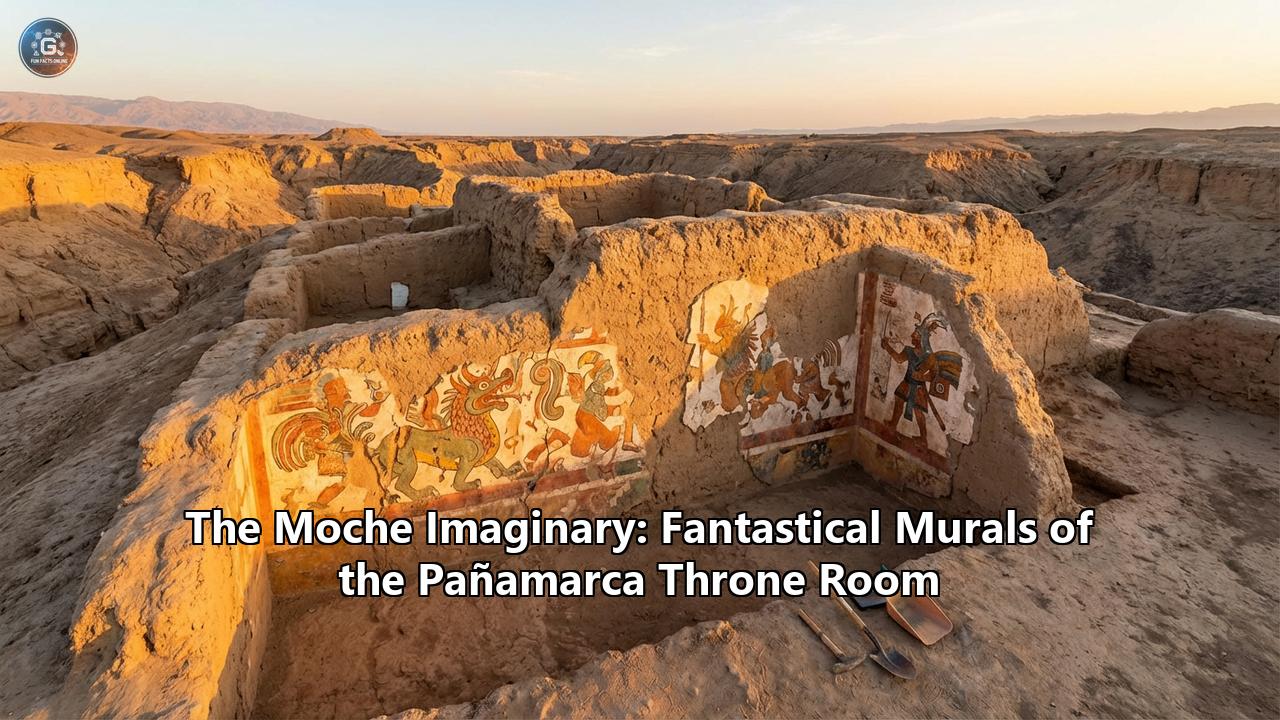
Dubbed the "Hall of the Moche Imaginary," this newly unearthed chamber is a kaleidoscope of ancient artistry. its walls are alive with murals that have retained their shocking brilliance—ochre yellows, deep reds, sky blues, and stark whites—depicting scenes that blur the line between the earthly and the divine. Here, a powerful woman sits enthroned, surrounded by a fantastical menagerie of bird-men, crescent moons, and sea monsters. It is a space of magic and authority, a "Sistine Chapel" of the Andes that challenges everything we thought we knew about gender, power, and the cosmos in pre-Columbian South America.
This article invites you on a journey into the Hall of the Moche Imaginary. We will peel back the layers of time to explore these fantastical murals, decode the symbols of the "Moon Monster" and the Braided Serpents, and meet the shadowy female figure who once commanded this room. We will delve into the rich history of the Moche, the science of the excavation, and the profound implications of a queen in a land of warrior-gods.
Part I: The Lords of the North Coast – Who Were the Moche?
To understand the magnitude of the Pañamarca discovery, we must first understand the world that created it. The Moche civilization (often referred to as the Mochica) flourished between approximately 100 and 800 AD along the arid northern coast of Peru. They were not an empire in the sense of the Romans or the Inca, with a single centralized capital and a monolithic administration. Instead, they were likely a loose confederation of independent polities, sharing a common culture, religion, and artistic tradition, much like the city-states of ancient Greece.
A Civilization of Blood and Gold
The Moche are often remembered for two things: their exquisite pottery and their gruesome rituals. Their ceramic art is among the finest in the ancient world. Using a signature bicrome palette of cream and red-brown, Moche potters created realistic portrait vessels that captured the nuances of human expression—worry, laughter, arrogance, and age. They modeled animals, vegetables, and scenes of daily life with a naturalist’s eye.
But alongside these charming depictions of ducks and deer were scenes of startling violence. Moche art is famous for its "Presentation Theme," a narrative sequence depicting ritual combat where losers were stripped of their armor and sacrificed, their blood consumed by elite priests and deities. For a long time, scholars believed these were purely mythological scenes. But forensic archaeology at sites like the Huaca de la Luna (Temple of the Moon) revealed the mass graves of sacrificed men, proving that the art imitated a bloody reality.
The Lords of Sipán and the Lady of Cao
For most of the 20th century, the Moche were viewed through a patriarchal lens. The discovery of the "Lord of Sipán" in 1987—an unlooted tomb filled with gold, silver, and turquoise—cemented the image of the Moche ruler as a male warrior-priest. He was buried with the trappings of power: ear spools, nose ornaments, and scepters.
However, the narrative began to shift in 2006 with the discovery of the "Lady of Cao" at the El Brujo archaeological complex. Here was a woman, buried with heavy war clubs, twenty-three spear throwers, and a golden crown. Her body was preserved so well that her skin still bore the intricate tattoos of snakes and spiders. She was a revelation—a woman who held the power of life and death. Yet, even with her discovery, some scholars hesitated to call her a "queen," preferring terms like "priestess" or "ceremonial figure."
The Pañamarca throne room would soon shatter that hesitation.
Part II: Pañamarca – The Southern Citadel
Pañamarca sits in the Nepeña Valley, roughly 350 kilometers north of Lima. In the geopolitical landscape of the Moche world, this was the southern frontier. It was an outpost, a place where the Moche culture rubbed shoulders with other Andean traditions.
Built on a natural rock outcrop, the site dominates the valley floor. It is a complex of adobe platforms, walled plazas, and pyramidal structures. Unlike the massive urban sprawls of the northern Moche capitals, Pañamarca is more intimate, yet no less monumental.
A History of Lost Murals
The site has long been famous for its wall paintings. In the 1950s, archaeologist Richard Schaedel and later Duccio Bonavia uncovered stunning murals at Pañamarca. They found images of priests, warriors, and a famous "Erotic" scene. Tragically, preservation techniques in the mid-20th century were not what they are today. Many of the murals exposed in the 1950s were left open to the elements or poorly consolidated, leading to their deterioration and loss. They became "ghosts," existing only in black-and-white photographs and watercolor reproductions.
This history of loss haunts modern archaeologists. It is why the current project, "Archaeological Landscapes of Pañamarca," led by Jessica Ortiz Zevallos, Lisa Trever (Columbia University), and Michele Koons (Denver Museum of Nature & Science), treats every inch of painted adobe with extreme caution. When they excavate, they do so with the knowledge that exposure is a double-edged sword: it reveals the art to the human eye but threatens it with the wind, sun, and humidity.
Part III: The Hall of the Moche Imaginary
In 2024, the team was excavating a pillared hall that had shown promise in previous seasons. As they brushed away the centuries of sand from the adobe pillars and walls, vivid colors began to emerge. They were not the faded, dusty hues of a typical dig, but bright, saturated pigments that looked as if they had been painted yesterday.
They had found the "Hall of the Moche Imaginary."
The Throne
At the heart of the room stood a structure that had no precedent in Moche archaeology: a throne. Built of adobe, it was a low platform with a backrest, situated to command the attention of anyone entering the space.
This was not merely a symbolic seat for an idol. The forensic evidence spoke of a living, breathing occupant. The backrest showed signs of erosion—wear and tear consistent with a person leaning against it repeatedly over time. Hidden in the crevices of the adobe were tiny greenstone beads, perhaps from a broken necklace, and fine threads from high-quality textiles. Most intimately, the archaeologists found human hair.
This throne was used. And the art surrounding it left little doubt as to who sat there.
The Queen of the Mural
The walls and pillars of the throne room are dominated by the image of a woman. She is not a background figure or a generic attendant. She is the protagonist.
In one scene, she sits on a throne identical to the physical one in the room. She wears a crown and elaborate textiles. In another, she is depicted receiving a procession of visitors, raising a goblet in a toast or ritual offering. The repetition of her image, her placement on the throne, and her central role in the narrative murals suggest she was the ruler of this domain.
This woman is associated with specific, powerful iconography:
- The Crescent Moon: She holds a rattle shaped like a crescent moon, linking her to the night sky and the passage of time.
- The Sea: She is surrounded by marine imagery, a critical domain for coastal people who relied on the ocean for food and trade.
- The Arts: Murals depict a workshop of women spinning and weaving. In the Andes, textiles were more valuable than gold. They were the currency of diplomacy, the markers of status, and the medium of sacred exchange. To control the production of fine textiles was to control the economy.
The Bird-Man and the Fantastical Court
The "Moche Imaginary" earns its name from the surreal creatures that populate the queen’s court. One of the most striking figures is a "Bird-Man." Painted on a pillar next to the throne, this hybrid being—part human, part avian—is shown in conversation with the enthroned woman. Is he a mythological messenger? A shaman in transformation? A symbol of celestial power?
The murals also depict the "Moon Monster" or "Strombus Monster," a mythological beast often associated with the sea and the moon. This creature, a dragon-like entity with a spiny shell and feline features, represents the chaotic and powerful forces of nature. That the queen is depicted in the company of such beings suggests her power extended beyond the political into the supernatural. She was a mediator between the human world and the world of spirits and monsters.
Part IV: The Hall of the Braided Serpents
As if the throne room were not enough, the archaeological team uncovered a second monumental space nearby: the "Hall of the Braided Serpents."
This hall, overlooking the main plaza, features wide square pillars decorated with a motif never before seen in Moche art: intertwining serpents with human legs. These "anthropomorphized" snakes writhe up the pillars, creating a dizzying effect of movement and transformation.
In Moche cosmology, snakes were often associated with the underworld and ancestors. To give them human legs suggests a blurring of the lines between the human ancestor and the chthonic deity.
Other murals in this hall depict:
- Warriors and Weapons: Anthropomorphized clubs and shields with arms and legs, marching as if alive. This "Revolt of the Objects" is a known theme in Moche art, representing a world turned upside down where tools rise against their masters.
- The Monster Chase: A large, terrifying monster is shown chasing a man. The dynamic movement and narrative tension in this scene are masterpiece examples of Moche visual storytelling.
The Hall of the Braided Serpents appears to have been a place of elite spectacle. It was renovated multiple times, with evidence of ritual burning and offerings. It may have served as a viewing gallery for ceremonies in the plaza below, or a restricted space for the most sacred of rites.
Part V: Priestess, Goddess, or Queen?
The discovery of the Pañamarca throne room has reignited a fierce debate in Andean archaeology: What was the nature of female power in Moche society?
For years, women in Moche art were categorized as "Priestesses." This title, while respectful, implies a role that is primarily religious and perhaps subservient to a male political ruler. The figure of the "Priestess" is well-known from the "Sacrifice Ceremony" iconography, where she presents a goblet of blood to the supreme lord.
But the woman at Pañamarca does not fit this mold.
- The Throne: Priestesses stand or kneel. Rulers sit. The presence of a permanent, built-in throne suggests a stable, political authority.
- The Crown: She wears the regalia of leadership.
- The Context: She is shown receiving visitors and overseeing economic production (textiles), functions of a head of state.
Lisa Trever, one of the lead archaeologists, argues that this distinction between "political" and "religious" power is a modern Western construct. In the Moche world, as in many ancient societies, the two were inseparable. To rule was to commune with the gods. To lead the rituals was to govern the state.
Whether we call her a Queen or a High Priestess, the distinction is semantic. The reality is that she wielded supreme authority. She commanded resources, labor, and loyalty. She sat on a throne that looked out over the Pacific, the master of her domain.
The Pañamarca discovery, combined with the Lady of Cao, suggests that female leadership was not an anomaly or a "regency" for a young male heir. It may have been a standard feature of Moche political structure, particularly in the southern valleys. The Moche world was likely far more gender-fluid and equitable in its power dynamics than early 20th-century archaeology assumed.
Part VI: The Cosmos on the Wall – Decoding the Symbols
The murals of Pañamarca are not just decoration; they are a text. Since the Moche had no written script, they wrote their ideology in paint and clay. Every color, every figure, and every prop in the murals carries meaning.
The Moon Goddess (Si)
The prevalence of lunar imagery—the crescent rattles, the night scenes—points to the worship of the Moon Goddess, often called Si in the local languages of the north coast (though "Si" is the Moon name in the later Chimú language, the connection is strong).
Unlike the Inca, who revered the Sun (Inti) as the supreme deity, the coastal people often held the Moon in higher esteem. Why? Because the Moon controlled the tides, and the ocean was the source of life. The Sun was a harsh oppressor in the desert, burning crops and scorching the earth. The Moon was the cool, nightly guardian who brought the fish. The Queen of Pañamarca may have been the living embodiment of this lunar force.
Ai Apaec and the Decapitator
While the Queen dominates the throne room, the shadow of Ai Apaec—the "fanged deity" or "Moche hero"—is never far. In other parts of Pañamarca, he is depicted fighting crabs and sea monsters. He is the order-bringer, the warrior who battles the forces of chaos. The interplay between the female lunar power and the male warrior power may represent the fundamental duality of the Moche cosmos: balance through opposition.
The Two-Faced Men
One of the most enigmatic figures found in Pañamarca (in excavations just prior to the throne room) is the "Two-Faced Man." These figures are shown with a face looking forward and another looking backward. They hold feather fans and are depicted in dynamic motion.
Scholars speculate these might represent movement itself—a way of showing a figure turning their head. Or, they could represent a supernatural ability to see the past and the future, the seen and the unseen. In the context of the throne room, they add to the atmosphere of "The Imaginary," a place where the laws of physics are suspended.
Part VII: The Paradox of Preservation
There is a bittersweet irony to the discovery of the Hall of the Moche Imaginary. The moment these murals are exposed to the air, they begin to die. The salt in the desert soil, when activated by the humidity of the air, crystallizes and crumbles the paint. The sun bleaches the vibrant pigments.
To save these masterpieces, the archaeological team must do something counterintuitive: they must bury them again.
The Reburial Technique
After the murals are excavated, cleaned, photographed, and digitally scanned in high resolution, they are carefully covered. A layer of protective sterile sand is placed over the art, followed by adobe bricks and soil. This returns the murals to the stable, dark, dry environment that preserved them for 1,300 years.
This means that you, the reader, cannot visit the Hall of the Moche Imaginary. No tourist can walk through the Hall of the Braided Serpents. The physical experience of the room is reserved for the few scientists who uncovered it, and then it is returned to the earth.
However, the "digital" excavation allows the world to see what was found. The team uses photogrammetry to create 3D models of the room, allowing virtual tours that are safe for the art. This ethical approach prioritizes the survival of the culture over the curiosity of the tourist.
Conclusion: A New Chapter in Andean History
The discovery of the Pañamarca throne room is a watershed moment. It forces us to discard the "Game of Thrones" stereotype of ancient history as a solely male domain of conquest. It gives us a glimpse into a sophisticated, colorful, and fantastical world where women ruled, where art was a conduit to the divine, and where the boundaries between human and monster were porous.
As we look at the digital reconstructions of the Queen on her throne, holding her crescent rattle and speaking to her Bird-Man counselor, we are witnessing a scene that was real and tangible in the 7th century. It is a testament to the human imagination and the enduring power of the Moche spirit.
The desert of Peru still holds many secrets, but the Hall of the Moche Imaginary has spoken loud and clear: The past was brighter, stranger, and more female than we ever dared to imagine.
Further Reading & Resources
- The Project: Follow the "Archaeological Landscapes of Pañamarca" project for updates from Lisa Trever, Jessica Ortiz Zevallos, and Michele Koons.
- Museums: Visit the Museo Cao at El Brujo to see the Lady of Cao, or the Larco Museum in Lima for the world’s finest collection of Moche ceramics.
- Digital Archives: Look for the digital photogrammetry models released by the research team to explore the murals virtually.
Reference:
- https://www.theartnewspaper.com/2024/10/03/moche-woman-ancient-throne-room-peru-discovery
- http://www.thehistoryblog.com/archives/71182
- https://news.artnet.com/art-world/ancient-throne-room-female-leader-peru-moche-2545134
- https://archaeology.org/issues/september-october-2017/features/peru-panamarca-moche/
- https://www.dmns.org/science/research/panamarca/
- https://www.panamarca.org/press-release-2024
- https://www.smithsonianmag.com/smart-news/see-newly-uncovered-throne-room-peru-may-have-belonged-ancient-queen-180985173/
- https://www.archaeology.wiki/blog/2023/03/17/unearthing-ancient-peruvian-history/
- https://www.youtube.com/watch?v=kUlKRmMF_NA
- https://blog.viajesmachupicchu.travel/en/moche-mythology-gods-myths-symbols/