
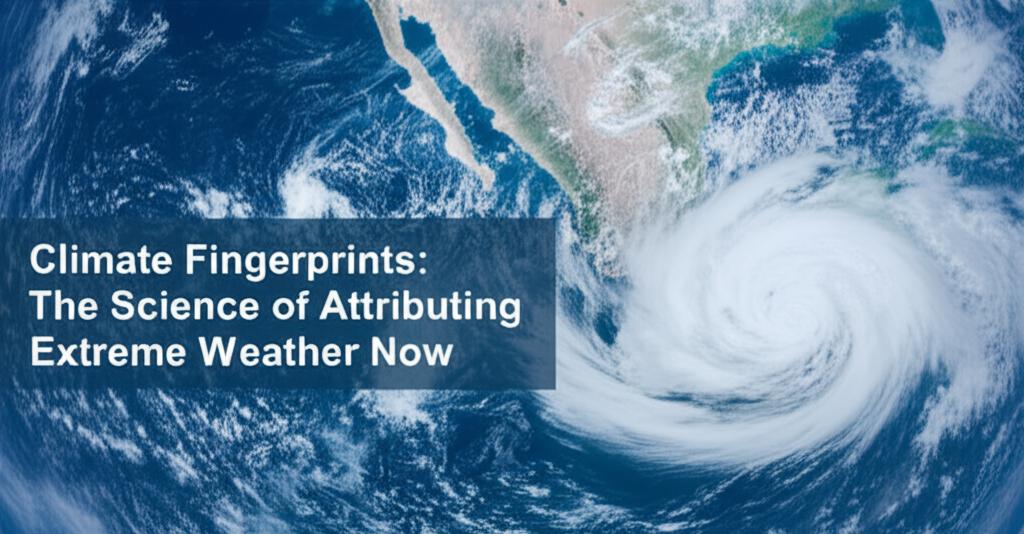
The roar of a wildfire, the relentless downpour of a flood, the suffocating grip of a heatwave – extreme weather events are becoming unnervingly familiar. But are these just unfortunate acts of nature, or is there a more direct, human-influenced cause at play? The rapidly evolving field of climate attribution science is now providing increasingly clear answers, acting like a forensic team for the planet, dusting for the "fingerprints" of climate change on individual extreme weather events.
For years, the standard line was that we couldn't link any single weather event directly to climate change, only long-term trends. That narrative is crumbling. Today, scientists can analyze an extreme event and, with growing precision, determine how much more likely or intense it was made by human-caused greenhouse gas emissions.
How Do They Do It? The Science of DetectionAttribution science relies on a powerful combination of historical weather observations, sophisticated climate models, and advanced statistical analysis. Researchers essentially create "two virtual worlds" for comparison. One simulates the climate as it is today, with current levels of greenhouse gases. The other models a hypothetical world without human-induced climate change, a world before the Industrial Revolution's surge in fossil fuel burning.
By running thousands of simulations of a specific weather event in both these worlds, scientists can compare the likelihood and intensity of that event. For example, they might find that a particular heatwave was made 30 times more likely, or 2°C hotter, due to the warming our planet has already experienced.
Rapid Insights in a Changing WorldOne of the most significant advancements is the speed at which these analyses can now be performed. Groups like the World Weather Attribution (WWA) initiative can provide scientific assessments within days or weeks of an event, offering crucial, timely information while the disaster is still fresh in public consciousness. This rapid response helps people connect the dots between the abstract concept of climate change and the tangible, often devastating, impacts they are experiencing locally.
Canada's federal weather service even became the first in the world to conduct rapid analyses of climate-driven heat events as they happen. This ability to provide near real-time attribution is transforming how we understand and communicate the immediate consequences of a warming world.
Not All Events Are Equal: The Nuances of AttributionThe confidence in attributing different types of extreme weather varies. Scientists can generally measure the influence of climate change on heatwaves with high precision. Heatwaves are among the most studied events, and the link is often stark – some extreme heat events are now considered "virtually impossible" without human-caused warming.
Attributing changes in rainfall, and consequently floods and droughts, can be more complex. Factors like local topography and the precise scale of rainfall bands, which can be smaller than the resolution of some climate models, present ongoing challenges. However, even in these areas, the science is rapidly advancing. There's strong confidence that a warming atmosphere holds more moisture, leading to the potential for heavier rainfall in many storms. Studies are increasingly finding that climate change is making extreme rainfall events more common and intense in numerous regions. For instance, research has shown that climate change intensified rainfall in major hurricane events and made devastating floods more likely in specific locations.
Wildfires are another area of active research, with studies focusing on how climate change influences "fire weather" – the hot, dry, and windy conditions conducive to blazes. Some analyses have found that climate change has made the weather conditions leading to major wildfires significantly more likely or intense.
Beyond Likelihood: Understanding ImpactsAttribution science isn't just about whether an event was made more likely or severe; it's also beginning to quantify the direct societal and economic consequences. Researchers are now exploring how human-driven warming has increased the total area burned by wildfires, amplified hurricane-related damages, and contributed to rising heat-related mortality. This "impact attribution" provides a clearer picture of the real-world costs of a changing climate.
The Future is Now: What This Means for UsThe ability to pinpoint climate change's role in extreme weather has profound implications. It strengthens public awareness and informs media reporting, moving the conversation beyond abstract warnings to concrete realities. This knowledge is vital for risk management and infrastructure planning, helping cities and communities prepare for future climate risks and build resilience. Furthermore, it plays a growing role in discussions around climate justice and "loss and damage," highlighting the unequal distribution of climate impacts.
While some extreme weather will always occur due to natural variability, the evidence is clear: human-caused climate change is increasingly loading the dice, making many types of extreme events more frequent, more intense, and more dangerous. The fingerprints of our warming world are no longer faint traces; they are becoming increasingly bold and undeniable, urging us to understand and act on the profound changes unfolding around us.