

G Fun Facts Online explores advanced technological topics and their wide-ranging implications across various fields, from geopolitics and neuroscience to AI, digital ownership, and environmental conservation.

Archaeology: The Lost Patriarchium: Unearthing Rome’s Carolingian Papal Palace

Archaeology: The Lost Patriarchium: Unearthing Rome’s Carolingian Papal Palace

The air in Rome is thick with the dust of centuries, but rarely does it swirl with such immediate, tangible excitement as it has in recent months. In the shadow of the Archbasilica of Saint John Lateran—the "Mother and Head of all Churches in Rome and in the World"—a modern construction crew prepari ...
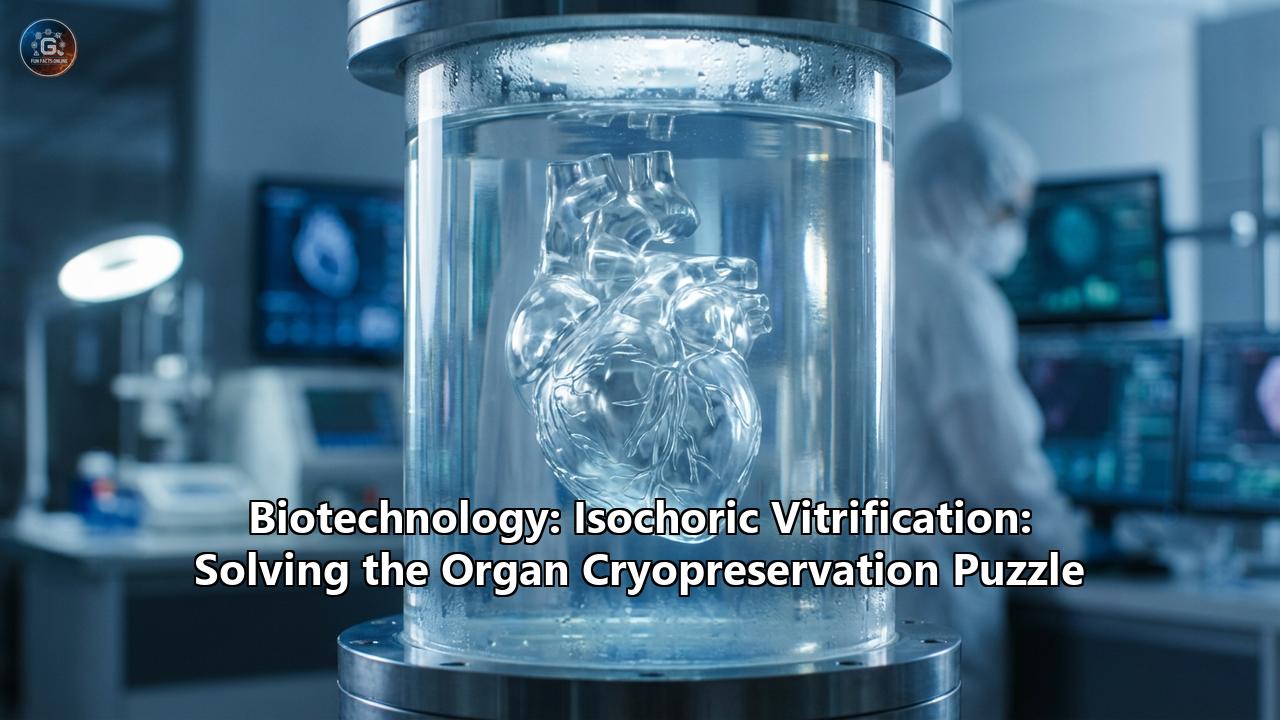
Biotechnology: Isochoric Vitrification: Solving the Organ Cryopreservation Puzzle

Biotechnology: Isochoric Vitrification: Solving the Organ Cryopreservation Puzzle

In the high-stakes world of organ transplantation, time is the ultimate enemy. From the moment a heart, liver, or kidney is recovered from a donor, a relentless biological countdown begins. For a heart, that clock offers a mere four to six hours. For a liver, perhaps twelve. This brutally short wind ...

Planetary Science: Coloe Fossae: Tracing the Glacial Scars of Martian Ice Ages

Planetary Science: Coloe Fossae: Tracing the Glacial Scars of Martian Ice Ages

The Red Planet is often imagined as a static world—a rusted, desolate antique frozen in time, its history written solely in the violent punctuation of impact craters and the silent towering of extinct volcanoes. This view, however, is a deception. Mars is a world of rhythm and flow, a planet that br ...

Agentic Artificial Intelligence

Agentic Artificial Intelligence

Introduction: The Third Wave of Artificial Intelligence For the past decade, the world has watched Artificial Intelligence evolve at a breakneck pace. First came Predictive AI, the era of classifiers and recommenders that told us what movie to watch or which transaction looked fraudulent ...

Canine domestication and evolutionary genomics

Canine domestication and evolutionary genomics

The Wolf in the Living Room: Deciphering the Genomic Code of Canine Domestication The transformation of the gray wolf (Canis lupus) into the domestic dog (Canis lupus familiaris) is arguably the most successful biological partnership in the history of life on Earth. It is an evolutionary master ...

Atmospheric escape and magnetospheres

Atmospheric escape and magnetospheres

The Atmosphere. It is the thin, fragile veil that separates biology from the void. It is the difference between the barren, cratered wasteland of the Moon and the lush, breathing biosphere of Earth. But atmospheres are not permanent fixtures; they are fugitive things, constantly seeking to escape th ...

Space-based tissue engineering

Space-based tissue engineering

Introduction: The Gravity Trap For three and a half billion years, life on Earth has operated under a strict, non-negotiable tyranny: gravity. Every cell that has ever divided, every tissue that has ever formed, and every organ that has ever evolved has done so while fighting the relentless ...

Wide-field infrared astronomy

Wide-field infrared astronomy

The cosmos is a vast, dark ocean, and for centuries, humanity peered into it through a narrow straw. We pointed our telescopes at specific stars, nebulae, or galaxies, marveling at the details but missing the grand tapestry. The optical light our eyes evolved to see is easily blocked by dust, hiding ...

Roman funerary customs and burial rites

Roman funerary customs and burial rites

In the bustling, noisy streets of ancient Rome, death was not a hidden affair. It was a public spectacle, a cacophony of wailing flutes and beating breasts, a parade of ancestors brought back to life in wax and wool. To the Roman mind, death was not merely the cessation of life but a profound transi ...

Antimatter containment and symmetry

Antimatter containment and symmetry

1. Introduction: The Paradox of Existence To look at the night sky is to witness a monumental crime scene. Every star, every galaxy, every cloud of gas we can observe is made of matter. You, the chair you sit on, the air you breathe—it is all matter. Protons, neutrons, electrons. But the fundam ...